What 26 years in education have taught me about what Malta's economy needs
In 2026, GBS Malta launched a new Thought Leadership Series featuring insights from key voices shaping Malta's higher education landscape. This article is part of that series, spotlighting Allen Lofaro, Director of Operations at GBS Malta
I've spent 26 years working in international education in Malta. Long enough to see what works, what doesn't, and what keeps quietly repeating itself.
One thing that hasn't changed much is this: too many students graduate with strong academic records and then spend months sometimes longer working out how that knowledge translates into an actual job. That gap between the classroom and the workplace isn't new. But in Malta right now, it matters more than ever. Malta's economy is moving fast. Real GDP expanded by 6.4% year on year in the fourth quarter of 2025.
The IMF confirms the country has averaged growth of nearly 7% annually over the past decade, driven by tourism, online gaming, financial services, and professional services. These sectors are not just growing they're generating roles that require specific, current, market-facing skills. Institutions that don't design their programmes around that reality are, in my view, quietly letting their students down.
This is what I want to talk about. Not in the abstract way we sometimes discuss "future-ready skills" at education conferences, but in practical terms what industry-relevant education genuinely looks like, why Malta needs more of it, and what that means for anyone deciding where to study next.
Malta's economy is moving. Is education keeping pace?
The numbers that matter here go beyond headline growth. Malta's labour force participation rate hit an all-time high of 83.3% in December 2024, with the 25–54 age group the precise cohort postgraduate education serves participating at 91.7%. Total employment has reached 327,643, a 4.3% rise year on year. That's an active, competitive market. But there's a persistent catch.
Only one in six workers in Malta currently holds a role that is fully aligned with their educational background. That isn't just a personal frustration for graduates it signals a mismatch that drains productivity and forces businesses to retrain people they expected to arrive ready. In a small island economy where every skilled worker counts, this costs time and money that neither employers nor new graduates can comfortably absorb.
What "Industry-Relevant" actually means in practice
When I talk about industry-relevant education, I don't mean turning degree programmes into glorified training manuals. That misses the point entirely.
What I mean is: design programmes that are taught by people who actually work in the sectors being studied. Use live business cases, not hypothetical ones. Build in projects alongside real companies. Integrate what's happening in industries today not what passed for best practice a decade ago.
At GBS Malta, this philosophy runs through everything we build. Our MBA carries five specialist pathways including Global Investment Banking, Project Management, and Entrepreneurship because we recognise that "business" is not one single profession. The MBA in Project Management is accredited by the Association for Project Management (APM), a globally recognised professional body. That accreditation is not cosmetic; it tells employers worldwide precisely what our graduates can do before they've sat down in an interview.
Our MSc in Information Technology Management prepares students not just for technical roles, but for leadership positions at the intersection of technology and strategy exactly where Malta's digital services sector is recruiting. The Master of Public Health, offered across three specialist pathways including Epidemiology and Health Promotion, responds to something both Malta and the wider world genuinely need: health professionals trained in policy, management, and real-world application.
Why this matters for Malta's future workforce
The conversation around industry-relevant education is often framed around employability, but I believe it goes deeper than that. It is ultimately about ensuring Malta develops the talent needed to sustain long-term economic growth.
Across sectors such as financial services, technology, healthcare, project management and entrepreneurship, employers are looking for professionals who can contribute quickly and adapt continuously. They need graduates who understand not only the theory behind their profession but also the practical realities of today's workplace.
For local students, this means choosing programmes that align with real labour market needs and future career opportunities. For employers, it means having greater confidence that graduates entering the workforce possess relevant skills and industry awareness. And for institutions, it means accepting responsibility for preparing learners to succeed in a rapidly changing economy.
This is where the concept of Return on Educational Investment, or ROEI, becomes important. A qualification should deliver more than academic achievement. It should equip graduates with the skills, knowledge and professional confidence needed to create meaningful value for themselves, their employers and the wider economy.
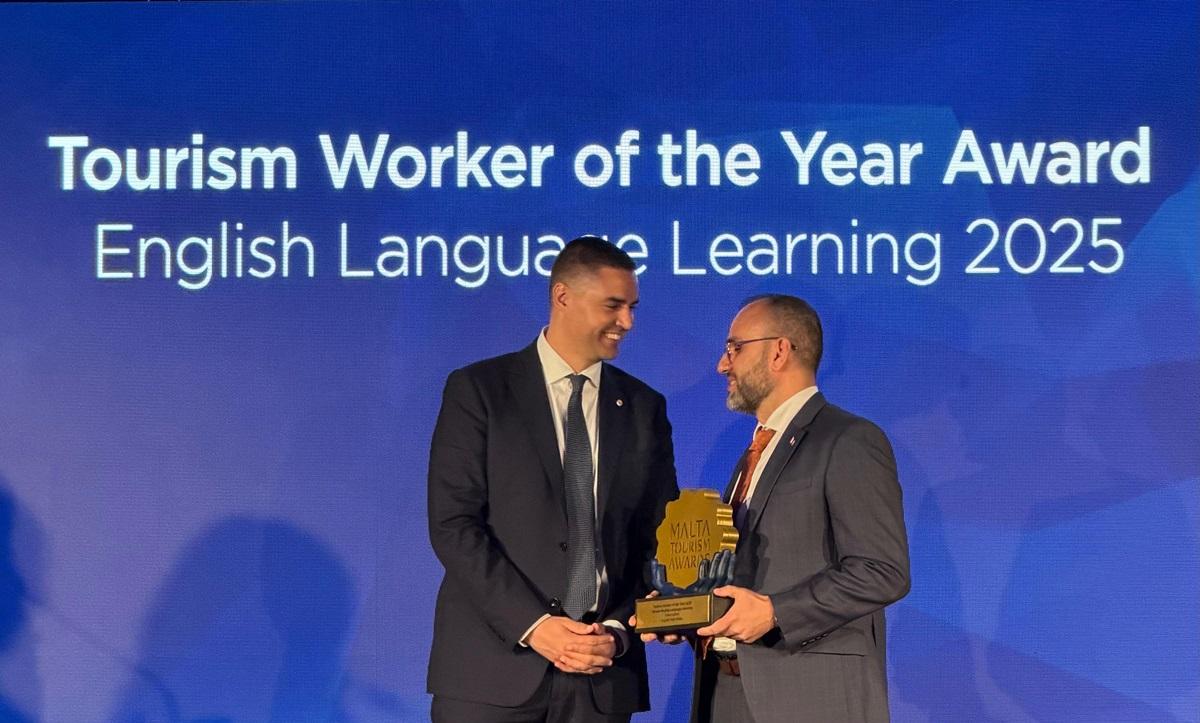 Allen Lofaro receiving the Tourism Worker of the Year Award.
The sectors that are growing and what they need
If you're weighing up where to study and you want real employability in Malta, the sector picture matters. Tourism expenditure alone rose by 23.1% in 2024. IT, financial services, and professional services are all expanding. GDP growth is forecast at 3.8% in 2026 and 3.5% in 2027 steady progress, not a blip.
Here's a practical look at where demand is concentrating:
|
Sector |
Skills in Demand |
GBS Malta Alignment |
|
Financial services & FinTech |
Risk management, investment analysis |
MBA in Global Investment Banking |
|
IT & digital services |
Software management, tech strategy |
MSc Information Technology Management |
|
Project management |
Leadership, agile methodologies |
MBA Project Management (APM-accredited) |
|
Healthcare & public health |
Policy, epidemiology, health management |
Master of Public Health (3 pathways) |
|
Entrepreneurship |
Venture development, business strategy |
MBA Entrepreneurship pathway |
These aren't aspirational categories. They reflect the roles that employers in Malta are actively trying to fill. Our curriculum is designed backwards from those needs not structured around what's convenient to teach.
The credential question and why accreditation outweighs prestige
I get asked fairly often whether a degree from a newer, smaller institution carries the same weight as one from a long-established university. It's a fair question, and I don't dismiss it.
My honest answer: the brand of the institution matters less than accreditation, programme quality, and what graduates can demonstrably deliver. GBS Malta is licensed by the Malta Further and Higher Education Authority (MFHEA), meaning all our programmes align with both the Malta Qualifications Framework and the European Qualifications Framework. Our degrees are recognised across Europe, not just locally.
As part of the GEDU network which supports around 80,000 students across 15 countries our students draw on globally developed resources and shared academic standards that stretch well beyond the Maltese coastline.
What I believe education owes its students
I've spent my career watching education either transform people's lives or leave them feeling vaguely short-changed. The difference almost always comes down to whether the institution treated employability as a nice-to-have or as the whole point.
At GBS Malta, we start from the second position. Malta's economy is at a genuinely exciting moment, and its higher education sector has both the opportunity and the responsibility to produce the people who will carry that forward. That means being honest about the skills market, designing programmes that speak to it directly, and making sure every graduate crosses the stage with a clear picture of what they're walking into.
That, for me, is what industry-relevant education actually means. And it's why I believe getting it right matters so much for Malta, and for every student who chooses to build their future here.
Sources:
- IMF Malta 2025 Article IV Consultation: https://www.imf.org/en/news/articles/2026/02/06/pr26034-malta-imf-executive-board-concludes-2025-article-iv-consultation
- Malta GDP Q4 2025 data: https://www.maltatoday.com.mt/comment/opinions/140044/maltas_growth_enters_a_new_phase_
- NSO Malta international student enrolment 2023-24: https://newsbook.com.mt/en/international-students-now-account-for-over-a-third-of-maltas-tertiary-enrollments/
- Allen Lofaro/Lovin Malta (employment stats): https://lovinmalta.com/sponsored/navigating-the-future-of-work-as-an-international-student-a-malta-perspective/
- European Commission Malta Economic Forecast: https://economy-finance.ec.europa.eu/economic-surveillance-eu-member-states/country-pages/malta/economic-forecast-malta_en