50th anniversary of the coronation of the painting of the Assumption in Mosta
The solemn coronation of sacred images in the Catholic Church is a tradition that dates back to the early 17th century
The coming August 10 marks the 50th anniversary of the solemn coronation of the titular painting of the Assumption of the Blessed Virgin Mary, venerated in her sanctuary basilica in Mosta. This anniversary stirs a deep sense of satisfaction and gratitude among local parishioners, as it encompasses centuries of art, history, tradition and, above all, Catholic faith.
The solemn coronation of sacred images in the Catholic Church is a tradition that dates back to the early 17th century, initially promoted by the Order of Friars Minor Capuchins. Foremost among his brethren was Girolamo Paolucci de Calboldi (1552-1620), who crowned the Marian image of Santa Maria della Steccata, currently enshrined in her sanctuary in Parma, Italy.
Approved by the chapter of St Peter’s basilica, the first recorded canonical coronation took place using funds bequeathed by Count Alexander Sforza-Pallavicini. The crown was affixed by Pope Urban VIII in 1631 on the painting of the Madonna della Febbre, located in the sacristy of St Peter’s basilica in Rome. The practice became more established in the 18th century.
Mosta’s canonical coronation, authorised by a papal decree, is one of 11 such coronations in the Maltese archipelago, and affirms the image’s role in promoting Christian, and in particular, Marian devotion. Moreover, it symbolises the perpetual and universal nature of graces bestowed on the Church by Christ through the intercession of his blessed mother.
 A general view of the titular painting in its reredos within the Mosta basilica, decorated for the solemnity of the Assumption.
Attributed to the Maltese leading baroque painter Stefano Erardi (1630-1716), the titular painting of the Assumption was commissioned in 1678 at the bequest of Don Giacomo Chetcuti to adorn the former local parish church. This church was built between 1610 and 1619 on the same site as the Rotunda, to the design of renowned local architect Tommaso Dingli.
Barely 200 years later, the painting’s canvas was enlarged and adapted to fit the arched reredos beneath the main apse of the new parish church, within the choir chapel located behind the high altar. The figure of the Madonna is truly expressive, evocative of seraphic beauty and resilience amid a life of adversity.
Being the first to be fully redeemed by Christ’s paschal sacrifice, she is borne aloft through divine intervention by a host of celebratory putti and contemplative angels towards a golden hue of celestial light. Her flowing robes seemingly emphasise the privilege with which she was uniquely bestowed and give life to the prophetic words of Psalm 132:8, “Arise, O Lord, into your resting place, you and the Ark which you have sanctified”. The apostles, foremost being Peter and Paul, look up in awe at this glorious sight, as they stand around her empty sarcophagus.
The coronation of Mosta’s foremost Marian painting had been a long time coming, kindled by a centuries-old local devotion to the Mother of God. This wish was further enhanced by the unforgettable events surrounding the bombing of the Rotunda on April 9, 1942
The coronation of Mosta’s foremost Marian painting had been a long time coming, kindled by a centuries old local devotion to the Mother of God. This wish was further enhanced by the unforgettable events surrounding the bombing of the Rotunda on April 9, 1942, during which the Blessed Virgin’s monumental building escaped largely unscathed when a 500kg bomb dropped by a German aircraft pierced the dome but failed to explode.
Acting upon the desire of the clergy and parishioners, archpriest Fr Bartholomeo Bezzina formally petitioned the intervention and approval of Archbishop Michael Gonzi in November 1973. Acceding to this request, and in accordance with established practice at the time, the petition was forwarded to the Vatican Chapter and the Sacred Congregation for Divine Rites in Rome for approval.
The official document authorising the solemn coronation of the titular painting of the Blessed Virgin Mary in the church was signed by Cardinal Joannes Villot, Secretary of State of the Holy See, acting on behalf and by authority of Pope Paul VI, on December 12, 1973. Subsequently published in the Acta Apostolicae Sedis (issue number 66, 1974), this all-important and much-awaited document was solemnly read by the emotional archpriest during a mass held on February 15, 1974. It remains on display to this day in the Rotunda’s main sacristy.
 The solemn procession, headed by Prof. J.J. Cremona holding the crown, making its way to Rotunda Square.
The solemn rite of coronation necessitated the creation of a precious crown, for which local parishioners generously contributed. Made of 22-carat gold and further decorated with precious stones, it was designed by Rabat-born artist Giuseppe Galea and artistically created by goldsmith Roger Mizzi from Birkirkara.
While essential, this was only one of a series of liturgical and paraliturgical initiatives taken by the parish in preparation for the solemn rite, which was scheduled for August 10, 1975, almost 25 years after the solemn proclamation of the dogma of the Assumption by Pope Pius XII on November 1, 1950.
Six silver sanctuary lamps (three on each side) were commissioned to adorn the painting of the Assumption in the Rotunda. Their intricate design was again entrusted to Galea, while the actual silverwork was skillfully carried out by the renowned local silversmith Tarcisio Cassar of Żejtun.
 A section of the crowd cramming Rotunda Square and its surrounding streets during the coronation ceremony.
A pastoral letter invoking participation of the Maltese faithful in the planned festivities was issued by Mgr Gonzi and read in all churches of the Maltese archdiocese on Saturday and Sunday, July 19 and 20, 1975. A national Marian pilgrimage was held on Saturday, August 2, in which the titular statue of the Assumption was carried from the outskirts of the village to the Rotunda. Other events included a Marian musico-literary evening and a pageant outlining Mosta’s history.
The preparatory days leading to and following August 10 involved the individual participation of the archdiocese’s collegiate chapters and religious orders. A specially designed platform, adorned with graphical designs outlining Mosta’s cultural and religious past, was set up on the parvis in preparation for the solemn event. A special coronation hymn, composed by Mro Anthony Sammut and Fr Ġwann Debono, was commissioned by the local Nicolò Isouard Philharmonic Society.
Over 50,000 faithful crammed every vantage point in the beflagged and decorated square
Sunday, August 10, 1975, started off with a specially authorised celebration granting first Holy Communion to 192 children. In the evening, three officiating bishops – Mgr Michael Gonzi, vicar general and Auxiliary Bishop Mgr Joseph Mercieca and Gozo Bishop Mgr Nicholas Cauchi – accompanied by over 100 priests, left the Sacred Heart Oratory en route to Rotunda Square where a solemn concelebration took place on the church parvis.
 Papal delegate Archbishop Mgr Michael Gonzi blessing the crown held by Prof. J.J. Cremona.
Chief justice J.J. Cremona carried the precious crown, whose safeguarding and perpetual affixing to the sacred image was entrusted to archpriest Bezzina and his successors by public deed, registered in the acts of notary Francis Micallef. This legal document was read, signed by the archpriest, witnessed by Labour MP Freddie Micallef and Nationalist MP Lawrence Gatt, and endorsed by Joseph Grech on behalf of the locals.
The unforgettable solemn crowning took place at 7.40pm, officiated by papal delegate Mgr Michael Gonzi, to the pealing of church bells, the singing of the Salve Regina and the emotional gaze and prolonged applause of the over 50,000 faithful who crammed every vantage point in the beflagged and decorated square and surrounding streets.
Following the concelebration and the intonation of the thanksgiving Te Deum hymn, the newly crowned painting was carried among the crowds in procession along the streets of the parish, led by auxiliary bishop Joseph Mercieca, who was co-officiating.
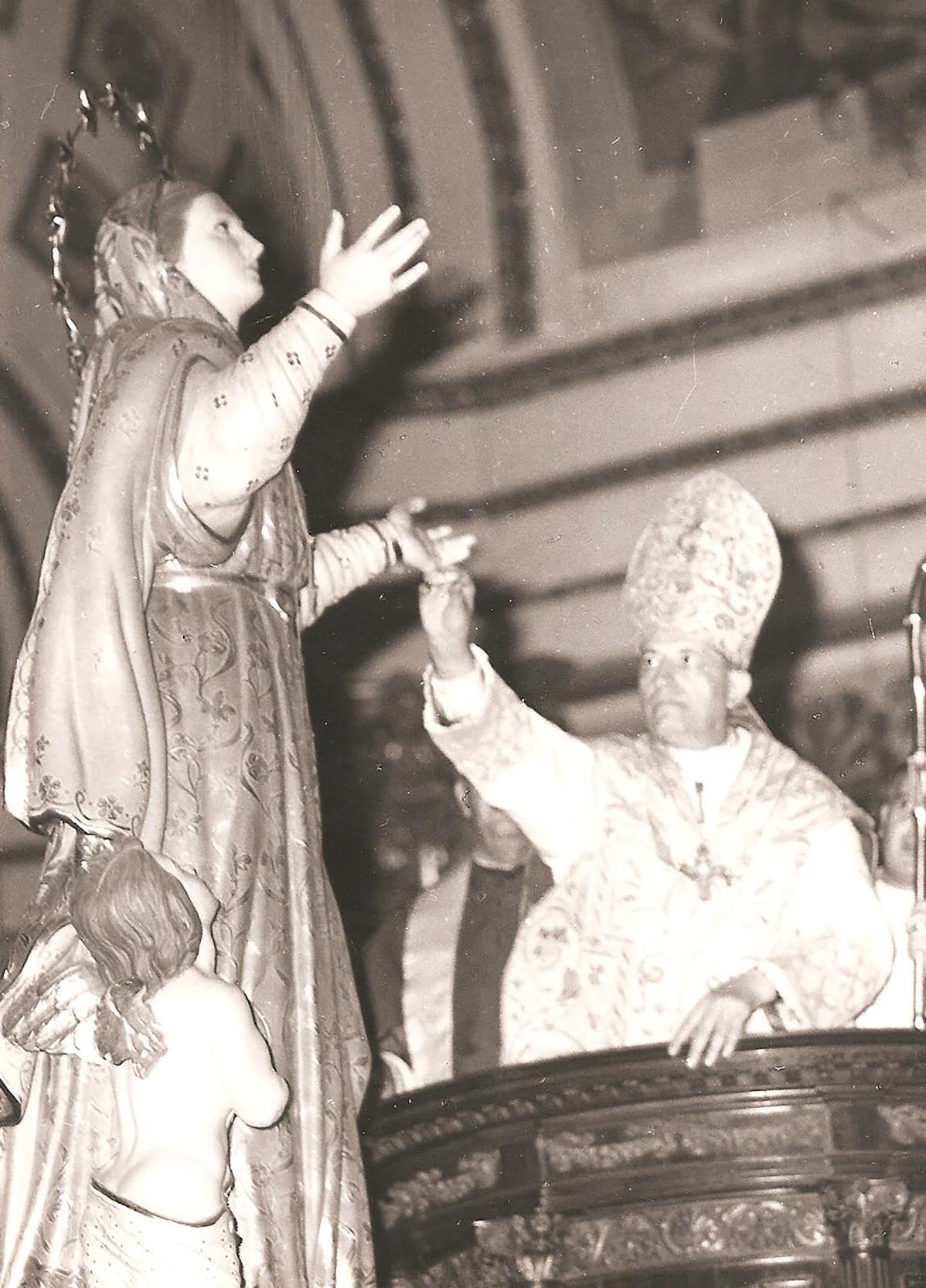 Cardinal Corrado Ursi of Naples placing a precious ring on one of the fingers of the titular statue of the Assumption on August 15, 1975.
Cardinal Corrado Ursi of Naples was invited to participate in the closing of the festivities on August 14 and 15, 1975. During a solemn concelebration on the solemnity of the Assumption, Ursi was entrusted with fitting a golden ring on one of the fingers of the titular statue of the Assumption. An etched marble plaque adorning the façade of the Rotunda records these memorable events.
Twenty-five years later, during the tenure of archpriest Fr Joseph Carabott, a set of 12 gold-and-diamond-studded stars were placed by clerics, lay and religious parishioners around the crowned head of the Blessed Virgin during a solemn ceremony presided by Bishop Cosmo Francesco Ruppi from the Metropolitan Archdiocese of Lecce, to the intonation of verses from the ancient Marian hymn the Akathistos.
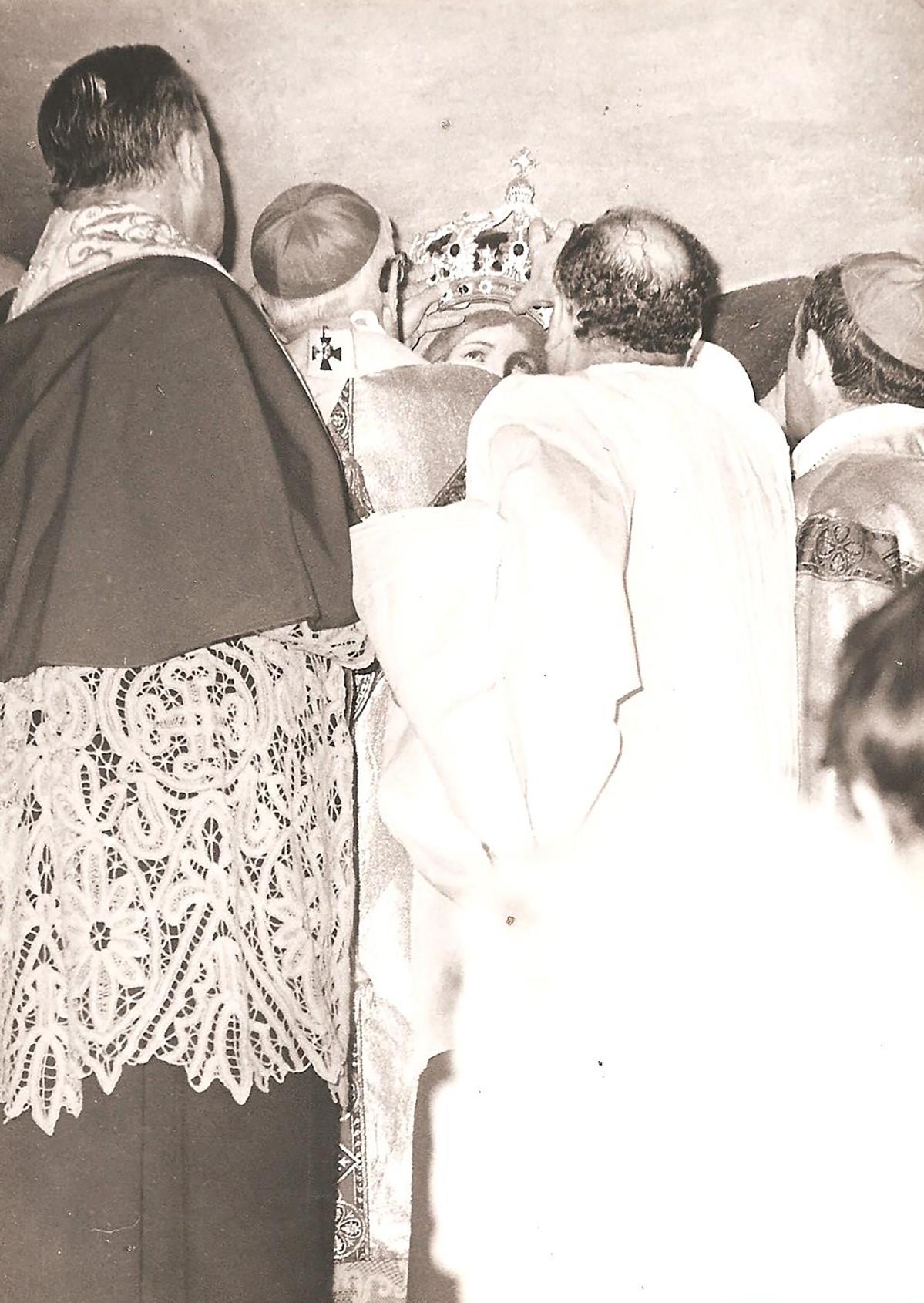 The solemn moment of coronation by Archbishop Mgr Michael Gonzi (second from left), as Archpriest Rev. Fr Bartholomeo Bezzina (first from left) and Auxiliary Bishop Mgr Joseph Mercieca (first from right) look on.
As the faithful gaze at the stunning crowned image of the Blessed Virgin, devotedly venerated throughout the centuries on the site of the current opulent and colossal sanctuary-basilica, they are invited to contemplate this extraordinary lady’s role in the story of Salvation.
Echoing the wise words of Pope Benedict XVI, uttered on the solemnity of her Assumption in 2011, this sacred image of her triumphant incorruptible body imbues “the immense love which God reserved – of course in an absolutely unique and unrepeatable way – for Mary… the Ark of the Covenant”.
Amid a turbulent period of world history, threatened by individualism and evolving international turmoil, we are invited to join this Petrine successor’s fervent prayer that she “shows us with luminous clarity that we are on the way towards our true home, the communion of joy and peace with God”.
Sandro Vella is a consultant physician, diabetologist and endocrinologist with an interest in Mosta’s cultural heritage.
Acknowledgements
The author acknowledges information gleaned from publications by Mosta parish and the late Fr Angelo Camilleri. The colour photos are courtesy of Mark Micallef Perconte. The historic photos are courtesy of Raymond Grech.