60 years of the Cecchetti Method in Malta
Lara Zammit speaks with Johane Casabene from the Cecchetti Legacy Group as she reflects on legacy, lineage and a renewed artistic future
This year marks 60 years since the Enrico Cecchetti Method took root in Malta – a milestone that honours not only a system of training but a lineage of teachers and dancers who have shaped classical ballet on the island.
A major photographic exhibition is marking the anniversary at the Manoel Theatre, offering a rare insight into the life and pedagogical legacy of the celebrated ballet master.
Curated by Johane Casabene of the Cecchetti Legacy Group, the exhibition traces Cecchetti’s journey from distinguished performer to influential teacher through archival photographs and researched panels, many of which have been carefully preserved for nearly 30 years in Civitanova Marche and are now being shown publicly in Malta for the first time.
“It was Tanya Bayona who first brought the Cecchetti Method to Malta 60 years ago, laying the foundations for structured classical ballet training on the island,” Casabene says. “This anniversary was, above all, a tribute to her vision and to the enduring legacy of Enrico Cecchetti.”
Cecchetti’s influence on Maltese ballet has been both technical and cultural. As Casabene explains: “Cecchetti’s methodology introduced a rigorously organised, musical and anatomically intelligent system of training – one that prioritises balance, coordination, épaulement, purity of line and artistic awareness alongside technical precision.
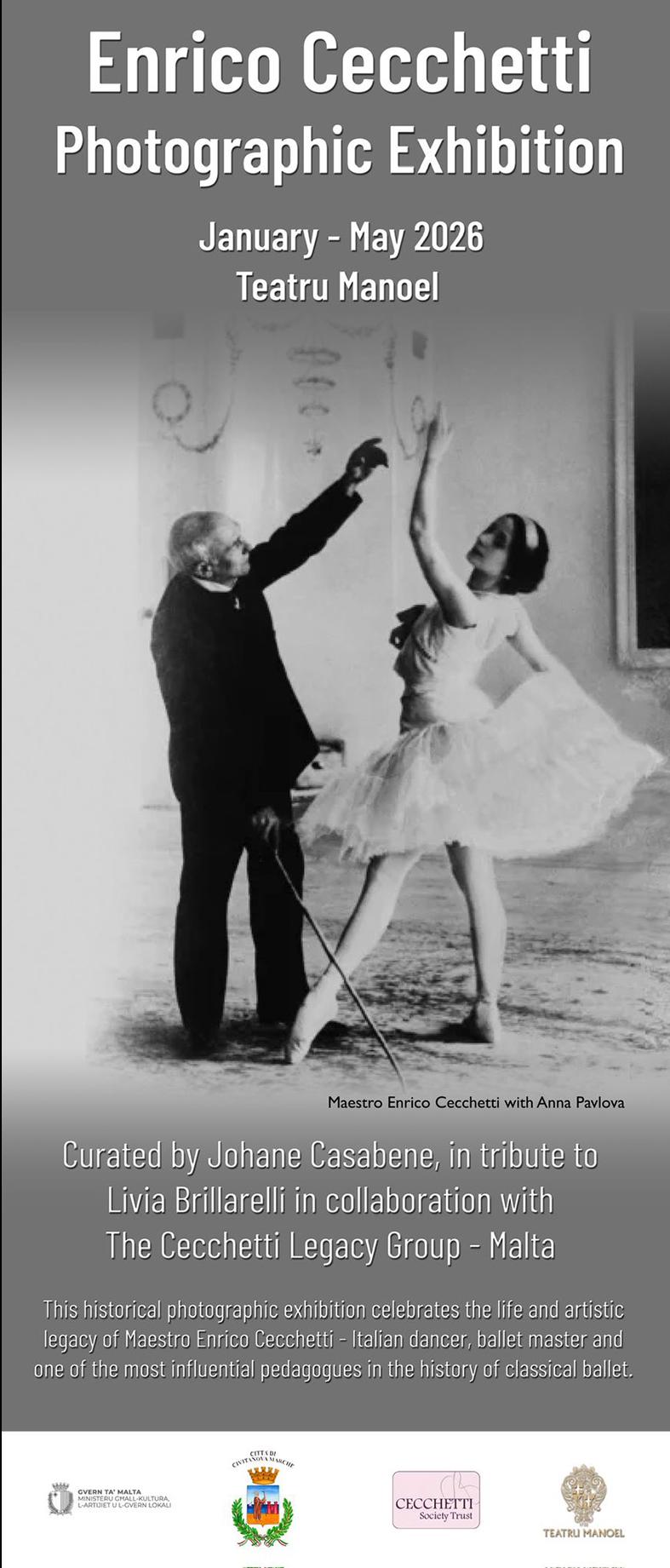 The exhibition poster
“In Malta, this approach established a culture of disciplined ballet education and produced generations of dancers and teachers grounded in clarity, musicality and respect for tradition.”
The method’s continued relevance, she believes, lies in its depth.
“What makes the method especially relevant today is its depth and adaptability. Cecchetti training does not prepare dancers for a single aesthetic; it develops technical intelligence.
“In a rapidly evolving dance landscape, that foundation allows dancers to move confidently between classical, neoclassical and contemporary work while maintaining strength, articulation and longevity.”
Six decades on, the system remains more than a syllabus.
“The method continues to shape not only capable technicians, but thoughtful artists –dancers who understand the ‘why’ behind their movement, not just the ‘how’.”
An international tribute in Malta
The anniversary celebrations reached beyond performance. Malta hosted distinguished scholars, examiners and artists from across the world, alongside a major photographic exhibition dedicated to Cecchetti’s life and pedagogical legacy.
The method’s relevance lies in its depth
“Hosting this international tribute in Malta was profoundly symbolic,” Casabene says. “As we celebrate 60 years of the Cecchetti Method on our island, it was both fitting and meaningful to present an exhibition dedicated to the life, lineage and philosophy of the maestro whose work shaped ballet training worldwide.”
Curated by Casabene herself, the exhibition traces Cecchetti’s journey from celebrated performer to master teacher.
“Visitors are guided through his artistic journey, from celebrated performer to master teacher, and introduced to the principles that continue to underpin classical training globally.”
The project was made possible through international collaboration, particularly with the mayor of the Comune di Civitanova Marche and archive custodian Andrea Foresi.
“Their assistance enabled the photographic material, carefully preserved in the archives for nearly 30 years, to be brought back into the public eye.”
The exhibition is currently housed at the Manoel and remains open to the public until May 1, inviting schools, dancers and the wider community to engage with this heritage. Casabene also acknowledges the support of the Cecchetti Society Trust, the Ministry for Culture and the Manoel Theatre.
By placing Malta’s anniversary within a broader historical framework, she explains, the exhibition does more than commemorate the past.
“The exhibition reconnects our local celebrations to a global lineage, reminding young dancers that the work they practise daily forms part of a living, worldwide tradition.”
If the exhibition honoured history, the gala performance signalled the future. Ten leading Cecchetti schools came together on one stage before a full house, an event conceived and coordinated by the Cecchetti Legacy Group Malta.
“Seeing these schools share one stage before a full house was more than a celebration; it was a statement of unity,” Casabene reflects. “It demonstrated that collaboration, rather than competition, is essential to raising standards and nurturing excellence.”
Looking ahead, the group is strengthening ties with Civitanova Marche and with the Associazione Nazionale Coreutica Enrico Cecchetti in Italy to encourage artistic and scholarly exchange. These relationships reinforce Malta’s connection to the heart of the Cecchetti archives and heritage.
International recognition is also growing. The Cecchetti Society Trust has invited Casabene to present the exhibition at its Trust Day programme, ‘From Studio to Stage’, hosted at The Royal Ballet School. At the same event, Julia Debono, a student of Theresa Lungaro Mifsud and recipient of the Tanya Bayona Award, has been invited to perform her solo.
“These invitations, organised by the Cecchetti Trust, reflect growing international recognition of Malta’s contribution to the Cecchetti tradition,” Casabene notes.
Over the years, a number of Cecchetti-trained dancers from Malta have pursued professional careers overseas, carrying their training onto international stages.
For the Cecchetti Legacy Group Malta, this anniversary is not simply retrospective ‒ it is a point of renewal.
“The Cecchetti Legacy Group Malta’s vision for the coming years is clear: to continue fostering unity, strengthening pedagogical standards, encouraging research and international dialogue, and ensuring that Malta remains an active and respected contributor to the global ballet community.”
The exhibition is currently housed at the Manoel Theatre, Valletta, and remains open to the public until May 1.