Charm of Italy’s powerhouse
The Mole Antonelliana, originally designed to be a Jewish synagogue, now houses the National Museum of Cinema. If you’re thinking of a city break to Italy, you’ll probably consider Milan or Rome before Turin springs to mind. Yet, this northern Italian...
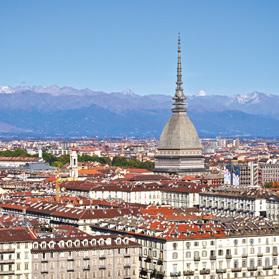 The Mole Antonelliana, originally designed to be a Jewish synagogue, now houses the National Museum of Cinema.
If you’re thinking of a city break to Italy, you’ll probably consider Milan or Rome before Turin springs to mind.
Yet, this northern Italian city, tucked into the base of the Alps, is well worth a visit, at any time of the year.
It’s January when I arrive and the trees are bare; the locals – people and dogs alike – are stuffed into thick winter jackets, and everyone’s knocking back espresso shots or enjoying a hearty Piedmontese dish with friends or family. Fiat 500s are parked everywhere, even on zebra crossings. On the horizon loom the Italian Alps.
The first thing you’ll notice when approaching Turin is that it’s not as flashy, brash, expensive or fast-paced as Milan; and nowhere near as touristic as Rome.
The architecture’s also different. It’s a potpourri of baroque, rococo, neo-classical and Art Nouveau buildings, with plenty of piazzas and monuments bearing witness to the city’s rich, aristocratic heritage thrown in for good measure.
Brief history lesson
The Taurini, an ancient Celto-Ligurian Alpine people, were the first residents of this strategic city.
Located on the River Po, in the region of Piedmont, Turin was under Roman and Charlemagne rule before Emmanuel Philibert (aka Iron Head) made it the seat of the Duchy of Savoy in 1563.
Turin was part of the French Empire for several years and, when Italy was reunified, became its first capital city from 1861 until 1865 when the capital was moved to Florence and then to Rome.
Even if you’re not a motor junkie or a football freak, you can’t miss two of the best tourist attractions in the city: the Museo dell’ Automobile and the new Juventus Stadium
During the industrialisation epoch, Turin grew rapidly, before the impact and aftermath of two world wars put the brakes on its development.
It was heavily bombed during World War II as its automotive industry was churning out defence vehicles instead of passenger cars.
After the war, the city and its automotive industry were rebuilt and, today, Turin forms part of Italy’s most important industrial triangle, which covers Milan, Turin and Genoa; its population has grown to around two million, half of which live within the city limits.
See and do…
Like other Italian cities, Turin boasts its fair share of piazzas, each individual, yet all featuring stunning architecture, cosy cafes and steeped in history.
Piazza Vittorio Veneto is the largest baroque square in Europe and there you’ll find Porto di Savona, a local restaurant with Piedmontese specialities.
Make sure you try bagna càuda, a local hot dip which is a bit like fondue but made from garlic, olive oil, anchovies and butter, spread over roasted vegetables such as peppers or artichoke, and some local dishes with chestnuts or truffle, both popular ingredients in this region.
Together with the bars and clubs dotted along the River Po, Piazza Vittorio, as the locals call it, is supposedly the mecca of Turin nightlife.
During the days when Turin was home to the House of Savoy, Italy’s royal family, it flourished as a cultural centre, attracting many famous Italian writers, poets and thinkers.
Not surprisingly, today it hosts some of Italy’s best and oldest universities; more surprising is the fact that its Egyptian Museum has one of the largest collections of Egyptian artifacts outside of Cairo, while the Museum of Oriental Art houses one of the most important Asian art collections in Italy.
If it’s local history you’re after, check out the Royal Library, Valentino Castle or the Palatine Towers, which are among the best-preserved Roman remains in northern Italy.
The Mole Antonelliana, originally designed to be a Jewish synagogue, now houses the National Museum of Cinema, believed to be the tallest museum in the world at 167 metres; it’s also one of the most popular museums in the city.
Turin is often considered the birthplace of Italian cinema; the first Italian screening took place in the city in 1896.
Cars and football are both synonymous with Turin, often called “the Detroit of Italy”, and even if you’re not a motor junkie or a football freak, you can’t miss two of the best tourist attractions in the city: the Museo dell’Automobile and the new Juventus Stadium.
The Automobile Museum is housed in a stunning modern building and contains beautifully restored vintage cars (also from other European car producers), Formula 1 racing cars including Ferraris (of course, we’re in Italy!) and much-loved classics like the original Fiat 500 and Fiat 600. You’ll get a great insight into how cars adapted to societal and cultural developments.
It might cost €18 to take a tour of the Juventus Stadium and Museum, but this state-of-the-art ground, which opened in 2011, is worth every penny of it.
So, if there are no live matches playing during your visit, at least take the tour to capture some Italian football fever.
And, if you are a chocoholic, don’t miss the CioccolaTò, a two-week chocolate festival in March, run by some of the large Piedmontese chocolate producers, like Caffarel, Streglio and Venchi.
After overdosing on chocolate, head into the Alps, less than an hour away, for some hiking or skiing, depending on the season.
So, don’t brush Turin off as an industrial powerhouse, far off the beaten tourist track. Yes, it’s one of Italy’s most important economic centres, home to some of the country’s best known companies, but, trust me, 48 hours in Turin in January is not enough. I’m heading back in the spring for another heady dose of Piedmontese culture and cuisine.
It’s a city that offers relatively good value for money, where locals are friendly and welcoming to tourists and which still somehow seems slightly undiscovered.
Getting there
Ryanair currently flies between Malta and Turin every Wednesday and Saturday.
Not to be missed
Historical Tram 7: ride an eight-kilometre, one-hour circuit around the city in this vintage tram. There’s no commentary, but during the €1.50 ride you can get a taste of the city’s architecture.
Automobile Museum: to get to grips with Italy’s automotive history.
Juventus Stadium: discover just why this is one of Italy’s most loved football clubs.
Egyptian Museum: if you’ve never made it to Cairo, this is the largest collection of Egyptian art and history outside of Egypt.
Floris House: quaint, aristocratic ambience in this store/villa/dining room on Via Cavour for afternoon tea or late lunch
Piedmontese cuisine: mix with the locals at Porto di Savona on Piazza Vittorio.
Italian dinner: at Ristorante Giovanni on Via Gioberti, where you can enjoy regional and national cuisine served up in an intimate, romantic atmosphere with great Italian hospitality.
A taste of Martini: enjoy a Martini in one of the city’s grand bars. After all, this is where the glamorous drink originated.