It’s been relatively mild... except for the ‘medicane’
Official records may show Malta experienced relatively mild weather in 2014, which will nevertheless be remembered as the year of the Mediterranean tropical cyclone. Referred to as the medicane, this kind of tropical cyclone is rare due to the...
Official records may show Malta experienced relatively mild weather in 2014, which will nevertheless be remembered as the year of the Mediterranean tropical cyclone.
Referred to as the medicane, this kind of tropical cyclone is rare due to the Mediterranean region’s dry nature and only about 100 have been recorded since 1948.
The last medicane witnessed was on November 7, when Malta was in the eye of the storm.
That evening, the Maltese islands were ravaged by heavy rain and fierce winds, which reached 64 knots, the highest for the month since 1947.
The storm forced the temporary suspension of air and sea traffic for a number of hours and damages were reported in several parts of the island.
In scenes reminiscent of tropical regions, the fierce storm left a trail of destruction with damaged power lines, uprooted trees and construction debris blocking a number of arterial roads.
Fortunately, no serious injuries were reported.
However, barring this rare phenomenon and the cold snap over the past days, 2014 was, by Maltese standards, a year of rather mild weather.
By the time of writing, when the data for December had yet to be factored in by the Meteorological Office, the lowest temperature recorded this year was 7˚C on March 12.
On the other hand, the highest temperature recorded was ‘just’ 34.7˚C on August 14, which was way below the record registered in 1999 when the mercury soared to 43.8˚C.
All months were warmer than the norm
Charles Galdies, university lecturer and former chief met officer, told Times of Malta that, judging by Met Office reports and observations, 2014 was warmer and drier than the norm (calculated between 1961 and 1990). “In fact, all months were warmer than the norm as reflected in the highest and lowest temperatures,” Dr Galdies said.
“Of particular relevance was September, which was warmer and drier than expected, with an average maximum temperature of 2.2˚C above the norm, and zero precipitation (compared to a climate norm of 40mm).”
Met Office data till the end of November indicates that rainfall was also below the norm, with the wettest month being November with 88.6 mm. This is still very low considering that, in 1999, a total of 420.3mm of rainfall was measured during the month.
During the same 11-month period, there were 70 rainy days, with the wettest being February 5 with 29.2mm. There were 2,909 hours of sunshine.
Up to the end of November, there were 10 days with thunder, nine days of fog and it hailed on three occasions.
The average sea temperature varied between 15˚C in March to 26.3˚C in August.
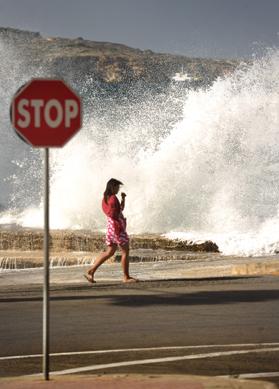 Give us a wave. Photo: Jason Borg.
Malta’s weather since 1947*
• Lowest temperature (at Luqa): 1.4˚C on January 29, 1981.
• Highest temperature: 43.8˚C on August 9, 1999.
• Wettest year: 1951 with 955.62 mm of rain.
• Wettest month: October 1951 with 476.5mm of rain.
• Driest year: 1947 with 228.41mm of rain.
• Highest wind gust (1961-1990): 72 knots (133.4km/h) on October 11, 1982.
• Most thundery days (1951-2010): 43 in 1986.
• Least thundery days (1951-2010): 14 in 1968.
• Most days with hail (1961-1990): 15 in 2005.
• Least days with hail (1961-1990): 2 in 1977.
• Highest number of foggy days (1961-1990): 17 in 1967.
• Lowest number of foggy days (1961-1990): 4 in 1982.
*Source: NSO (The Climate of Malta: Statistics, Trends and Analysis 1951-2010 by Charles Galdies. This document includes data from 1947.)