Pedestrians come last
People often have to walk on the road because pavements are too narrow or broken to walk on. A recent report by the Today Public Policy Institute branded the Maltese as the fattest, laziest and most car-dependent people on earth. It pinpoints the sad...
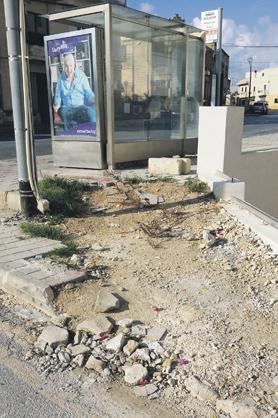 People often have to walk on the road because pavements are too narrow or broken to walk on.
A recent report by the Today Public Policy Institute branded the Maltese as the fattest, laziest and most car-dependent people on earth. It pinpoints the sad state of our urban environment as one of the contributors to our ill-health and reliance on the car.
We are a nation obsessed with the car. I am as guilty as anyone. Until not so long ago, I would drive to my neighbourhood’s convenience store, even though it is walking distance from my house. And sometimes I would double park right in front of it, too.
Less than two years ago I wrote to the Times of Malta calling upon the authorities to build underground tunnels to solve the congestion problem.
Government policy echoes our obsession. It is obsessed with making traffic move faster. We have big dreams of bridges linking Malta and Gozo, of spaghetti junctions and flyovers to replace roundabouts. We make a video showcasing Malta’s “most beautiful road” and celebrate how it cut our journey time by minutes.
All well and good. There is no denying that many of our roads are in dire need of maintenance and that the updating of certain junctions – such as the Kappara and Addolorata ones – are greatly needed to improve the functionality of our island metropolis.
But in focusing all our attention on cars and traffic, we are neglecting our communities. For crying out loud, our arterial roundabouts are better landscaped than our streets.
I live in Triq il-Qaliet in Marsascala, and like most Maltese streets, it has one major design flaw: it completely disregards the needs of the pedestrian.
The pavement is so narrow that two people cannot walk side by side. This makes walking a lonely and unpleasant experience. Making matters worse are the obstructions encountered along the way.
Construction sites block the pavement entirely, forcing even buggy-pushing parents to veer off into the road, facing oncoming cars.
Some garage ramps are built into the pavement, dishevelling it. Huge sections are broken or sunk-in. Zebra crossings at street corners are non-existent.
I do not even want to begin to imagine what it’s like for wheelchair-bound people to navigate our island.
Let us…make walking and cycling a pleasurable experience once again
We admonish people for being lazy and fat, and for resorting to the car just to pick up some cold medicine from the pharmacy a block away. And yet our streets are designed to encourage this behaviour.
Getting places without a car is increasingly becoming inconvenient and unsafe. We are shaping our roads to accommodate the increasing number of cars, but we are not updating our streets to cater to the needs of people.
This limits our freedom and access to basic needs, especially for those people who do not have a choice: children, disabled people, the poor and the elderly. It also continues to fuel our car-dependency.
The worst part of all of this is our indifference to it all. We have grown accustomed to our unwalkable streets. We see nothing wrong with having to walk on the road with cars whizzing past us because our pavements are too narrow and broken to walk on. We would rather double-park in front of our corner shop rather than walk to it, even though it is minutes away.
Triq il-Qaliet was recently the subject of some controversy owing to the local council’s decision to install bollards to separate its two lanes.
The objective was to slow down speeding cars and discourage overtaking.
The €50,000 bollards were removed weeks later following public outcry because the bollards proved a major headache for motorists.
But the solution to reduce speeding on residential roads was not to install bollards or speed cameras. We are human and we respond to our environment. We see a wide straight road and we drive fast, irrespective of the speed limit or road conditions.
The answer is narrowing the street, which would in turn allow us to widen the pavement.
Making it one-way is a suitable option too, albeit an unpopular one. Narrowing the road and widening the pavement would slow down speeding cars, discourage overtaking, and it would make walking a pleasant and safe experience for everyone.
So let us make it easier for everyone to get around.
Let us passionately yearn to transform our neighbourhoods as passionately as we yearn for better highways, tunnels andflyovers. For it is in our neighbourhoods that we live, work and play.
Let us turn our attention to the street which is home to our grocery store, our pharmacy, our office, our children’s school and of course, our house.
And let us make it more liveable, more pleasing to the eye, more pleasurable to walk through.
If we are to expect people to use public transportation, simply improving the bus service is not sufficient. We are focused on speed and efficiency, but the simple act of walking to the bus stop, and waiting for the bus, is just as important as the bus journey itself.
Let us then make our streets complete. Let us make our towns more walkable. Let us improve the connections between our homes and the places we need to go to.
Let us fix our pavements, widen the walkways, introduce zebra crossings, plant more trees, and make walking and cycling a pleasurable experience once again.
And in doing so, we would reduce speeding and overtaking in residential zones, without installing expensive devices that only make drivers more frustrated. In doing all this, we would give the people the freedom to walk or cycle to their convenient stores, their pharmacies, their churches and their pubs.
Let us make every transportation method function better instead of focusing all our efforts on the car.
Let us update our landscape to the needs of people, not the needs of the car.
This does not entail rendering driving less convenient; it simply means giving more travel options for the community.
This is, after all, not an attack on the car: it is a plea to give people a variety of transport options.
And maybe one day, the government will release a video celebrating Malta’s “most pedestrian-friendly street”.
Andrew Saliba has degrees in communications and law.