A history of life imprisonment in Malta
A look back at the history of legislation regulating the sentencing to life in prison
Before the promulgation of the Criminal Code in 1854, life sentences were given for wilful homicide, grievous bodily harm, theft aggravated by violence and sacrilegious theft.
Today, life imprisonment is the punishment meted out in cases involving wilful homicide, endangering the life of the president of Malta by bodily harm, subverting or attempting to subvert the government of Malta by committing certain acts, or for some drug trafficking cases, depending on the type and amount of drug involved and the accused’s intent and criminal history.
In the past, there have only been two trials where more than one accused was sentenced to life imprisonment, namely the cases of Pawlu Attard and Salvu Vella in 1891 and of Andrea Bugeja and Giovanni Camilleri in 1920.
In more recent times, there was the case of Mohsin Bin Brahim Mosbah and Ben Ali Ben Hasan in 1988 and, lately, four men were sentenced to life for the murders of Daphne Caruana Galizia and Carmel Chircop. These latest court judgments are a landmark in the history of trials in Malta.
No records are available about prison terms at the Great Prison or the Castellania prison in Valletta. However, in 1837, 67-year-old Pawlu Galea was sentenced to life for stealing the ciborium from the church of St Therese in Cospicua. He was actually sentenced to death but governor Sir Henry Bouverie commuted the sentence to life imprisonment. Galea is the only known prisoner who left the Great Prison in a coffin – he was murdered by a fellow inmate on December 1, 1839.
 The courtyard of what used to be the Castellania prison in Merchants Street, Valletta (now the premises of the health ministry).
After the 1971 Criminal Code amendments, life imprisonment became the maximum sentence the Criminal Court can impose on anyone who, after a trial, is found guilty of wilful homicide, irrespective of the number of victims mentioned in the bill of indictment.
The Criminal Code states that where at any time before the constitution of the jury the accused declares himself guilty, and for the fact admitted by the accused there is established the punishment of imprisonment for life, the court may, instead of the said punishment, impose the sentence of imprisonment for a term ranging from 12 to 40 years.
It shall be lawful for the court to award a sentence of imprisonment for a term of not less than 12 years in lieu of the punishment of imprisonment for life if, in establishing a fact involving the latter punishment, the jury’s verdict is not unanimous.
After sentencing any person to life imprisonment, the court may recommend in writing to the prime minister within 24 hours the minimum period which, in its view, should elapse before the prisoner is released from prison. Such recommendation shall be made available to the person sentenced and a copy thereof shall be kept by the registrar.
In the past, amnesties were mainly granted on the occasion of visits by members of the royal family, constitutional changes, changes in government and on religious occasions. Among those who have benefitted from these amnesties were prisoners serving life sentences, who also received remission of their sentence. This all stopped in the 1990s when amnesties for prisoners with life sentences came to a halt, and a life sentence meant the persons involved would remain in prison for the rest of their lives.
Currently, there are 19 inmates serving life sentences in Malta’s prison
Moreover, according to the 2012 Restorative Justice Act, prisoners sentenced to life imprisonment are not eligible for parole; however, in 2018, the Constitutional Court ruled that a prisoner sentenced for life was entitled to apply for a review of his sentence after serving a minimum of 25 years, upholding the prisoner’s argument that a life sentence with no prospect for sentence review was incompatible with article 3 of the European Human Rights Convention.
Currently, there are 19 inmates serving life sentences in Malta’s prison.
Ninety-one persons were sentenced to life imprisonment since 1800 after being found guilty of wilful homicide. Twenty-five persons – 20 men and five women – were given this sentence after they were reprieved from the death sentence. The others, 66 men and two women, received a life sentence from the court.
In the long list of men sentenced to life imprisonment, Toni Cutajar’s case is worth highlighting. Cutajar was the youngest prisoner to be sentenced for life when, in 1838, at the age of 12, he was caught stealing from the sanctuary of the Immaculate Conception in Qala. When he was released after nine years, he went to Turkey.
In 1848, Cutajar was extradited to Malta for killing Maltese emigrant Paolo Stella and was again sentenced to life imprisonment. Cutajar, who for many years was the only local prisoner given two separate life sentences, escaped from Corradino prison in August 1867 and managed to leave the island.
Another prisoner who failed to reform himself was Angelo Farrugia. In 1838, Farrugia was given a life sentence after he was found guilty of killing Joseph Barbara of Żejtun. Farrugia was released in 1858 after benefitting from a special amnesty but, in June 1860, he was hanged for killing a policeman.
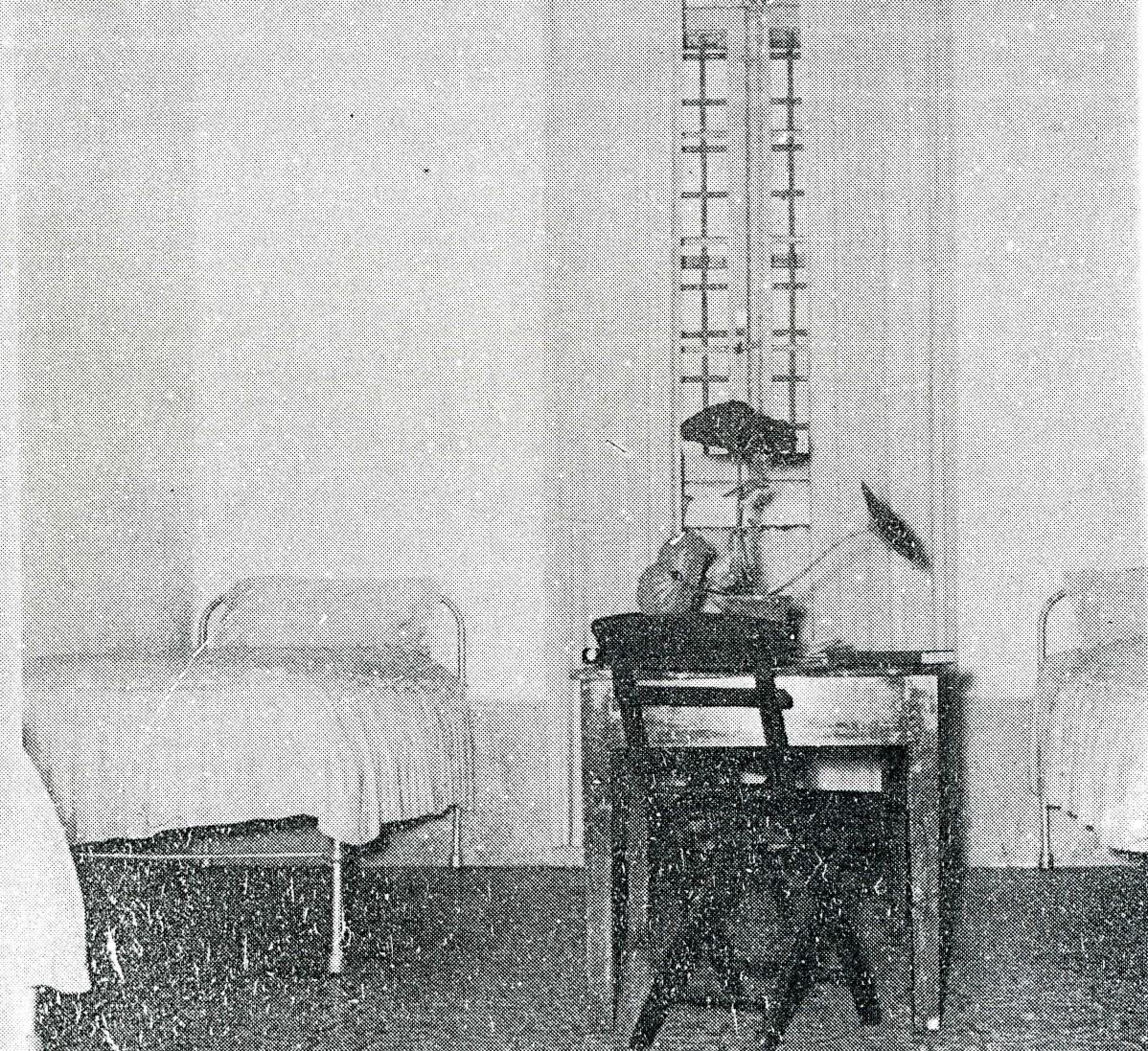 Part of the former female prison section.
Another case worth mentioning is that of Silvio Mangion. In 2010, Mangion was jailed for life after a jury found him guilty of the murder of Rożina Zammit, 54, who was stabbed in her home in Safi in 1984. Prior to this sentence, Mangion had been given a 21-year jail term for the murder of Frenċ Cassar and the attempted murder of the victim’s sister on August 18, 1998. Moreover, in September 2012, Mangion was given another life sentence after being found guilty of stabbing to death Maria Stella Magrin at her home in Cospicua on October 30, 1986.
For many years, the longest term in prison was that of John Naylor, of the 88th Regiment of Foot, the Connaught Rangers. On March 6, 1843, Naylor shot and killed Dr William Martin, the inspector-general of the navy hospital. The doctor had just left a meeting with Sir John Louis, Admiral Superintendent of Malta Dockyard, and was boarding a boat in Dockyard Creek when he was shot by Naylor. The rifle shot penetrated Martin’s torso and tore his right lung and part of his intestine.
Naylor was found guilty by a six-to-one verdict (juries at the time were composed of seven jurors) and was sentenced to life. However, he was released and returned to Ireland following the issuing of a warrant by the governor, Sir Patrick Grant, on March 1, 1870, after spending 27 years in Valletta’s Great Prison and later at Corradino.
Naylor’s term in prison was surpassed by that of Mohsen Mosbah Bin Brahim and Ben Ali Wahid Ben Hassine, two Tunisians who were imprisoned for life on February 20, 1988. After about four years in preventive custody, the two were each given a life sentence after pleading guilty to killing four men, namely, Peter James Rhead at Ta’ Xbiex on February 12, 1988; George Cucciardi on the same night; and Alfred Darmanin and Frenchman Levarlet Guillaume Andrè Michel, the last two on February 18, 1988.
 The Criminal Court.
The first woman reprieved was Giuseppa Buttigieg, who, in 1856, was convicted of infanticide, which at that time carried the death penalty. The sentence was later commuted to life imprisonment owing to Buttigieg allegedly being pregnant. However, it was subsequently revealed that the ‘pregnancy’ was a pure fabrication.
Ordinance XXXVII of 1934 prohibited the imposition of death sentences on pregnant women, and, instead, the maximum sentence for women became life imprisonment. This provision was repealed in 1971 when the death penalty was abolished altogether.
In 1858, 75-year-old Evangelista Cini was given a life sentence after the governor commuted her death penalty. Cini had been sentenced to death for murdering her daughter’s newborn child. The woman threw the baby into a cellar belonging to a man named as the illegitimate child’s father. Cini died in prison some months into her sentence.
Another reprieved woman was Karmena Abdilla, who, in 1937 instigated her 14-year-old son to kill a certain Joseph Debattista. Governor Sir Charles Bonham Carter commuted her death sentence, and, on June 16, 1941, governor Sir William Dobbie granted a special amnesty to Abdilla and she was released from prison. This was the shortest jail term a prisoner ever served after being given a life sentence. It can be said that Abdilla was the luckiest ever female inmate at Corradino prison.
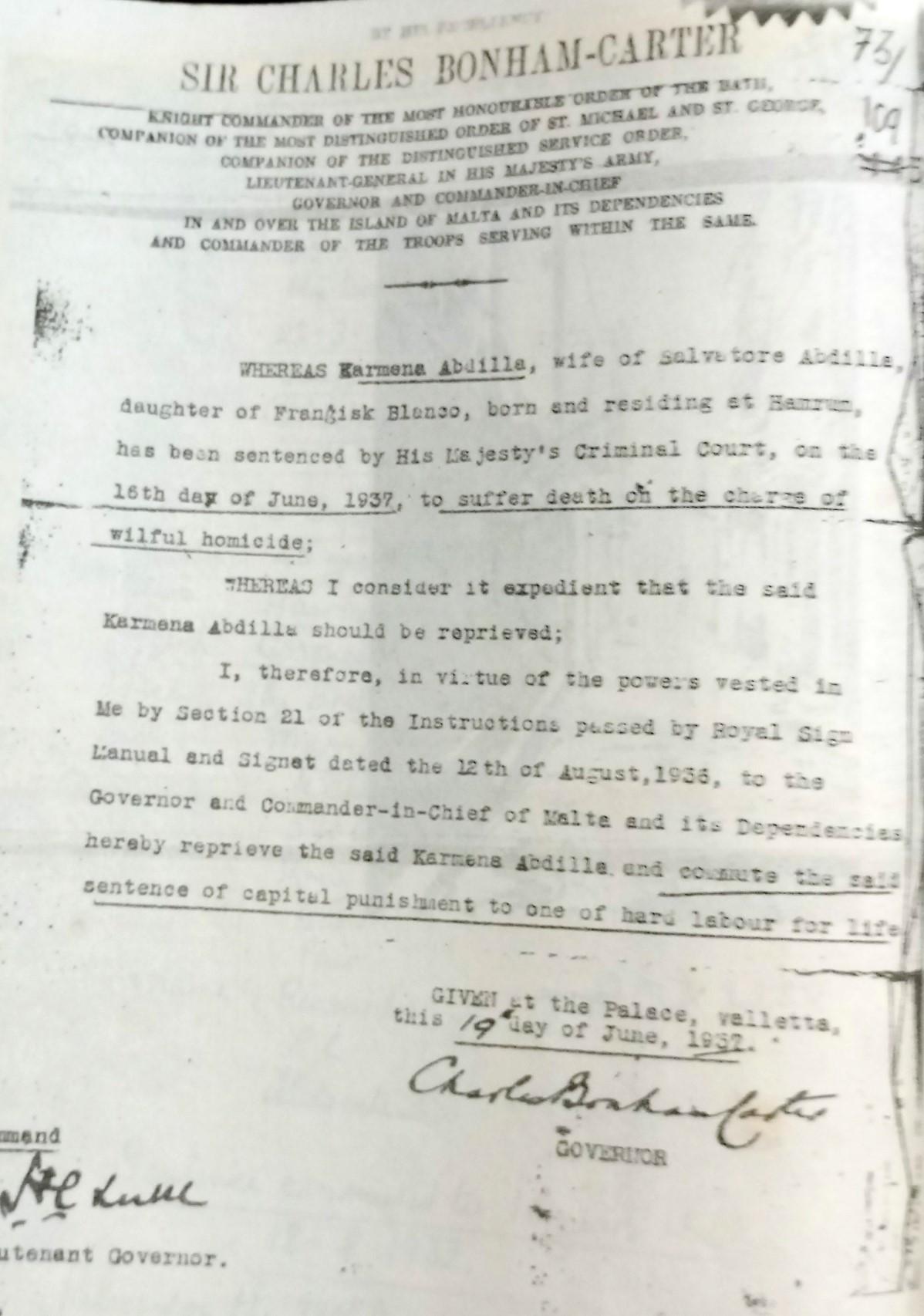 Governor Sir Charles Bonham Carter's warrant granting a reprieve to Karmela Abdilla in 1941.
By a verdict of eight votes to one, Paola Camilleri escaped the death penalty and was sentenced to life imprisonment instead. In October 1934, 53-year-old Camilleri was found guilty of killing her daughter-in-law, Rosa Camilleri, by suffocating her.
In 1944, three years before the Criminal Code was amended to diminish the penalty for infanticide, 19-year-old Vittorja Micallef was sentenced to death for killing her illegitimate newborn child. After a commutation of the death penalty, Micallef was given a life sentence but she died of tuberculosis in June 1947.
It can be said that Karmena Abdilla was the luckiest ever female inmate at Corradino prison
The last woman whose death sentence was commuted to life imprisonment was Luigia Camilleri, who, on February 21, 1961, was found guilty of killing her eight-year-old son Twannie. Luigia was released from prison in 1970 after various amnesties.
In November 1971, a woman was imprisoned for life after being found guilty of murdering her husband. This trial was the first wilful homicide indictment as the death penalty had been abolished a month earlier.
On August 7, 2025, Mayumi Santos Patacsil, a 48-year-old Filipino national, received a life sentence for stabbing her partner to death in 2021.

Edward Attard is a crime historian and former police officer