From a pretend Pope to an invisible puppy: Online fraud costing Malta millions
The real-life stories of Maltese people who have lost a lot of money to sophisticated online scams
A woman was convinced she was chatting on Facebook with Pope Leo XIV and was sending him money for his projects – and she simply did not believe Bank of Valletta when it told her the ‘pope’ was a scammer.
Another man lost his life savings to a fictitious Canadian woman whom he chatted with for months, and after she took all his money, he went to look for her abroad, only to discover the address she gave him didn’t exist.
And another woman spent seven years and €170,000 trying to buy a dog that never even existed.
These are not plot lines from a film but real-life stories of Maltese people who have lost a lot of money to sophisticated online scams during the past months. Their stories will be detailed in an episode of Times Talk to be released this week.
The episode delves into a wave of increasingly sophisticated and insidious online scams that is sweeping across Europe, leaving a trail of financial and emotional devastation.
The victims are not just the vulnerable or the uninformed; they are often educated, high-earning individuals who fall prey to meticulously crafted psychological traps.
In fact, a recent study found that 40% of Malta’s highest earners have lost money to online scams.
Ryan Caruana, Group Chief Anti-Financial Crime Officer at Bank of Valletta, believes that scamming has become so widespread that by the end of this year, everyone in Malta will know someone in their close circle, a family member or a friend, who would have lost money to an online scam.
Caruana was one of the expert guests on the podcast, along with police inspector Clive Brimmer and communications strategist for the Chamber of Commerce, Rachel Bondi Attard.
All three have met victims who have lost livelihoods and their sanity due to online scams, and the stories behind the statistics are a stark reminder of the human cost.
Quest for a dog that never was
One of the most heart-wrenching stories Caruana shared involved a ‘well-educated’ Maltese woman who spent seven years and a total of €170,000 trying to buy a dog that never existed.
The scam began simply enough. She paid a €2,000 deposit for a dog she found online. The scammers soon contacted her, claiming the dog had died in transit. They then convinced her that she could sue for damages, and over the next seven years, they slowly drained her of her savings.
She sent money for legal fees, court costs, and even a bribe for a judge in Nigeria, all in the desperate hope of recovering her initial investment.
The fraudsters expertly manipulated her emotions, pushing her further into the rabbit hole every time she expressed doubt. Brimmer said she was too emotionally invested to let go, however.
Allure of romance
Romance scams are among the most devastating, preying on people’s loneliness and desire for connection, the experts said.
A man, who had recently sold his house, fell victim to one such scam, losing all his life savings – leaving him with “not even a €100 in his bank account”.
Convinced that the woman he was communicating with online was real and that they were in a relationship, he sent her large sums of money over a period of months, thinking he was investing it.
When she took off with his money and he went to search for her in Canada, he found the address she gave him was fake.
The emotional toll of these scams is immense. Bondi Attard said these cases “not only drain the bank accounts of people but send them spiralling into very serious mental health issues”.
Trusting the wrong people
Sometimes, the scams are so outlandish they defy belief, yet they still work. One woman, for example, was convinced she was chatting with Pope Leo XIV on Facebook Messenger.
A scammer, posing as the pontiff, told her he needed money for charitable projects and that sending her pension to him was how she would please God.
Caruana said she would send him all her pension the day after she received it. When her bank, BOV, flagged the suspicious transactions, the woman withdrew the money in cash and tried to send it through other means.
Caruana said she was so convinced it was the pope that she even went to a bank branch “complaining that the bank was not allowing her to send money to the pope”.
Many people are also losing thousands to scammers impersonating the prime minister, the finance minister, the opposition leader, or some other prominent Maltese figure.
Some will watch a deep fake video on social media in which the prime minister appears to be encouraging people to invest in a high-return scheme and are lured to a site that takes their money.
In other cases, Robert Abela, Clyde Caruana, Bernard Grech or some other trusted politician will seem to send them private messages urging them to invest.
The victims, convinced they were getting an inside tip, refused to cooperate with the police, stating they would not believe the authorities over the prime minister.
“In some cases, the investment scheme appears to work at the beginning,” Caruana said.
“In the first few months they start sending you more money than you invested, so you trust them and believe it’s real.
“Then they’ll ask you to send a big sum, a few hundred thousand, for instance, to receive even more within a few months. You do it and they disappear with the money for good.”
15 reports daily
The issue is widespread and only getting worse. According to Brimmer, who is a police inspector at a specialised unit dedicated to financial crime, the police receive an average of 15 reports every day related to online scams.
And the money lost is staggering. He recounted the case of an 80-year-old Maltese woman who lost €800,000 to a romance scam.
“In another case, a 70-year-old woman was contacted by a scammer claiming to be an engineer coming from Gaza needing to go to Turkey. She was married, but she pitied him, built a relationship with him and ended up sending him €568,000,” he said.
“These are all Maltese people and these stories happened in Malta very recently, over the past months. This woman has a tertiary education.”
But with money often transferred across multiple jurisdictions within minutes, he said, retrieving it is often impossible.
“Traditional crime is down, but this kind of crime is exploding, and we’re constantly under siege.”
He noted that in 2004, the police received about 50 such reports a year, a number that has now soared to around 2,500.
Caruana said this year alone, BOV clients have already lost over €3 million to online scams, with the bank’s controls managing to stop nearly another €2 million from being stolen.
He highlighted the scale of the problem, noting that in the EU and UK combined, fraud accounted for an astonishing €85 billion in losses last year.
And BOV only managed to retrieve 10 per cent of all the money that was lost in Malta last year.
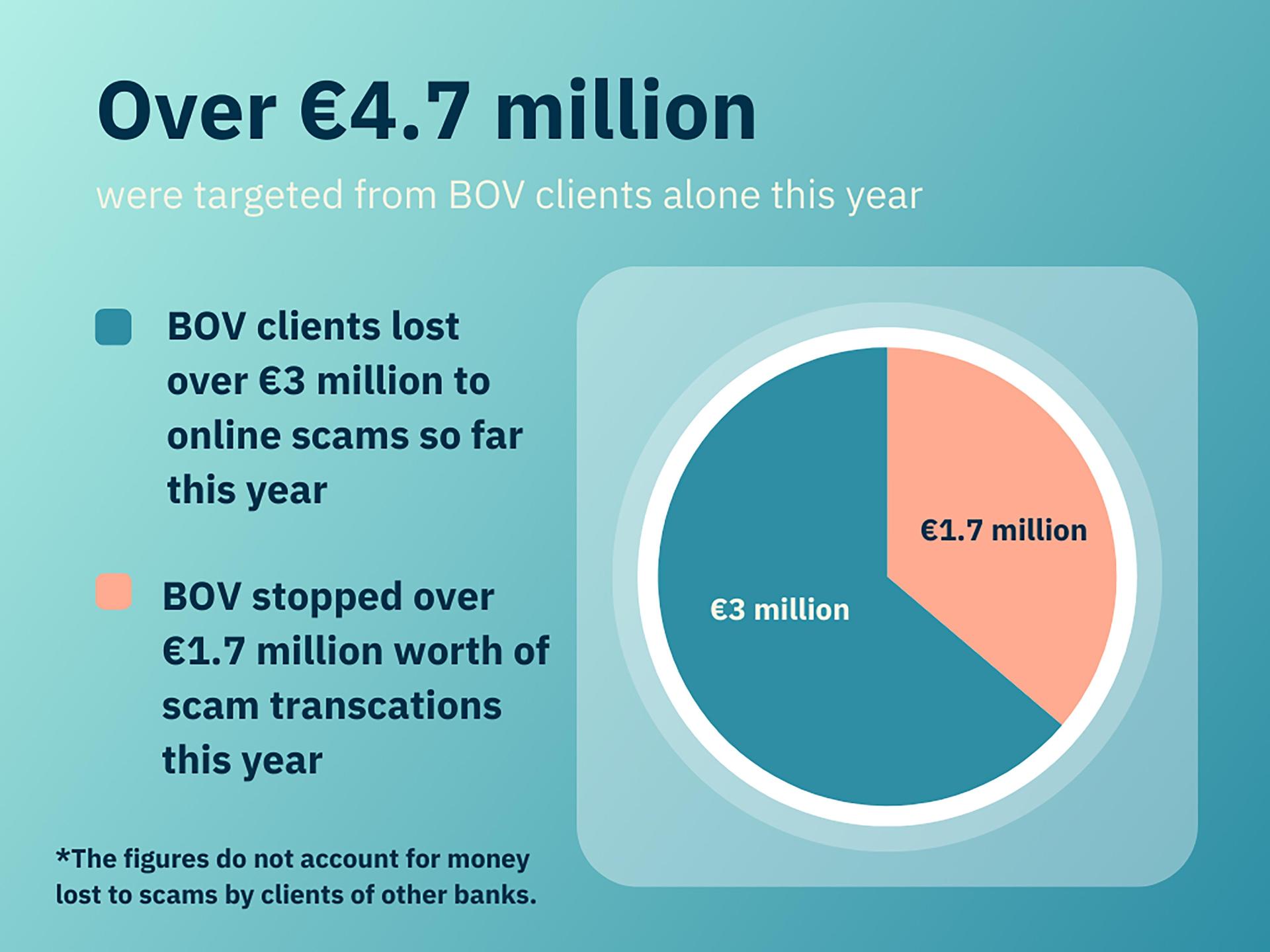 This year alone, BOV clients have already lost over €3 million to online scams, with the bank’s controls managing to stop nearly another €2 million from being stolen.
Spoofed SMSs
Caruana also warned against a common scam tactic. Fraudsters send an SMS claiming your bank card is about to expire, along with a link. Tapping the link takes you to a fraudulent site designed to steal your details and give scammers control of your phone.
“We need to think hard about this,” he said. “Nowadays, we’re carrying all our life savings with us on our phones every day – it’s all we’ve been working for our whole life.”
This is why, according to the experts, awareness and prevention are the best defences.
Scammers often leverage emotions – whether it’s greed, loneliness or a sense of urgency – to bypass critical thinking. The message from the police, the business and the banking sector is clear: “Don’t rush.
Before you do something, ask yourself what’s going on.”
“They will target people at their most vulnerable,” Caruana said.
“It is a psychological game,” inspector Brimmer explained. “If anyone pressures you to send a payment quickly, it’s likely a scam.”
Who are the victims?
They are not all who you might expect.
While a common stereotype suggests scam victims are uneducated or low-income, a study published earlier this year revealed a different reality.
Over 40% of Malta’s highest earners have fallen victim to online fraud, losing money in the process.
Commissioned by the Office of the Arbiter for Financial Services and the TVM programme Illum ma’ Steph, the study by Professor Vincent Marmarà found that 40.5% of respondents in the highest income tax bracket reported losing money to scams.
This vulnerability extends to the well-educated, with 24.3% of victims holding a tertiary-level education.
According to the study, this trend is due to their greater exposure and frequent use of digital platforms like online banking, Revolut and Apple Pay.
The study found over half the population reported being targeted by scammers. And while a high level of general awareness about financial scams exists, a considerable 15.8% of targeted individuals still suffered a financial loss.
Almost 80% said their money was only stolen once, but 10% said they lost money twice, and another 10% fell victim more than twice.
Bondi Attard said that while older generations may be more cautious and seek help, it is the younger generation that might be most at risk.
“Young people believe they know how to use technology, so it’s easy to put their guard down,” she said, adding that this overconfidence could make them particularly susceptible.
On Times Talk, the experts also said in other cases, a woman lost €900,000 in just two years, and some companies and businesses lost €500,000 in a single transaction.
Problem plaguing business
Businesses are not immune to these sophisticated attacks. Bondi Attard highlighted the rise of scams like business e-mail compromise (BEC) and fake invoicing.
In a BEC scam, a fraudster impersonates an accountant or another trusted employee, e-mailing a business with instructions to make an urgent payment. The e-mail address appears legitimate, but it is a carefully crafted spoof.
“There is no foolproof plan that guarantees you’ll never be scammed. The EU is pushing for digital, but that leap must come with many safeguards. That’s what we, as the Chamber, are telling businesses,” she said.
“You can’t just have one person processing payroll or payments. Other people need to double check those transactions. Sometimes even the business owner will get scammed – everybody has their weak days, when they’re going through problems in life and they’re less alert.”
The experts said there are notable rises in romance scams around Valentine’s Day and Christmas, and businesses are more likely to fall for a scam around Black Friday.
‘Prevention best defence’
For Caruana, the best control against these scams is not a bank’s security measures but the individual’s own awareness and prevention.
Inspector Brimmer echoed this sentiment, noting that money moves between accounts – sometimes within minutes – to different jurisdictions, making it almost impossible to recover.
And some victims only report months after the transaction, by which point the money is spread all over the world.
“Education, not just awareness, is key,” Bondi Attard said.
“If our primary schools are not going to hammer this into children, they will grow up using technology blindly.”
How do I know if it’s a scam?
If anyone pressures you to send payments urgently, it is more likely to be a scam.
An SMS ‘from’ the bank is not necessarily coming from the bank. An SMS from a scammer can find its way in the thread of messages you genuinely receive from the bank on your phone.
If you are a BOV client you should know that genuine bank messages will never ask you to press links in SMS messages.
Beware of e-mails, messages and calls, even you think they are from the people you trust or have worked with for many years, if they suddenly tell you they need urgent help or to send money in new bank accounts. It could be a scammer impersonating them, not them.
If you realise you have lost money to a scam, report it immediately to the police and your bank.
If some offer sounds too good to be true, it’s probably because it isn’t true.
If you have been a victim of a crime, you can access therapeutic support or legal assistance through Victim Support Malta on 21 228333, email info@victimsupport.org.mt , or fill in the referral form on victimsupport.org.mt