‘A smell of death’
World leaders should be working towards full global nuclear disarmament
Just over a month after the US dropped an atomic bomb on Nagasaki, a US Navy officer visited the city and reported “a smell of death and corruption pervades the place”. By the end of 1945, over 140,000 people died in Hiroshima and 74,000 in Nagasaki from the blasts. Survivors faced increased cancer rates, particularly leukaemia, and other chronic diseases. Up until today, the bombings continue to affect succeeding generations through genetic damage and psychological trauma.
The atomic bombs used on Hiroshima and Nagasaki had yields of 15 kilotons and 20 kilotons of TNT, respectively.
September 1959 documents show that a one megaton atomic bomb (3% of the combined power of the bombs dropped on Hiroshima and Nagasaki) dropped on Senglea to wipe out all the UK and NATO military logistical hubs then based in Malta would kill 143,057 people – around half of Malta’s 1959 population of 289,135, leaving another 59,747 seriously injured.
With an effective evacuation scheme, 41,192 would still die and 62,345 would be left injured.
Valletta, Floriana, Cospicua, Senglea, Vittoriosa and Kalkara would be the worst hit, and it was estimated that without any evacuation programme 90% of the persons there would die and the rest would be seriously injured. It was estimated that out of a population of 289,135 people in case of war there would be shelters for only 54,400.
Sixty-five years after the atomic explosions on the two Japanese cities, a survivor from Nagasaki, Miyako Taguchi told the Agape community of Massachusetts: “Life after the atomic bombing and the war brought even more pain to the survivors. Both Nagasaki and Hiroshima lost their ability to function. They were no longer cities where people could live. All survivors struggled to get clean water and food and shelter to sleep under while they suffered the tremendous fear and sadness in their minds. They had lost their families and friends and, yet, people were still dying from unknown diseases without much medical treatment. Many young female survivors were afraid to marry and to get pregnant because there were many cases of stillbirth and deformed babies.”
In July 1955, Bertrand Russell and Albert Einstein urged the world to seek peaceful resolution to international conflict. They warned: “The general public, and even many men in positions of authority, have not realised what would be involved in a war with nuclear bombs. The general public still thinks in terms of the obliteration of cities... there will be universal death, sudden only for a minority, but for the majority a slow torture of disease and disintegration… People scarcely realise in imagination that the danger is to themselves and their children and their grandchildren, and not only to a dimly apprehended humanity. They can scarcely bring themselves to grasp that they, individually, and those whom they love are in imminent danger of perishing agonisingly.”
We are in one of the most dangerous periods in human history- Evarist Bartolo
Wealthy people across the US and Europe have the illusion that they can survive a nuclear war by buying nuclear bunkers designed to protect occupants from nuclear explosions. Organised war propaganda campaigns are fuelling demands by high-net-worth individuals and corporations for nuclear bunkers. The global nuclear bunker market is projected to expand at an annual growth rate of 13.4% from 2025 to 2033, from over €616 million in 2025 to €1.7 billion by 2033.
These bunkers give their owners a false perception that a nuclear war is survivable. Ironically, most of these bunkers are located in former government facilities abandoned for their impracticality as a means of protecting civilian populations.
The abyss
In 2024, the nine nuclear-armed states collectively spent over €85 billion on their nuclear arsenals, an increase of approximately 11% compared to the previous year. The US was the largest spender, accounting for more than half of the total.
Other significant spenders included China and the United Kingdom.
The US: €48 billion, China: €10 billion, United Kingdom: €9 billion, Russia: €7 billion, France: €6 billion, India: €2 billion, Israel: €1 billion, Pakistan: €1 billion and North Korea: €540 million.
The private sector also profited significantly from these expenditures, earning at least €36 billion from nuclear weapons contracts in 2024 alone.
The American Federation of Teachers says: “Our national security would be better protected if there were universal healthcare for our people, high-quality education and training, affordable housing, environmental justice, and adequate nutrition for all, and full global nuclear disarmament, rather than continuing these bloated military programmes.”
Nuclear weapons programmes divert public funds from healthcare, education, global warming mitigation, disaster relief and other vital services.
While public expenditure is considered extravagant and not affordable when it comes to improving the lives of millions of people, there are no budgetary constraints as governments that used to pride themselves as being welfare states now boast they are becoming warfare states.
US Congressman James McGovern of Massachusetts has been trying for almost 50 years to raise awareness about a nuclear apocalypse and to promote non-proliferation: “If we ever get to a point where there’s all out nuclear war, underground bunkers aren’t going to protect people… Instead, we ought to be investing our resources and our energy trying to talk about a nuclear weapons freeze, initially.”
He is worried that the situation is getting worse as the US will be spending $1 trillion to modernise its nuclear arsenal. “The stakes, if a nuclear weapon is ever used, is that millions and millions and millions of people will die. It really is shocking that we have world leaders who talk casually about utilising nuclear weapons. I mean, it would be catastrophic, not just for those that are involved in an exchange of nuclear weapons, but for the entire world.”
“We are now in one of the most dangerous periods in human history,” said Dan Smith, director of the Stockholm International Peace Research Institute.
“There are numerous sources of instability – political rivalries, economic inequalities, ecological disruption, an accelerating arms race. The abyss is beckoning, and it is time for the great powers to step back and reflect. Preferably together.”
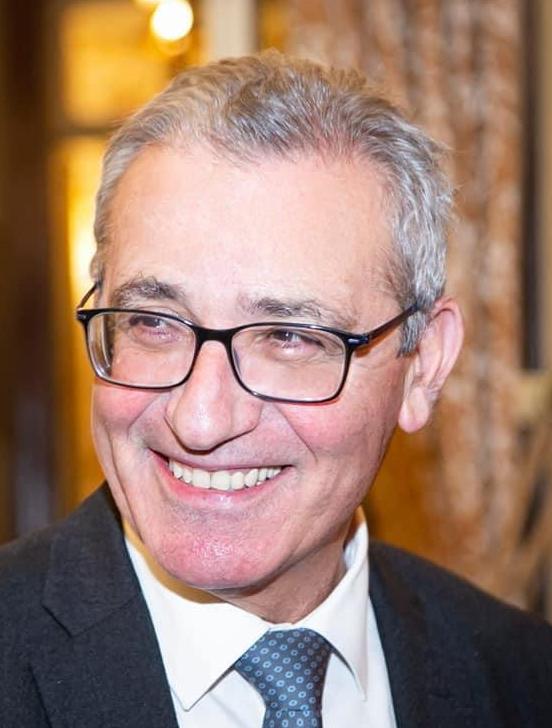 Evarist Bartolo.
Evarist Bartolo is a former Labour foreign and education minister.