Another world beyond the visible: a retrospective of Joseph L. Mallia
His most distinctive modernist contribution is the concept of notations
Entering Another World Beyond: The Art of Joseph L. Mallia is like stepping into the inner life of one of Malta’s most innovative modernist painters.
Spanning over six decades, the exhibition is organised into four thematic, non-chronological sections, tracing Joseph L. Mallia’s personal artistic journey from disciplined figurative studies to increasingly abstract explorations, namely Exploring the Self, Figures & Still Lifes, Structures of Place: Landscapes and Cityscapes, and Beyond the Visible.
At the heart of this long trajectory lies his most distinctive modernist contribution: the concept of notations.
The exhibition texts provide important context, highlighting a pivotal moment in Mallia’s artistic development at the Ealing School of Art, where he was tasked with drawing the breakfast he had eaten that morning.
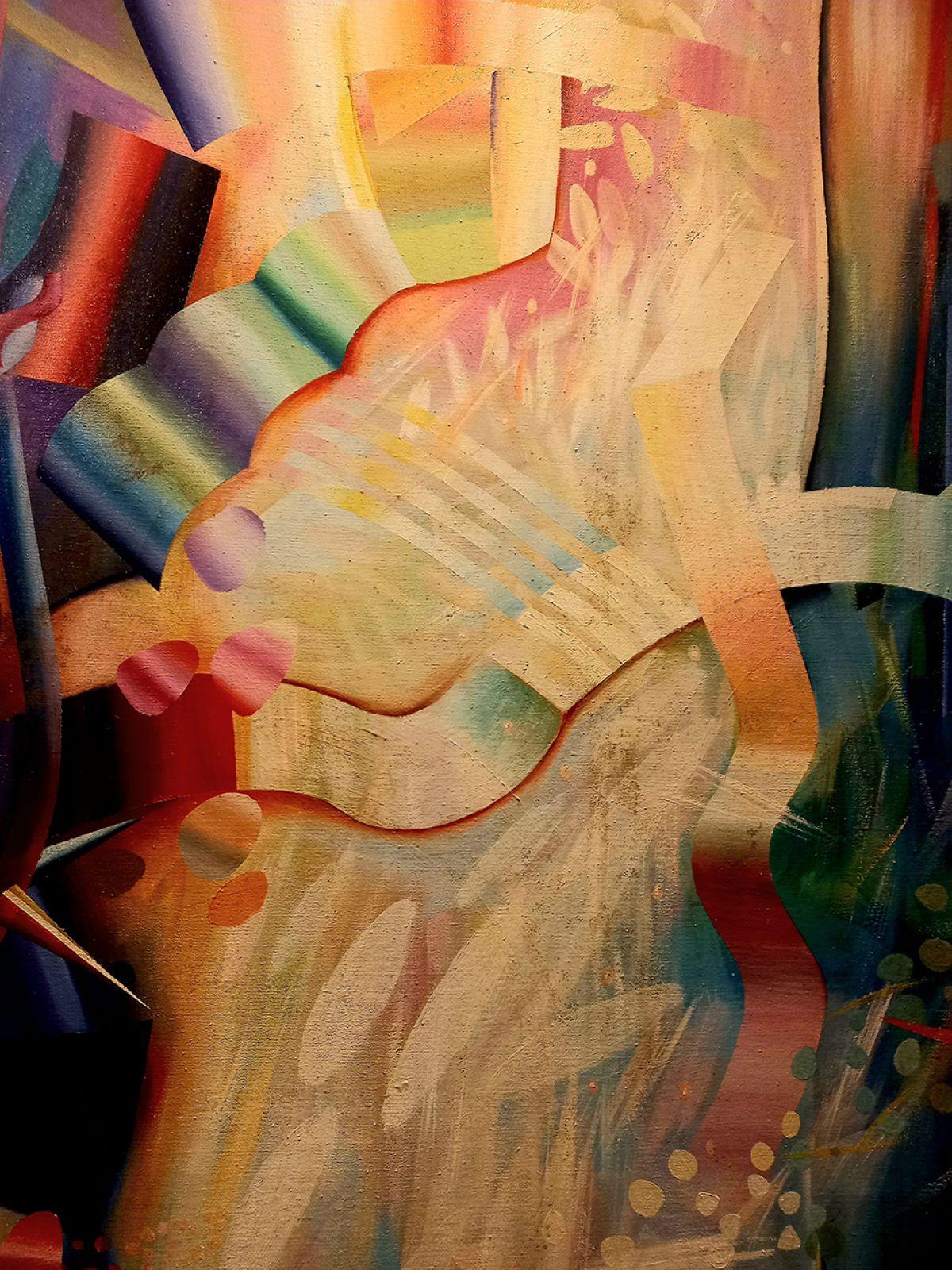 Detail from Untitled, 2002
The exercise was not intended as a naturalistic study; instead, it emphasised capturing the experience itself – the sensations, impressions and memory of the meal – through marks, or, more precisely, notations, that conveyed hot liquidness, oozing viscosity, crunch, melting and pooling.
Ingeniously, the task displaced the traditional focus on mimetic accuracy to a conceptual and sensory rendition of objects that were not physically present.
This challenge pushed Mallia beyond his comfort zone, transforming his understanding of art: to record fleeting sensations, impressions and states of mind, rather than replicate external reality. The philosophy of notations would continue to guide his practice, becoming the leitmotiv of his entire oeuvre.
This new understanding allowed Mallia to treat cityscape and landscape as vessels of emotional memory rather than mere depictions of external reality. In this, his modernism parallels literary innovations in the early 20th century.
In Ulysses, James Joyce abandons traditional narration in favour of stream of consciousness, a stylistic device whereby the interior thoughts and feelings of characters are interwoven with external events.
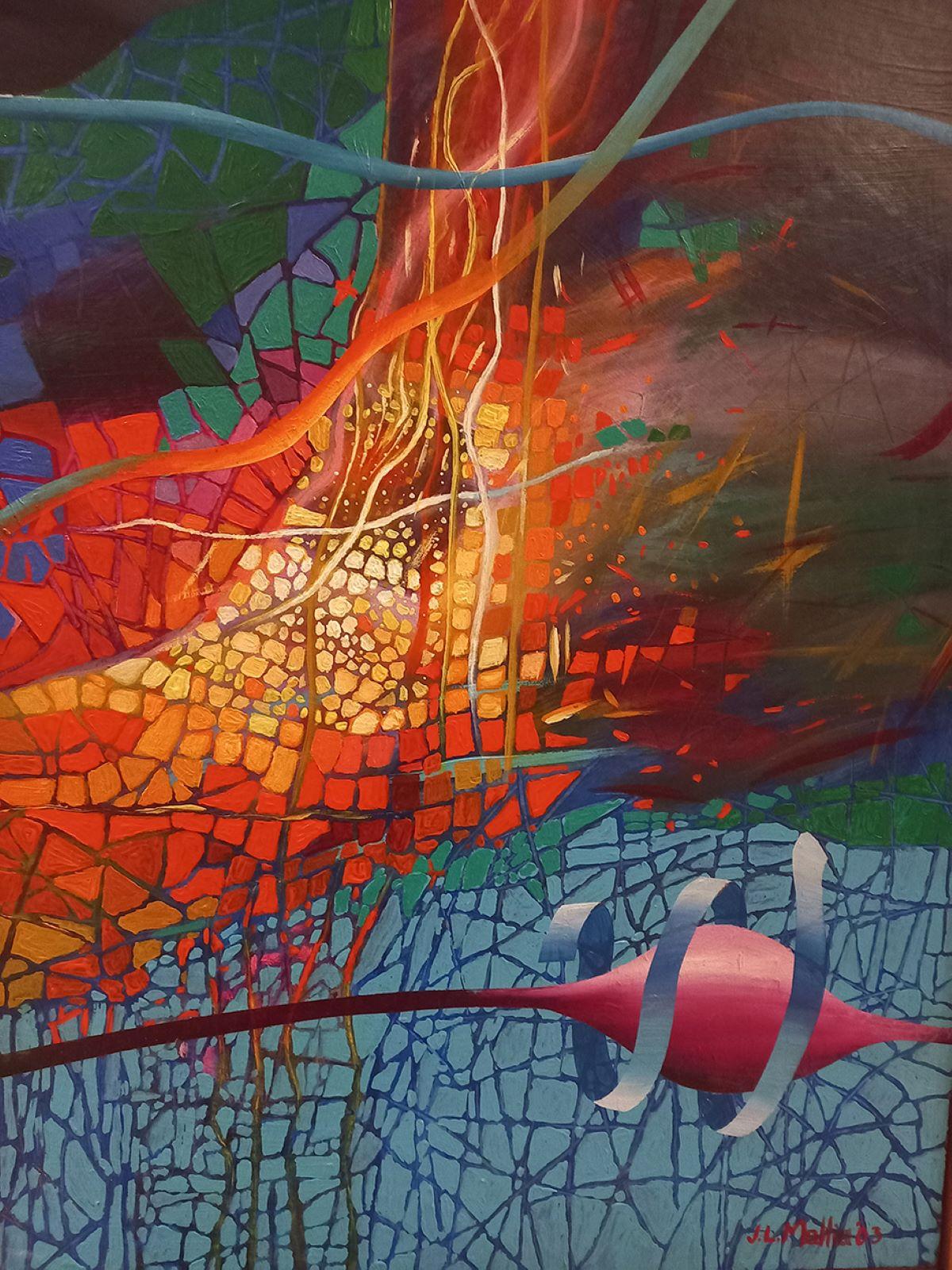 Detail from Untitled, 2003
Similarly, Virginia Woolf urged novelists to “record the atoms as they fall upon the mind in the order in which they fall… trace the pattern… each sight or incident scores upon the consciousness,” creating a new, avant-garde narration where plot and character are no longer defined externally.
Mallia’s cityscapes and landscapes operate on the same principle: familiar features – whether urban walls, arches, stairways, or rural fields and coastlines – are abstracted into rhythms of perception, transformed by memory and emotion into a visual stream of consciousness.
Colour, form and composition act as notations of sensation and recollection, privileging inner experience over mimetic fidelity. These motifs no longer serve as architectural or topographical documentation but as compositional elements that evoke movement, memory and the rhythm of lived experience.
Although most of the works are untitled, the exhibition situates the cityscapes within Senglea, Mallia’s harbour hometown. Like Joyce’s Bloom wandering through the city of Dublin, Mallia may thus be seen as a flâneur in his Senglea, filtering its architecture, stairways, tunnels, Catholic rituals and everyday bustle into a painterly language of perception.
Just as Joyce and Woolf narrate consciousness in flux, Mallia renders sensation into notations on canvas, making his modernist project an exploration of lived experience rather than mere appearance. In both painting and literature, modernism becomes a method for recording the flow of consciousness, totally redefining how reality is perceived and represented.
Seen in this light, Mallia’s relationship with modernism becomes clearer. He is neither a cubist nor a futurist, neither a constructivist nor a suprematist. Though he borrowed visual elements from all of them, these borrowings were always subordinated to his overarching aim: transcribing sensation, memory and perception.
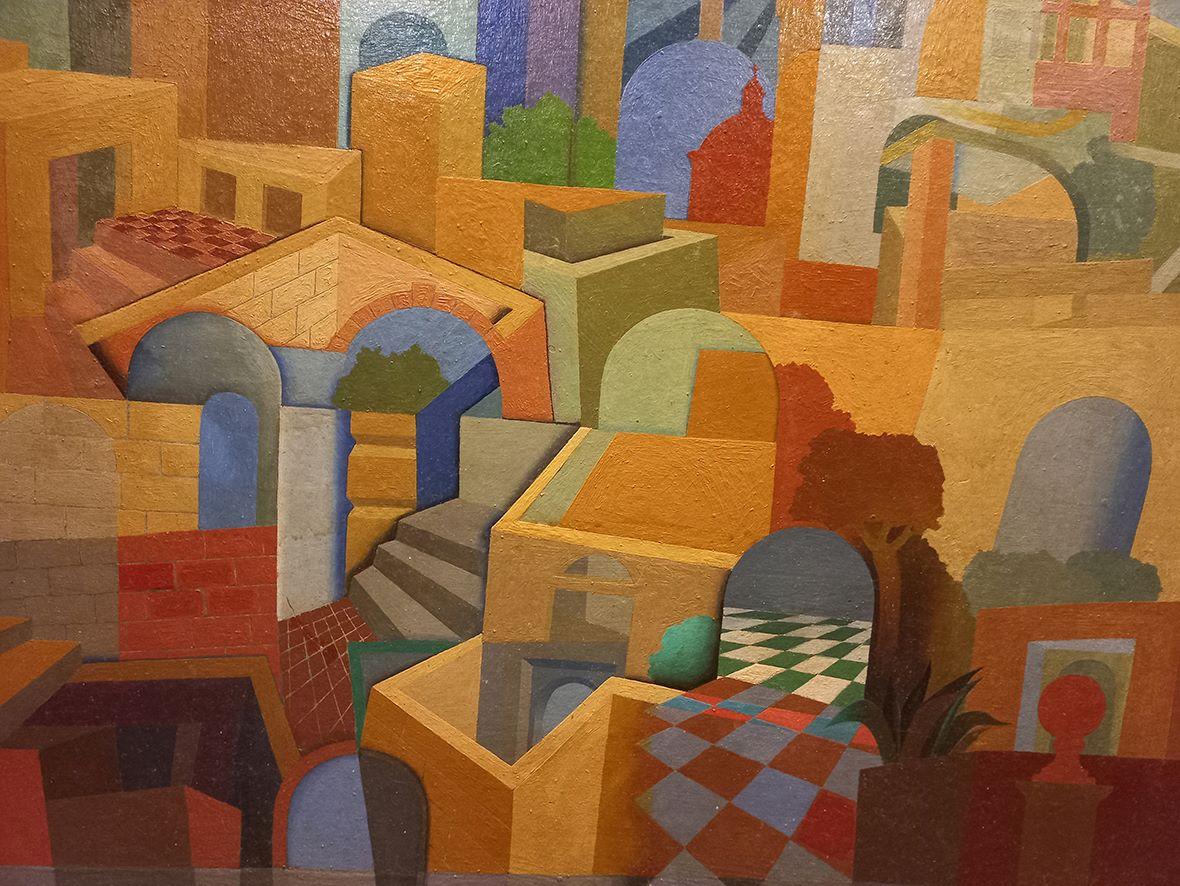 Untitled,1974
The geometry, rhythm and abstraction of these movements became tools in the service of his own vision, rather than philosophies to follow. In this sense, Mallia’s apparent eclecticism reflects not indecision, but a deliberate and functional adaptation of modernist vocabularies, all filtered through the concept of notations.
Indeed, several works in the Landscapes and Cityscapes section could just as easily belong to the final section, Beyond the Visible, since they already verge on abstraction.
While the cityscapes and landscapes filter Malta’s environments through perception, memory and emotion, the abstractions push further: they strip away representation almost entirely to probe form, colour and sensation in their purest states. Here, the philosophy of notations finds its most radical expression.
If notations in the landscapes and cityscapes transcribe lived experience through recognisable fragments of environment, in the abstractions they become a pure language of perception itself. What remains are not depictions of the world but the very act of perceiving it – fleeting impressions, rhythms and energies, all transcribed onto canvas. In this abstract space, Mallia seems to ask: what is to be discovered when notations reach their purest state? His answer is clear and uncompromising: another world beyond.
This final section, devoted to abstraction, may thus be read as the key to the exhibition’s title. As Mallia himself declared: “I always believed that there is another world beyond mere appearances and I was constantly engaged in discovering this.”
In this light, Beyond the Visible does not merely close the exhibition – it reframes it. It reveals that Mallia’s entire artistic journey, from early figurative studies to self-portraits to fragmented cityscapes and memory-laden landscapes, was driven by the same pursuit: the translation of sensation, memory and perception into a visual language capable of revealing a world beyond the immediately visible – a world of pure perception.
Another World Beyond ultimately situates Mallia as an important figure in Maltese modernism – not because he imitated its international movements but because he reinterpreted them through his unique philosophy. This is Mallia’s legacy: a vision of painting as notation. Another World Beyond is thus a rare opportunity to witness art as notation, to step into a visual language that records not what the world looks like but what it feels like to inhabit it.
Another World Beyond: The Art of Joseph L. Mallia is open until November 9 at MUŻA, Valletta and is co-curated by Christian Attard and Sheldon Saliba in collaboration with the Department of Art and Art History at the University of Malta.