AP Valletta project honoured at Architectural Review awards
The Osu Salem Presbyterian School in Accra, Ghana, reimagined
ANN DINGLI and ERICA GIUSTA sit down with Lara Zammit to discuss the winning project.
Renowned architecture firm AP Valletta made waves at this year’s Architectural Review Future Projects Award with its regeneration proposal of a school in Ghana.
The Osu Salem Presbyterian School in Accra, Ghana, designed by AP Valletta and David Kojo Derban, had two massive wins in this year’s Architectural Review Future Project awards, with the project winning the New and Old prize and was one of three projects highly commended overall.
Erica Giusta, project lead at AP, says they saw this project as a new way to think about heritage regeneration – an approach that prioritised the everyday use and meaning of heritage buildings, not just the ‘monumental’ aspect of historic urban fabric.
“We wiped the slate clean, discovering first-hand how buildings evolve in different places,” she explained.
“We feel this approach can influence heritage thinking globally. Locally, it helps us question the way we treat historic buildings, and whether we are guilty of commodifying our own heritage.”
Giusta further explained how their partner on this project, Kojo Derban, who is an architect and a leading authority on Ghanaian architectural history, shares AP’s vision for exploring heritage regenerative possibilities.
“We piloted this project for the Osu Salem school together,” said Giusta.
“The school represents a crucial part of Accra’s built and social history and, as the Architectural Review judge Indy Johar remarked of our win, its reconstitution could become an exemplar for restoring and reusing historic structures across Accra.
 Ann Dingli, Erica Giusta and David Kojo Derban on site.
“This would be our ultimate goal – to have impact that reaches beyond our own work. This award will hopefully attract more attention to our methodology.”
The winning design includes a re-imagining of a Ghanaian 19th-century building to incorporate new uses, initially through a programme of repair of the original two-storey structure.
Notably, the design is a culmination of the multidisciplinary project Valletta Accra: a dialogue between mercantile cities, headed by AP Valletta, Kojo Derban and Ann Dingli.
“AP Valletta approached me in early 2023 and asked if I would be interested in collaborating on a project that would study the heritage systems of two port cities: Valletta and Accra,” said Dingli.
“Erica’s pitch was that the project needed more than designers – it needed its own curation, it needed to be captured, and it needed to be communicated. I thought: finally. This is how architecture should be made.”
Dingli explained how Valletta Accra had been a composite project from the start, saying all involved occupied different roles and understood that truly interrogating the urban composition of places cannot be a mono-disciplinary exercise.
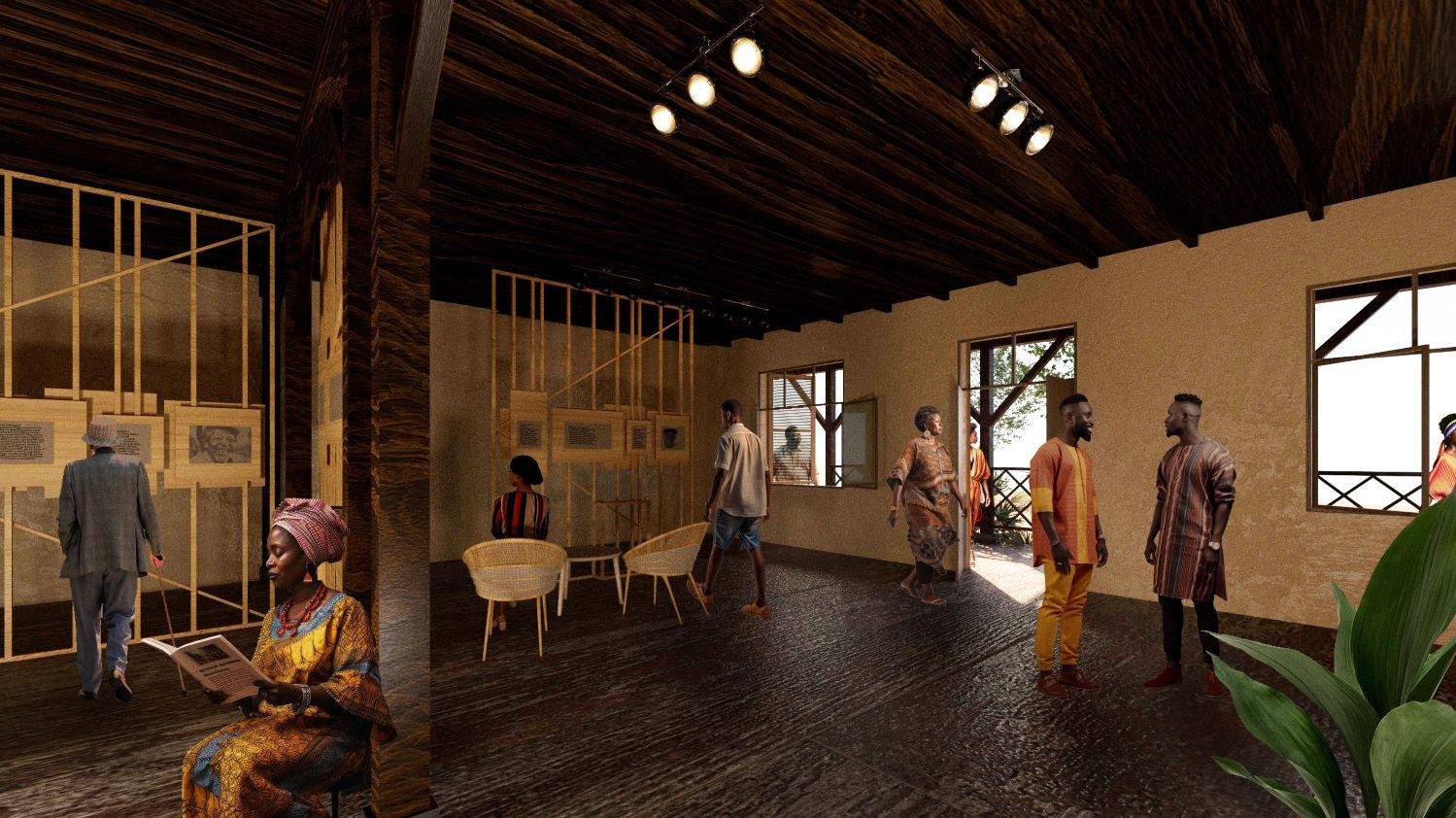 The proposed school interior.
She says the project incorporated many different things that happened concurrently – on-site observation across continents; traditional historical research; ongoing storytelling through social media, ensuring knowledge was disseminated in a way that people cared about and consumed daily; and the more formal capture of findings in a long-form publication.
When speaking about the project’s distinctive methodology in the field of collaborative heritage research and how this evolved as an interdisciplinary exercise, Dingli noted how they based this on a scientific metaphor.
“There’s a scientific term called ‘observation parallax’ which refers to the distortion or shift observed in a single object’s position when viewed from two different perspectives,” she said.
“We used this as a metaphor for our methodology on Valletta Accra, because we were looking at each heritage system from two different viewpoints.
Resisted a closed interpretation of what the building could be
“In so doing, we were able to see the ‘distortions’ occurring in both. What we found was a spectrum of heritage realities – on one end a reality defined by the perils of the neglect, on the other by the side-effects of commodification. This approach is replicable.”
Dingli went on to say their dream is to repeat this methodology in different cities, comparing Valletta in multiple observation parallaxes over time to chase cumulative knowledge on its dynamic heritage story.
The methodology also took on a unique mix of research approaches.
“We built on the 1950s philosophy of ‘psychogeography’, birthed by the French Situationists as meandering pedestrian discovery of how geography affects emotions and behaviour,” said Dingli.
The Situationist Theory asserts that human behaviour results from external circumstance rather than personal traits.
“When you are studying the hegemonic forces of heritage systems – in our cases both cities having been subject to colonial rule – the understanding of how architecture orders human behaviour is crucial,” she continued.
“So, we married psychogeographical exploration with traditional research and then wrangled with our thoughts and comparisons through written and visual essays.”
Giusta said the design for the Osu Salem regeneration extended from these methodological considerations.
“We resisted coming up with a closed, finite interpretation of what the building could be,” she said.
“Instead, we asked a series of ‘what if’ questions, approaching its regeneration with curiosity and openness, aiming at finding new ways to positively contribute to ongoing social and environmental changes, in combination with pragmatic considerations prioritising feasibility.”
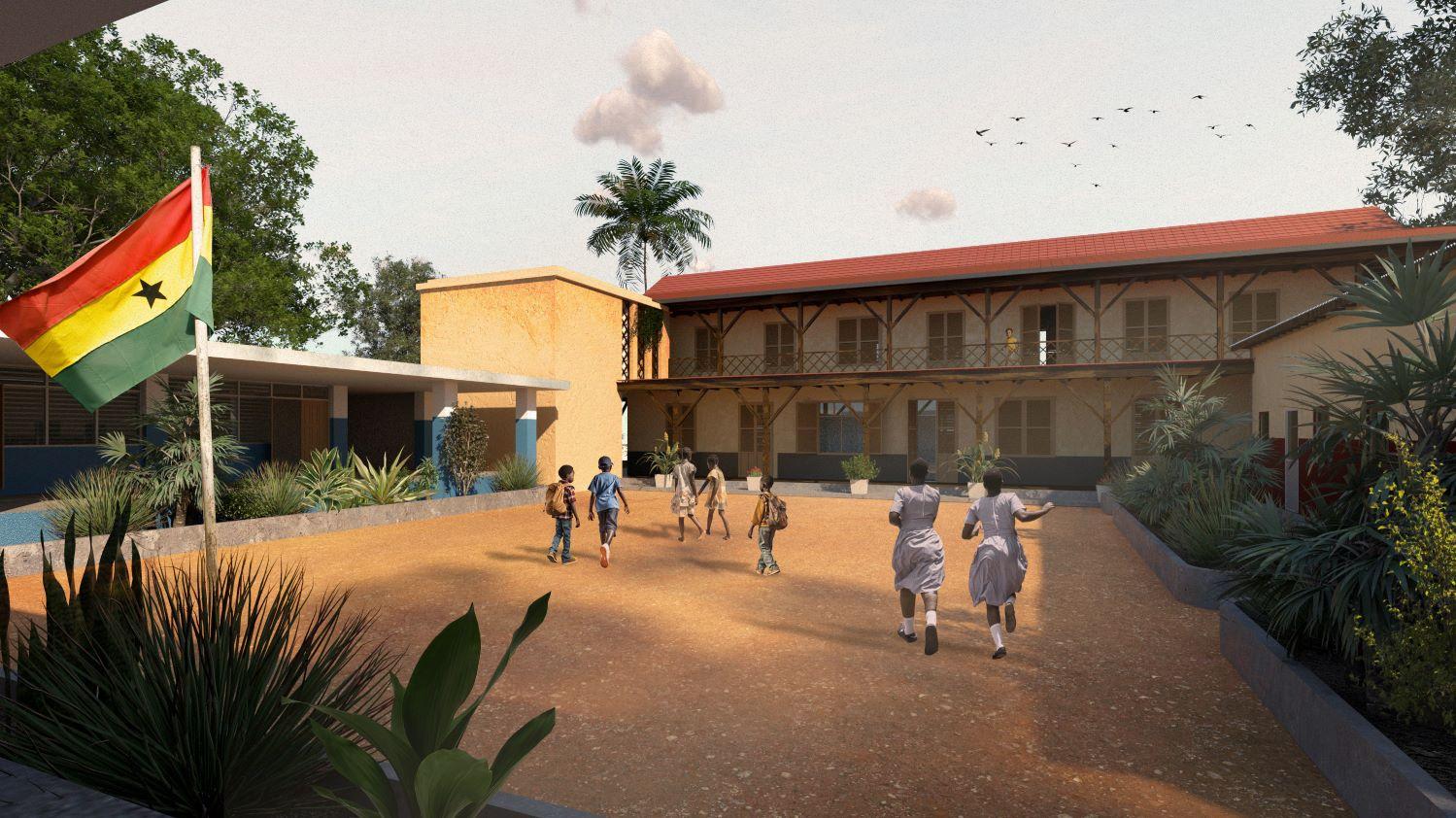 The proposed courtyard at Osu Salem Presbyterian School in Accra.
Giusta explained how they first and foremost wanted to understand what the building needed to be for its community, what it represented for their collective memory and how it should be designed to avoid limiting its future use.
She said that this for them is the true meaning of ‘sustainable heritage’, saying they look forward to discussing it at the awards ceremony in Milan in April.
“Winning this award and being commended as one of the best three projects in all categories is providing an important opportunity for visibility, which will also contribute to raising the support needed to take the implementation of the project further,” she concluded.
The Valletta Accra: A Dialogue Between Mercantile Cities research project was supported by the International Cultural Exchange Fund of the Arts Council Malta and by the High Commission of Malta in Ghana. The resulting publication will soon be distributed online by ACTAR publishers.