Are smokeless tobacco products the key to helping Malta quit cigarettes?
Times of Malta was among a number of media organisations invited to the launch of Omni platform – a repository of research and product data collected by British American Tobacco – in Stockholm last month
As my Greek colleague lit up a cigarette on a street close to our hotel in Stockholm, the atmosphere seemed to subtly change.
While the streets were quiet and the small clouds of tobacco smoke a temporary presence easily avoided, passing pedestrians appeared to convey their disapproval; a furtive glance here, a stiffened walk there...
It could have all been in our imagination but considering Sweden’s smoking rates, one could be forgiven for drawing such conclusions.
Because the Scandinavian nation has made staggering progress reducing smoking rates in recent years; since 2012, Sweden’s smoking rate has halved to just 4.6 per cent among Sweden-born adults and 5.4 per cent overall – almost one-fifth the EU average of 24 per cent, according to Swedish Public Health Agency and European Commission data.
And with some organisations and countries classifying smoke-free societies as those with smoking rates of no more than five per cent, native Swedish society is already there and the country getting close.
So, how has Sweden done it? And can Malta do the same?
Less puff, more pouch
Tobacco giant British American Tobacco (BAT) attributes Sweden’s success to the proliferation of cigarette alternatives, namely vaping products, tobacco-heating devices and nicotine pouches – small parcels of nicotine powder placed under the lip for absorption through the mouth.
According to company promotional materials: “A key to Sweden’s success has been its openness to allow the sale of smokeless alternatives to cigarettes that satisfy adult smokers’ desire for nicotine, and to avoid excessively restricting these products.”
BAT points to nicotine pouches as a significant development, billing them as a less risky product than smoking that has seen easy adoption due to the country’s historic use of snus – a similar product but one instead made of powdered tobacco leaf.
The company suggests that its tobacco-free nicotine pouches are the safest product in its line-up, with “less than one per cent of the toxicants found in tobacco smoke”.
Do I know what will happen in 100 years? No, but I know for a fact that if I’ve reduced the risk in the short term, I’ve definitely reduced the risk in the long term,” she said, while acknowledging cigarette alternatives were “not perfect; the best thing is to quit- BAT Western Europe representative Martina Branconi
In fact, it says that nicotine is “relatively harmless to health” and “not carcinogenic” aside from its addictive qualities, quoting Britain’s National Health Service.
The company may face some pushback from the scientific community, however; studies have linked the chemical to cardiovascular disease and other adverse health effects.
The tobacco giant was keen to extoll the virtues of its smokeless products, in particular nicotine pouches, at the launch of its Omni platform – a repository of research and product data collected by the company – in Stockholm last month.
Times of Malta was among a number of media organisations invited to the launch.
The launch, a slick affair held at Stockholm’s National Museum of Science and Technology – in what could be interpreted as a nod to the futuristic, cigarette-free vision marketed by the company – featured speeches from company executives, including its lead scientist, private sector personalities and policymakers.
‘A bit strong’
BAT’s claims about the popularity of alternatives to traditional cigarettes seemed borne out in visits to high street shops as part of a field trip organised by the company.
Well-stocked shelves of snus and nicotine pouches dwarfed the comparatively meagre offerings of cigarettes and other smoking paraphernalia in the shops visited, while knowledgeable staff provided recommendations on flavours and strengths of products.
Asked by one journalist – a smoker – which nicotine pouch they should choose, the shop assistant directed them away from a choice featuring higher levels of nicotine, advising that even for a smoker “that might be a bit strong”.
Meanwhile, journeying around Stockholm revealed a conspicuous lack of smokers on the street; Times of Malta counted just two people smoking during the two-day visit to the city.
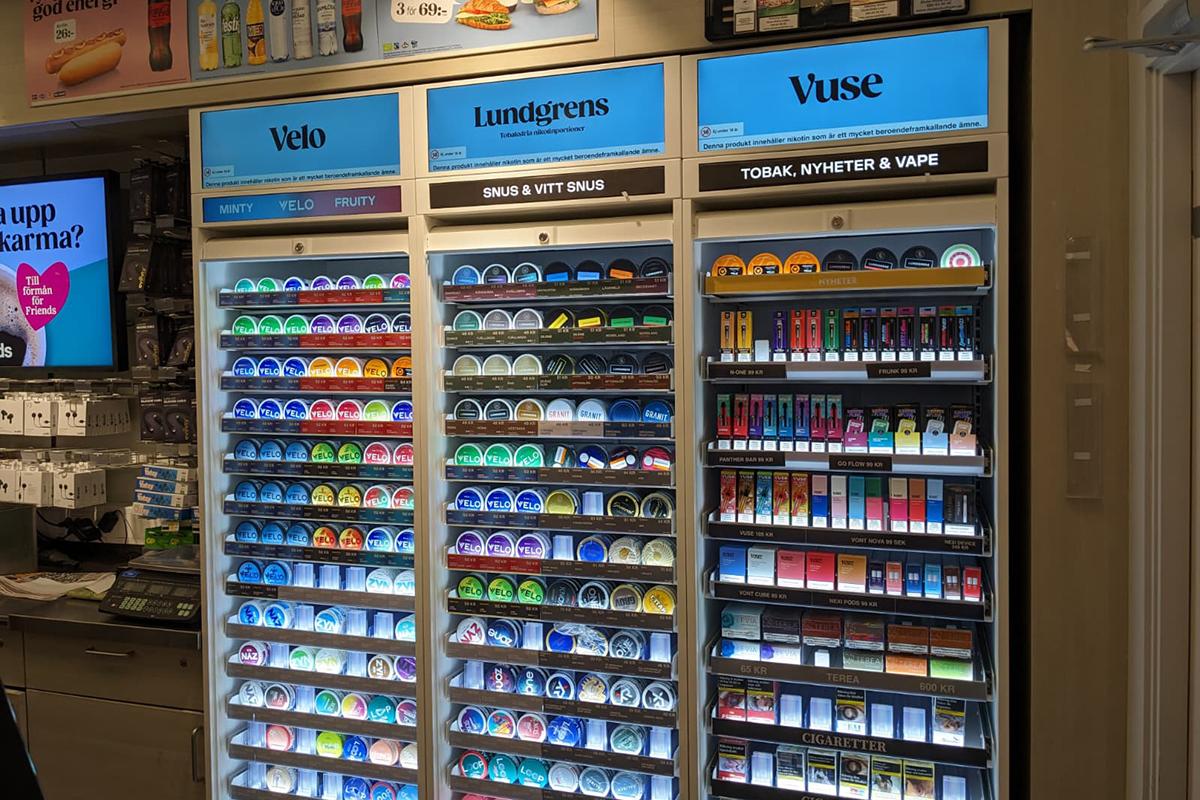 The number of traditional smoking products seemed paltry next to quantities of alternatives in Stockholm shops. Photo: James Cummings
‘Quit-or-die’
BAT Western Europe representative Martina Branconi called steps to reducing smoking “a journey; a lot of politicians are still into the ‘quit or die’ approach, [but] it’s easier to understand when you have real-life examples like in Sweden”.
“It’s less easy to understand it when you’re in another country like Malta or Greece where you still do not have those [smokeless] products getting into the market,” she said.
At the time of publication, snus is illegal in Malta, while nicotine pouches and vaping devices are available. Heated tobacco products may soon be spotted on the streets in Malta, following the government removing a ban on the devices last month.
Oral nicotine products “are normal in [Swedish] culture”, Branconi said. “It’s not normal in Malta or Italy – that’s why we go back to the range of smoking products; not one product fits all.”
Emphasising that Swedish authorities had moved from a “reduced harm to reduced risk” approach, she said the company knew “for a fact the short-term risk of a cigarette and a pouch, or vape, are completely different”.
“Do I know what will happen in 100 years? No, but I know for a fact that if I’ve reduced the risk in the short term, I’ve definitely reduced the risk in the long term,” she said, while acknowledging cigarette alternatives were “not perfect; the best thing is to quit”.
Burning questions
Critics of the tobacco industry argue this does not tell the full story, however, pointing instead to proven anti-smoking measures as driving smoking numbers down.
The Union for International Cancer Control (UICC) accuses the industry of “aggressively promoting this narrative as part of its agenda... to market snus and other smokeless nicotine products as public health tools and capture a new generation of consumers”.
Sweden, the UICC argues, is “experiencing a concerning rise in alternative nicotine product use”, with e-cigarette use doubling, and snus and nicotine pouch use also on the rise among 16- to 29-year-olds.
Tobacco advertising bans, graphic health warnings on cigarette packaging, taxation, age restrictions and smoke-free environments, “not alternative nicotine products, remain the most effective tools for reducing smoking rates and protecting public health”, it argues.
BAT, which covered the costs of the trip, says it supports retail licensing and restrictions, tougher enforcement against illegal products, bans on flavours attractive to underage smokers and “adult-orientated” packaging, among other measures designed to restrict products from underage users.
And while the company argues the industry has seen a culture change in recent years, BAT has faced questions in the past over funding research into a controversial theory arguing some people are more likely to develop lung cancer due to ‘bad genes’, and marketing tactics appearing to target younger audiences.
So, why should people trust BAT?
“It’s not a matter of trusting BAT but trusting the science,” said the company’s head of corporate and regulatory affairs for Greece, Malta, Cyprus and Israel, Katerina Sipitanou.
“The goal is to help people who are tobacco users to move to less harmful alternatives”.