Armenian bank sees HSBC Malta takeover as gateway to Europe
Ardshinbank wants to revive Mid-Med brand, denies conflict of executive advising on deal
Armenian bank Ardshinbank plans to revive the Mid-Med Bank brand and use Malta as a “hub” to expand in Europe, if its bid for HSBC Bank Malta succeeds, the bank’s deputy chair David Sargsyan said.
Sargsyan, a former Armenian finance minister, was speaking to Times of Malta in an interview in which he confirmed that the bank had submitted an offer to take over HSBC Malta.
Aside from discussing the bank’s plans, Sargsyan rebutted suggestions that the bank’s owner, billionaire Karen Safaryan, currently has Russian business interests, describing the bank’s interest in Malta as part of Armenia’s plans to shift towards the West.
He also denied that the bank’s use of HSBC’s former head of acquisitions as an advisor on the deal constituted a conflict of interest.
A ‘geopolitical shift’
Sargsyan describes Ardshinbank (an Armenian term that translates to “industrial construction bank”) as a “blue chip company” for Armenia, operating as a “classical commercial bank with corporate, retail and investment” elements.
He says the bank’s potential move to Malta reflects Armenia’s broader efforts to cut long-standing ties with Russia in favour of looking westwards.
Despite the historical links between the two countries, diplomatic and commercial relations between Armenia and Russia have become strained in recent years, particularly following Russia’s full-scale invasion of Ukraine in 2022 and Azerbaijan’s blockade of Nagorno-Karbakh the following year.
Sargsyan describes this as Armenia’s “geopolitical shift, departing from Russia and moving towards the West”.
We are long-term investors, which means we are not going to buy and just hold passively- Ardshinbank deputy chair David Sargsyan
After 2022, Ardshinbank, too, found itself “in a situation where we have to conduct the business according to global rules, especially for financial institutions,” he says, describing how the bank has since upped its anti-money laundering and financial crime work.
The natural next step “was for us to put our building block into the country’s overall vision for the future and start looking towards markets in which we can operate”.
“We started to look into the EU two years ago, looking at different jurisdictions inside the EU. And then we stopped on Malta in late 2023.”
Why Malta?
Sargsyan says it is down to a mixture of factors, foremost among them being the ease of doing business, with Malta’s open economy being “much less bureaucratic than other EU countries”.
But there were several other reasons why Malta was particularly attractive, he says, including “very high standards of transparency and governance, the regulator is very up-to-date and modern, and all the rules of the game are transparent and understandable”.
 Will Armenian bank Ardshinbank take over HSBC Malta?
Ardshinbank’s potential arrival to Malta would not mark the first intersection between the Maltese and Armenian banking worlds, with there being several overlaps between HSBC’s operations in the two countries in recent years.
At the time of its sale in 2024, HSBC Armenia’s board of directors was chaired by former HSBC Malta CEO Andrew Beane, with Irina Seylanyan, a one-time HSBC Malta head of global markets as its CEO.
Three other opportunities in Malta
HSBC Malta was not the first local opportunity to catch Ardshinbank’s eye. There were three particular cases in which the bank was “looking very closely at other possible opportunities,” Sargsyan says.
But when HSBC announced its plans to sell its Maltese operation in September 2024, Ardshinbank “jumped into the process from the very beginning”.
Sargsyan strikes a hopeful tone when speaking of the bank’s chances of winning the race, banking on Ardshinbank’s recent takeover of HSBC in Armenia.
For a start, “we understand their priorities and what is important for them as a seller,” he says. Moreover, he adds, the changeover from HSBC Armenia to Ardshinbank went remarkably smoothly.
“If we didn’t break any record of migration and integration, we are very close. We did the full transition in nine months,” he says.
Sargsyan reels off several other attributes that, he says, makes Ardshinbank well placed for success.
Being a systemically important bank in Armenia, the bank “usually knows what the regulator should expect,” he says. And, just as importantly, the bank has the cash to see a deal through, Sargsyan says, describing its liquidity as “quite enough to deliver a transaction of this magnitude”.
All this means that “we at least have pluses in front of our name, so we are quite confident,” Sargsyan says.
The bank’s local workforce will also grow, with the bank needing new blood to cover functions that HSBC Malta currently outsources to its international partners- Ardshinbank deputy chair David Sargsyan
Mid-Med Bank name to return
He insists that Ardshinbank will be in it for the long run, promising to “remove the straitjacket from HSBC Malta”, and describing the top players in Malta’s banking sector as “not as active as they organically could be”.
“We are long-term investors, which means we are not going to buy and just hold passively,” he says. “We are not the persons who are going to buy and then sell it in five or seven or even 10 years.”
Sargsyan makes a pitch for Maltese national pride, saying he wants to “revive the pure Maltese nature of the operation”. Top of the list in this respect, he says, is adopting the Mid-Med Bank name, a move already promised by previous bidders RS2.
Eventually, Ardshinbank wants to use Malta as a stepping stone to further expand its operations in Europe. Its takeover of HSBC Malta would mark the bank’s first step outside of Armenia.
“In the medium term, three to five years maybe, we want to start going inside the EU, using the Maltese operation as a hub,” Sargsyan explains.
Meanwhile, Ardshinbank says it would strengthen the local operations, saying the bank “definitely needs further investment in branches”, and would receive a boost in its digital banking operations (“digital banking in Europe is very far from being modern,” he says).
The bank’s local workforce will also grow, he promises, with the bank needing new blood to cover functions that HSBC Malta currently outsources to its international partners.
“We are not a global institution that has everything in place, so we need people ourselves,” Sargsyan says. “We have to build up everything onshore in Malta”.
Meanwhile, HSBC Malta’s shareholders can rest assured that Ardshinbank has no intention of delisting the bank, Sargsyan says.
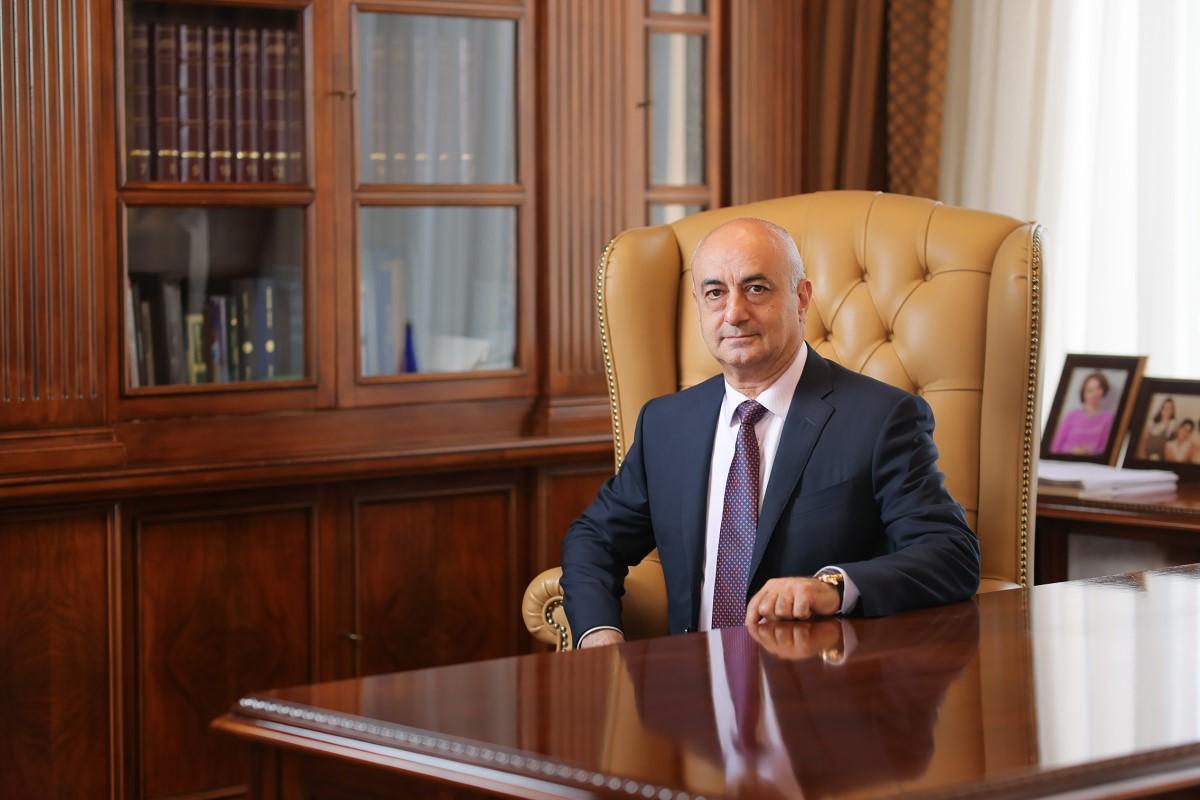 Karen Safaryan, a billionaire with past business links to Russia, owns 98% of the bank’s shares. Photo: Ardshinbank
Russian links
News of Ardshinbank’s bid was met with concern by local banking insiders, particularly over the deep-rooted Russian business connections held by the bank’s owner, billionaire Karen Safaryan.
However, Sargsyan is quick to rebut claims that the bank’s owner, Karen Safaryan, still maintains business links in Russia.
He admits that Safaryan was “very active” in Russia throughout the late 1990s and early 2000s but insists that he gradually started shedding his Russian businesses in 2007.
“By 2019, he had almost nothing there,” Sargsyan says. “His net worth is well over €1 billion, but all his assets in Russia by the time of the war in 2022 totalled to just around €10 million”.
He continued divesting his Russian assets after the war, Sargsyan said.
“Currently the only two assets he has in Russia are his apartment in Moscow and his apartment in Nizhny Novgorod.”
Besides, Ardshinbank itself never operated in Russia, he insists, while “there was never any integration or link” between Safaryan’s businesses in Russia and those in Armenia.
Nevertheless, Ardshinbank’s 2016 acquisition of Gazprombank’s Armenian branch, at a time when the Russian bank was already under an initial set of EU sanctions, has raised eyebrows.
But Sargsyan insists he doesn’t understand the concern, saying the issue was never raised during due diligence and background checks the bank undertook when teaming up with international and US partners.
He also argues that the bank should not be penalised for a transaction in 2016 when, “until recently, all the world, including European countries, was paying for gas” from Russia.
He also dismisses the “false speculation” that the bank’s balance sheet hints at any potentially dubious Russian transactions. A KPMG report into the Armenian banking sector in 2024 shows that while Ardshinbank ranks as the country’s top bank across most metrics, including profitability, its loan portfolio is relatively low.
This is “purely a balance sheet management issue,” Sargsyan says, pointing to how it is growing its loan portfolio in recent months.
The only two assets Karen Safaryan has in Russia are his apartment in Moscow and his apartment in Nizhny Novgorod- Ardshinbank deputy chair David Sargsyan
Former HSBC head of acquisitions as advisor
Sargsyan says Ardshinbank has employed “well-known, very experienced legal and regulatory advisors” to work on its bid.
Is there any truth to the rumours that the bank has engaged Maged Latif, HSBC’s former head of mergers and acquisitions, and now owner of leading London-based investment banking firm Latif & Company, on the deal?
“Yes,” Sargsyan says, after a brief pause.
But he is quick to deny the suggestion that this could constitute a conflict of interest or hint at an incestuous relationship between the two banks.
“It’s total speculation, there is nothing about this for sure. As far as I know that company advises on a number of transactions, not only with HSBC but with many other vendors who don’t have anything in common with HSBC,” he says.
If there were a conflict of interest, he says, “it would be stopped on day one” by HSBC’s own internal rules and policies, as well as by regulators.
“Latif & Company is a regulated institution in the UK, as is HSBC. Even if there is any potential conflict there, I’m more than sure that all the institutions would definitely stop this, but there is absolutely nothing there”.
Armenian press reports suggest that Ardshinbank worked with Latif & Company on other deals in the recent past, including the acquisition of HSBC Armenia. Maged Latif himself was in charge of HSBC’s mergers and acquisitions until 2019, when he left to open the company.
Ultimately, Sargsyan says, Ardshinbank is treating this as a “very important transaction”. While larger banks might view a bank in Malta as “just one of its operations,” things will be different for the Armenian bank.
“We will dedicate much more effort and time towards this than others,” Sargsyan promises. “We will do everything within our resources to make it a success”.