Artwork showing blank party walls wins top prize at Malta Biennale
Artist says architectural legacy of Ġgantija is being replaced with blank white walls
A photographer has won the top prize at the Malta Biennale with a piece depicting blank party walls, one of Malta's most controversial architectural realities.
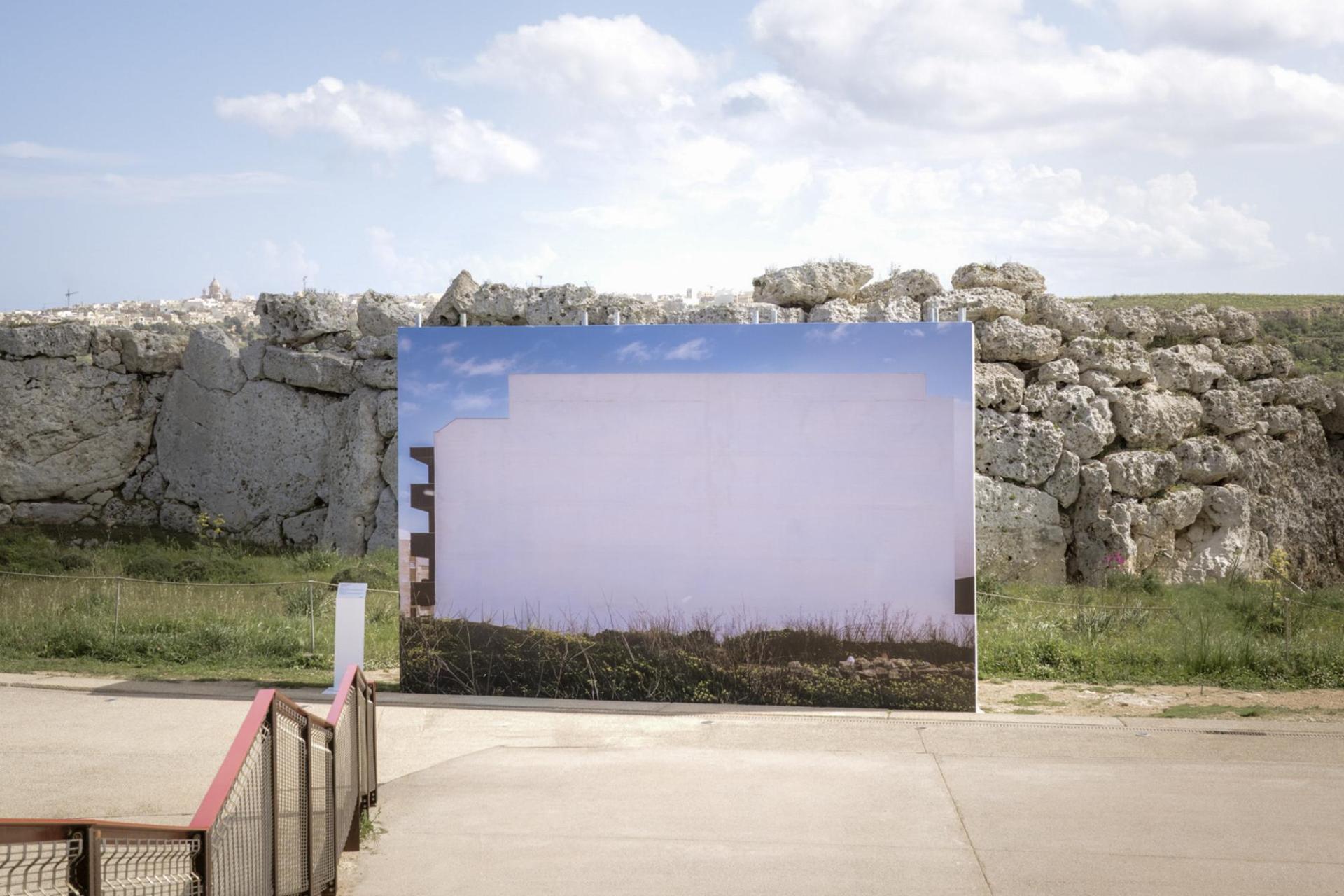
Therese Debono's piece positioned a photograph of a massive, white, windowless wall standing next to Gozo's important prehistoric Ġgantija temple complex.
She jointly won the Best Artwork Award with her piece, entitled, simply Blank.
“Ġgantija is one of the oldest sites we have, yet we are replacing that legacy with blank white walls," she said. "The legacy we are leaving is not the same as that of our ancestors.”
The award was presented during last Friday’s Malta Biennale ceremony. Italian artist Concetta Modica also received the prize for her work, Fragments of the sky of Malta: The journey of a tomato sepal to become a star.
But Debono’s winning image placed the focus squarely on the contrast between Malta’s ancient past and the built environment now rising around it.
The idea for the project first emerged during the pandemic. Debono said that while training on the roof of her home in Żebbuġ, she realised that a newly built wall had blocked her view of the village church.
“As a proud, Żebbuġija, that link felt so disruptive and violent, it was as if they had taken it away from me. It felt personal. Then these blank walls started cropping up everywhere”.
 Therese Debono was inspired by a blank party wall that blocked her view of a church. Photo: Elena Schiatti
She said the experience prompted her to start documenting similar blank walls appearing across the islands.
Debono described these structures as, “tombstones, silent and waiting.”
Controversial development
She said said she chose Ġgantija as the location for her Biennale piece for several reasons. The temples, located in Xagħra, date back around 5,600 years and hold a central place in Malta’s heritage and cultural identity.
However, the site has also recently been at the centre of a planning controversy involving a proposed three-storey development located about 157 metres from the Ġgantija Temples.
The 22-apartment development was originally approved in 2023 despite there being no heritage impact assessment on how the project would affect the UNESCO World Heritage status of the site.
The permit was later revoked after it emerged that the site falls within UNESCO’s 2015 buffer zone for Ġgantija. However, the dispute remains ongoing and is expected to return to the Planning Authority in the coming weeks.
She noted that, “It is not just a matter of development; it is also about whether we are thinking about what we are doing.”
She questioned whether people are truly aware of buffer zones, whether they respect them and whether they genuinely value them.
Debono said she does not blame the owner of the site for wanting to make money. However, she noted that reflecting on the significance of the land could change how people think about its use and the legacy they leave behind.
“Think about its link to that temple. You should feel proud to have a sacred piece of land.”
She added: “I understand development and money, but there has to come a point where we stop, reflect, and reclaim our heritage”.
Taking heritage for granted
Debono also expressed concern that many people appear reluctant to take ownership of Malta’s heritage, in part possibly because of how abundant it is.
“We are so full of heritage and so rich in it that perhaps we take it for granted, like sunny days in Malta. We don’t appreciate it because it is always there, “she said.
"But how long can we continue like this? When a block of apartments is being built 150 metres away from a heritage site.”
From nothing and nowhere she said blank party walls violently sever the traditional landmarks that define Maltese culture, such as churches, which kept communities connected to one another and to their heritage.
“Their silence and magnitude take away so much, and that it feels violent. They remove the core of where and who we are.” said Debono who noted that blank walls create structures with no character, no culture and no spirit.
Winning the award was a positive yet humbling experience for Debono, she said.
The other winner of the award was talian artist Concetta Modica for her work Fragments of the sky of Malta: The journey of a tomato sepal to become a star.
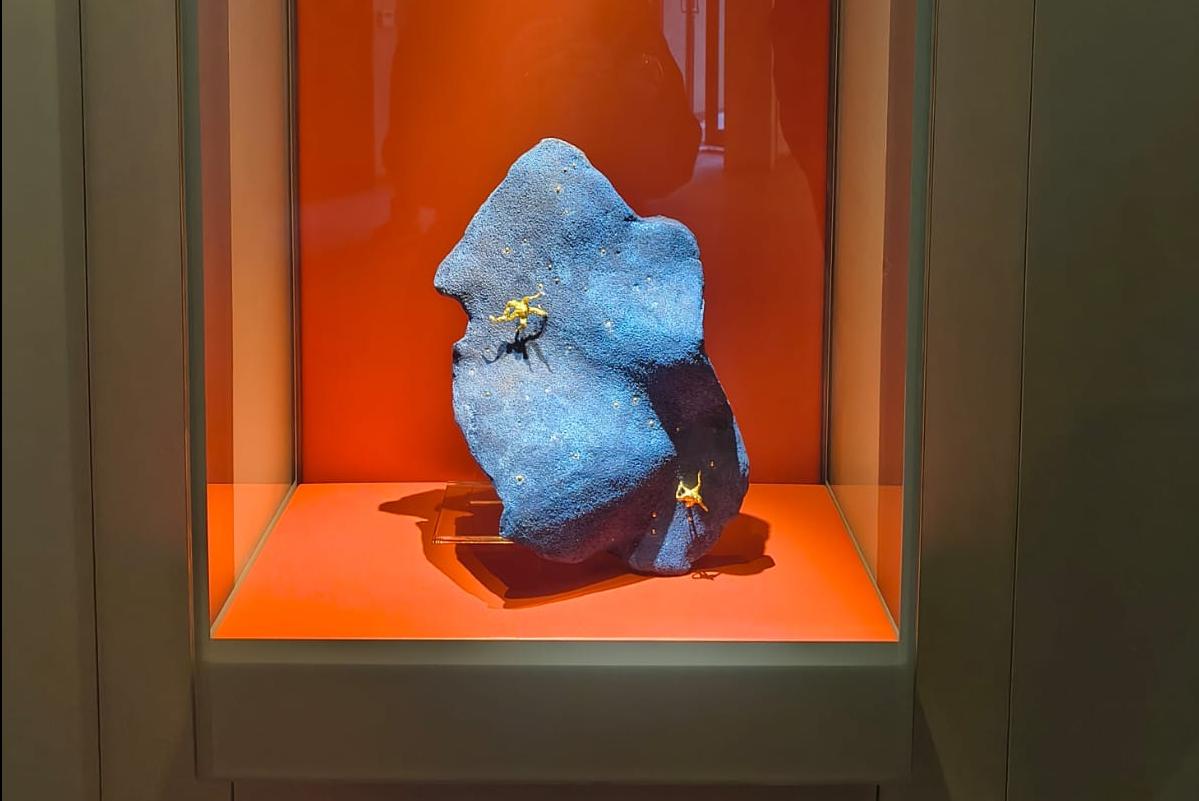 One of the sculptural pieces at Ġgantija Photo: Concetta Modica
Her work, which also engages with the Gozitan temple complex, has been in development for several years. She said she was invited by Malta Biennale artistic director Rosa Martinez to present works.
“These are journeys through specific nights in history, nights when small things changed the course of events,” said Modica.
One example explored in her work relates to how, on a winter night around 3400 BC, at dawn, the rising sun would have shone through the temples’ entrances to illuminate their inner chambers, possibly in connection with rituals carried out by their builders.
Her project focuses on a series of Maltese nights, moments when small events shifted the island’s history, even if only slightly.
These include events such as the illumination of the temples and the night Caravaggio completed The Beheading of Saint John the Baptist for the Oratory of St John’s Co-Cathedral in August 1608.
Part of the project involves the creation of a sculptural “piece of sky”, which was distributed in display cases at historic museums connected to Malta’s history and archaeology.
On March 13, Modica also presented a Tomato Sepal Liturgy, described as a collective prayer, at Ġgantija Archaeological Park in Xagħra.
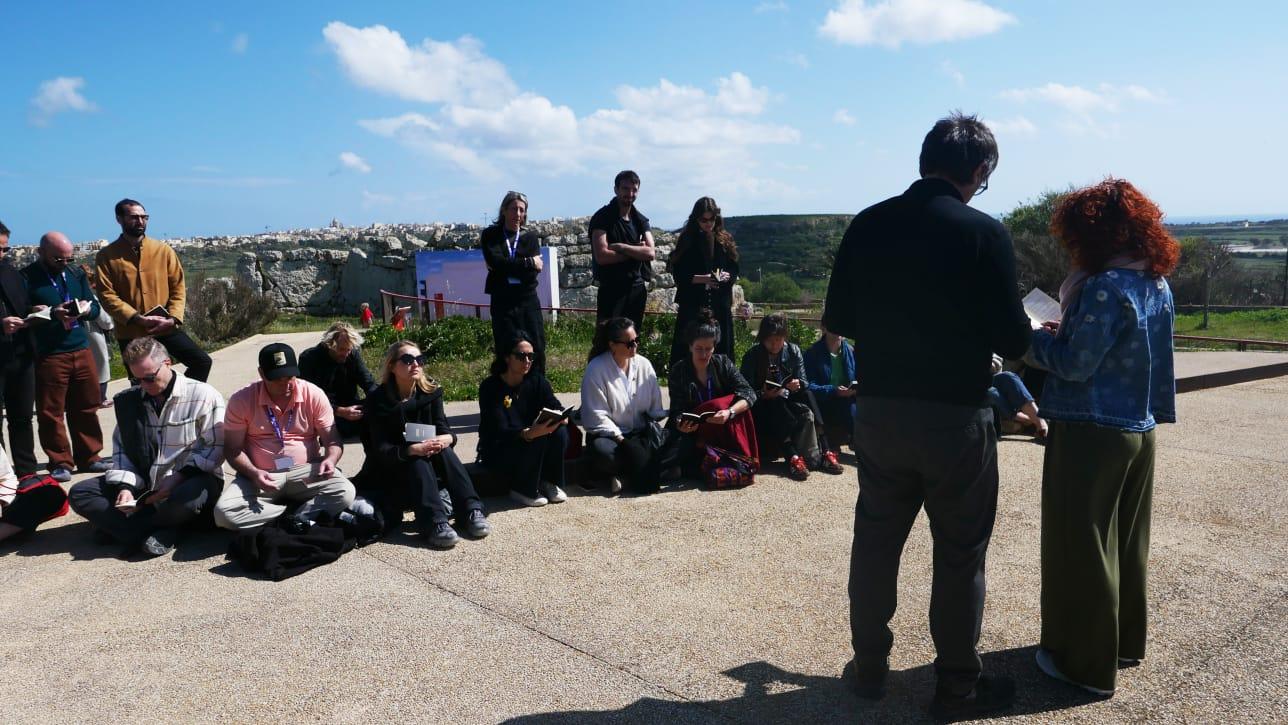 Modica’s prayer in action in front of Debono’s work. Photo: Concetta Modica
She said Ġgantija was selected because of its sacredness and explained that the prayer belongs to no religion. “It is a secular prayer that involves men, women, animals, plants, compost, and nature.”
She described the moment as deeply emotional.
“It was a very moving moment for me. It felt deeply shared and heartfelt by everyone.” Especially because people rarely get that spiritually connected experience out of the churches.
“The place and the atmosphere helped us a lot. It was a wonderful debut, and there will be new opportunities to repeat it,” she said.
She said she was able to do the prayer with the assistance of the Maltese poet and PhD candidate Elena Cardona who read and prayed in Maltese as well as with the help of Carlo Catacchio.