Back to the moon: new mission sets sights on long-term human presence
It would be a shame if exploration becomes ownership, experts say
More than 50 years after humans last set foot on the moon, a new wave of missions is aiming not only to revisit it, but to lay the groundwork for humanity’s future beyond Earth.
The last time humans walked on the moon was in December 1972 during NASA’s Apollo 17 mission. Now, attention has turned to NASA’s Artemis programme. Artemis 2, which lifted off on April 1, is a key step in that effort. The mission will see four astronauts fly around the moon and return to Earth without landing, testing systems needed to safely send and bring back crews from deep space.
Times of Malta spoke to astrophysicist and professor Joseph Caruana and surgeon Gordon Caruana Dingli, a space travel enthusiast and author of We Went to the Moon, about what this renewed push into lunar exploration could mean for us on Earth.
“You could say that Apollo was about proving that we could reach the moon and land on it; now we want to learn how to live and work on another world in space,” Caruana said.
“The ultimate goal is to build a sustainable presence on the moon.”
A baby step… to Mars
He said Artemis is about developing the infrastructure needed for longer stays and future missions deeper into space.
“It is about redeveloping expertise and building new capabilities to stay there longer, and then potentially reaching beyond, like Mars,” he said.
Caruana noted that in the distant future, not in the next few decades or even centuries, “we know that conditions on Earth will inevitably turn sour”.
Even if humanity avoids destroying itself, natural processes such as the sun gradually becoming hotter mean that there is a time-limit for life on Earth.
“So perhaps this can be seen as a baby step towards obtaining an insurance policy, namely learning how to inhabit other places.”
He stressed that exploration should not come at the expense of caring for Earth, and more should be done to protect and care for the planet.
“We still have many challenges here, but it is a good idea to explore. Taking care of our planet and exploring what lies beyond are not mutually exclusive endeavours,” Caruana said.
Caruana Dingli agreed that curiosity and exploration are central to humanity’s nature but said there are also practical drivers behind renewed lunar ambitions.
“As mankind we are ultimately curious and explorers by nature,” he said.
However, there are also more economic reasons to explore the moon.
“We will probably, and unfortunately, exploit the moon,” he added.
He pointed to helium-3, a compound found on the moon that could potentially be used to generate energy.
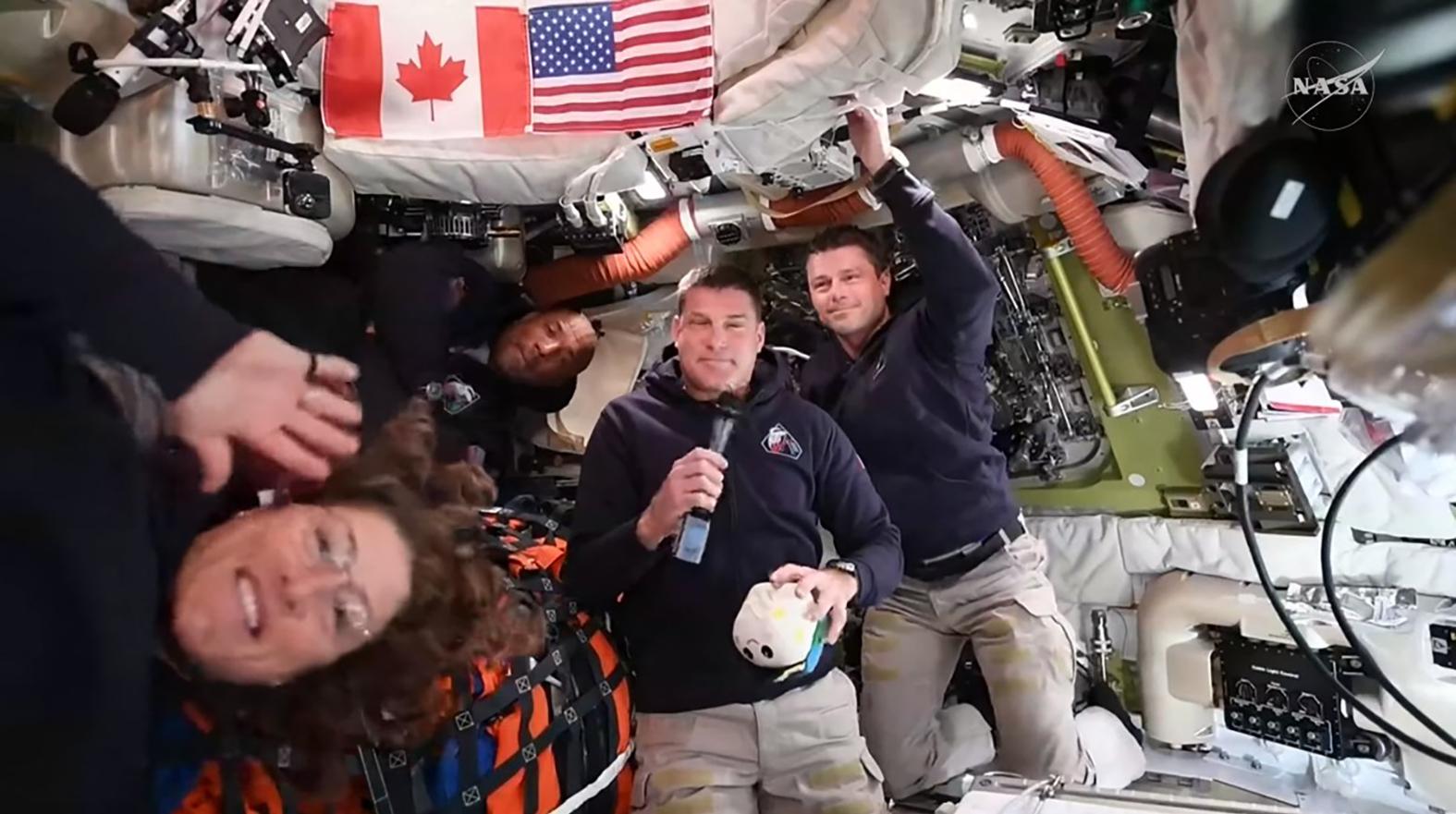 Astronauts Christina Koch, Victor Glover, Jeremy Hansen and Reid Wiseman in the Orion spacecraft, as part of the Artemis II mission. PHOTO: NASA/AFP
“When you explore, you find things you didn’t know about, there might be valuable things on the moon.”
Both highlighted how space exploration has led to technological advances that benefit everyday life, including developments in computing, camera technology and medicine.
However, significant challenges remain before a long-term human presence on the moon becomes viable.
Re-entry
The Artemis II mission is expected to last 10 days. Caruana Dingli pointed to the difficulty of safely returning astronauts to Earth, describing re-entry as one of the most critical phases.
“It is the bit that worries me the most. They will need to bounce up a bit, come down and bounce a bit more. It’s like it’s dancing down the atmosphere.”
While Caruana highlighted the dangers posed by space radiation, which can damage DNA, cause cancer and harm vital organs, on Earth, humans are protected by the atmosphere and magnetic field.
“Finding solutions for effective shielding is a major challenge,” he said.
Caruana said one of the most ambitious challenges is sustaining global collaboration over time.
“A key question is whether we will truly commit to sustaining collaboration on a large scale over the long term. It would be a shame, for example, if exploration becomes about ownership. Astronauts are envoys for humanity, not representatives of nationalistic endeavours.”
Caruana Dingli noted that US President John F. Kennedy had called for cooperation in space at the United Nations in the 1960s, though this was rejected by Soviet leader Nikita Khrushchev, probably because the USSR wasn’t as advanced as they were projecting.
Today’s renewed push into space is often framed as a rivalry between the US and China, echoing the Cold War-era competition with the Soviet Union. NASA is working on an accelerated plan to land Americans on the moon by early 2028, while China has said it is confident it can achieve the same by 2030, raising concerns about a new space race.
“We need to be careful to avoid a space war,” Caruana Dingli said.
Better legal frameworks needed
He urged policymakers to revisit the work of Maltese diplomat Arvid Pardo, whose 1967 UN speech helped shape international law on the use of the seabed as a shared resource for humanity. That speech led to the UN Convention on the Law of the Sea, adopted in 1982. Space law has drawn on these principles but still lags behind technological developments.
“Overall, we need much better, binding legal frameworks to manage space activity; in that respect, we are playing catch-up," Caruana said.
Costs for the missions also remain an important consideration. According to The Independent, the US has spent about $4 billion as part of a broader return-to-moon programme estimated at $93 billion.
However, both Caruana and Caruana Dingli argued that such figures should be viewed in context, pointing to the scale of the US’s military and defence spending.
By the sixth day of the conflict with Iran, the US had already spent around $12.7 billion, according to the think tank The Center for Strategic and International Studies.