Beyond yes and no: the strange principle of quantum logic
It has been very influential beyond the microscopic physical world
Logic is the skeleton of reasoning. For centuries, classical logic has been applied to describe all the observed physical phenomena.
In classical logic, statements are either true or false and the distributive law holds.
But in the early days of quantum mechanics, physicists noticed that this framework struggled to capture the strange behaviours of the microscopic world.
In the quantum world, particles appear to exist in a superposition of several states at once. For instance, an electron passing through a double slit is not simply “here” or “there” until it is observed. Even propositions such as “the electron has spin up” cannot be assigned simple truth values independently of measurement.
Heisenberg’s uncertainty principle reveals that we can’t know simultaneously the position and momentum of a particle with unlimited accuracy.
This strange behaviour led Garrett Birkhoff and John von Neumann, in the 1930s, to propose something new: quantum logic.
Quantum logic tackles this by swapping set theory for geometry. Propositions become subspaces of a Hilbert space: “AND” means intersecting subspaces, “OR” means taking their span, and “NOT” means looking at orthogonal directions.
In the quantum world, particles appear to exist in a superposition of several states at once
Unlike classical logic, the distributive law doesn’t always hold; indeed, the set of quantum events forms not a Boolean lattice but an orthomodular lattice. This makes it possible to explain strange phenomena, such as why a particle’s position and momentum cannot always be combined so simply.
But does quantum logic overthrow classical logic? Not quite. Although it models the structure of quantum measurements and observables correctly, quantum logic cannot replace classical logic in mathematics or philosophy because it’s more a contextual tool rather than a universal framework.
Still, quantum logic has been very influential beyond the microscopic physical world. It inspired new approaches in computer science, artificial intelligence and information theory. In quantum computing, echoes of quantum logic appear in the way algorithms manipulate states and probabilities.
Much like non-Euclidean geometry, which expanded mathematics without destroying Euclidean geometry, quantum logic stretches our imagination. It shows that even the “rules of thought” are not carved in stone. They, too, evolve as we push deeper into nature’s mysteries.
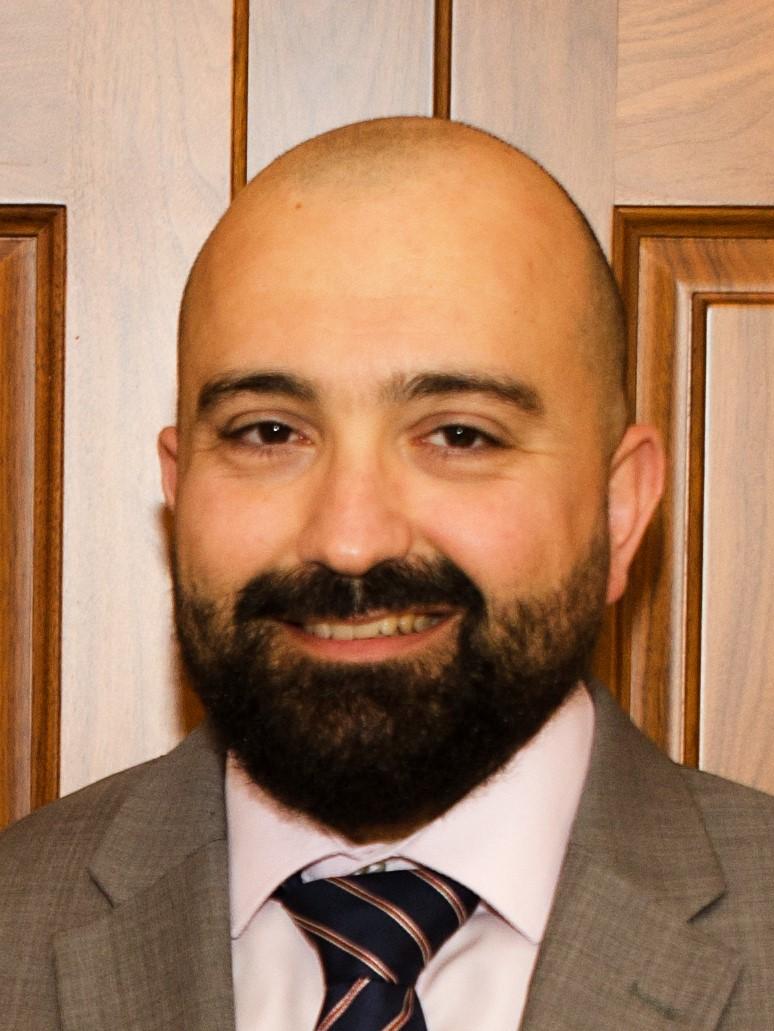
Emanuel Chetcuti is professor of mathematics at the University of Malta. In 2006, he received the Birkhoff-von Neumann Prize, awarded by the International Quantum Structure Association, for his work in quantum structures. In 2024, he was elected to the council of the same association.
Photo of the week
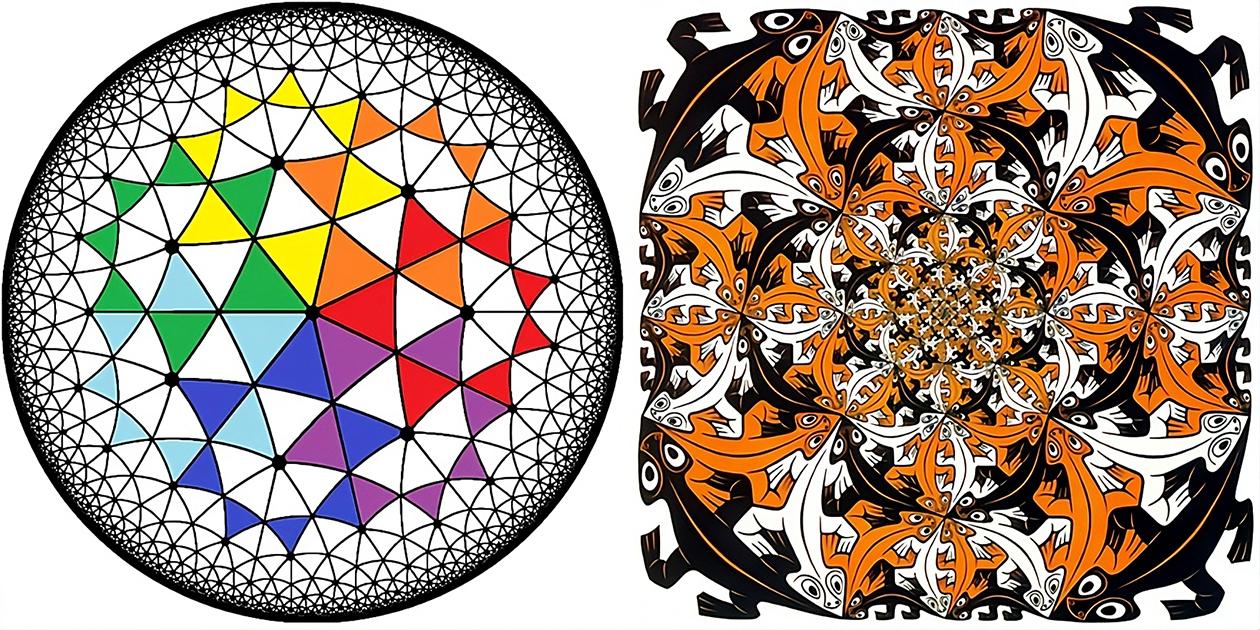 .
.The figure shows a colourful hyperbolic tessellation, inspired by the artwork of Maurits Cornelis Escher (1898- 1972). M. C. Esher was a Dutch graphic artist known for his mathematically inspired artworks that explore infinity, symmetry and impossible perspectives. Escher’s work challenges perception and illustrates the beauty of mathematical structure in visual form.
DID YOU KNOW?
Mathematics isn’t just about calculating. From ancient temples to digital art, mathematics has been the hidden brushstroke behind beauty. Here are some examples:
• The golden ratio (roughly 1.618) is a proportion that artists and architects have used for centuries to create harmony and balance in their compositions. It is thought to be naturally pleasing to the eye. Leonardo da Vinci used it in the Vitruvian Man. Many famous buildings, logos, paintings and artworks also follow this ratio.
• Before the Renaissance, most art looked flat. Then artists discovered linear perspective, using geometry and vanishing points to make paintings look three-dimensional. Raphael’s School of Athens uses perspective lines to create a sense of space.
• Symmetry is central to many art forms. Tessellations cover surfaces with repeating shapes, often creating mesmerising, infinite patterns, such as in Islamic tilework. M. C. Escher turned mathematics into art by exploring infinity, symmetry and topology. He applies mathematics to create illusions of impossible staircases, endless waterfalls and twisting worlds.
• Music is deeply mathematical; harmonies come from simple frequency ratios and rhythm is based on dividing time into precise fractions. Without mathematics, music theory wouldn’t exist. An octave (do-re-mi) is exactly a 2:1 ratio of frequencies.
• Generative art uses mathematics and algorithms as a creative tool. Artists design rules, formulae and randomness. Then computers follow them to produce unique patterns, shapes and textures, creating anything from fractals and spirals to digital landscapes.
For more trivia, see: www.um.edu.mt/think. For more science news, listen to Radio Mocha on www.fb.com/RadioMochaMalta/.