Bjorn Formosa: ‘I’d be happy to live to 100 if I can still work and dream’
Telethon in aid of ALS Foundation Malta will air live on all TV stations on Sunday
Ten years ago, Bjorn Formosa was diagnosed with ALS and told he had two years to live. Ten years later, he has done the impossible.
In an e-mail sent to then Times of Malta head of media Herman Grech 10 years ago, Bjorn Formosa was brutally clear about his future.
“My name is Bjorn Formosa, I am 28 years old and in the past weeks I have been diagnosed with ALS. I’m not naive, I know that no cure will be found for my case, I have max 2 years left on this planet,” he wrote, just weeks after being diagnosed with ALS.
He wanted to get his story out on Times of Malta to raise awareness, funds and possibly find a cure.
Ten years later, a cure still has not been found and Bjorn is suffering more than ever, but he survived those two years and another eight over and above them – long enough to see his incredible dream raise millions, become a foundation and build two state-of-the-art homes for ALS patients.
Today, as the country rallies for Dar Bjorn’s annual telethon, Bjorn lives on to reflect on a decade of extraordinary work and a life he once believed was all but over.
“If I can still work and dream, I’d be happy to live even up to a hundred. Life is too beautiful, despite the hardship,” he told Times of Malta.
“As long as I can take it, I’d live, even with this suffering.”
Bjorn is almost completely paralysed nowadays and communicates mostly through a computer that reads his eye movements. But for this interview he removed the computer and made an immense effort to utter each word himself, to his wife Maria, who joined the interview.
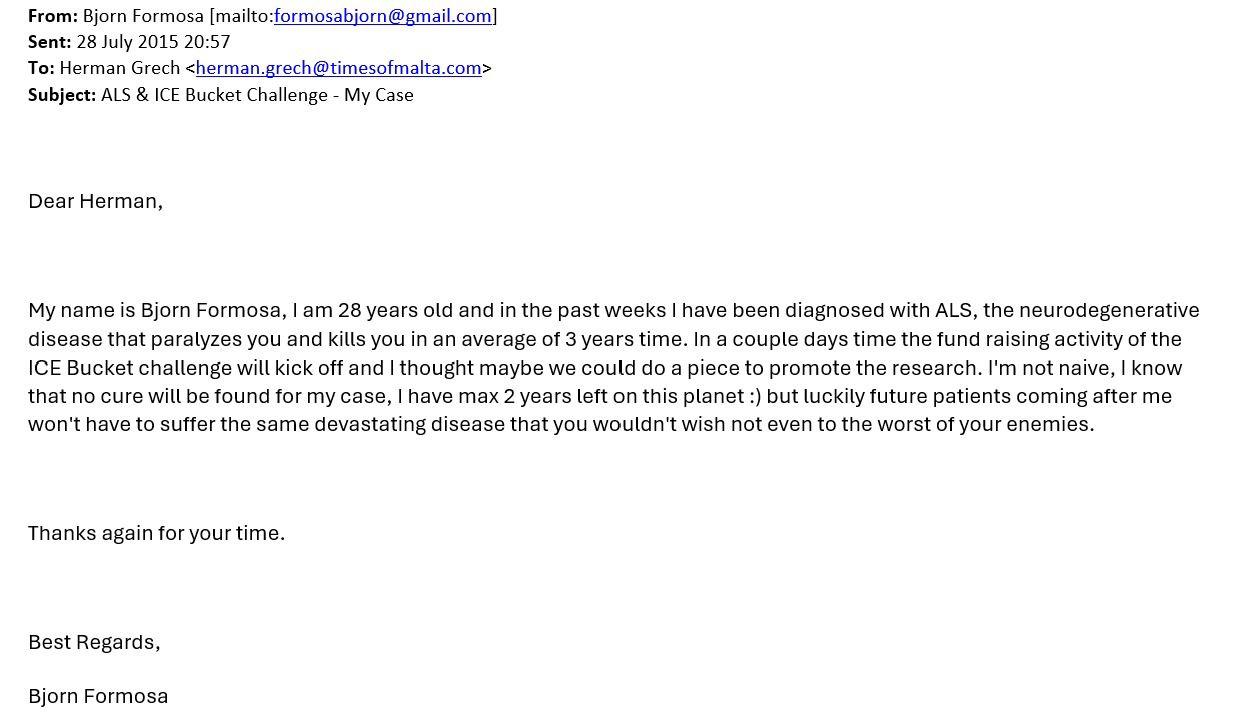 Formosa's 2015 email to Times of Malta editor-in-chief Herman Grech.
‘Thank God I got it’
Despite the suffering and several brushes with death, he says he feels grateful for the disease.
“Thank God I got the disease, because without it, none of this would have happened. We helped so many people.”
Bjorn’s initial e-mail to Grech, sent on July 28, 2015, a few minutes before 9pm, was a plea to raise awareness for ALS research. He felt a sense of urgency, believing he had only two years left.
When asked about that prediction, Bjorn, now 38, is characteristically defiant.
“I couldn’t have known, because patients don’t normally live longer than three years with this condition,” he said, adding with a hint of pride, “but in my head, I wanted to live 10 years. Now it’s harder. I wish to live more, but it’s getting physically impossible. But I’ll try.”
Asked why he thinks he managed to live so long, he said: “It’s because I’m hard-headed”.
His story is one of immense determination. His illness slowly stripped him of his physical abilities and gradually left his mind trapped in a paralysed body.
In his e-mail to Grech, he had said the disease is so cruel you would not even wish it upon your worst enemy. Yet, he refused to be a victim. Instead, he channelled his energy to help others with ALS and other neurological conditions.
Two homes in a decade
Shortly after his diagnosis, Bjorn founded the ALS Malta Foundation and launched his first fundraising campaign, the Ice Bucket Challenge. It was just the beginning.
Over the past decade, he mobilised the nation, raising millions of euros to build and operate two state-of-the-art residential homes in Qormi and Żebbuġ, providing round-the-clock care for patients.
His fundraising efforts, driven by an unwavering belief in a solution for everything, have been monumental.
With his wife, Maria, by his side, they are now working on an extension for the Żebbuġ home to serve as a respite, a new residence in the south of Malta, and a project in Gozo.
“We must always dream, otherwise we die,” he said.
Maria is his rock. She said he still runs the organisation himself and jokingly added he does it with quite the iron fist.
That is when Bjorn interjected, jokingly comparing his method to Dom Mintoff’s iron fist.
“Mintoff had the belt. I have my eyes,” he said.
“I was going to die a hundred times, but I always survived. One day I will die for real. It’s just not today,” he said.
While the conversation naturally touched upon life and death, Bjorn is unwavering in his stance on euthanasia, which has been the subject of recent public debate.
“I will always work in favour of life, but I respect everyone’s decision. Nobody should be judged in such difficult circumstances.”
When asked if he would choose euthanasia for himself, he replied: “I don’t think so, even if I previously had a different opinion. I don’t want to die, but everyone has their opinion, and we should respect it.”
He admitted he does not fear death itself, but the moments before it.
“I will probably die suffocated,” he said.
Maria said he already had close calls with death a few times when he was not taking in enough air to breathe but managed to survive.
As the telethon is set to begin, Bjorn Formosa’s legacy is already secured. He is not just a survivor; he is a force of nature, a philanthropist who turned his personal tragedy into a national movement. And he is not done yet.
The foundation has a succession plan to ensure that his work will continue long after he is gone.
“In case I’m not around anymore, we have a strong succession plan so that everything goes on as if Bjorn was never here.”
The telethon will air live on all TV stations on Sunday from noon until midnight.