Book review: Malta’s short-lived fascist union
Gabriel Micallef's well-researched study sheds light on homegrown fascism
Marching On. Captain Frederick Oloff Samut & The Union of Maltese Fascists
by Gabriel Micallef
published by Fondazzjoni Wirt Artna, 2024
Gabriel Micallef’s Marching On: Captain Frederick Oloff Samut & The Union of Maltese Fascists is a well-researched, profusely illustrated study of his protagonist, the party he created, and of that little known aspect of Maltese politics – home-grown organised fascism.
Most people are unaware that the label ‘fascist’, so widely misapplied by Lord Strickland and his supporters to their political adversaries, was adopted with pride by a small circle of political activists, some of whom revelled in their black shirts.
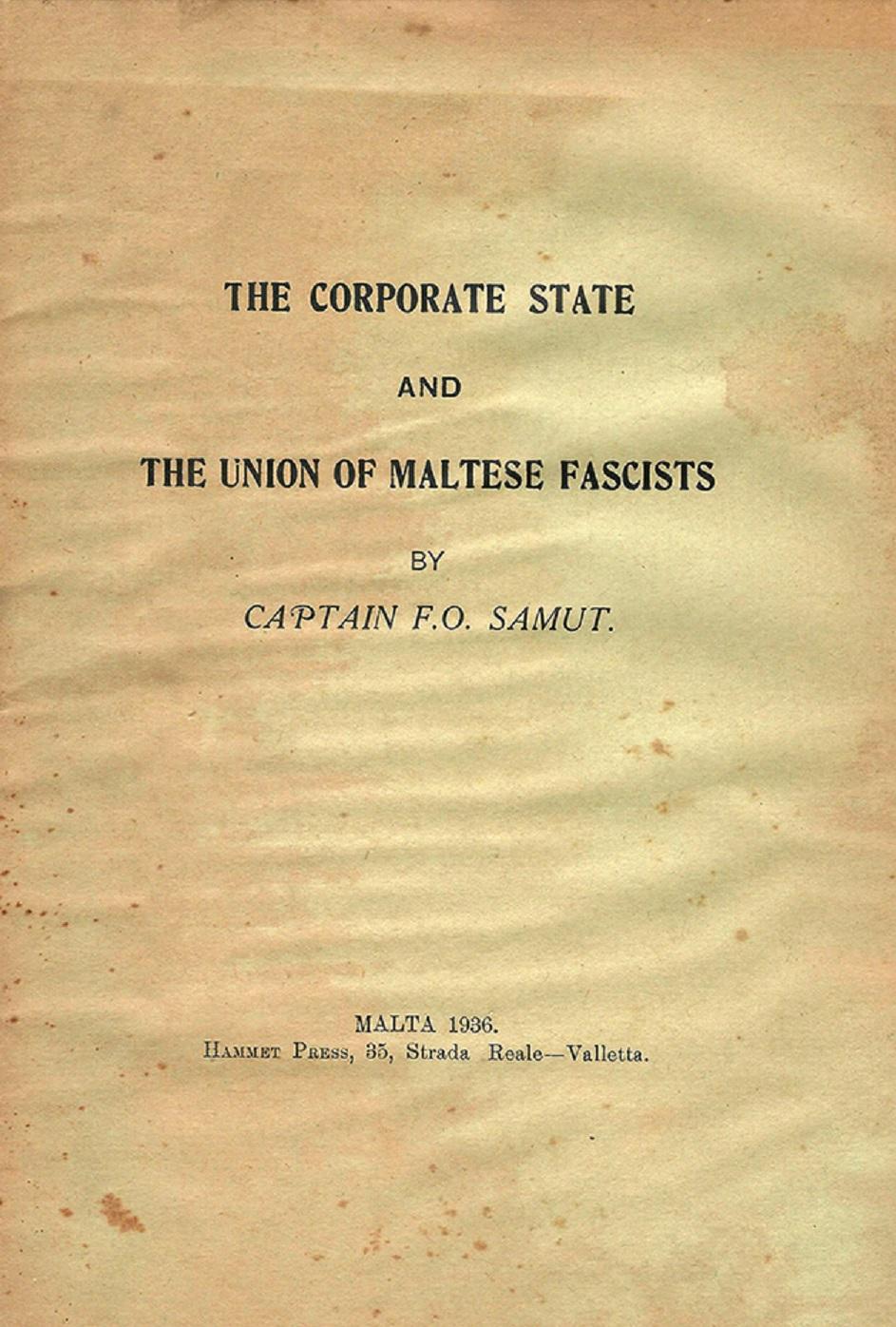 Front cover of the UMF manifesto. Photo: Fondazzjoni Wirt Artna
The synoptic history of the Samut family with which Marching On opens provides a good foundation for what is to follow. The Samuts were a family with a proud medical and military tradition, “stalwart defenders of British values and interests”, ready to bear arms in defence of the empire. Their ethos was expressive of “a deep-seated patriotism, an unwavering devotion to their King and country”.
 Captain Frederick Oloff Samut. Photo: National Archives Malt
Captain Frederick Oloff Samut (1893-1937) was a worthy scion in the family tradition. A product of Jesuit education in Malta and at Beaumont College, Windsor, he followed a pre-ordained path from school to recruitment in the British army.
During World War I, he fought in France, was severely wounded and decorated. Post-war, he served in Cape Town, Ireland, India and Aden. He retired from the army in 1929 and returned to Malta.
His strong sense of duty, coupled with battle experience and belief in his ability to initiate meaningful change, led him to enter politics. Influenced by two people he highly respected, his uncle Achille Samut and his mentor Colonel George Chesney, Samut unsuccessfully contested the 1932 election on the Nationalist Party’s behalf.
The following year, Maltese ministers were dismissed, the constitution suspended and later revoked. It was an official British coup d’état that returned Malta to gubernatorial rule a mere 12 years after having been awarded limited self-government. The strong protests of the Nationalist, Constitutional and Labour parties were ignored. Samut blamed the local political parties for the loss of the constitution and looked elsewhere for a new approach.
Major Wolsey De Piro, star-struck by Sir Oswald Mosley, set up his own Maltese Fascists as a branch of Wolsey’s Union of British Fascists (BUF). When the Malta branch was abandoned by the BUF, De Piro resigned and was replaced, but the branch withered and was soon dissolved. Frederick Samut, who had played a prominent part in the enterprise’s activities, was undeterred. He would save Malta.
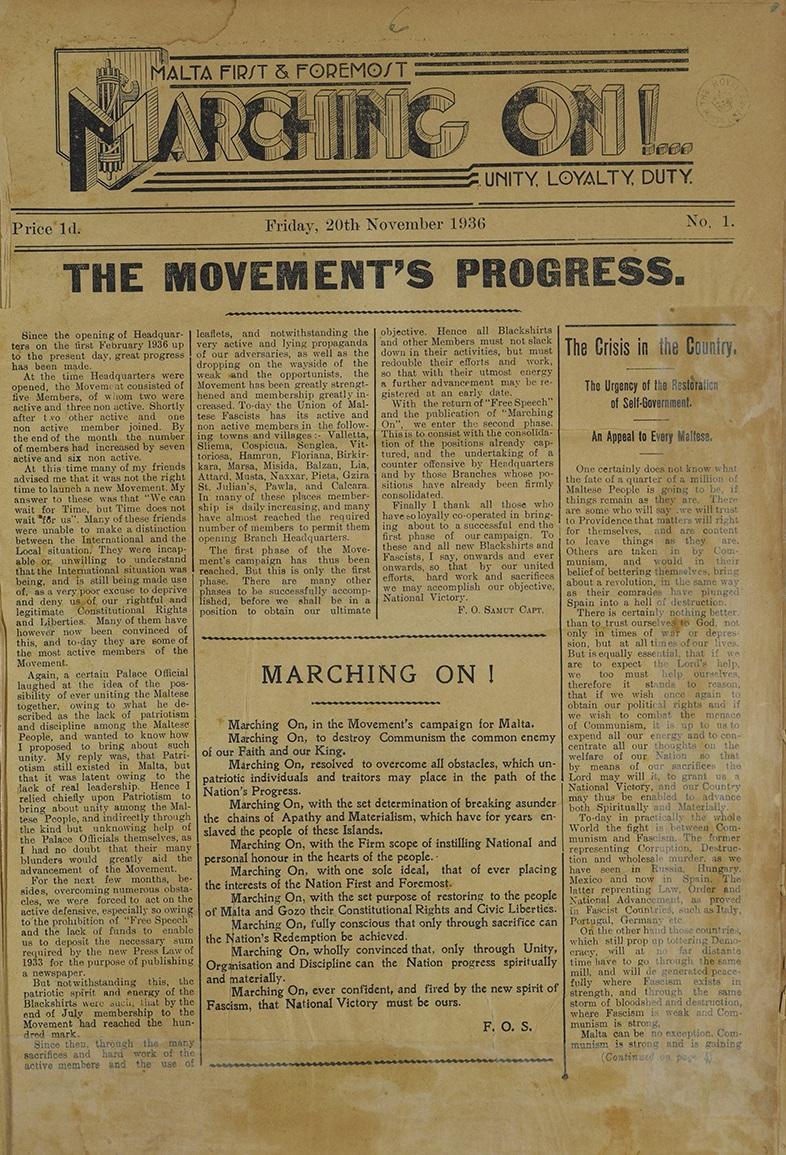 Front cover of the first issue of the Marching On! Photo: National Archives Malta
On February 1, 1936, he founded the Union of Maltese Fascists (UMF). It had its headquarters in Valletta and published the weekly Marching On. The UMF welcomed all Maltese, “regardless of gender, age or social class, who genuinely prioritised the welfare of the nation over personal or party interests”.
Prospective members “were required to sign a declaration affirming their loyalty to the king (which ‘was a top priority’), the nation, and the movement”. Those who signed were given the option of either joining the Blackshirt formation or the political section of party canvassers. All were barred from carrying weapons.
Female members “were offered diverse courses ranging from first aid to cookery, household management and needlework. In instances of sickness, unemployment or distress among members, it was incumbent upon women in the Blackshirt formations to extend support and solace”.
Like his model and hero Benito Mussolini, Samut was convinced that he alone could awaken the potent force of Maltese nationalism and transform Malta into an economically self-sufficient island.
The party never gained traction and was hardly taken seriously
Criticising what he called the island’s ‘decadent democracy’, Samut argued in favour of the corporate state. Corporations would replace parties. The UFM in power “would grant official recognition to corporations representing various socio-economic interests” while “adjusting existing laws to align with Fascist principles”.
UMF’s dream of the outcome of this party-less state were grandiose. They included “large steamers capable of navigating the world carrying [Maltese] cargo, passengers and mail” and Malta being transformed into the “air Clapham Junction of the Mediterranean”, becoming a premier air hub for commercial, mail and passenger air services.
They overlooked certain details. One was Malta’s colonial status. Until 1962, Maltese governments could not trade or have other relations with third countries. Moreover, the wages and salaries earned by the vast majority of Maltese workers were paid, and thoroughly controlled, by the British Services whose interests came first and foremost.
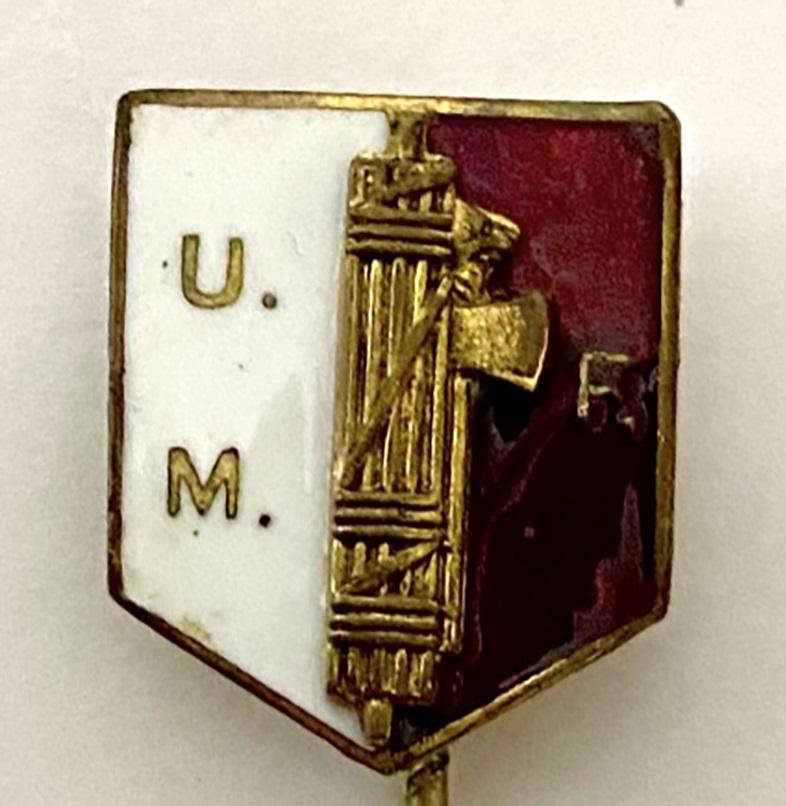 Lapel pin badge of the Union of Maltese Fascists (UMF). Photo: Karl Camenzuli
Frederick Oloff Samut passed away on March 19, 1937, at the age of 44. Victor Savona, son of the Labour Party’s first leader, who succeeded him as party leader, resigned the following September. Alfred Anastasi took over briefly before he too resigned. The UMF, which even in its heyday never had more than a hundred members, quietly disappeared.
The party never gained traction and was hardly taken seriously except by its members. It does not feature in Governor Bonham Carter’s extensive diary.
Major Bertram Ede, head of British security in Malta, who saw a spy under every bed even in dormitories fitted exclusively with hammocks, paid them little attention, though four MUF members, including Victor Savona, were eventually deported to Uganda for the duration of the war.
However, Micallef’s comprehensive study of the UMF, which covers the party’s various aspects, inspiration, ideology, aspiration, organisation, activities and publications, is worth reading.
Marching On throws light on a little-known episode of our political history that, to my knowledge, has not yet been properly researched, thereby adding another piece to the complicated picture of 1930s Malta.
Perhaps inadvertently, Micallef also adds another compelling argument for agreeing with D.H. Lawrence’s plea: “Oh Lord, send us no more saviours of the people.”
 Joseph M. Pirotta is a historian and former head of the Department of International Relations, University of Malta