‘Borma Tbaqbaq’: new play reclaims silence, language and the kitchen
The play’s structure is driven by an unusual fusion: grounded legal realism intertwined with myth and the unspoken histories of Maltese womanhood
Borma Tbaqbaq, a new bilingual theatrical production written and performed by Angele Galea, Pauline Fenech and Valerie Buhagiar and directed by Tyrone Grima, opens at Aġenzija Żgħażagħ in Santa Venera this month.
Supported by Arts Council Malta, Give or Take Productions, Aġenzija Żgħażagħ and MCAST, the work delves into Malta’s collective memory, patriarchal structures and the quiet power that women forge in spaces historically used to contain them.
Blending courtroom drama, ancestral echoes and the coded rituals of the Maltese kitchen, Borma Tbaqbaq asks its audience to confront the silences Malta has inherited – and the ones it continues to produce.
Myth, memory and the ‘ancient silence’
The play’s structure is driven by an unusual fusion: grounded legal realism intertwined with myth and the unspoken histories of Maltese womanhood. For Galea, that fusion emerged from observing a familiar cycle of violence and erasure in today’s Malta.
“As I read article after article in our newspapers,” Galea explains, “stories in which women forgive their aggressor, or in which perpetrators receive shockingly light sentences, I also find myself drawn to the comments beneath them.”
 Angele Galea
What she sees there – victim-blaming, minimisation and contempt – reinforces for her a painful truth: many women remain silent simply to survive. The silence, she argues, is not new. It is centuries old, coded into our social structures, absorbed from our past conquerors and passed down through generations.
“We invoke our missirijietna, almost never our foremothers,” she notes. “This absence, this erasure, is the ‘ancient silence’ I wanted to confront.”
For Fenech, the play’s central case and its protagonist Josie are rooted in real events in Canada, highlighting the universal nature of this silence.
“The MeToo movement revealed the harm silence can inflict,” she says. In Malta, she adds, the weight of silence is even heavier. The island’s closeness – where everyone knows everyone – places enormous pressure on women to protect family reputations, even at the cost of their own safety.
“Silence is seen as preserving harmony, but in reality, it shields wrongdoing and prolongs suffering,” she says. The play’s refusal to accept that silence becomes, for her, an act of solidarity with women whose voices are routinely dismissed or suppressed.
Buhagiar approaches the story through her fascination with how justice operates – and fails – in complex legal cases. A particular Canadian trial inspired her: a celebrity accused by multiple women, defended by a female lawyer who ultimately won the case.
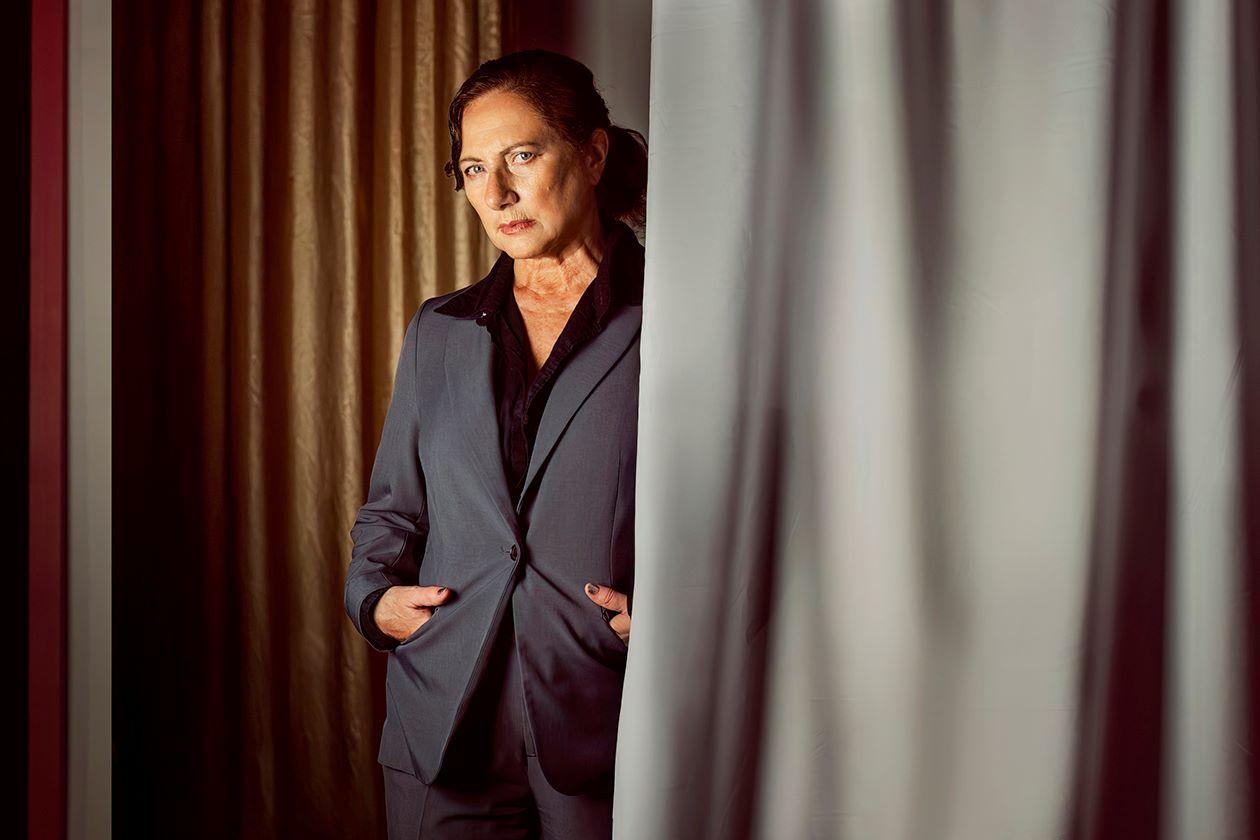 Valerie Buhagiar
“How does she represent justice? What does justice mean to her?” she asks. Layering this with Malta’s personification as a woman and the ancient Fertility Goddess allowed Buhagiar to place the lawyer’s professional composure in conversation with a more omniscient, mythic maternal force. The result is a narrative that feels contemporary and ancient at once, grounded yet expansive.
The kitchen as resistance
If the courtroom is the public battleground of the play, the kitchen is its intimate centre – a place reimagined by all three authors not as a site of confinement but of coded power, storytelling and quiet rebellion.
For Galea, the kitchen’s reclamation mirrors the evolution of the Maltese language itself.
“When our conquerors dismissed Maltese as merely the language of the kitchen, it did not stop us from shaping that language into a tool of identity and power,” she says.
Today, women still balance work, motherhood and societal expectations, sometimes literally with a laptop on the kitchen island. But they do so with resilience rooted in generations of foremothers who carved dignity from constraint.
 Leah Grech
Fenech builds on this, framing the kitchen as a space where agency emerges through routine. What appears mundane – preparing food, exchanging glances, sharing whispered truths – becomes a form of resistance.
“The kitchen becomes the place where small acts of defiance challenge patriarchal expectations,” she says. What was once dismissed as women’s work becomes a site of political and personal power, where memory, identity and solidarity simmer together.
For Buhagiar, the kitchen’s significance is inseparable from language – and from the legacies of colonisation. Learning that Maltese was once deemed “a vulgar language of the kitchen” sharpened her sense of how language shapes identity.
“If this is where truth is conveyed, then this is where truth resides,” she says. And alongside this lies a lingering question, posed to her once by a young man: What if colonisation had never occurred? The silence that followed that question, she suggests, echoes through the play itself.
Borma Tbaqbaq is showing at Aġenzija Żgħażagħ, Santa Venera, from November 28-30 and December 5-7 at 8pm. Tickets from showshappening.com.