Buried cannons and a gruesome discovery
Theft of sand from Malta’s northern beaches during the years 1908 to 1943
Malta’s northern coast is varied: cliffs, clay slopes, rugged shorelines full of huge boulders and, of course, beautiful sandy beaches that are frequented by thousands during the sultry, hot summer months.
The sand on which bathers lay their towels and beach mats took thousands of years to form. It was once rock, which the relentless action of the sea slowly ground into tiny particles over thousands, and even millions, of years.
Throughout the years, these golden particles have attracted not only sun worshippers but also entrepreneurs. It was soon discovered that if natural sand was mixed with cement, the result was a form of concrete as hard as granite.
It was not long before labourers were seen toiling along Mellieħa’s beaches, shovelling sand into carts and luzzus, and later into trucks, to be used for tile-making and construction. After all, many believed, this resource was infinite.
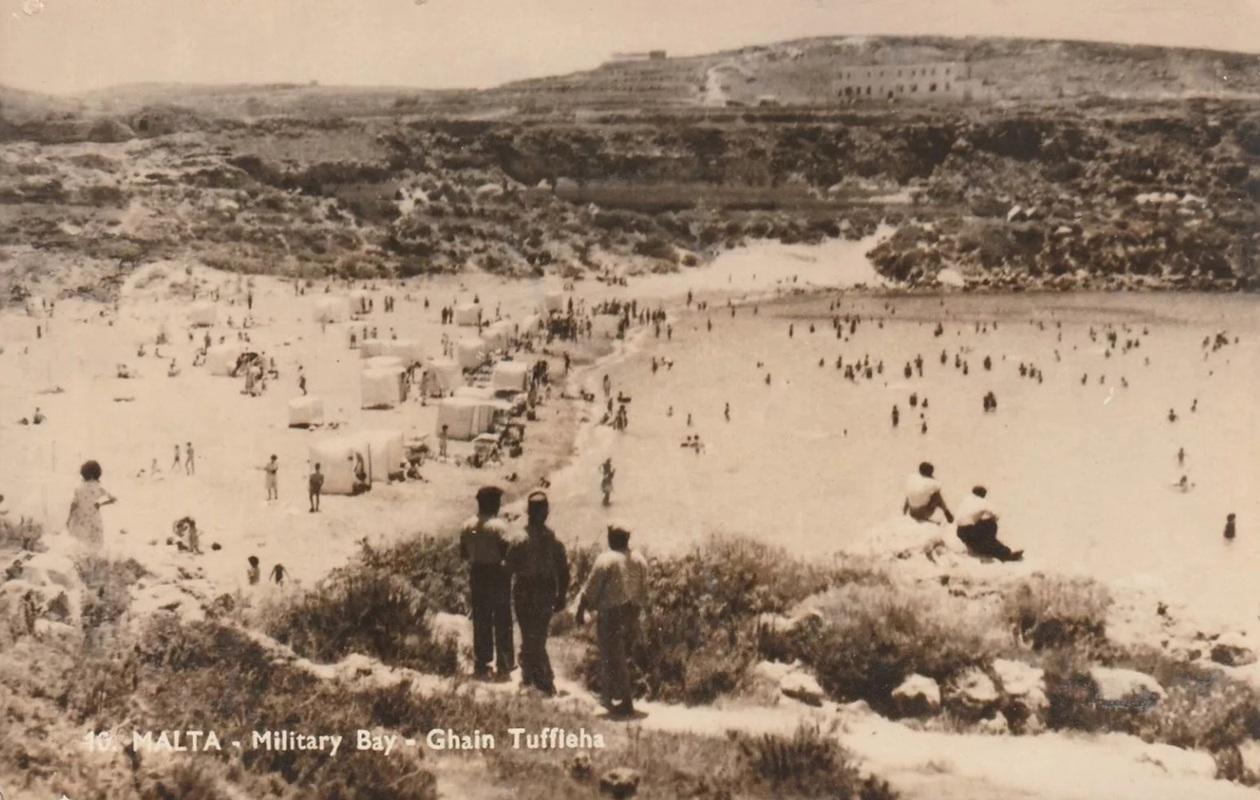 The director of public works accused the military authorities of using the excuse of double loading so as not to take sand from Għajn Tuffieħa (military bay), keeping it in pristine condition for servicemen to enjoy. Photo: Postcard, private collection
However, the British government thought otherwise, and soon issued laws making it illegal to take sand without permission. Of course, there were many who did so clandestinely.
The oldest case I have encountered occurred in February 1908, when Indri Vella reported to the police that someone had stolen sand from his field at it-Torri l-Abjad.
The culprit was soon caught; it turned out to be Lorenzo Debono from Għajnsielem, Gozo. He had entered Vella’s property and loaded a pile of sand onto his luzzu; for his troubles he was fined five shillings by the court.
Such cases were not always so straightforward. Just a few days later, marine policeman no. 53 S. Camilleri spotted a luzzu filled to the brim with sand at Paradise Bay.
Camilleri took down the particulars of the seven Gozitans he found on the beach. Again, all were from Għajnsielem. However, in the courtroom, the constable had to admit that he had not seen any of the Gozitans shovelling sand into the boat, and all went home scot-free.
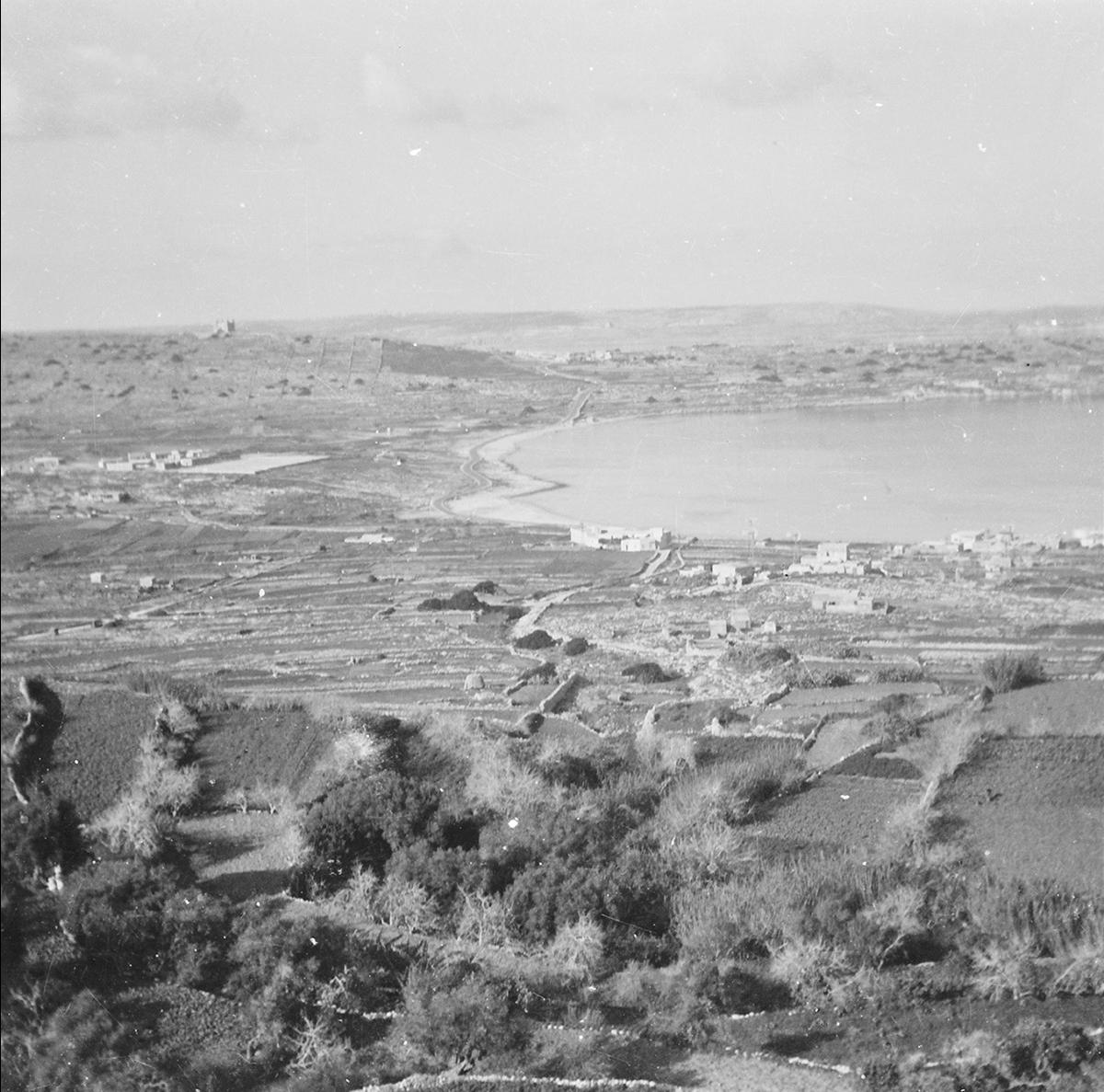 Mellieħa Bay in the 1950s. Photo: Family Sammut
Mistra Bay had been rendered completely bare (it still is) by Gozitans who loaded tons of sand illegally into their boats by moonlight
At the National Archives of Malta, I came across a letter sent to the chief secretary to the government by Ġorġ Attard in June 1936, which shows that the situation had not improved by that time.
Attard, who was from Ħamrun, wrote:
“I be much obliged of your Excellency while I inform you that my boats can’t gather some sand for cement industries from the bays of Malta. This depends the lives of forty-four persons which are employed by me. For such a thing I beg your Excellency to give me permission to take the sand from any bay you like for my industries. I hope that your Excellency don’t find any objection to give me such a request, for the best of my employees and their families.”
Little did Attard know that his letter would set off a chain of events that would lead to better protection for our beaches. His correspondence was passed on to the public works department, which noted that Malta’s beaches were being stripped bare.
For example, Mellieħa Bay was supposedly protected; only small amounts of sand were allowed to be taken away, exclusively for government works. The public was permitted to load sand from the it-Torri l-Abjad inlet, and only after obtaining a permit.
However, an inspection carried out soon after Attard’s letter was received had discovered no cart tracks or tyre marks at it-Torri l-Abjad. Instead, sand was being carried away clandestinely at night from Mellieħa Bay.
It was noted that, in a short time, Mistra Bay had been rendered completely bare (it still is) by Gozitans who loaded tons of sand illegally into their boats by moonlight. It was feared that Mellieħa Bay would suffer the same fate.
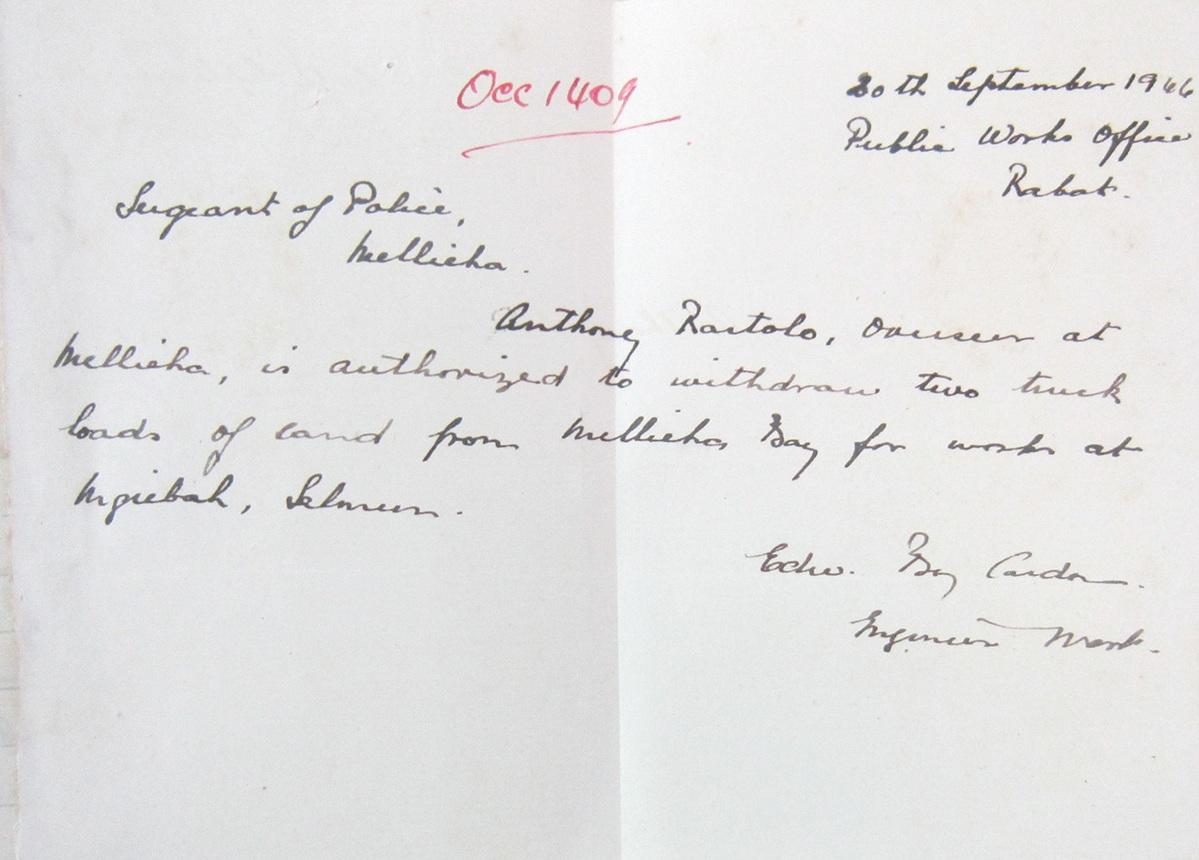 Anthony Bartolo was granted a permit to take two truckloads of sand to carry out some works at Imġiebaħ. Photo: National Archives of Malta
Word spread that people were being caught and fined for taking sand, and soon the abuse stopped, not only at Għadira Bay but even at Armier
The commissioner of police was asked to take immediate action, but he was not prepared to issue a wage of £300 a year merely to keep three constables guarding Malta’s largest bay day and night. Instead, he passed the matter back to the public works department, noting that its workers were paid lower wages and, besides, could also look after the public latrine and prevent abuse while keeping an eye out for sand thieves.
Thus, two public works department watchmen, with a wage of three shillings per day, were posted on Mellieħa beach. They even had a direct telephone line to the Mellieħa police station, as they had no authority to arrest anyone.
The installation of these watchmen was an immediate success; word spread that people were being caught and fined for taking sand, and soon the abuse stopped, not only at Għadira Bay but even at Armier.
Meanwhile, Attard was completely forgotten in this saga. It was only in July 1936 that he received a reply: he was told to apply for a permit to obtain sand and to follow its conditions accordingly. One wonders where he obtained his sand during the year he spent in limbo, waiting for an answer to his query!
Then war intervened, and the demand for sand increased immensely. Pillboxes, beach posts, forts, gun positions; thousands of tons of sand were swallowed up in the mixture used to make these fortifications. Incredibly, in August 1941, Colonel G. J. Eaton Matthews, chief engineer, Malta, complained to the public works department:
“I am obtaining small quantities [of sand] from Birżebbuġa and Rinella Bay. I understand that you do not approve of this. In the north area, there is plenty of sand at Għajn Tuffieħa, but it is impossible to get a lorry right down to the beach. Double handling to gate carts is thus involved, which is a slow and troublesome process. At Mellieħa, there appears to be plenty of sand left, but I understand that the watchman you had earlier in the year over the area from which we drew sand has now been discharged, and a notice put up that no sand is to be drawn from the beach.”
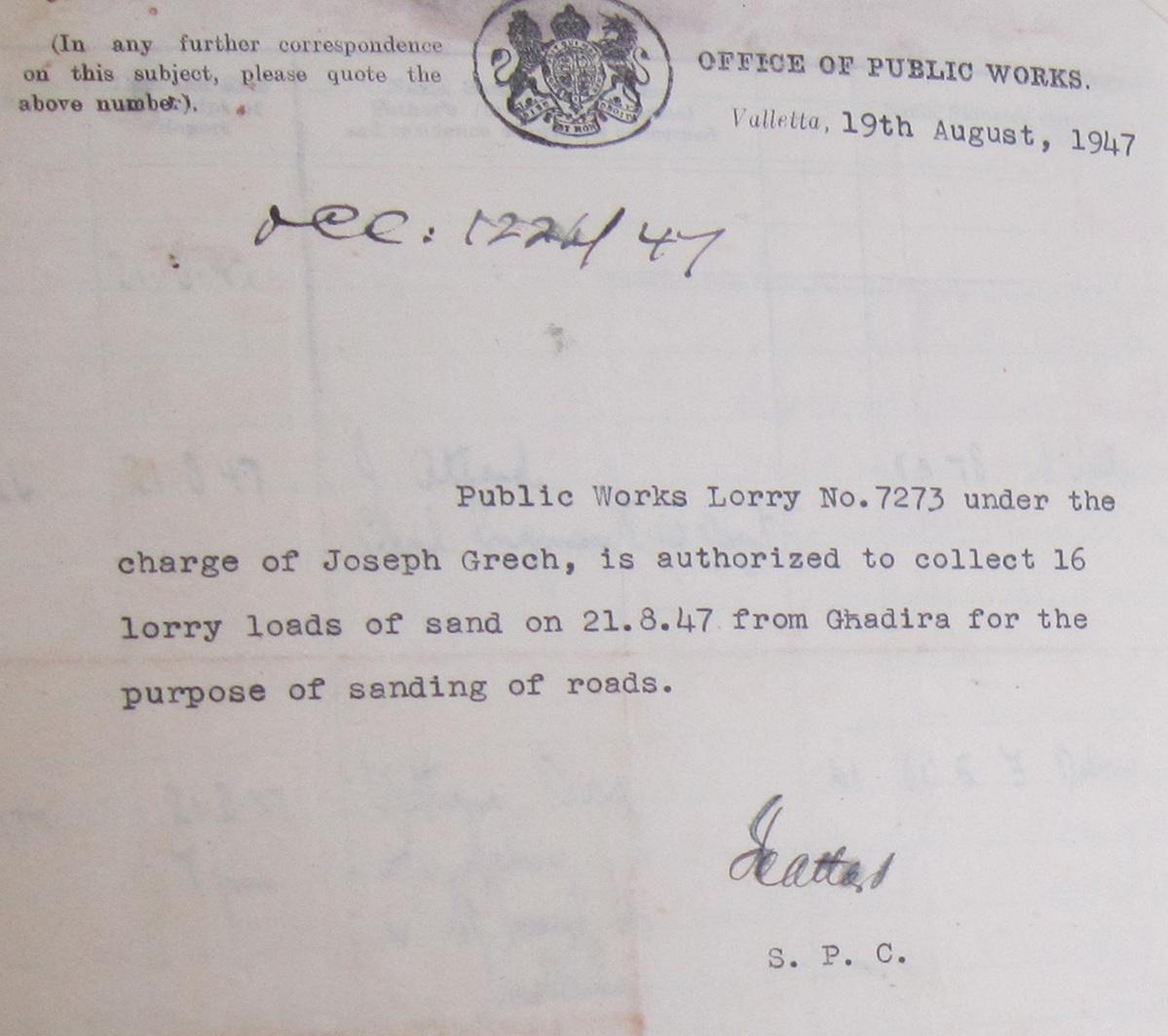 Joseph Grech was given permission to take 16 truckloads of sand from Għadira to be used for surfacing roads. Photo: National Archives of Malta
Eaton-Matthews then asked permission to draw sand from any place the department deemed suitable. Imagine that, asking for permission to remove sand to strengthen the island’s defences while a war raged and fear of an invasion grew!
The director of public works replied a month later. He told the chief engineer that:
“He is allowed to draw his requirements from any bay. I would strongly recommend, however, that withdrawals should, as far as practicable, be distributed over all beaches and sandy sites, and should be in proportion to the amount of sand available, rather than limited to a few specially convenient points… The maintenance of sandy beaches (though their enjoyment is very much restricted in wartime) is no less an important consideration from the civilian point of view than the provision of sand is from a military viewpoint.”
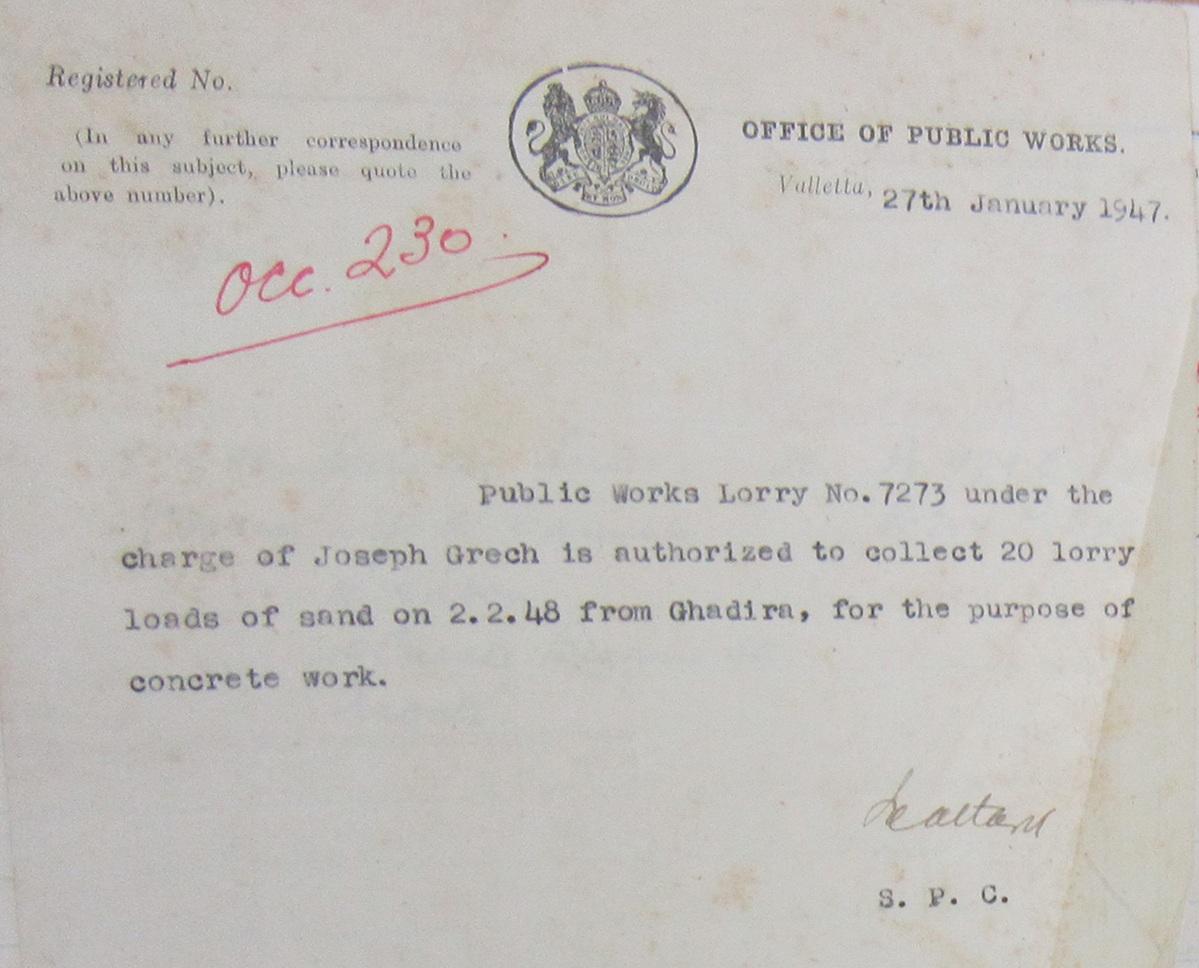 Another permit issued to Joseph Grech, this time to take 20 truckloads of sand from Għadira for the manufacture of cement. Photo: National Archives of Malta
He also pointed out that the reluctance of the military to take sand from Għajn Tuffieħa was more likely due to the fact that it was enjoyed by servicemen in their leisure time than because of the inconvenience of carrying sand in carts for long distances to load onto the trucks (double handling).
Are we ensuring the same for our environment for our children, or are we burying our heads in the sand out of greed?
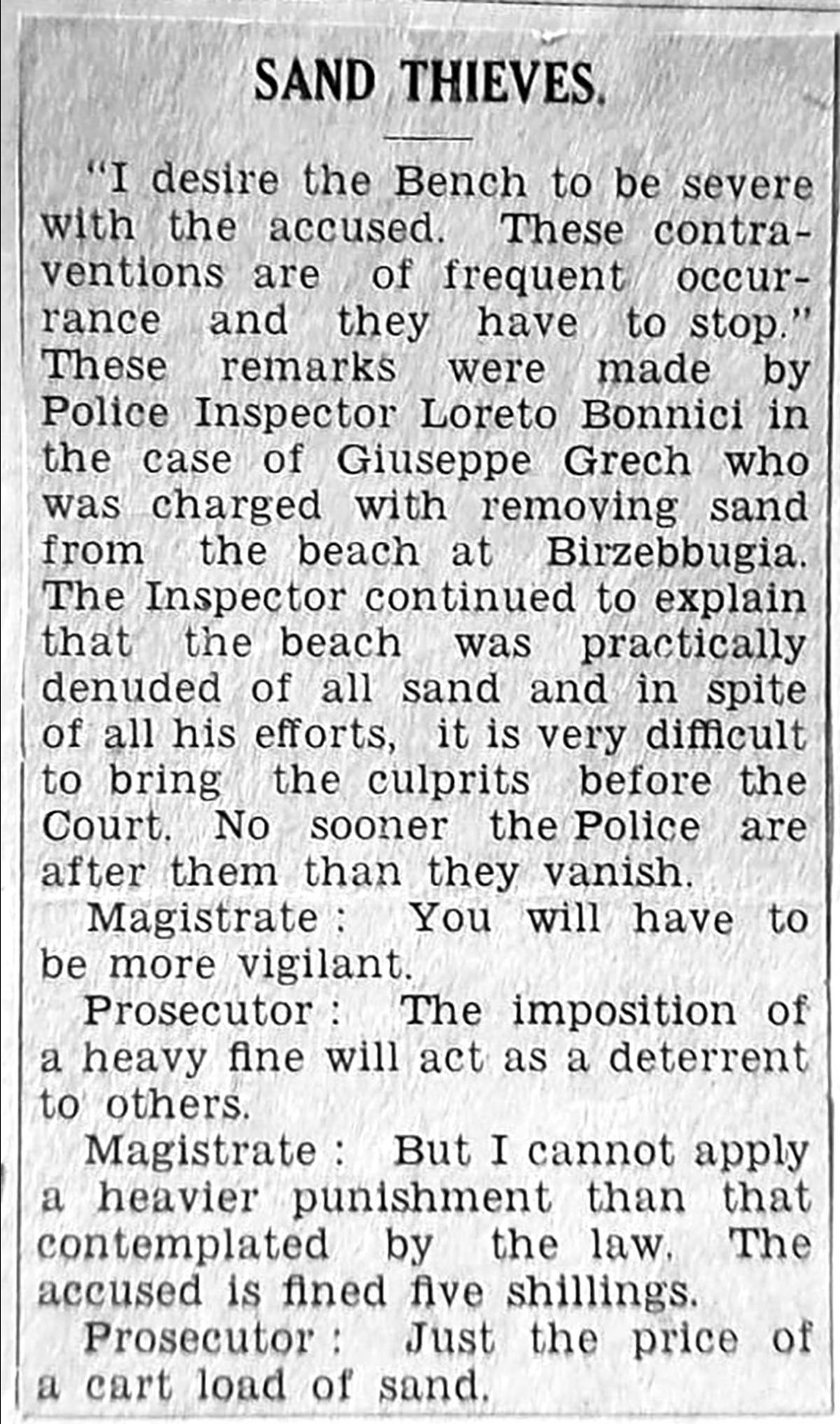 An extract from The Daily Malta Chronicle of January 1936, explaining how fines were not deterring sand thieves. Photo: National Archives of Malta
This episode shows that even during wartime, with Malta facing the threat of invasion, the authorities were thinking ahead to safeguard our sandy beaches for future generations. Despite the tons of sand taken from our bays, they can still be enjoyed today by locals and tourists alike. Are we ensuring the same for our environment for our children, or are we burying our heads in the sand out of greed?
Back to the labourers who shovelled so much of this golden dust for business or defence works. While at work, they made some strange discoveries.
In December 1939, watchman Michael Buttigieg reported that some servicemen taking sand legally from Għadira Bay had uncovered four iron cannons, 2.1 metres long and 30 centimetres wide. The museum curator, Dr J. Baldacchino, examined them and declared them worthless; they probably ended up being melted for scrap. These armaments most likely formed part of the redoubt that once existed on the shoreline of Mellieħa Bay.
Four years later, servicemen were at Għajn Tuffieħa when their shovels began uncovering human remains under nine feet (2.7 metres) of sand.
An investigation by Professor J. Hyzler concluded that the bones belonged to a girl aged between 14 and 17, and there were no signs of violence. She had been buried there for less than 40 years, and since there had been no cases of missing persons in the area, it was presumed that she had drowned and that the waves had eventually buried her under the sand.
Acknowledgement
The author thanks Simon Mifsud, Ruben Vella and the staff at the National Archives, Rabat, without whose assistance this article would not have been possible.