Carmel Said’s artworks speak of island life
The artist's Malta is one of contrasts, a Caravaggesque chiaroscuro
“An island can be both a paradise and a prison, both heaven and hell,” writes Godfrey Baldacchino. “Any island, any islander, is a contradiction between ‘here’ and ‘there’.”
This “rootedness” and “restlessness” that Baldacchino writes about might be felt even more acutely by an islander who has fled his tiny island, only to fetch up, for the better part of half a century, on a much larger one – an island swollen with illusions of greatness, still clinging for dear life to the remnants of a fading empire.
Life on an island tends to be invariably exoticised, not only by those who daydream of island life from their vast, well-connected cities, but just as often by those who live on islands themselves, who shape and reshape their mythologies from within.
The tropes of island life are endlessly revisited in reality TV shows, for example, where scantily clad contestants are marooned on idyllic shores and made to compete, forage, fight, or fall in love in front of voyeuristic cameras.
But for the islander who has left, the island, perhaps, is no longer a fixed place. It becomes a feeling, a flicker of memory, a question of belonging that never quite resolves. This might be what Carmel Said feels.
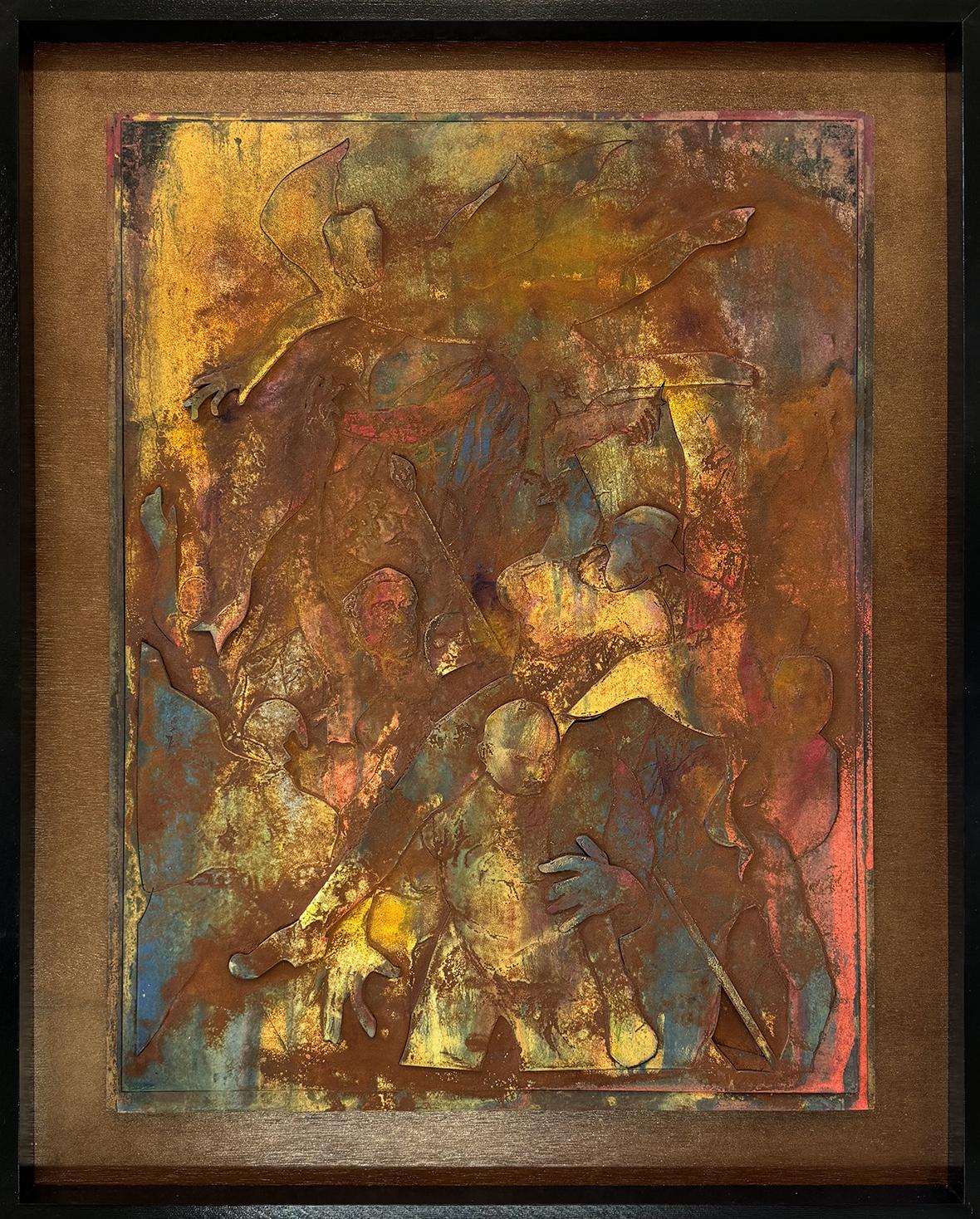 Festivity and Mayhem Rusty Painting
A Maltese artist, Said first trained with George Fenech at St Joseph’s Technical School in Corradino. In the 1960s, he continued his studies under Carmelo Mangion at the Malta School of Art, before moving to England to study at Croydon, Loughborough, and later at the Royal College of Art in London. He never truly returned home.
Thus, Said’s Malta, seen from across lands and seas, becomes a memory, a myth, but not necessarily one clothed in nostalgia. In a world where news travels fast, especially bad news, it is hard for him to think of island tales as merely innocent or free.
As in Golding’s dystopian fable, Said knows all too well that island life can turn dark, violent, and far from idyllic in the blink of an eye. His is not the island of eternal sunshine, though sun, fun, and celebration are very much present. Yet these are always undermined, or counterposed, by an unrelenting darkness. Or madness, perhaps.
And as in Camus’ The Stranger, it is perhaps the very implacably revealing sun that exacerbates Meursault’s madness. Or the one that pushes Said’s ambitious, fat, fated Icarus to his death.
Said’s Malta is one of contrasts, a Caravaggesque chiaroscuro, a place where light cannot exist without darkness. It is not far removed from the Spain that Hemingway describes in his Death in the Afternoon: “and when they have a religion,” he writes about his Castilian peasants, “they have one which believes that life is much shorter than death.” Or magistrate Giovanni Falcone’s Sicily where “Solitude, pessimism and death are the themes of our literature, from Pirandello to Sciascia.”
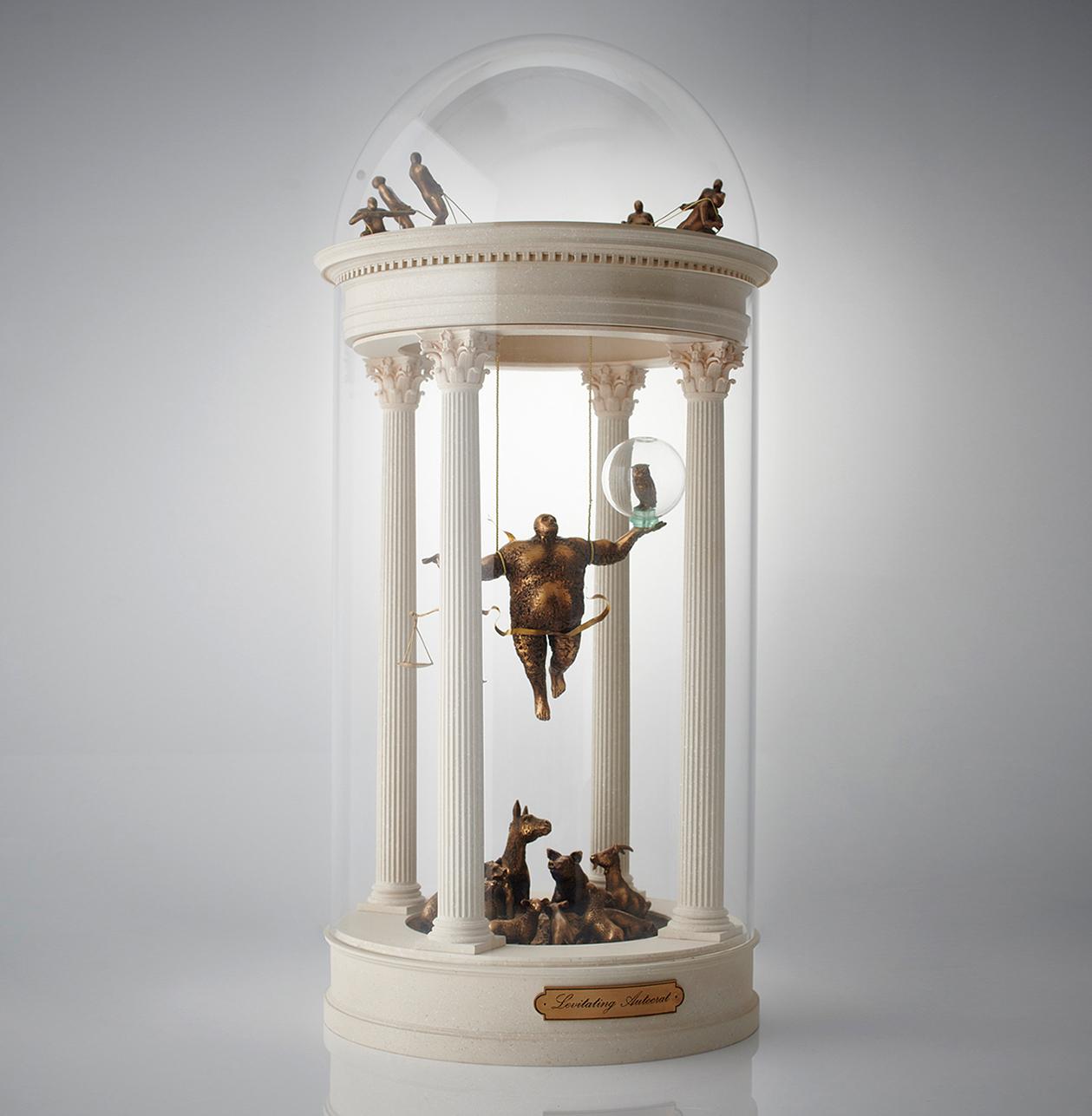 Levitating Autocrat, 2019
Perhaps the very Baroque that permeates Spain, Sicily, and Malta, with its sun-drenched sensuality and fruitiness, has a dark underbelly it cannot do without. And it is precisely there, in that shadowy underside, that Said positions himself as an artist. In that liminal space between light and darkness. And that is where he sees his Malta.
The visual language Said uses toys with the grand theatricality of the Baroque, its heaviness, its worldview, dramatic, emotional, excessive, contradictory
The visual language Said uses toys with the grand theatricality of the Baroque, its heaviness, its worldview, dramatic, emotional, excessive, contradictory. Neither minimalist nor restrained, Baroque wants everything: light and dark, heaven and hell, ecstasy and suffering. Said taps into this intensity as a way of exploring Malteseness without the need to be too literal about it.
Like artist Kara Walker, he mixes fact, fiction, and fantasy in a language that is deliberately overblown, to evoke an island where everything feels larger than life, where festa-loving, drunken crowds rub shoulders with angels, demons, and titans. It is a world that at times seems to be falling apart, fragmenting, dissolving before our eyes.
Copper plate matrices are purposefully corroded, their etched images rendered irrevocably unusable. Disembodied limbs and other bits of human carrion reassemble in a never-ending grotesque parade. Said’s Malta morphs into a Goyaesque nightmare, blackly humorous, unnerving. Island tropes are turned on their heads, inverted and defiled.
Perhaps because he lives far from Maltese shores, yet still on another island, Said communicates a Malta that bears little resemblance to the Mediterranean Eden promised in glossy tourist brochures and online ads.
It almost seems as though he is intent on tearing down, capriciously, all the definitions that attempt to describe the island, to focus instead on an inherent violence: Catholic, misogynist, patriarchal, corrupt.
Said’s Rampage is a case in point. A cross between Malta’s Easter traditional processional run with the statue of the Risen Christ, Jacob Epstein’s Rock Drill, and the iconographies of the Triumph of Death, it is an image of power gone awry, terribly and tragically wrong.
This might all seem inherently Maltese, but it is likely that Malta is here being put under the microscope primarily due to the artist’s origins. Given the island’s size and understandable insularity, everything there tends to feel magnified, more intense.
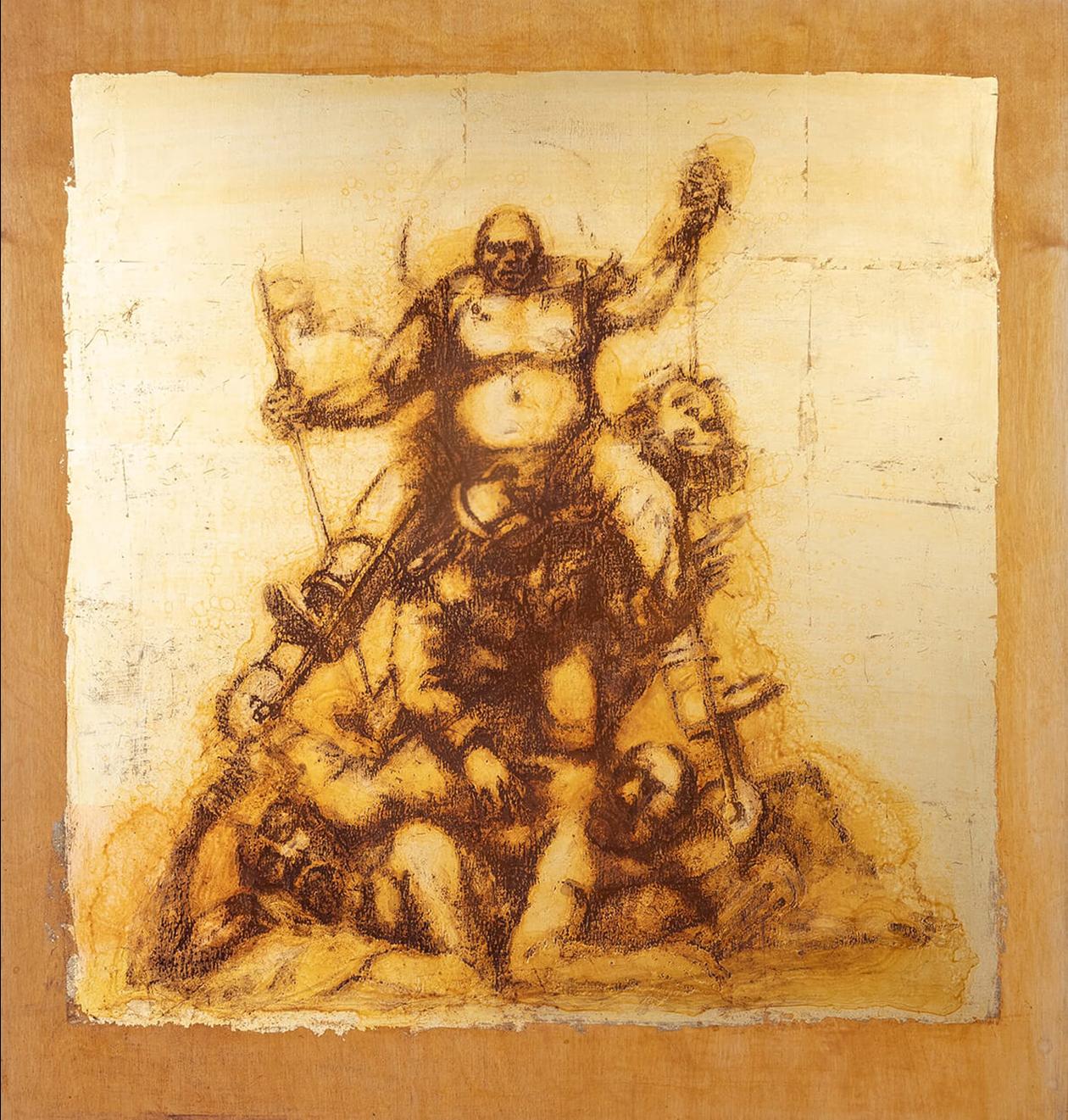 Rampage, 2021
The issues Said grapples within these works may seem distinctly Maltese but, when all is said and done, they are hardly exclusive to the island. That heady mix of corruption, despotism, debauchery, faith, machismo and vice has an age-old, biblical resonance, and Malta certainly cannot claim ownership of it.
At the core of Said’s inquiry is that universal dialectic between human vulnerability and the drive toward megalomaniacal power. A dynamic that inevitably gives rise to the self-made hells depicted here.
The quote that serves as the title for this writing is lifted from a podcast Said recorded with Francesca Balzan.
It encapsulates the essence of how Said approaches his art: not literal, not direct, not insipidly illustrative, yet deeply topical in a roundabout, allusive, imaginative, and magically realistic way. And because his work plays with fantasy, it can paradoxically afford to be more blatantly truthful, distilling deeper, often very uncomfortable truths.
Carmel Said’s exhibition Parade runs at the George Fenech Art Museum and Gallery, Mellieħa until May 30.