Central Bank flags uncertainty as Malta economy outperforms euro area in 2025
Precise projections are being complicated by the Middle East conflict
Malta outperformed the euro area in 2025 with steady growth and contained inflation, but Central Bank officials warn its outlook is clouded by uncertainty linked to the US-Israel conflict with Iran.
The Central Bank of Malta published its 2025 annual report on Friday with information on the state of the Maltese economy and euro area.
However, the results were presented with a caveat: all of the information, including projections, comprises a period preceding the US-Israel war with Iran, and does not take the effects of the conflict into account.
Economic growth moderated last year but remained above the euro area average, driven by domestic demand and exports.
Inflation stabilised at 2.4%, and the debt and deficit-to-gdp ratios are within the thresholds of the Maastricht Treaty.
The bank is projecting a further easing in economic growth and slight decline in inflation, but chief economist Aaron Grech made it clear during a press conference that the projections are subject to high uncertainty and might not reflect the situation post-conflict.
He said initial indications from the private sector suggest that demand and sentiment is still strong and activity remains above normal.
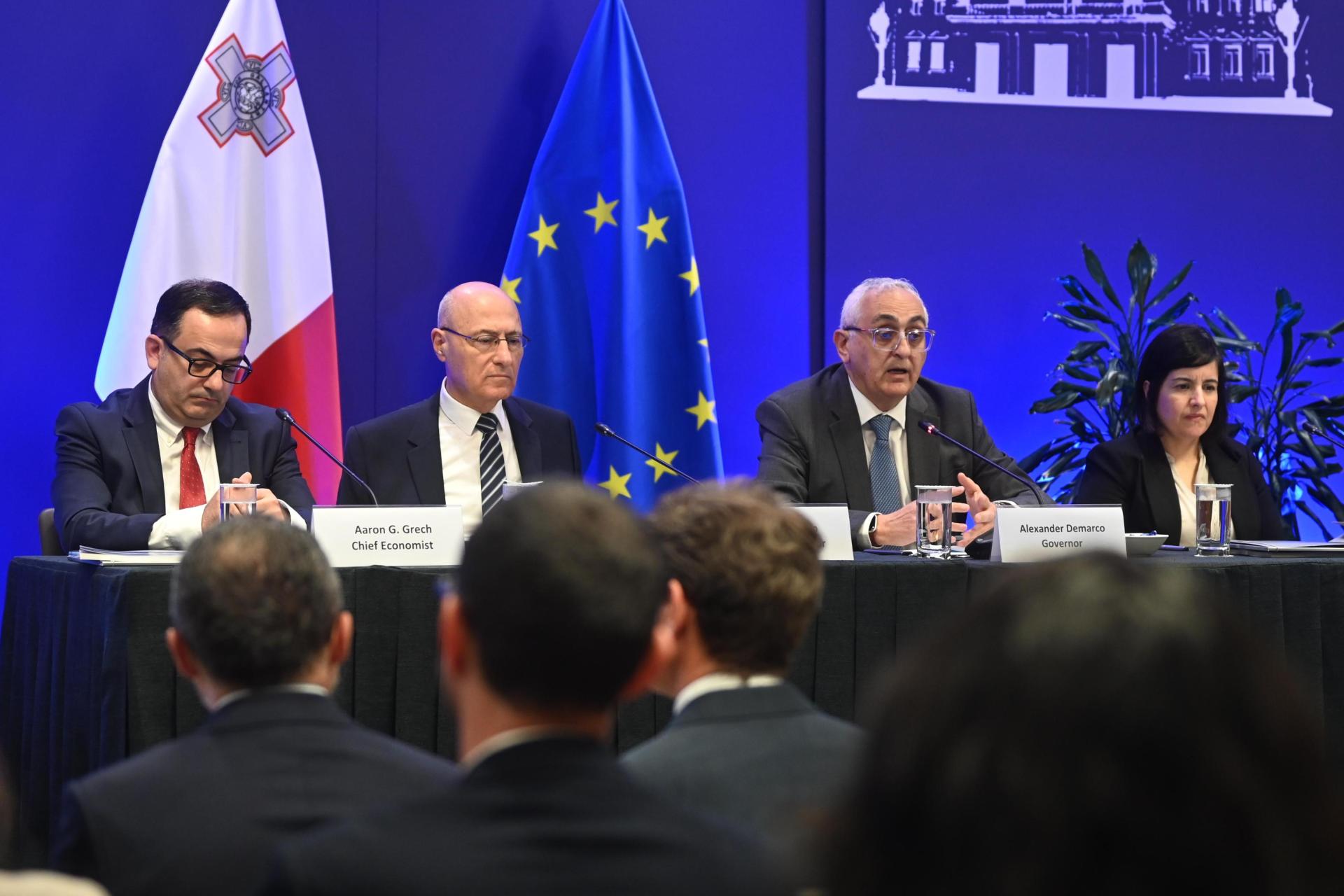 Central Bank governor Alexander Demarco presenting the bank's annual report alongside other officials. Photo: Jonathan Borg.
Central Bank Governor Alexander Demarco shared this sentiment when speaking about the euro area more generally. For Malta, a prolonged conflict and closure of the Strait of Hormuz would not only affect the economy through higher energy prices but also shortfalls in supply.
He said monetary policy can do little to ease supply shocks or a temporary rise in energy prices, but if a prolonged conflict raises prices in the medium term, the European Central Bank may consider raising interest rates.
However, he said the data seen by the central bank indicates that the impact of indirect effects is limited.
“The Strait of Hormuz is still closed. It’s not a likely prospect at this stage that energy prices will return to what they were before the war,” he said.
Small balance sheet contraction, increased profitability
Rita Schembri, the central bank’s deputy governor responsible for monetary policy, presented an overview of the bank’s financial results for 2025.
The central bank’s balance sheet recorded a small contract, reflecting a decrease in deposits at credit institutions and the unwinding of the monetary policy asset purchase programe.
IT registered an operating profit of €38.92 million before transfers to provisions. This is up from €4.95 million in 2024. This was driven by higher net interest income and a lower expense from the net result of the pooling of monetary income within the Eurosystem.
Due to policy uncertainty abroad and financial risks, the bank increased its risk provisions by €28.92 million. The bank also transferred €10 million to the government of Malta.