A chapel of line and spirit
Rowna Baldacchino examines the Josef Kalleya Gallery at the University of Malta Valletta campus
The Josef Kalleya Gallery at the University of Malta’s Valletta Campus, inaugurated in 2021, brings the public face to face with one of the most enigmatic figures in Maltese modern art.
The gallery houses part of a larger corpus of 65 works donated to the University by Josef Kalleya and his family, with 28 drawings currently on display. Created between 1971 and 1980, these works represent a late but defining period in the artist’s career – years of introspection, tension and spiritual resolve.
Kalleya’s art is elusive and unfathomable. Through the simplest of materials – felt pen, ballpoint, crayon, charcoal, chalk, paint and clay – he constructed an entire visual theology. His line is never decorative; it is an incision, an act of excavation.
Each drawing feels as though it has been torn from the depths of the artist’s being, carrying the intensity of a man who believed that creation itself could be a form of redemption. His mark-making carries, in the unfettered anxiety of its line, the memory of surrealist automatic writing, while it unfolds with a prehistoric impulse.
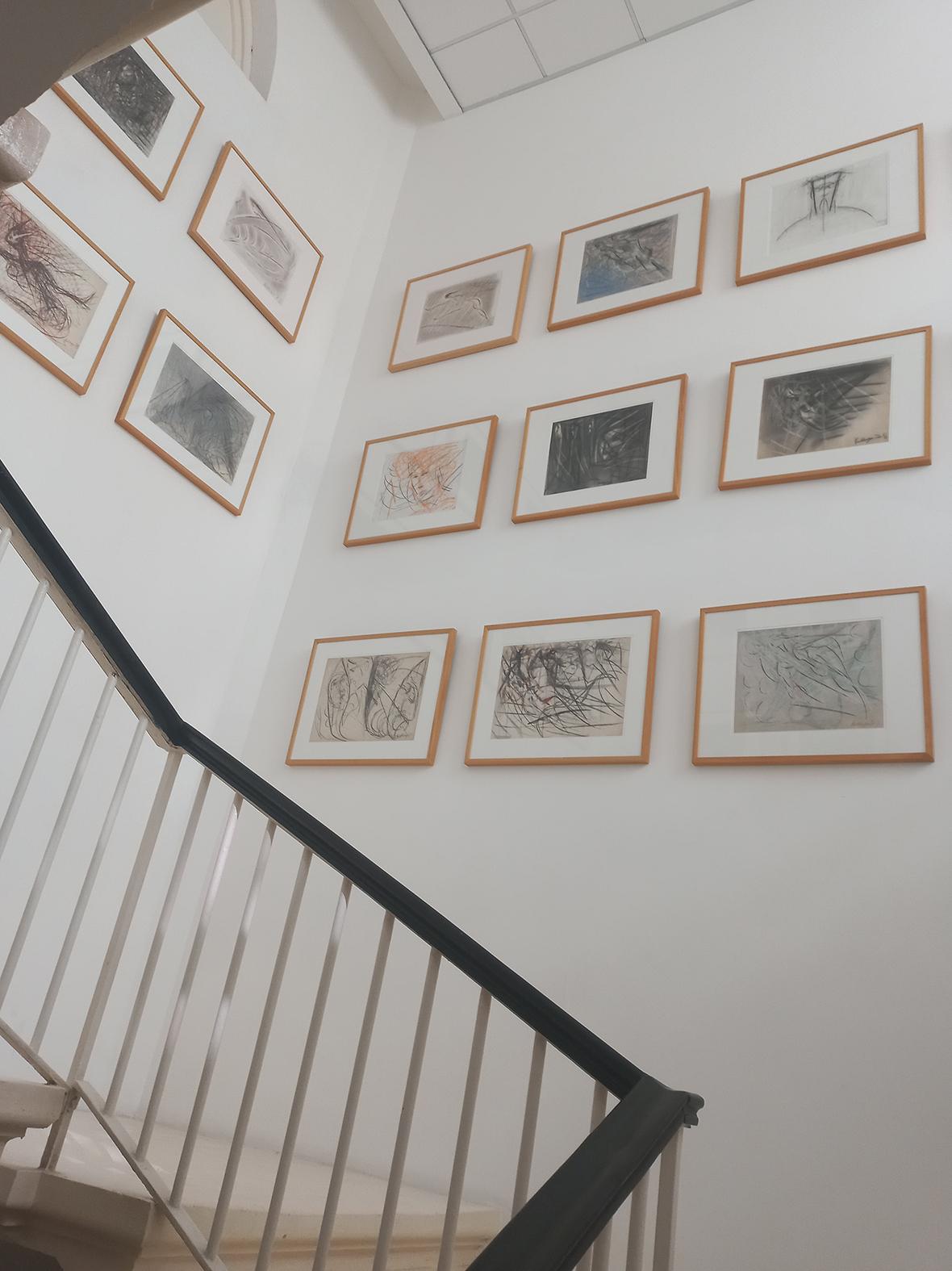 The gallery is housed within the Univeristy of Malta’s Valletta campus.
The surfaces are restless: graffiti-like scratches, scribbles and frenetic lines animate the page, their raw immediacy pointing to a mind both tormented and illuminated. Kalleya’s drawings distil a lifetime of spiritual searching.
The themes that haunted his imagination reappear with renewed urgency: clowns and bishops, figures in flight, Dantean visions and Christ crowned with thorns. These recurring subjects, familiar throughout his oeuvre, are here transformed into something deeply personal and visceral. Christ’s suffering becomes universal rather than devotional; the clowns, tragic witnesses to human folly.
To understand these works, one must consider Kalleya’s spiritual evolution. As a young man, he was deeply influenced by Catholic devotion but soon turned toward questioning and philosophical reflection. He became drawn to Origen’s doctrine of Universalism – Apokatastasis – the belief that all souls, even the damned, would ultimately be reconciled with God. This radical vision of salvation permeates his art.
This belief pulses through these drawings, which merge anguish and grace in equal measure. Each mark seems to oscillate between destruction and salvation, as if the act of creation were itself a form of spiritual healing. What we see is not a confessional narrative but a cosmic meditation on redemption – an artist using the line to traverse the boundary between doubt and faith.
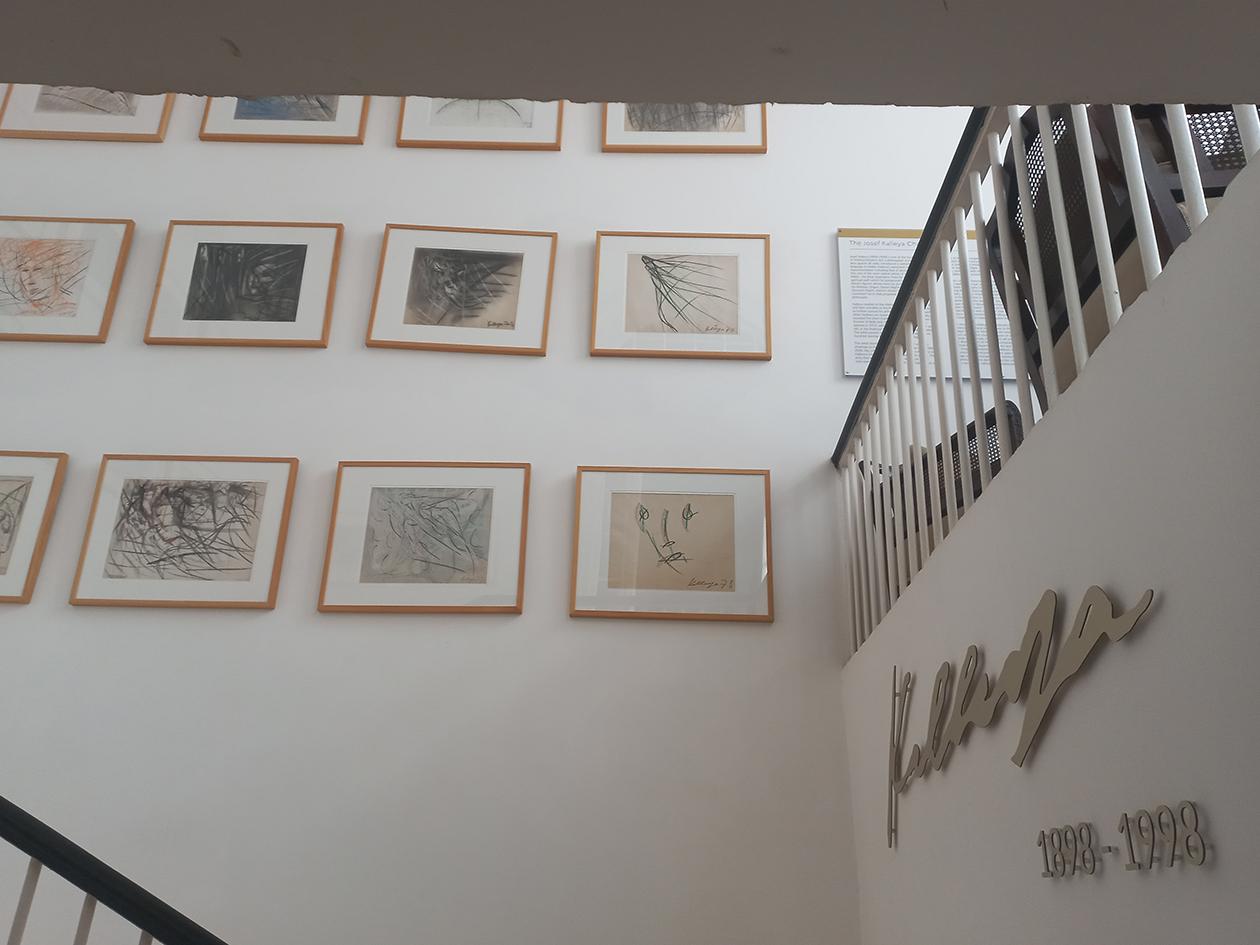 The gallery within the Univeristy of Malta’s Valletta campus.
The works reward patience. In their fragile, layered surfaces, one senses Kalleya’s lifelong pursuit of meaning through matter. His touch alternates between fury and stillness – at times almost violent, at others meditative. Forms seem to dissolve and reform before the eye, as if suspended between the corporeal and the spiritual.
Several of the drawings reveal Kalleya’s fascination with Dante’s Divine Comedy, a text that became central to his later years. Indeed, Kalleya engaged in a ceaseless, confrontational dialogue with Dante’s Divine Comedy. Dante’s journey through Hell and Purgatory toward Paradise mirrored Kalleya’s own inner struggle – his oscillation between torment and transcendence. Creation, redemption, salvation – his personal trinity – echoes through every line.
These drawings, stripped of ornament, become acts of prayer. Yet they are not pious in a conventional sense. Kalleya’s spirituality was too restless, too human for dogma. His line is both confession and defiance, a testament to faith as an act of questioning. In his world, the sacred is inseparable from the doubt that defines it.
The Josef Kalleya Gallery captures this duality with remarkable sensitivity. Set within the University’s historic Valletta Campus, this quiet room feels less like a museum and more like a chapel. The space invites silence, contemplation and slow engagement. Each drawing, given ample room to breathe, radiates a quiet intensity.
Seen together, the 28 works form a kind of spiritual journey. They reveal an artist who sought not beauty but truth – and found both through struggle. The viewer is drawn into that same dialogue between light and darkness, doubt and revelation.
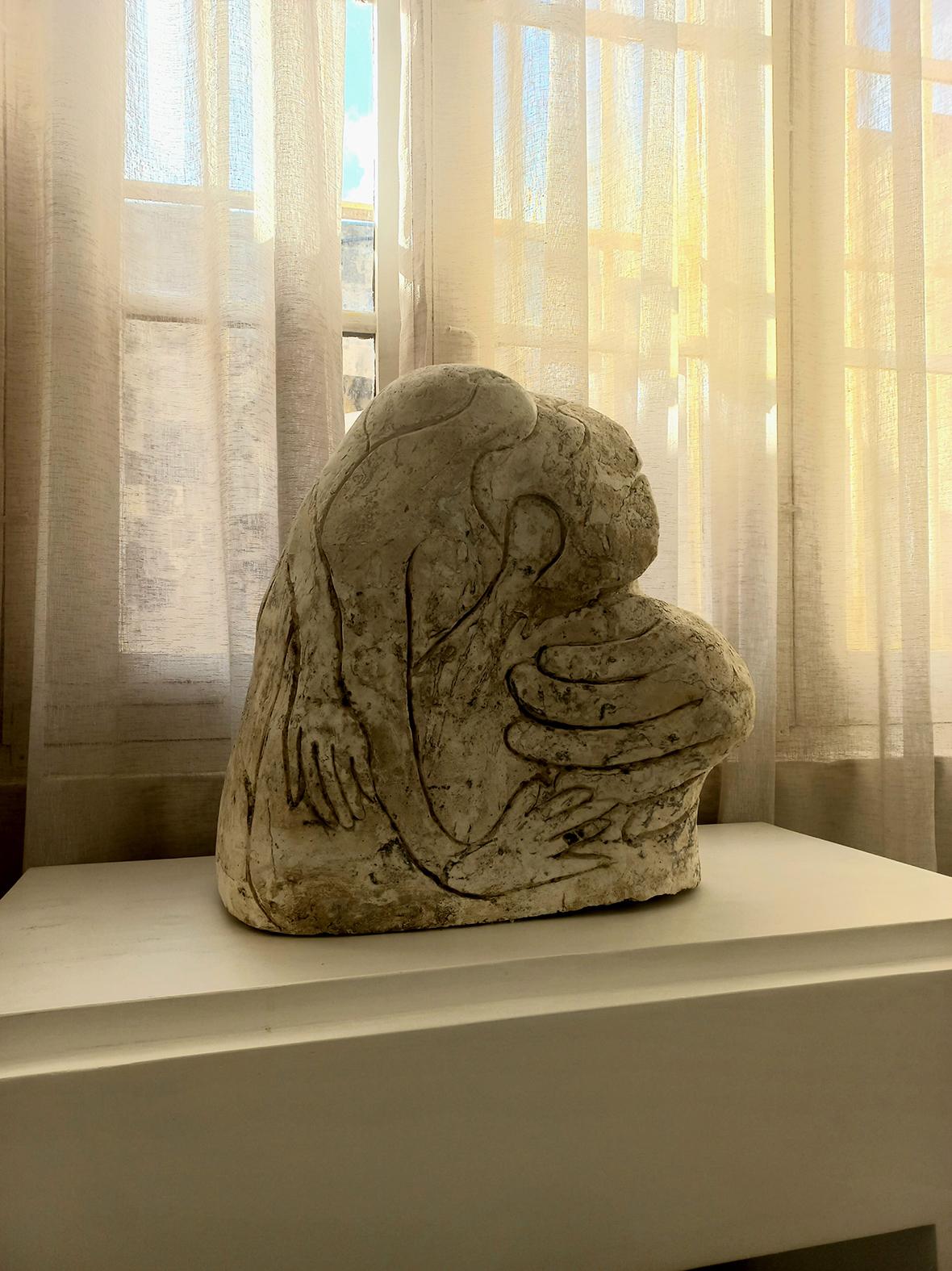 One of the sculptures on display at the gallery.
A small sample of his sculptural works, shown alongside the drawings, echo the same inner turbulence. Rough-hewn and incised with a knife, these figures reject classical polish, privileging the trace of gesture over finish. Like his drawn line, the sculptural cut becomes an act of revelation – a primal incision through which being is made visible.
Matter, for Kalleya, is never inert; it bears the imprint of a spiritual struggle, a tension between flesh and transcendence. The sculptures stand as the material counterparts to his drawings, as if the line itself had risen to inhabit space.
What emerges from this collection is the portrait of an artist who helped shape the very foundation of Maltese modernism, not through imitation of European trends but through introspection and metaphysical courage. For Kalleya, modern art was not a stylistic choice but a spiritual necessity – a means to probe the nature of being.
The Josef Kalleya Gallery stands as both homage and discovery. It anchors Kalleya’s legacy within Malta’s cultural and academic landscape, reminding us that the island’s modern art history is as much about spiritual inquiry as aesthetic innovation.
In the tremor of Kalleya’s line, we encounter not answers but questions – and in those questions lies his enduring power. The gallery is, in every sense, a space of pilgrimage: a site where art, faith and doubt coexist, and where Kalleya’s restless spirit continues to lead us toward the unknown.