‘Clean | Clear | Cut’: Malta Biennale’s invitation to rethink new value systems
The Valletta sites, host to the headline acts, prompt reflection on how ideas from this major art event might permeate into larger systems of thinking
The second edition of the Malta Biennale, themed ‘Clean | Clear | Cut’, instructs its audiences to purge, cleanse and pursue alternative value systems, reflecting the urgency of – among other issues – environmental preservation in Malta.
Under the stewardship of curator Rosa Martínez, and via the promotional literature of this year’s edition, Valletta has emerged as the home of the biennale’s headline acts, residing within a dense configuration of historically loaded sites. The Grand Master’s Palace, Fort St Elmo, MUŻA and the National Museum of Archaeology, all under the care of Heritage Malta, become destinations where contemporary works encounter layered histories.
This dialogue between site and intervention is particularly evident in Maurizio Cattelan’s work – a 1:6 replica of Michelangelo Buonarroti’s Sistine Chapel, installed within the Grandmaster’s Palace.
Cattelan, a globally renowned Italian contemporary artist, originally exhibited this work during Shanghai Fashion Week in 2018, as part of an exhibition exploring replication as a creative act. Its new placement within the Grand Master’s Palace effectively stages a heritage site within another existing heritage site, importing a constructed sacred space into an already historic setting.
Cattelan’s comment on replication converts into one of repositioning. The Sistine Chapel is shifted into an accessible experience, where photography is permitted, and where the space he creates gives the viewer a more intimate dialogue in contrast to its Roman counterpart.
Conversely, the Guerrilla Girls’ work at MUŻA appears less accessible through its confinement within the art institution – at odds with the on-the-ground impact that the collective’s early activist endeavours carried, beginning with picketing in the mid-1980s and later pivoting to disruptive forms of street activism. By situating their work, the group’s mission of accessibility and awareness is somehow confined. Could it have increased in potency if its curatorial mandate had been expanded beyond the institution, outwards to the city, and onto the streets – invading the realm of the everyday?
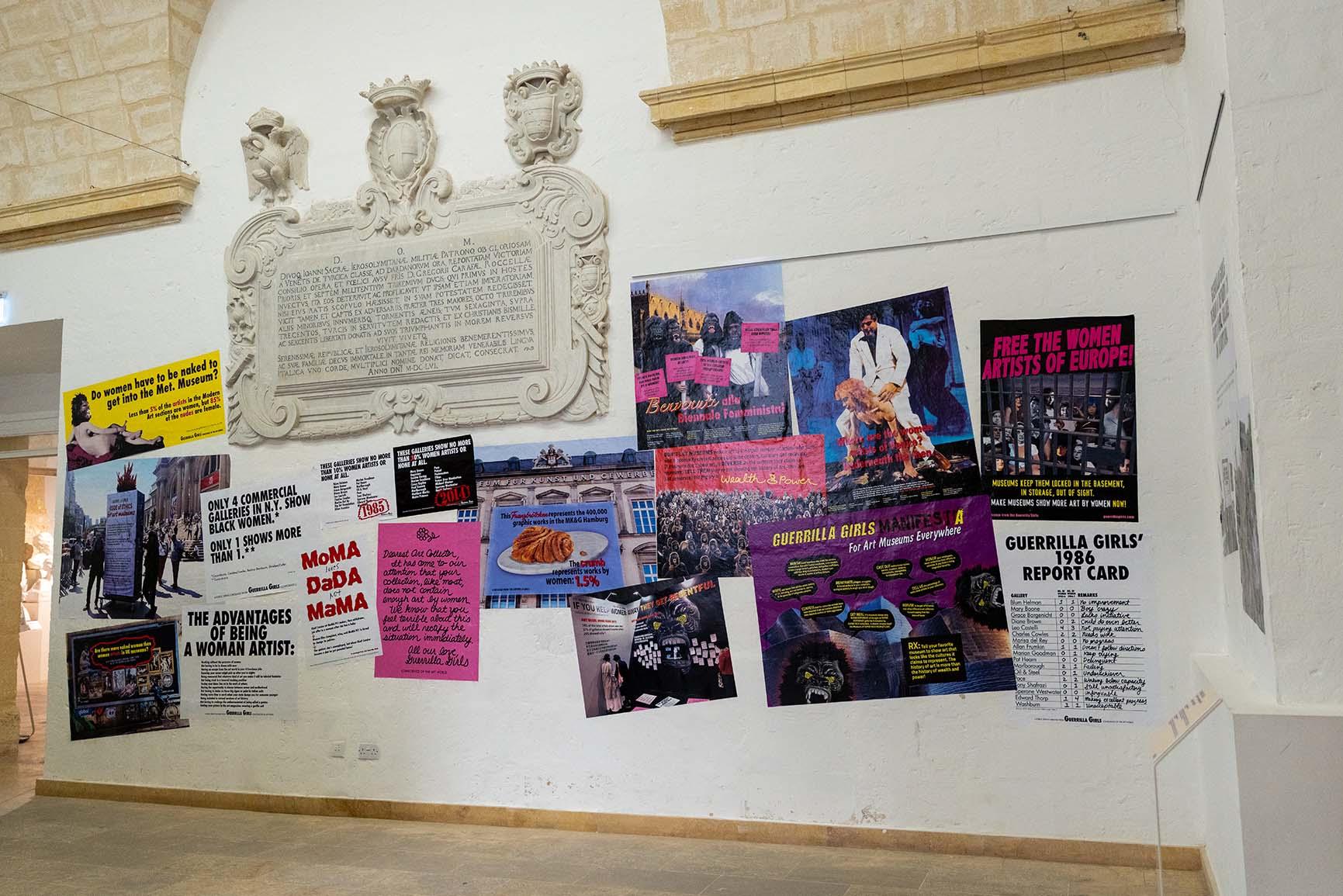 The Guerrilla Girls’ Laugh, Cry, Fight (2026)
Yet instead of a spatial footprint, the work Laugh, Cry, Fight (2026), takes up a sociological one. In it, the collective showcases a career span of poster work, initiating a call to action to take down male “grazing”, among others, and allowing audiences to complain about the status quo by writing their personal protests on a monumental chalk board. The work returns power to the viewer, providing the tools needed to advocate against an oppressive patriarchal system.
This female rights-inclined framing proves significant within Malta’s conflicted attitude towards many women’s rights issues. Yet the radical approach that the Guerrilla Girls traditionally employ seems to be dampened within MUŻA’s setting.
The male grazing video tackles institutional barriers from the inside. However, their “complaints department”, while accessible to MUŻA visitors, could have given a voice to a much wider audience had it been able to break through the Auberge’s walls.
The Guerrilla Girls’ early works thrived on the street walls of New York City, denouncing art institutions for all to see. Their very deconstruction of the invisible boundaries that exist between art audiences and the world at large is a significant part of what historically set their work apart.
Could the Maltese urban landscape have benefitted from a Guerrilla Girls takeover – their posters meeting the tarmac and cement of the daily commute? That radical accessibility may have amplified both their presence and message.
These and many other works across the biennale’s Valletta venues provoke questions of visibility and accessibility
While the work of the Guerrilla Girls foregrounds women’s visibility through its explicit exposure of the systemic underrepresentation of women within museum structures, Therese Debono’s In Place. Where the Land Holds (2025) takes a contrasting approach.
In line with her drive to explore the relationship between landscape, memory and the built environment, Debono shifts the focus towards what is no longer visible: she gives form to what is withheld rather than what is shown. There is no overt narration of the events she is referencing − only small, unpretentious images of sites which witnessed abuse of women and which, over time, have been altered, erased and made ordinary.
Presented within MUŻA, but at basement level, and notably removed from the ornate interiors of the majestic Auberge d’Italie, Debono’s work occupies a space that feels deliberately set apart. Within the framing of the biennale’s overriding theme around jettisoning from past social and value systems, this spatial and visual restraint makes a comment in and of itself.
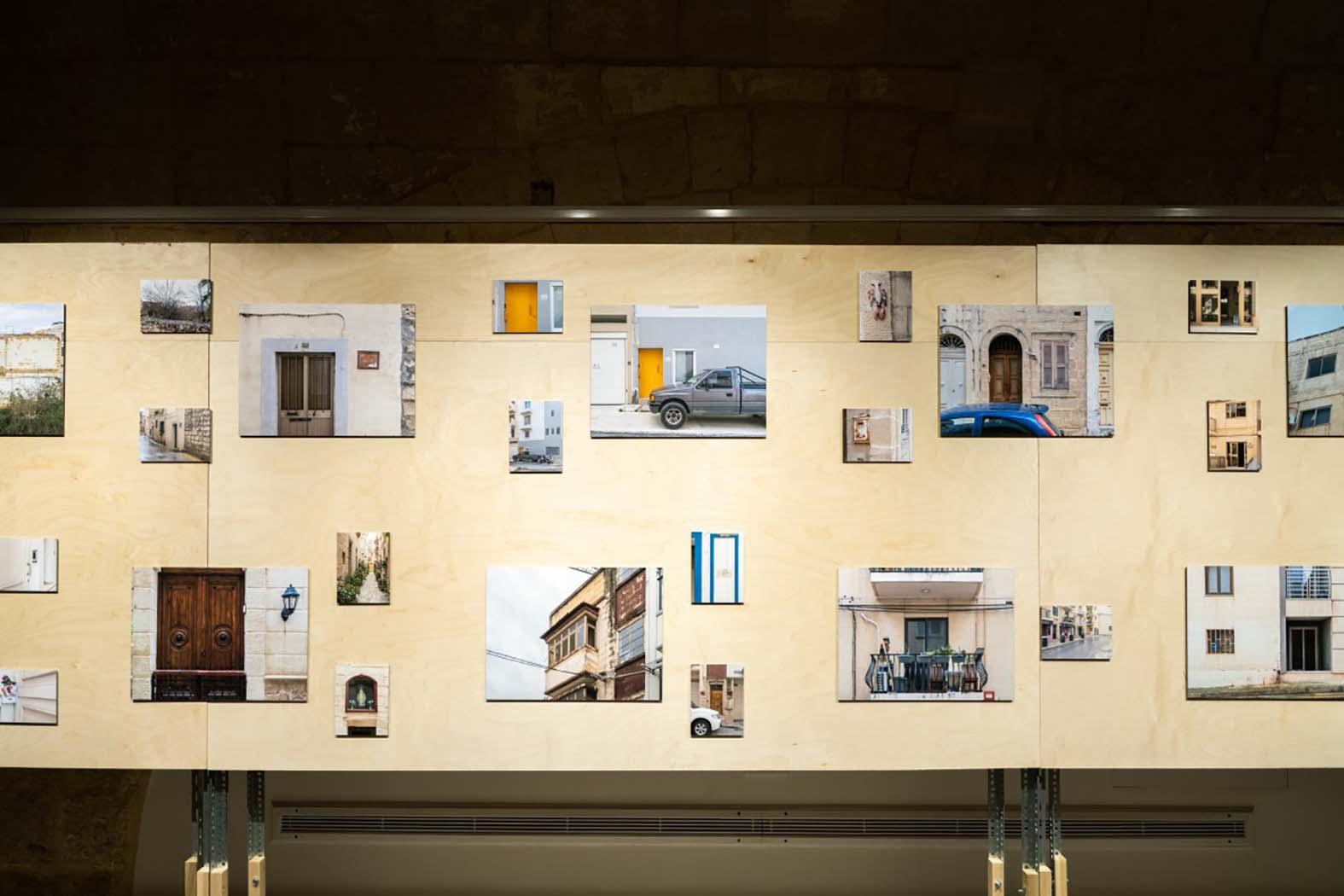 Therese Debono’s In Place. Where the Land Holds (2025) at MUŻA. Photos: Heritage Malta/Malta Biennale 2026
Debono presents her surfaces as apparently composed, even neutral, yet they quietly conceal layers of rupture and erasure. In their silence, the images continue to hold the traces of trauma and of lives marked, and perhaps even ended, by violence.
The near-hidden basement setting inevitably calls to mind how forms of violence – particularly domestic violence – remain obscured within the apparent normalcy of everyday spaces. Both the content and the placement of the work become quiet provocations – inviting us to break from our own desensitisation, to recognise what persists, albeit unspoken, beneath the veneer of normality.
If these works negotiate visibility through placement, interaction or withdrawal, Mohamed Ibrahim Elmasry’s The Economy of Power Pays the Price (2018 and ongoing) introduces a more abrupt condition: enforced absence. Conceived as a large-scale installation of two monumental golden tanks, the work reflects on the economic systems through which power and conflict circulate, exposing the instability beneath structures that appear fixed and absolute.
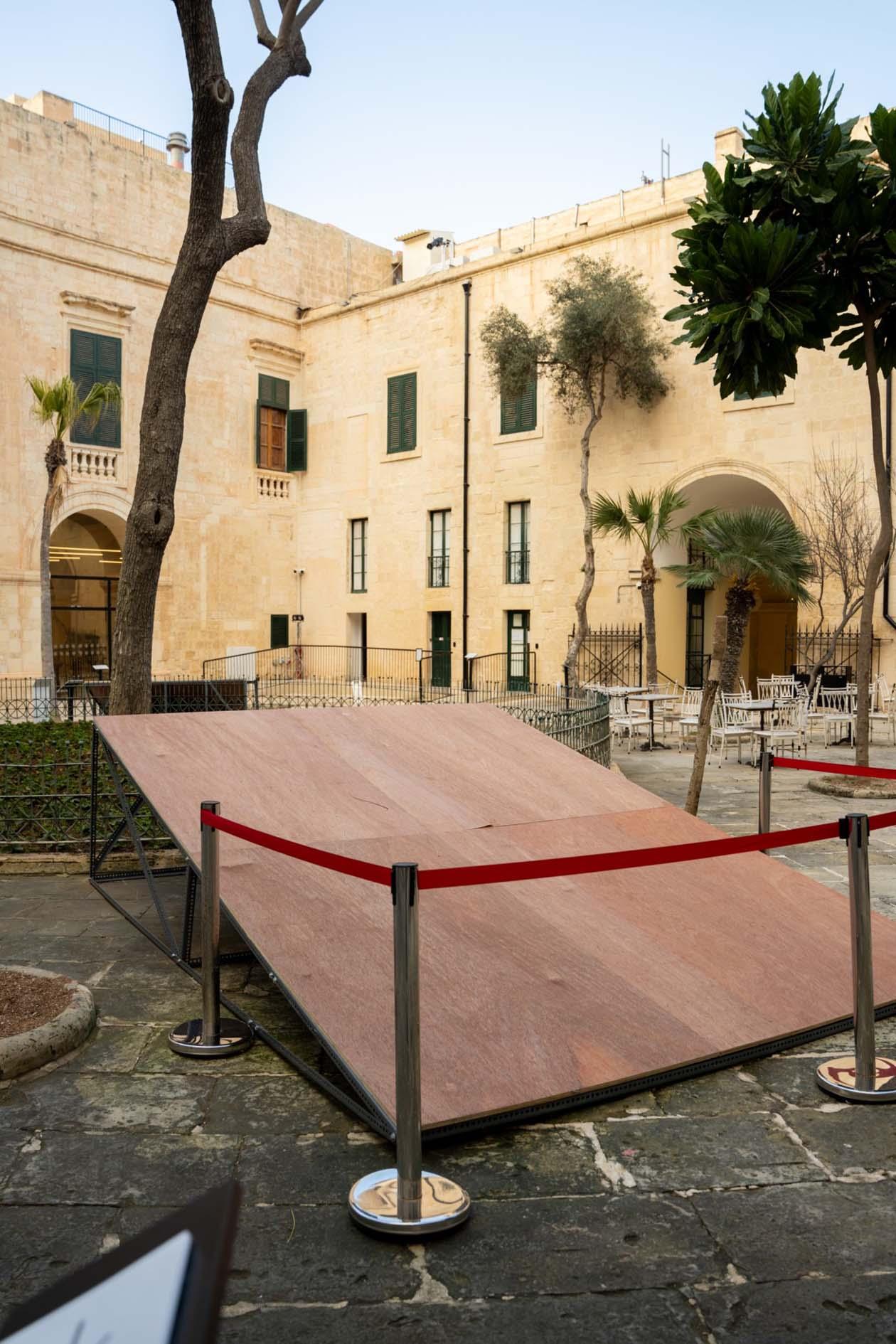
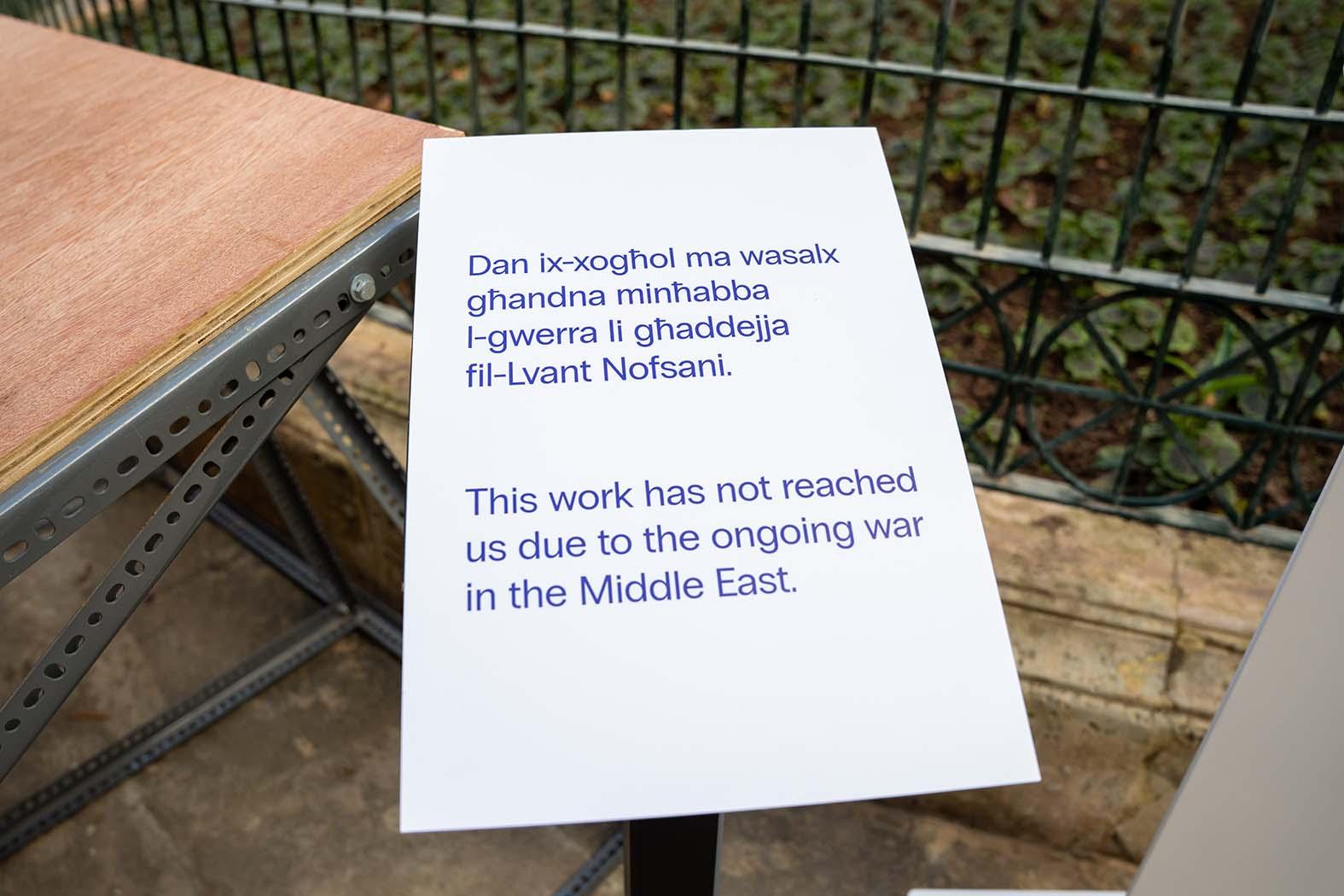 Mohamed Ibrahim Elmasry’s The Economy of Power Pays the Price (2018 and ongoing) did not make it to the biennale.
Originally intended for the Grand Master’s Palace, Elmasry’s work is encountered only through what remains: two empty ramps in a garden space, a label, and a notice stating that it “has not reached us due to the ongoing war in the Middle East”. By the artist’s account, the work became inaccessible and unmoveable from Lebanon as conflict escalated in the run-up to the Biennale opening, halting transport entirely.
Elmasry’s proposed alternative, featuring a reduced version and documentation of this disruption, was not included in the ultimate showcase. The work’s absence reflects both war and curatorial decision-making, raising questions around what it means for a work centred on circulation to be immobilised, and how far its absence is shaped by what can and cannot be seen.
Installed in a small, isolated room just ahead of a chapel within the Grand Master’s Palace, Lumen (2025), by artist Austin Camilleri, reveals itself discreetly at first glance. Unlike Siġġu, his piece for the 2024 Malta Biennale that stood within Republic Square, Camilleri’s work for the second edition resides indoors.
First shown in a 2025 exhibition at the Malta Society of Arts, Silence Within Abundant Birdsong, Camilleri returns to limestone – a material synonymous with Malta. A small screen reveals the stone’s interior, resembling an ultrasound. Emerging from a period marked both by birth and grief, the evocation of ‘womb and tomb’ arises almost instinctively, suggesting both a birth and death that meets the same material that forms the islands.
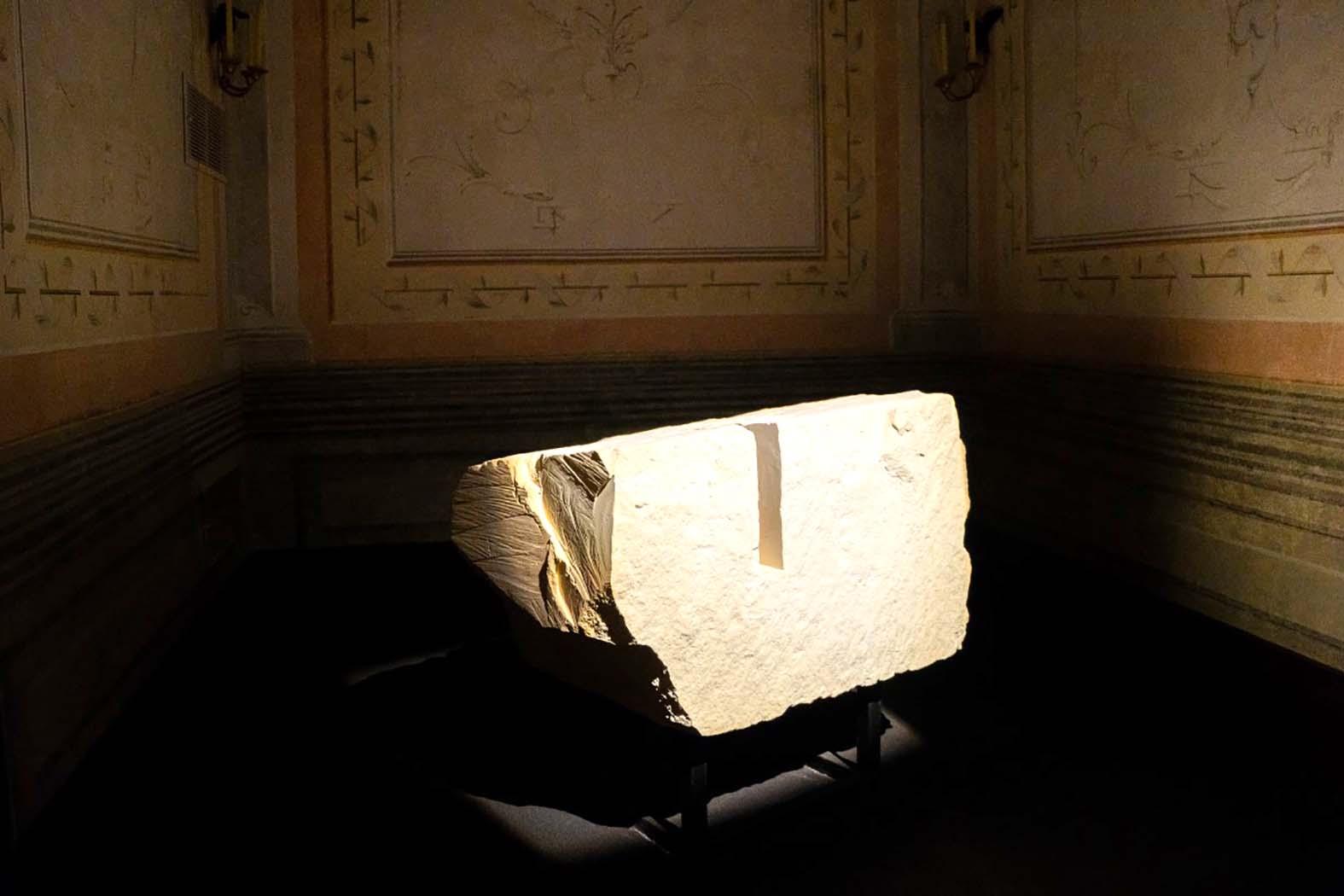 Austin Camilleri’s Lumen at the Grand Master’s Palace.
Lumen functions more as a protracted encounter rather than a statement. When revisiting Siġġu – a work that overtly confronts the space it occupies in a way that is conceptually very close to this year’s curatorial theme – Lumen’s narration itself becomes the point of greatest intrigue. Less explicit than the 2024 piece, what does Lumen’s subtler confrontation bring to a curatorial statement that seems to be expressly – and alliteratively – about a direct and clean break?
These and many other works across the biennale’s Valletta venues provoke questions of visibility and accessibility – which in turn allow audiences to engage with the biennale’s central theme with different intensities and varied efficacy.
Some, like Cattelan’s, invite engagement through the bold juxtaposition of recognisable landmarks; others, like Camilleri’s, through a subtle call for communion with material and land. Others do it through sound, performance, communal activism or through the reframing of the mundanity of violence. Some, like Elmasry’s, do it through the echo of their total absence.
This article is part 1 of a review of the Malta Biennale that has been collaboratively authored by the 2026 Modes of Art Writing workshop students, led by Ann Dingli and held annually within the Department of Art and Art history, Faculty of Arts – University of Malta. The second part will focus on the biennale works on display in Gozo and Vittoriosa.