‘Curious. Very strange dialect’: 1950s Malta through the eyes of a travel writer
Leading 20th-century Catalan author Joseph Pla was surprised by Maltese society and its dialect
Valletta in the 1950s had a “southern but clean appearance”; the Maltese preserved their “very strange dialect as if it were their own blood”; the shops were better than Italy and Times of Malta was the best newspaper, according to diary entries of the leading Catalan writer of the 20th century.
To Josep Pla, Malta was “very curious. Catholic”. This is what the prolific author wrote in his diary in March 1956, as he visited the island by boat on his way to Athens.
The entries were unearthed by researcher Chiara Cecalupo, from the Department of Classics and Archaeology at the University of Malta, who has been studying the Catalan language as a hobby for many years.
While reading Pla’s private diaries, Cecalupo discovered that the writer had visited Malta 70 years ago, and his observations about the island were published in a Catalan newspaper during the Francoist regime.
Pla, a crucial figure in the modernisation process of the Catalan language, wrote continuously and extensively, publishing an impressive number of opinion articles, newspaper reports and lengthy travel pieces from many countries around the world.
At each stage of his travels, he would write articles in Spanish for the Barcelona newspaper he worked for, Destino, and entries in his personal diary, in Catalan.
Among these journeys was the long sea adventure from Barcelona to Athens, during which he visited Malta for the first time. On March 22, 1956, the boat City of Messina arrived here, and from it disembarked the Catalan journalist.
His visit took place just one month after the Maltese voted in favour of full integration with the UK, under Dom Mintoff’s integration plan.
Pla’s lengthy article, ‘Malta: A theocracy under the British flag’, was penned on the ship while sailing. It was published in the newspaper two months later, featuring interesting snapshots of local everyday life.
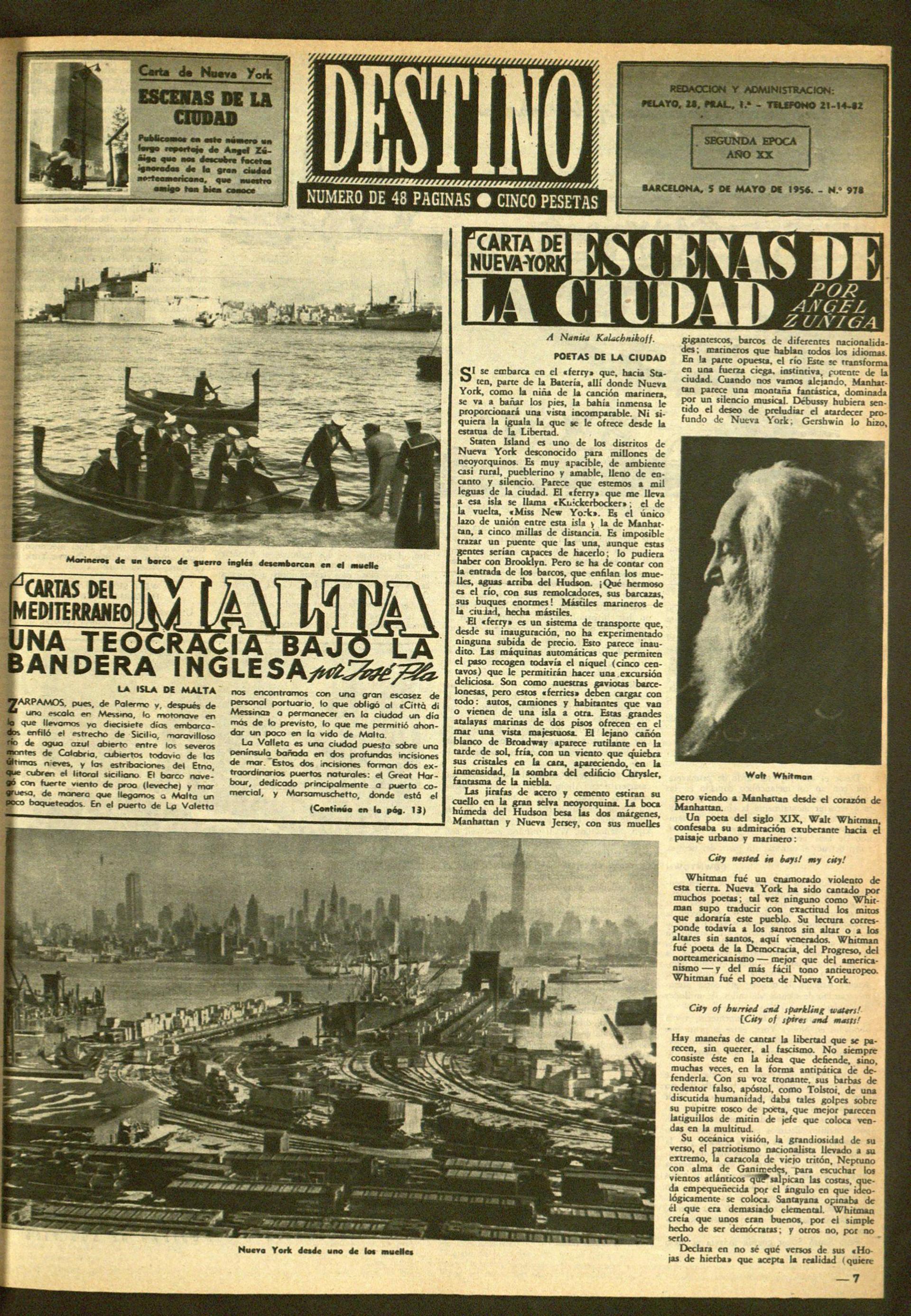
The lengthy article on Destino was accompanied by various pictures of Malta
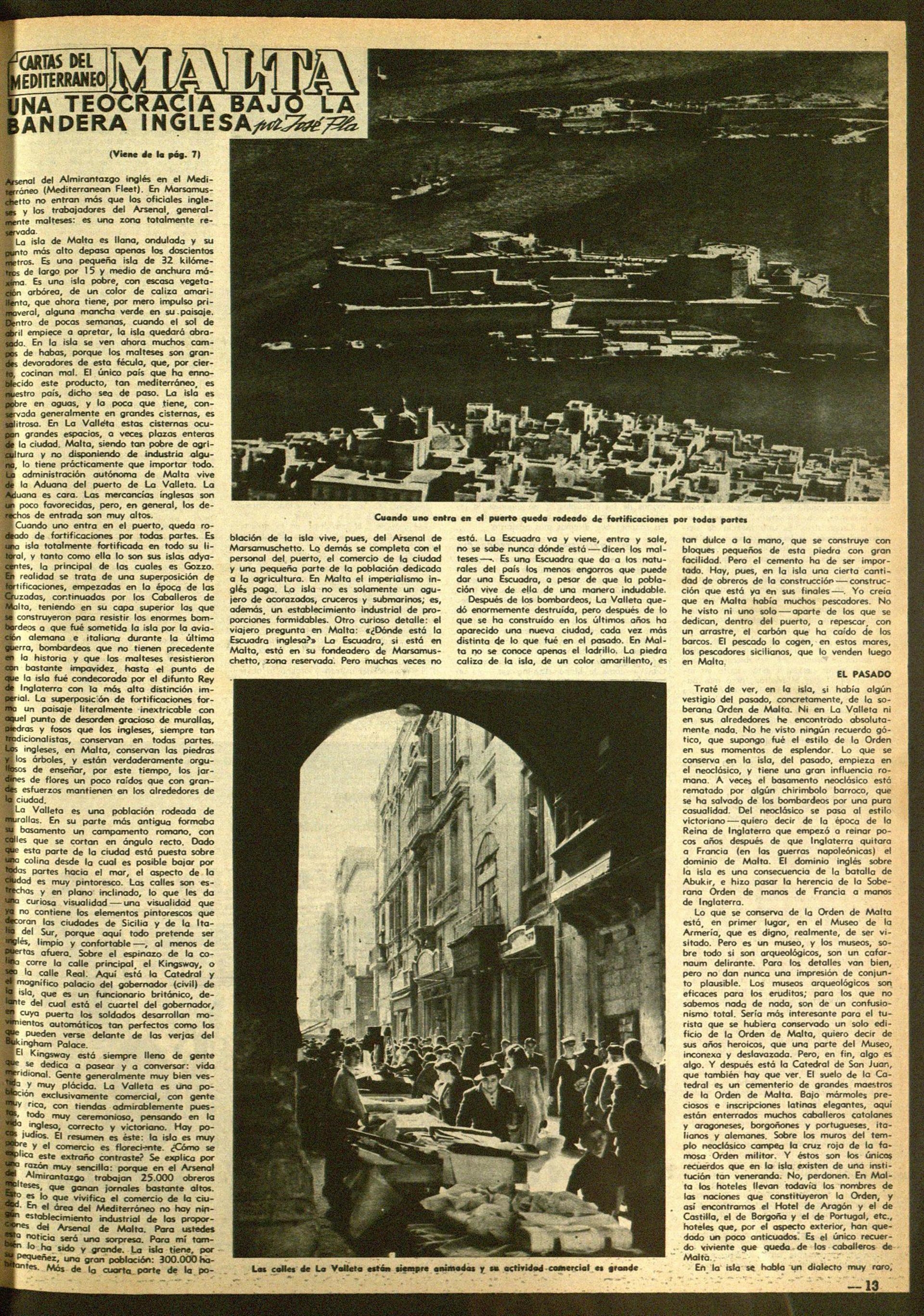
.
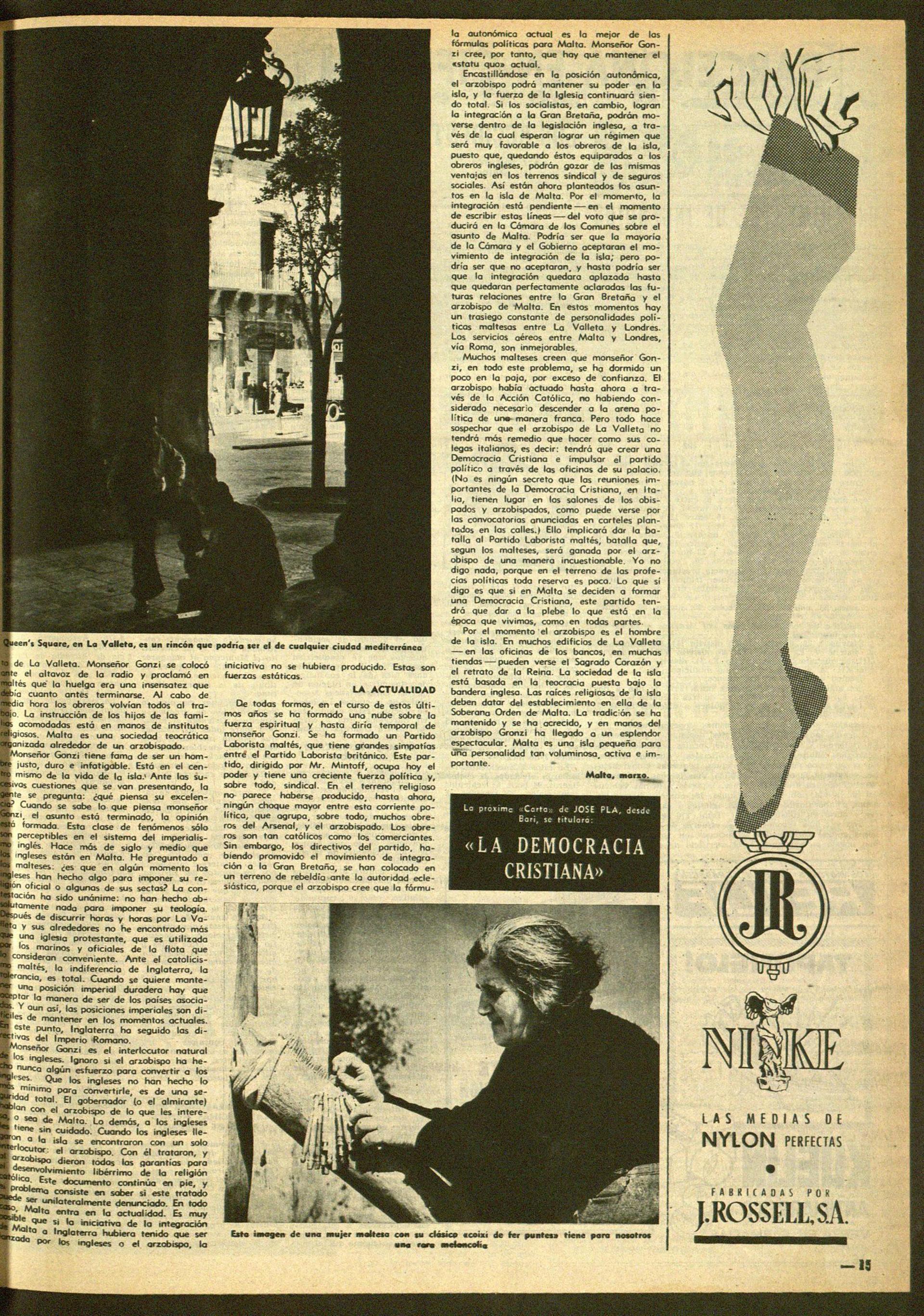
.

.
Part of a series, ‘Letters from the Mediterranean’, Pla offers a vivid description of Valletta: its imposing fortifications, picturesque, southern but clean appearance, full of people and fervent commerce.
Struck by the tombs of the Catalan knights at the ever-impressive St John’s Co-Cathedral, which he visited, Pla was also intrigued by the language – “a mixture of Sicilian, French, lingua franca and much of the language spoken by the Muslims”.
Pla noted: “A very strange dialect is spoken on the island, but the Maltese preserve it as if it were their own blood.”
He also makes a brief reference to this newspaper: “The best newspaper is written in English: it is the Times of Malta, but it seems more a newspaper for the English than for the locals.”
In concluding his article, Pla dedicates a long “digression” to the cultural and political power of the bishop, at the time Mgr Michael Gonzi, his relationship with Dom Mintoff’s Labour Party, and the 1956 referendum, about which he had already written a long account in an issue of Destino.
The PN had boycotted Mintoff’s referendum, and the proposal was also rejected by the Catholic Church led by Gonzi.
In his private diary, the writer describes his experience in Malta in a more informal, intimate and detailed way.
Even his interest in the Maltese language may be read in connection with Catalan bilingualism
“The mixture of dialect elements is curious. Valletta is very big; I am told 300,000 people. The island is low and very poor,” he noted.
“Of an easily workable yellow limestone. The architecture – with the lack of Gothic – is curious. It is a neoclassical city. Many people in the streets. The shops are good, better than Italy,” he writes about the capital city, its cathedral, the governor’s palace and the working-class district, which he visited as soon as he arrived in the morning of March 22, 1956, following a restless night.
The next day, Pla comments that it is “full broad-bean season” and notes that “the country is very curious, Catholic”.
The author was not spared a taste of the south wind during his pitstop in Malta, and the scirocco features in the author’s diary, with its “yellow, unreal, almost orange, cloudy atmosphere”.
These texts were first published in 2014 in La Vida Lenta, Pla’s unedited diaries, and have never been translated from Catalan, said Cecalupo, who stumbled upon them and translated them into English.
“I liked the fact that such an important travel journalist reported about his stop in Malta through his journey in the Mediterranean. I liked that he was so surprised by Maltese society that he perceived it as divided into the British on top and then Maltese people living their life autonomously,” Cecalupo said.
They also shed light on a connection between Malta and Catalonia, she said.
“Pla was clearly very interested in Maltese politics because he sees it as a very special situation, especially after the 1956 referendum,” continued the researcher of catacombs and underground explorations in the Mediterranean.
“Even his interest in the Maltese language may be read in connection with Catalan bilingualism,” she maintained.