‘Debate on childcare should focus on quality, not shame’: WHO official
Bishop’s comments could be catalyst for important national debate, Natasha Azzopardi Muscat says
Stigmatisation of parents – especially mothers – for sending their young children to childcare centres may discourage them from seeking support, to the detriment of both the family and the child, a senior World Health Organisation (WHO) official has warned.
Natasha Azzopardi Muscat, WHO Europe’s Director for Country Health Policies and Systems, noted that research consistently shows that when people feel stigmatised, they are less likely to ask for help.
She stressed that not all parents have the same opportunities or support structures to provide a nurturing environment while they are at work. For some families, the only alternative to childcare may be older grandparents who may not always be able to provide the level of engagement a young child needs.
Out of shame or fear of judgement, those parents may avoid childcare even when it would benefit the child.
She was reacting to comments by Gozo Bishop Anton Teuma, who sparked backlash after claiming that parents are treating their babies as “objects” by sending them to childcare centres under the age of two.
Out of shame or fear of judgement, those parents may avoid childcare even when it would benefit the child- Natasha Azzopardi Muscat
“If your baby is treated simply as an object, once they are two or three months old, they will be thrown into a childcare centre,” the bishop said in a recent homily.
His remarks drew criticism from several quarters, including Parliamentary Secretary for Equality Rebecca Buttigieg and Environment Minister Miriam Dalli, who condemned the comments as deeply unfair and out of touch with the realities faced by modern families.
The Childcare Centres Providers Association also responded, insisting that childcare centres have become “an integral part of children’s early upbringing, supporting working parents and contributing towards the child’s early development”.
Quality of care matters
In a comment on Facebook, Azzopardi Muscat stressed the importance of looking at research. It was clear that the earliest years of life are a uniquely sensitive period for brain development, she said. However, what matters most for infants and toddlers is not where care happens but how it happens.
“Children thrive when they receive nurturing care – that is, care that ensures health and nutrition, safety and security, responsive and loving relationships and opportunities for early learning through play and interaction.
“WHO does not state that children under two should never attend childcare. Instead, it emphasises that all caregiving – whether by parents, relatives or professional caregivers – must be responsive, stable and high quality,” she said.
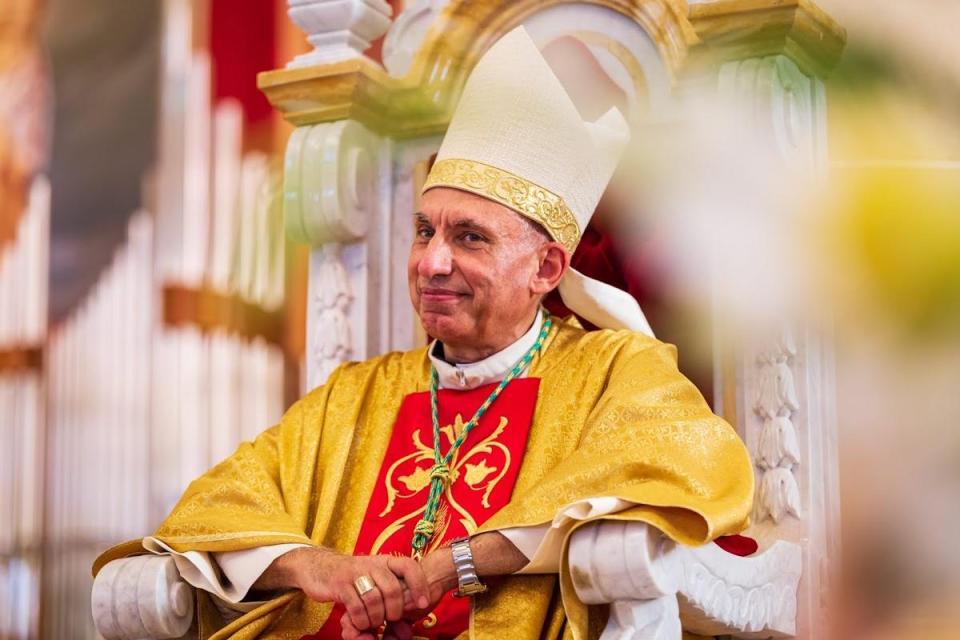 Gozo Bishop Anton Teuma warned against children being placed in childcare centres under the age of two.
Bishops’ comments not to be brushed aside
While stressing that stigmatisation can backfire, Azzopardi Muscat told Times of Malta that the bishop’s words could not simply be brushed aside. She acknowledged that there are cases where children spend up to 10 hours a day in childcare centres.
She emphasised that effectiveness is not a one-size-fits-all issue and depends on the child and the family’s specific situation. Poor-quality care – marked by high staff turnover, low responsiveness or a lack of emotional security – can be harmful at any age. High-quality childcare, by contrast, can support development and help reduce inequalities, especially when families lack other forms of support.
Balance is therefore required, and this is where the bishop’s comments could act as a catalyst for an important national debate. However, childcare is only one measure within a wider set of policies that must be considered – particularly in the context of Malta’s low fertility rate.
The WHO, she said, highlights the role of public policy. Paid parental leave for both parents, breastfeeding protection, mental-health support for parents and well-regulated, high-quality childcare services all help families provide the nurturing care young children need.
“As a country struggling with a very low birth rate let us seize the opportunity to examine how our policies can be improved to allow both parents to participate in raising their children to the greatest extent possible while also participating in the workforce. This is the real question to be answered,” she said.
Working mothers in Malta are entitled to a total of 18 weeks of maternity leave – approximately four-and-a-half months. Free childcare is currently available from the age of three months to three years.
A recent Central Bank analysis noted that free childcare has helped thousands of women move out of economic dependence. The study highlighted a sharp increase in employment among women aged 25 to 49 starting in 2014, the year childcare services became free for working parents.