Denton de la Cour Ray, the British soldier who painted at Valletta's Main Guard
Among the paintings uncovered on the walls the Main Guard in Valletta created by British officers who were actually artists, many were by the renown anti-war cartoonist Denton de la Cour Ray
Malta enjoys various artistic legacies of the British colonial era but one unique location contains a collection of artistic records, some not so professional, of various British regiments that were stationed in Malta.
Many of these regiments were assigned to furnish a squad of between seven and 14 soldiers, led by a sergeant, for guard duties at the Main Guard opposite the then Governor’s Palace in Valletta. Many still remember the two soldiers who paced across the front of the portico or stood on guard and were replaced by others at intervals.
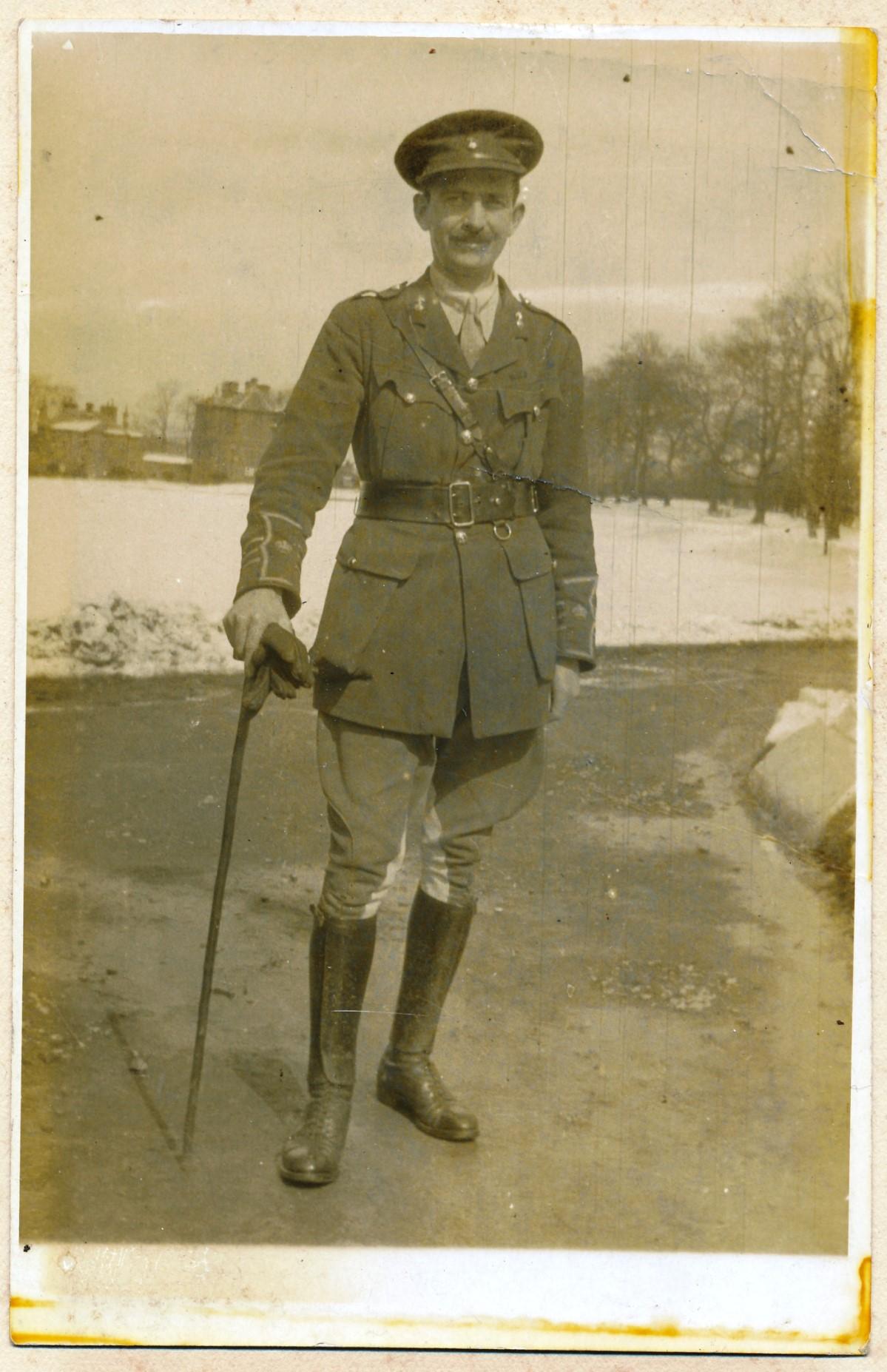 Denton de la Cour Ray
The military life of the Main Guard started around 1814 when Malta was handed to Britain as a protectorate and a military guard was posted at the Governor’s Palace. The ground floor had served as the quarters for the soldiers that mounted the guard, while the upper floor was the officers’ quarters and later also their mess hall.
British regiments, and also those Maltese of the British Army, took pride in their badge, and many can still be found carved in former barracks, living quarters and other auxiliary buildings. But the Main Guard has something more unique to Malta and possibly even beyond its shores.
During their stay in Malta and duty at Main Guard, the regiments left paintings on the walls that depict their badge, the officers, memories of home, caricatures, historical events, battles, of their sweethearts and even certain puns or jibes that only the soldiers of the time would have understood. In short, these walls contain a pictorial record of most of the British and Maltese regiments that performed guard duty at the Main Guard.
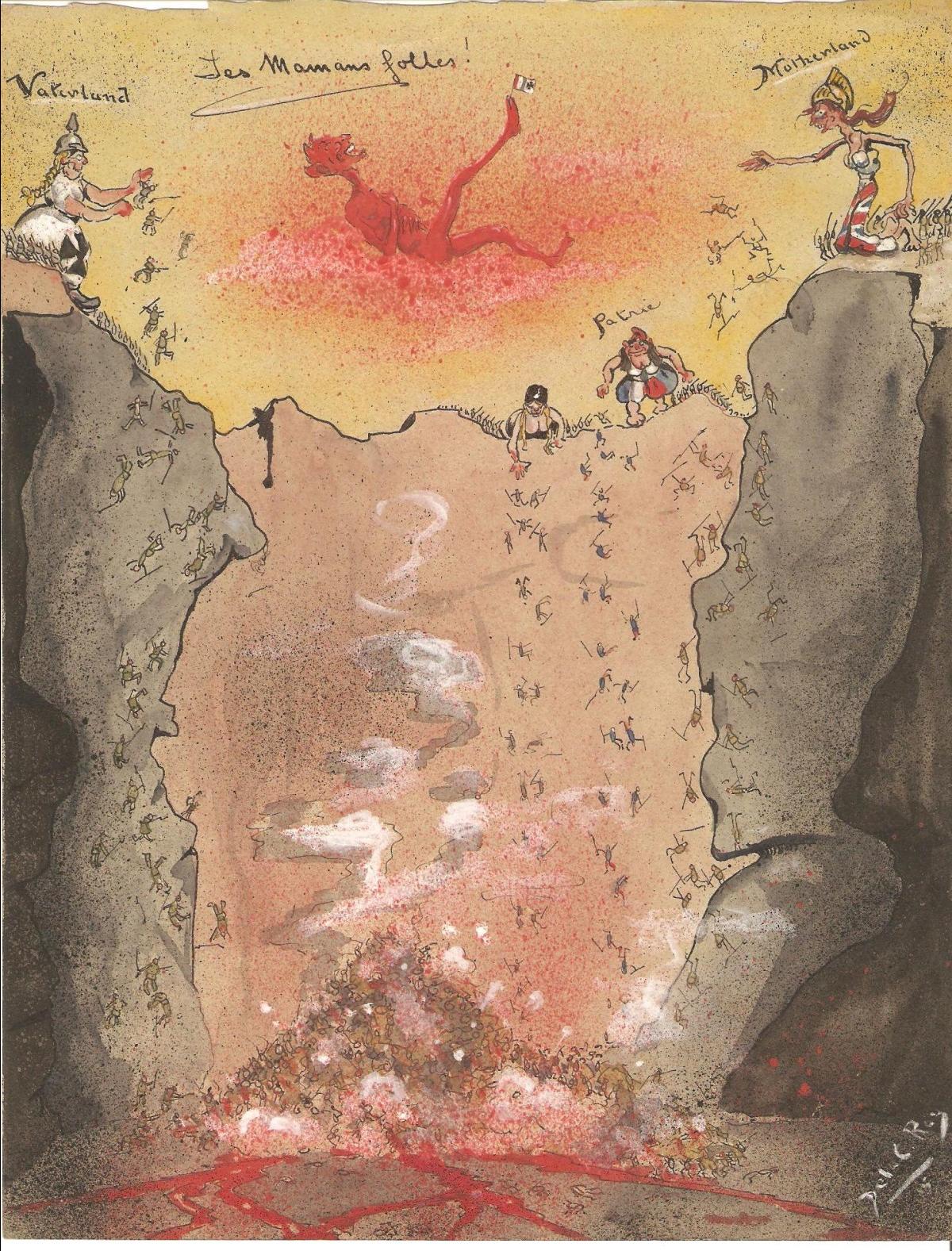 One of Denton de la Cour Ray’s many anti-war cartoons, The Crazy Motherlands, depicting the pathos and futility of life in the trenches during World War I.
During these past years, conservators from Heritage Malta have painstakingly restored these wall paintings and others that were uncovered under the various coats of whitewash. The paintings had suffered a lot of damage after being exposed to sunlight and being covered up for many years. Since these conservators are not Maltese, they needed information to guide them regarding what many of these paintings represent, for example, on the British army and its traditions, on regimental badges and other such information relating to these regiments, their histories and their stay in Malta.
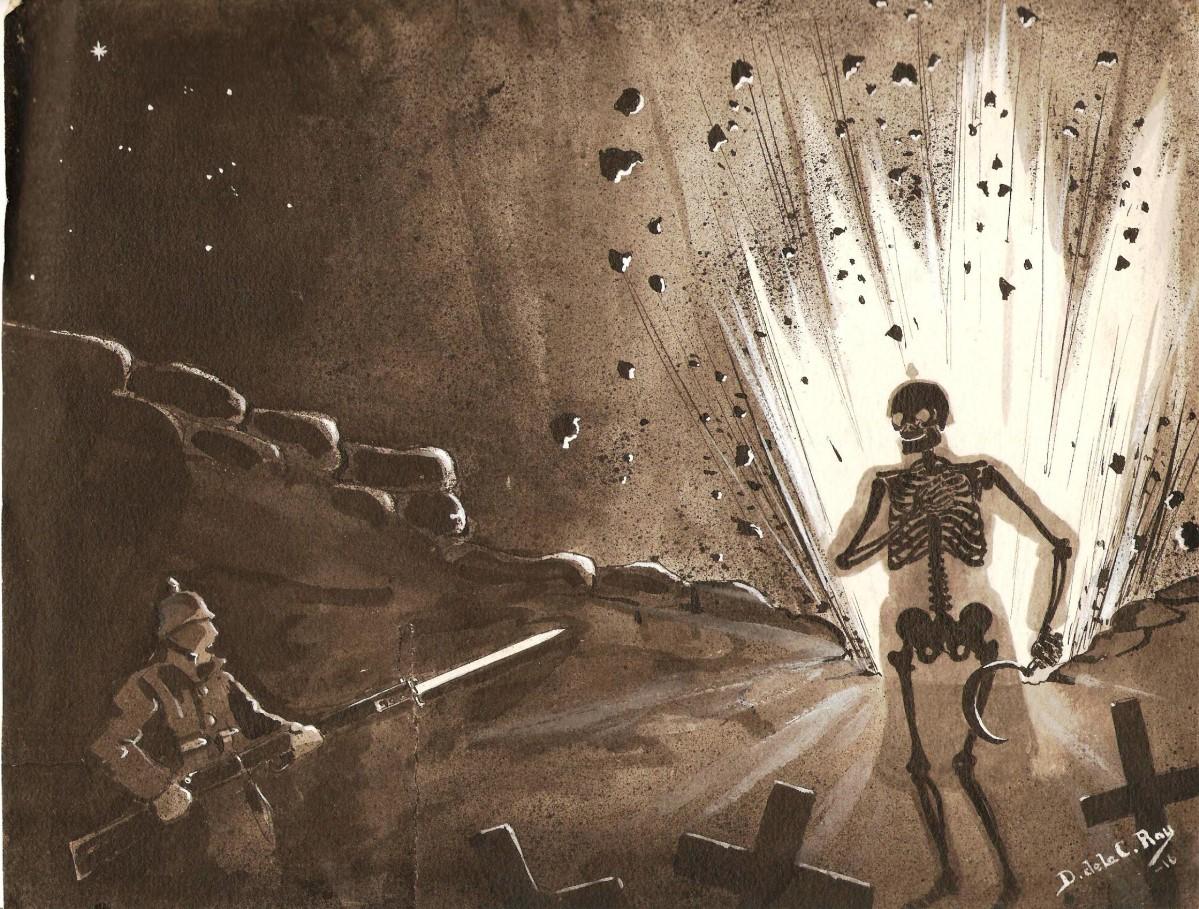 Denton de la Cour Ray’s cartoon Death Harvesting on the Front, 1916.
Many of the paintings are by ‘artists unknown’ as they are either not signed or the signature is obscure or was painted over at some time. Furthermore, they were not all done by the hands of officers but some by soldiers who had some artistic qualities. What is interesting is that certain officers who painted some of these wall paintings were actually artists, and even renowned ones.
His cartoons, which question and criticise, are part not only of our heritage, but of our present and our future- Denton de la Cour Ray’s grandson, Brian Mathew
One particular officer and artist was Denton de la Cour Ray of 2nd Battalion, The Inniskilling Fusiliers. The 27th (Inniskilling) Regiment of Foot was raised in 1689 by William III from the troops who had defended Enniskillen when it was besieged by King James. On July 1, 1881, the 27th linked with The 108th (Madras Infantry) Regiment to become The 1st Battalion The Royal Inniskilling Fusiliers. The 108th became the 2nd Battalion.
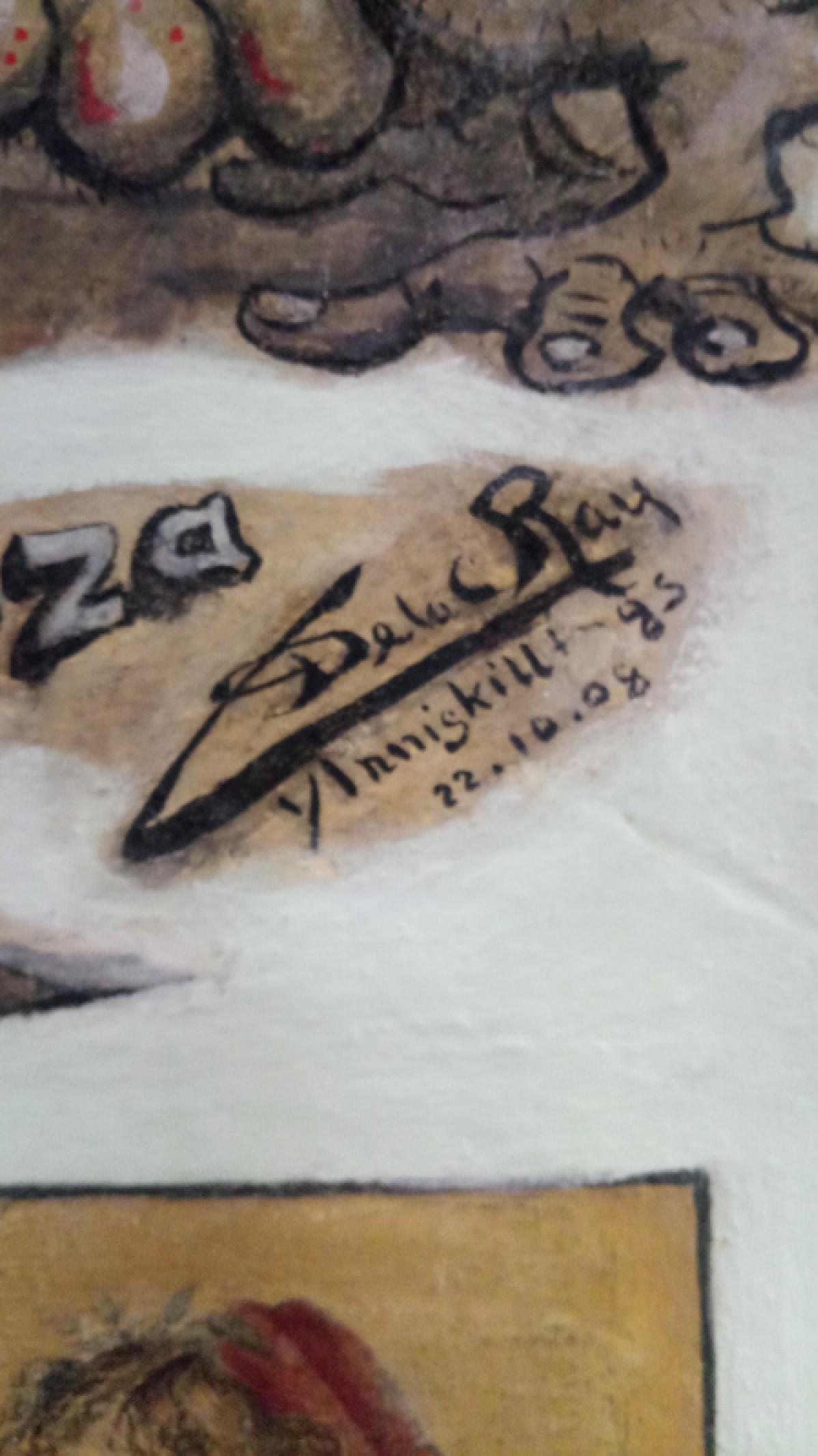 Denton de la Cour Ray’s signature under one of the wall paintings at the Main Guard in Valletta.
On July 1, 1968, The Royal Inniskilling Fusiliers merged with the Royal Ulster Rifles and the Royal Irish Fusiliers (Princess Victoria’s) to form The Royal Irish Rangers, an existence that was quite short, as in 1992, the regiments merged with the Ulster Defence Regiment to form the Royal Irish Regiment (27th (Inniskilling) 83rd and 87th and Ulster Defence Regiment).
Denton de la Cour Ray was born on April 17, 1881, at St John’s in Fredericton, New Brunswick, Canada, to Alfred Donald Ray and Catherine Adelia née Dever, a mixed Protestant and Catholic marriage requiring special dispensation. His maternal grandfather was James Dever, a senator. Denton married Emily Florence Dorothea Thompson at Omagh in 1915 and had three children, Valerie, Hubert Denver and Celeste.
After completing school, on January 8, 1901, Denton was appointed as a 2nd Lieutenant (unattached) and commissioned on March 9 in The Inniskilling Fusiliers, then one of the Irish regiments of the British Army. He was promoted to lieutenant on July 18, 1902 and served in the 2nd Anglo-Boar War as part of the 5th (Irish) Brigade (Queen’s South Africa Medal with five clasps); in China in the wake of the Boxer Rebellion; and in India.
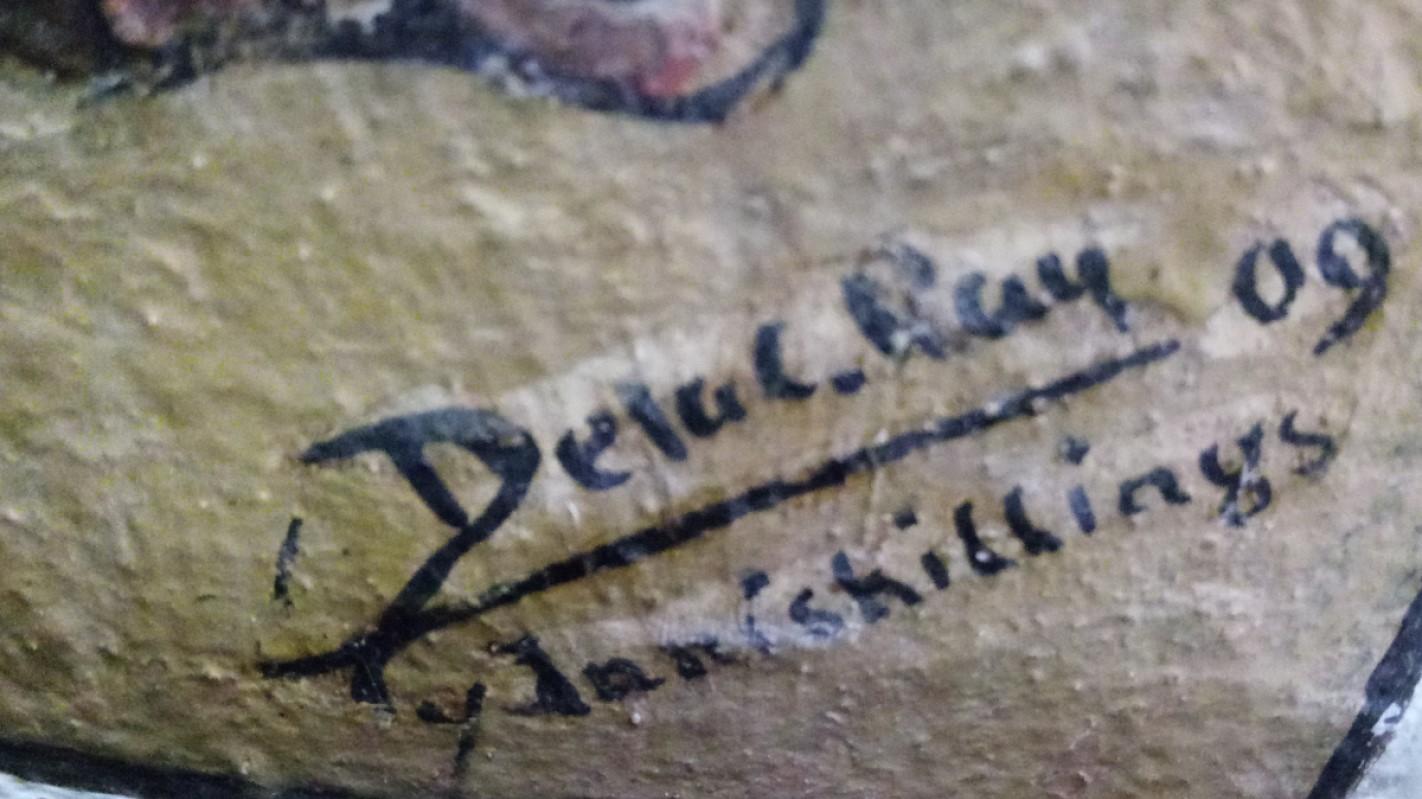 Close-up of Denton de la Cour Ray’s signature.
Denton’s connection with Malta was when The 1st Battalion. Royal Inniskilling Fusiliers was stationed in Crete, as Crete formed part of the Malta Mediterranean Command. The regiment arrived in Malta from Crete on the Sicilia on February 28, 1908, occupying parts of St George’s Barracks and St Andrew’s Barracks at the Pembroke Camp, during which stay, the regiment lost two of its members. However, the stay in Malta was a brief one, as the regiment departed Malta for China in September 1909.
Denton was promoted to Captain on February 19, 1910. During World War I he served with the regiment in Gallipoli in 1915, and in France the following year for service on the Western Front. He was promoted to major on January 8, 1916. It was around this time that Denton came down with TB and he subsequently retired from the army on June 1, 1921.
Denton spent his later years as a sergeant instructor training the volunteer Ulster Special Constabulary, commonly called “B-Specials” or “B Men”, a quasi-military reserve special constable police force set up in October 1920. He received the King George V Coronation Medal. He was also a linguist and acted as a translator, speaking both French and Russian. Denton passed away in Tyrone, Ireland, on December 15, 1959.
But Denton was also an artist and had a number of his cartoons published in the Bystander magazine, many of which were anti-war, showing the pathos and futility of life in the trenches during World War I, as well as the common nature of humanity across borders.
As his grandson, Brian Mathew, explained: “His cartoons which question and criticise, are part not only of our heritage, but of our present and our future. They are necessary because of their ability to pose questions, capture people’s imagination and then provoke people to share those thoughts”.
Since Denton de la Cour Ray was posted in Malta and he was an officer at the Main Guard in Valletta, it was to be expected that he would have left various contributions on the walls of the officers’ mess. Although there are various paintings at the Main Guard that are dedicated to the Inniskilling Fusiliers, it is perhaps the caricature of himself as a lieutenant in a khaki uniform and solar topee that is most striking.
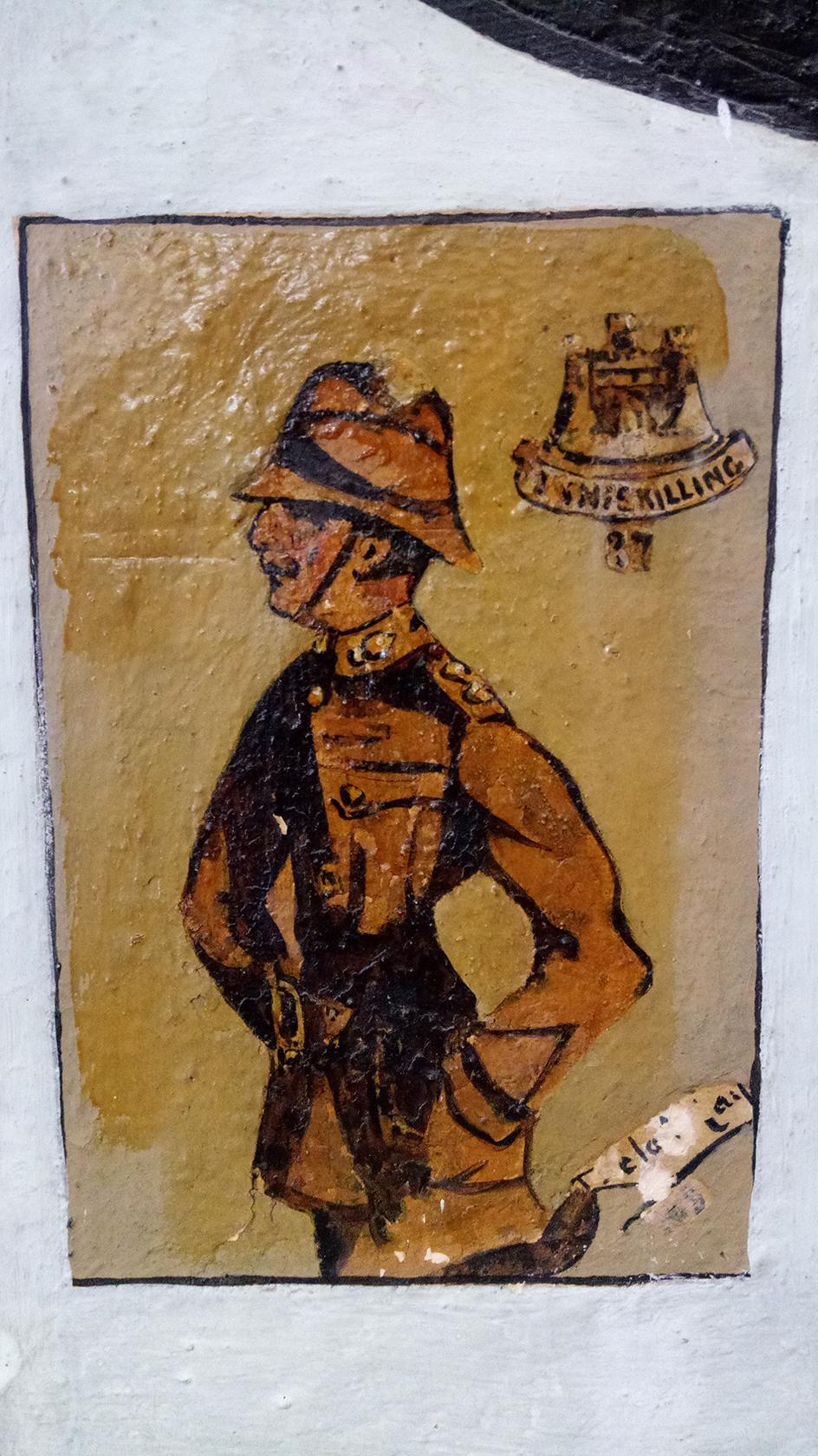 Self-portrait in uniform.
At top right is the badge of the 1st/27th (Inniskilling), the Castle of Enniskillen with the flag flying to the right, which is the central device of the ‘grenade badge’ of the regiment, below which is ‘27’, which dates to when the regiment ranked as the 27th Foot in 1747. Although slightly scratched, at bottom right of the painting is the signature ‘De la C. Ray’. The painting was most likely done some time between 1908 and 1909, when the regiment was in Malta, stationed at St Andrew’s Barracks at Pembroke, and he was on duty at the Main Guard.
Most of his wall paintings can be easily identified due to having what look like ribbons on certain corners; however, the one that practically recalls and mimics the officer while on duty at the Main Guard is De la Cour Ray’s largest and most detailed piece, entitled Main Guard Pleasures, which depicts the contrasts between winter and summer at the Main Guard.
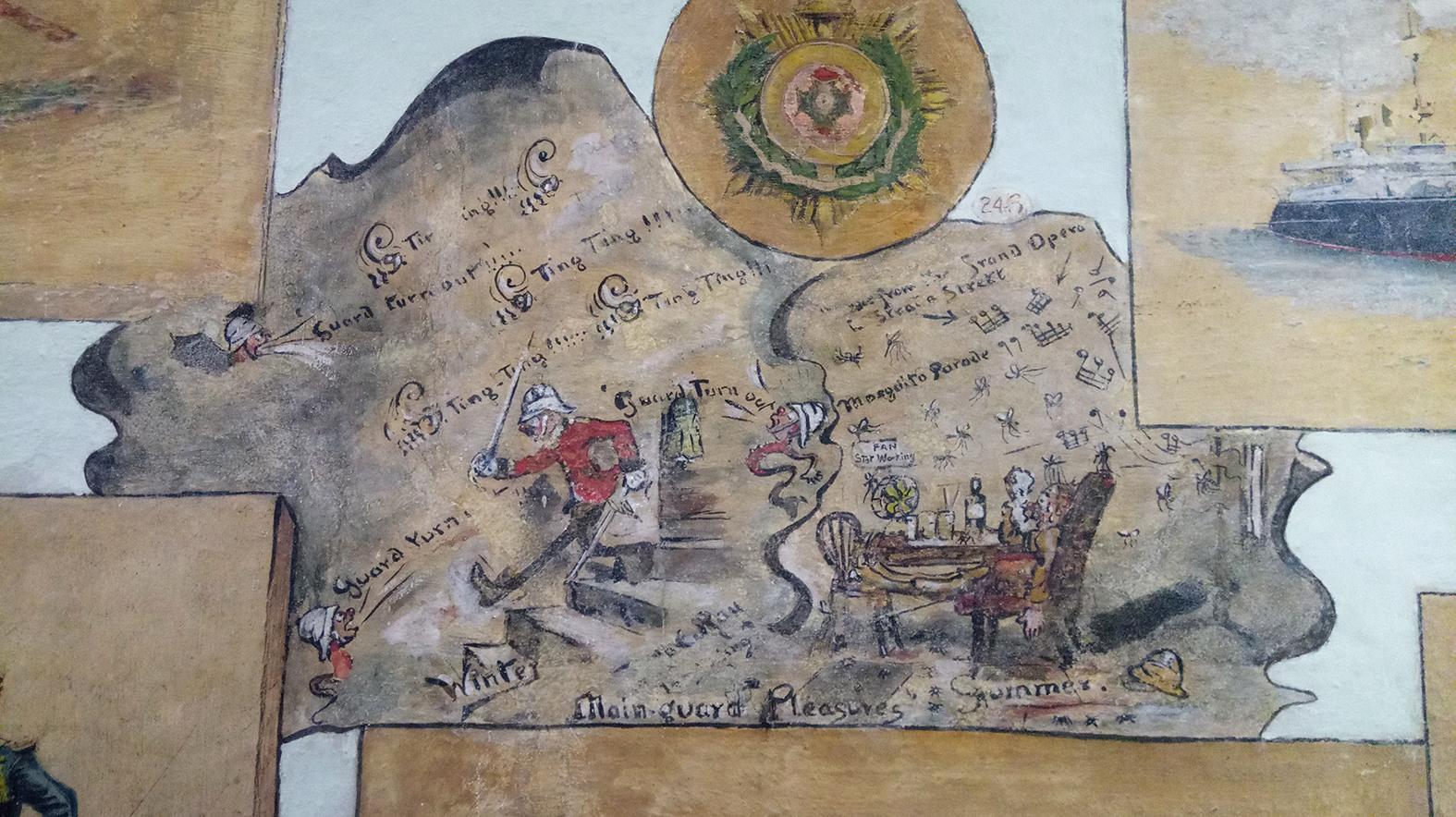 Main Guard’s Pleasures, ‘Guard, Turn Out!’
In Summer, the officer is sweating breathlessly in his underwear in the summer heat, with flies buzzing around him and floating musical notes, with the captions, ‘Music from the Grand Opera at Strada Stretta’ and ‘Marguits Parade’. On the table are a bottle and a glass, and an electric fan with a sign ‘Fan not working!’
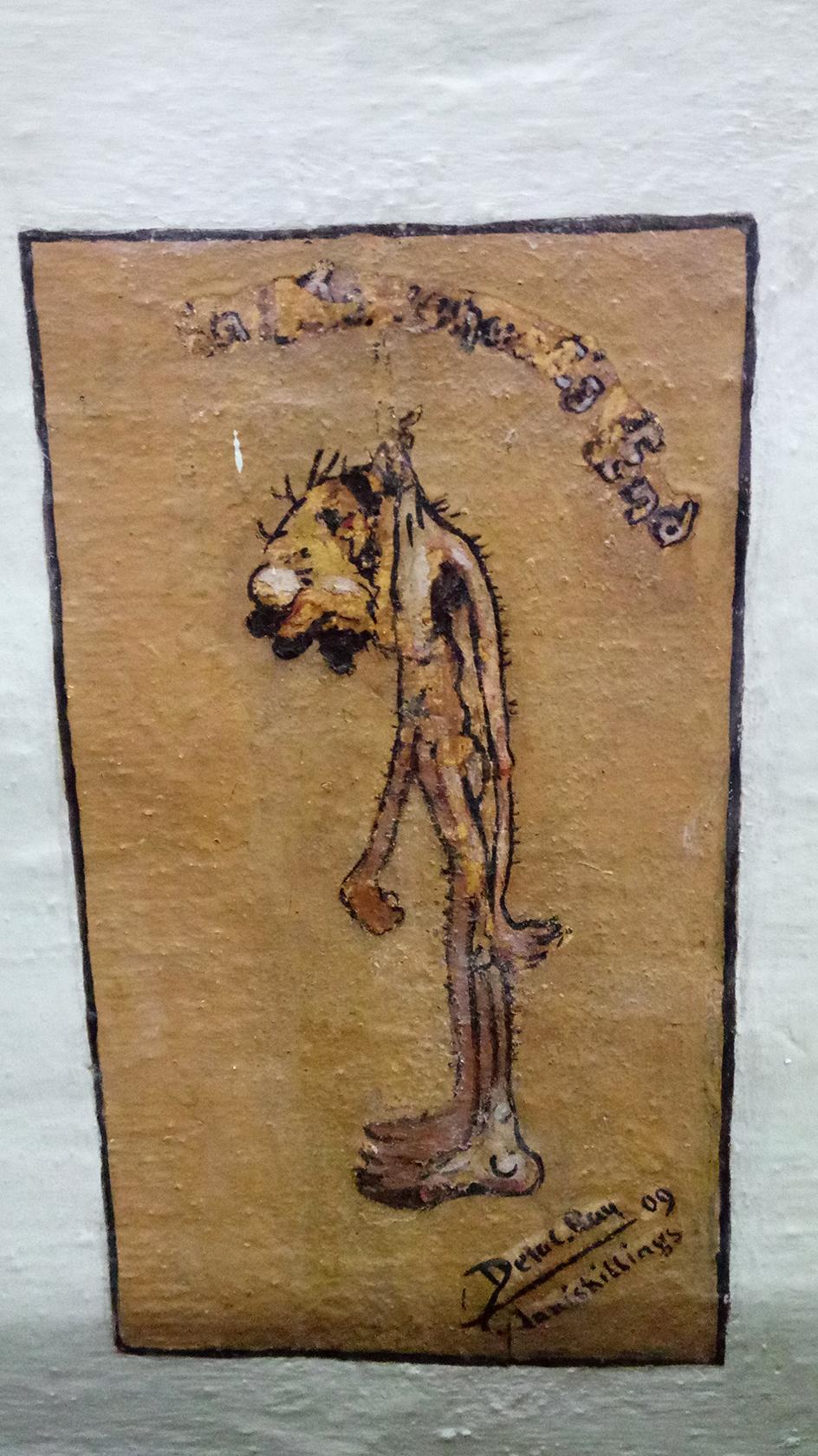 A Denton de la Cour Ray caricature of a drunkard looking much like an empty sack hanging from a peg.
Meanwhile in Winter, the duty sergeant repeatedly chimes the bell, ‘Ting Ting’, ‘Ting Ting’, ‘Ting Ting’, ‘Ting Ting’, and yells ‘Guard, Turn Out!!!’, followed by further ringing. At the centre is the officer with sword in hand running down the stairs.
A more realistic version was portrayed in an edition of the Illustrated London Times of 1885, inclusive of the officer running down the stairs with drawn sword as in the large wall painting for the officer of The 35th (Royal Sussex) Regiment on the wall of the side stairway. The painting is signed ‘De la C. Ray, 27th Inniskillings’; although it was dated, the date is not visible.
The next painting is a framed caricature of a drunkard having a very striking face, who had a sad end, looking much like an empty sack hanging from a peg. The caption above is damaged and illegible but possibly reads, ‘A........ shoots End’. It is again signed by the artist in 1909 along with the regiment’s name.
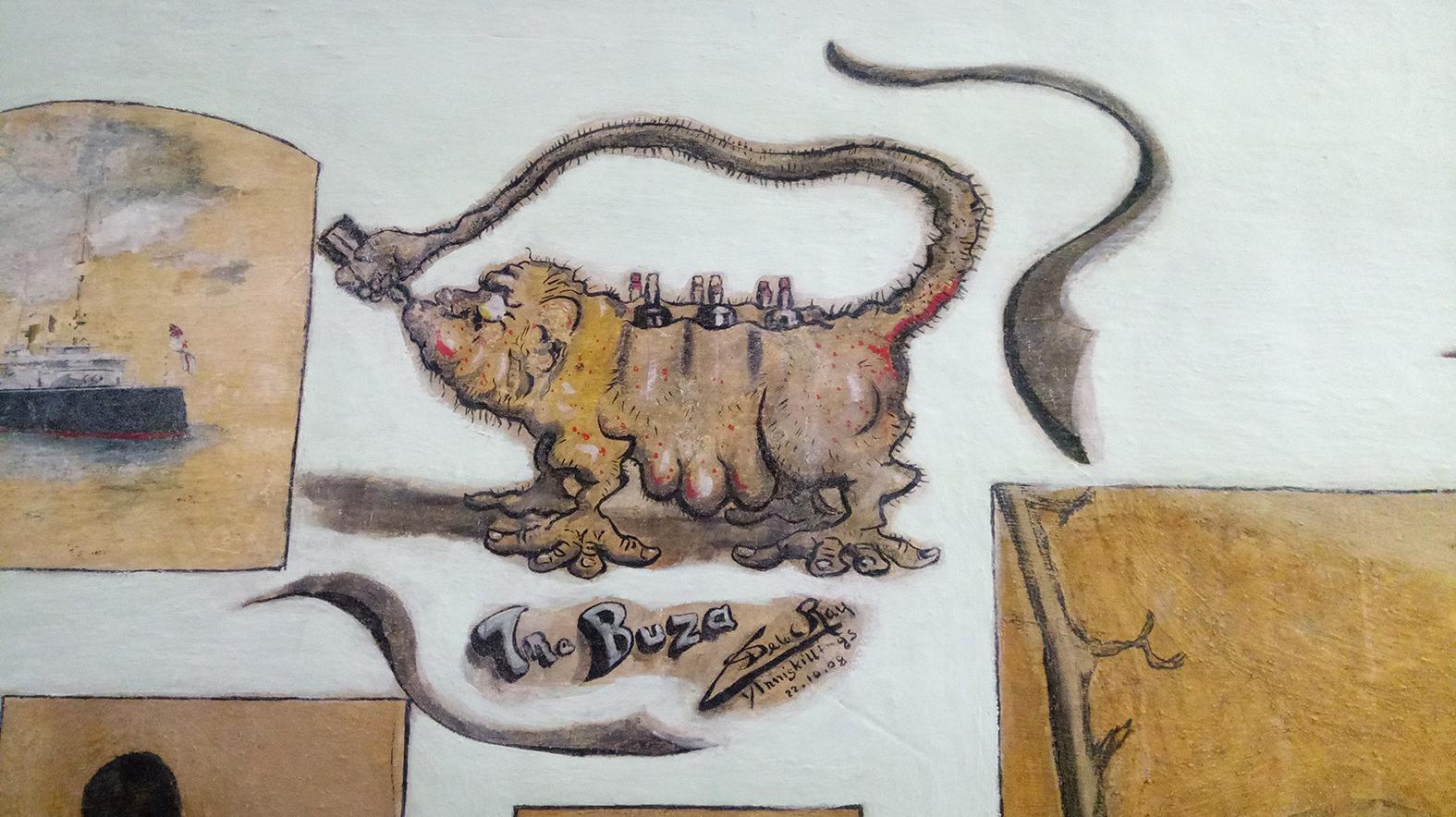 ‘The Buza’ (Boozer)
An interesting character is ‘The Buza’, which shows an animal with four legs and fingers for toes and a distorted human face, framed within two ribbons. His body skin is formed into pockets for holding grog bottles and his tail is long and has a hand on the end, which is holding a bottle for him to drink from.
The title likely refers to a ‘boozer’ or ‘booza’, which is English slang for a person who is a drunkard. There are a number of possibilities as to what it may represent – whether a particular person from the regiment who was a heavy drinker, or even a mascot, likely a dog whom the squaddies had made to enjoy sharing their grog. The painting is slightly scratched. It is signed and dated ‘De la C. Ray, 1/Inniskillings 12.10.08’.
Another of his paintings shows a woman dressed in a skirted fusilier’s officer’s uniform, including two medals, and she is holding a bearskin. Her hair is in the ‘Pompadour style’ of the era, her stockings resemble army trousers, being dark blue with a red strip running down the outside seams. A curved title ‘27th Inniskillings’ is above her to the left, while two ‘ribbons’, are floating around her sides. His usual signature is seen at the bottom left, with the distorted date ‘?.9.09’.
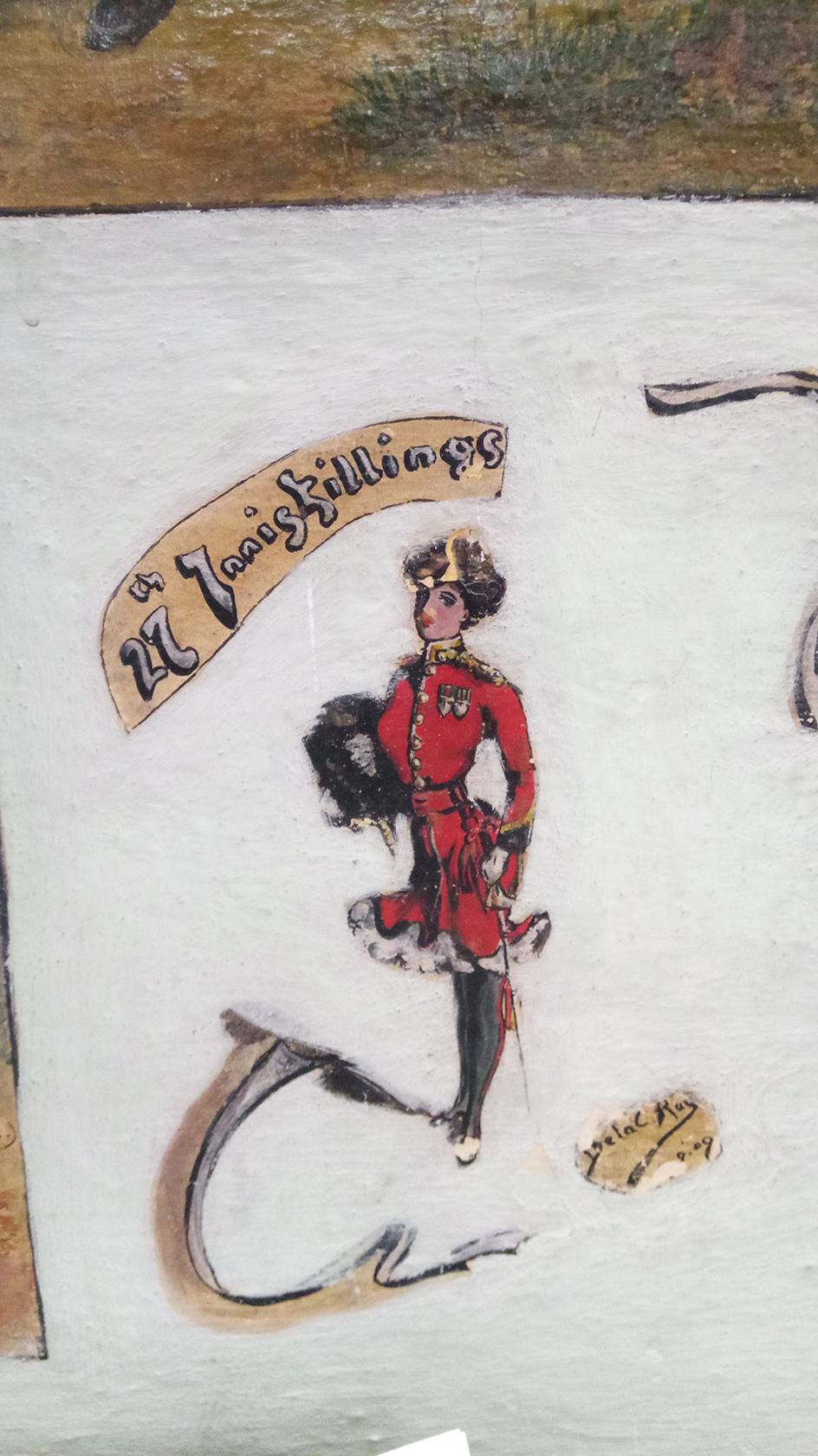
Female ‘27th Inniskillings’
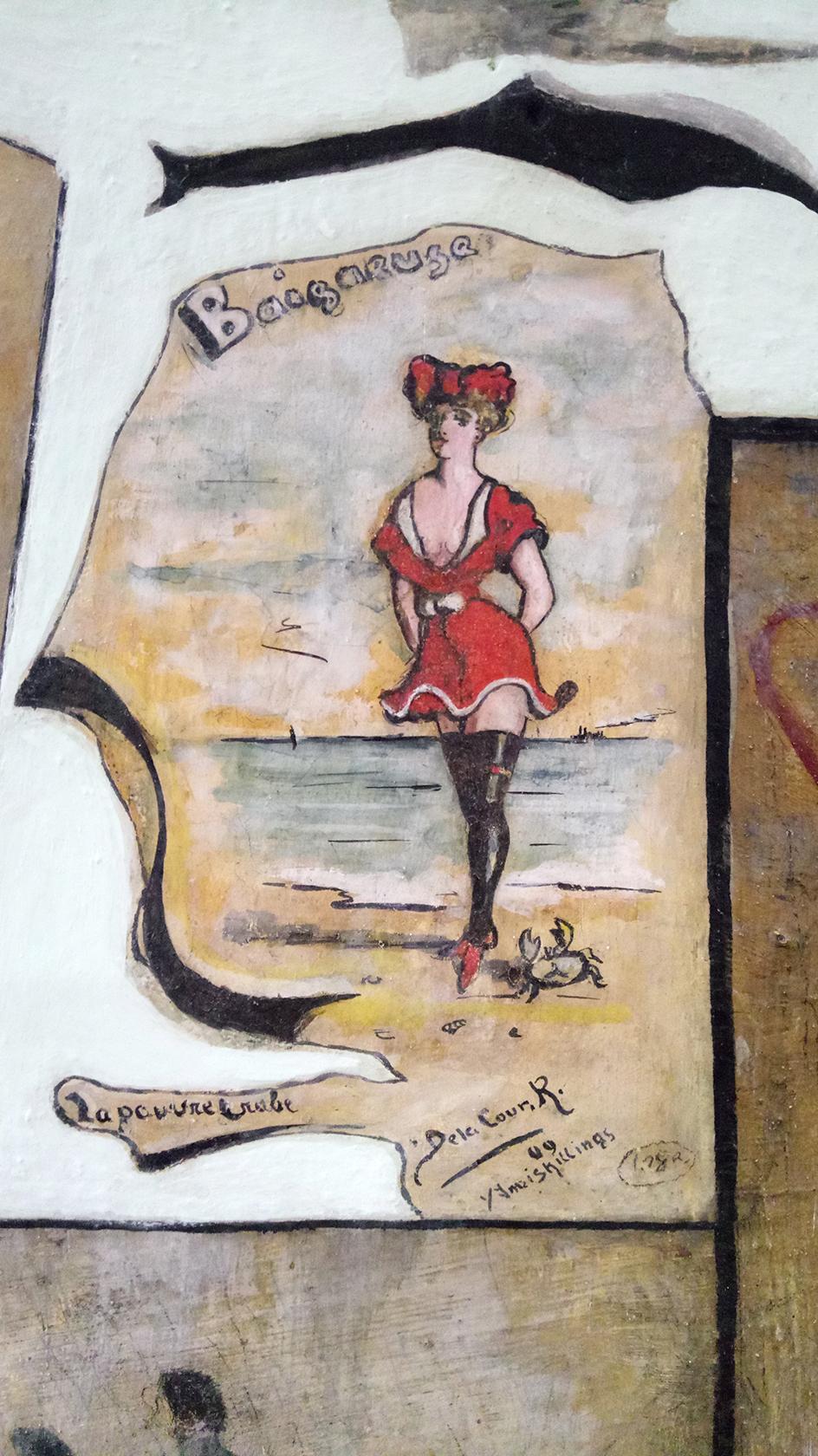
‘Baisarusa’ and the crab
His next figure is likely the same woman and is titled Baisarusa, possibly being her stage-name or what her admirers called her. Strait Street, or the ‘Gut’ as most servicemen called it, was at the rear of the Main Guard. She is depicted on a beach wearing a low-cut bathing costume of the time, shoes and stockings with a suspender.
Her hair is held by a large red bow. A crab is looking up at her, possibly peeping! The caption in French reads ‘La pouvre Crabe’ (The poor crab)! The painting has the same floating ‘ribbons’ around it, as well as the same artist’s signature and ‘Inniskilling 09’ denoting the year.
There are other works by the artist, and likely other paintings that were not signed or his signature was painted over when they were ‘restored’ in the past
The Main Guard walls are reputed to have a number of other paintings by this artist, but they are difficult to identify if not signed. If one takes note of the ‘ribbons’ around and above the caricature, there is a similarity with other paintings within a similar ‘frame’, although some were the works of other artists.
One such caricature possibly by De la Cour Ray is unfinished and not signed. It shows the rear of a woman in what seems to be underwear, although it may have been painted but faded with time. It is untitled and not signed, although it could have been and was painted over, but has two floating ‘ribbons’ as with his previous paintings.
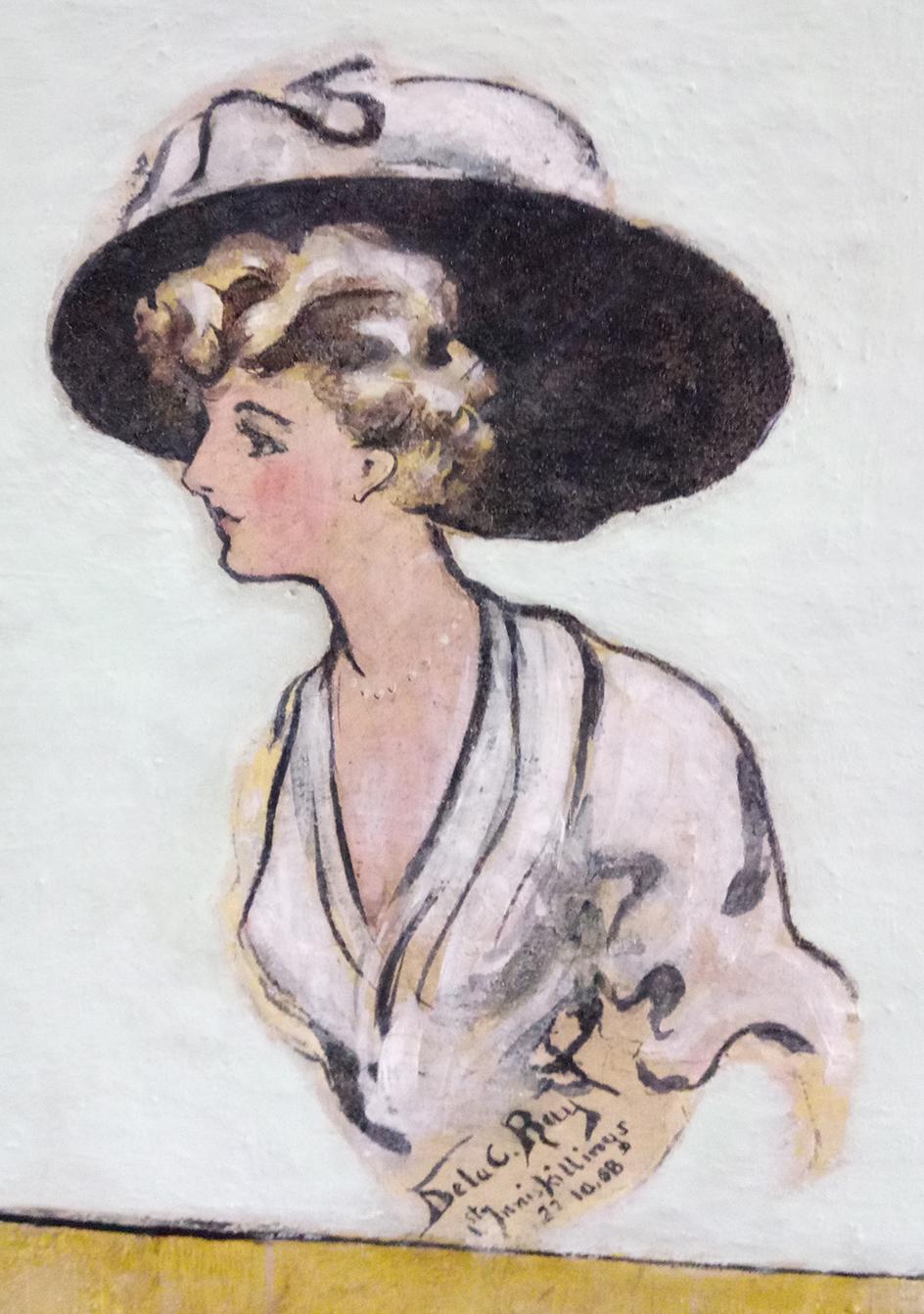 Blonde Edwardian Lady with Large Hat
Painting ladies must have been one of his better hobbies, as his next is a blonde, although her face looks similar to the others. She is more formally dressed in a light-coloured summer dress and the large Edwardian style hat. There are no ribbons around it and it is signed with the date ‘23.10.08’. His grandson, Malcolm Mathew, recently said it may have been a likeness of his grandmother, Dalton’s wife Emily.
In a similar style to the Buza painting and some of his other works abroad, the next painting by Dalton is that of a drunk in torn clothing, who is sitting on a bench begging. On the floor in front of him are three drawings titled All my own Werk, which could be referring to what had brought the man to his present situation or what he lacks.
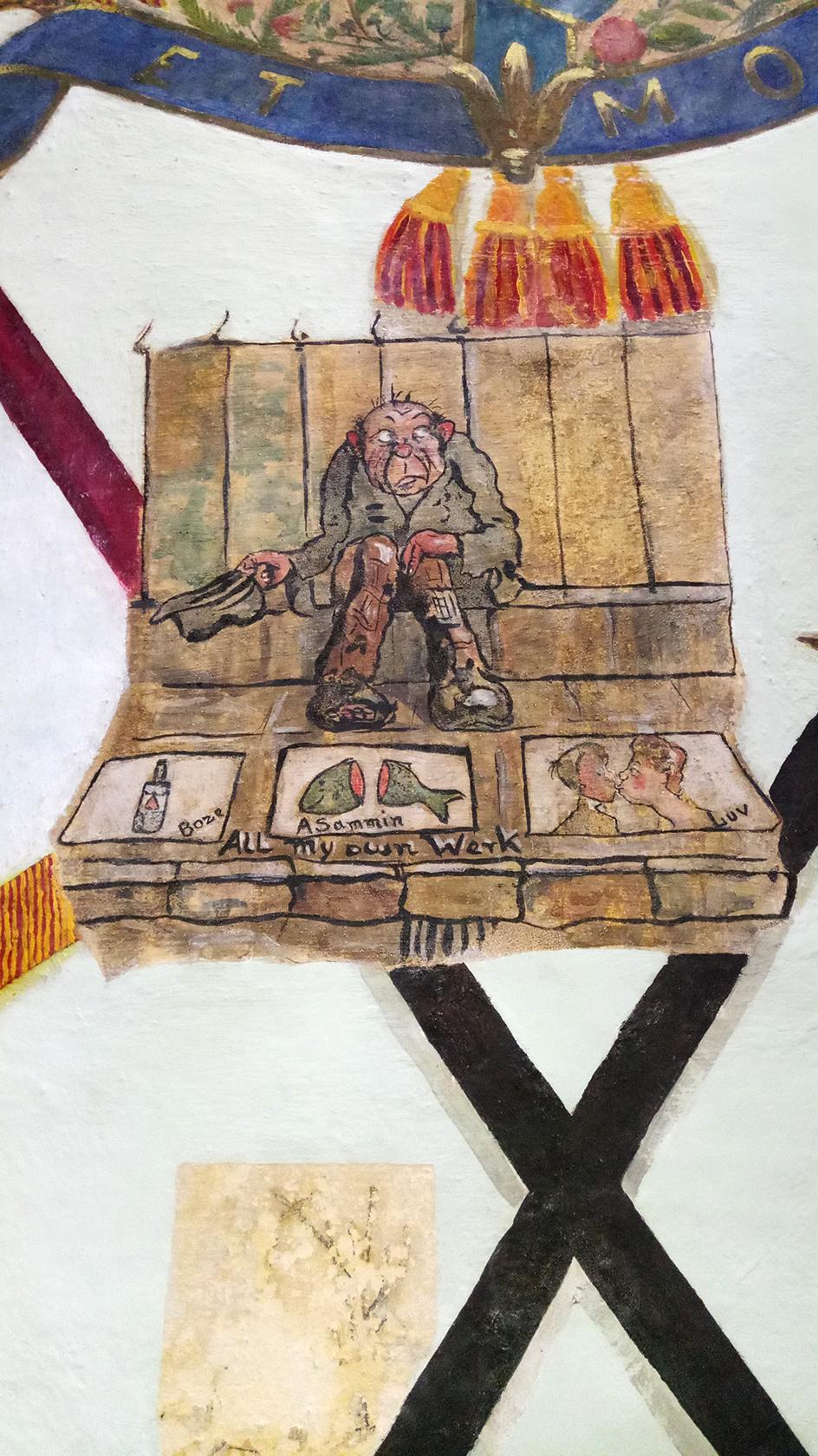 The Begging Drunkard
The first shows a bottle and is titled Booze, the second a fish and is titled A Sammin and the third is Luv and shows a couple kissing. Unfortunately, it cannot be ascertained whether it is actually De la Cour Ray’s work, nor whether he left it unsigned or the signature was painted over.
There are other works by the artist, and likely other paintings that were not signed or his signature was painted over when they were ‘restored’ in the past.
His son, Hubert Denver de la Cour Ray (1920-1991), was commissioned in 1940 and also joined the Inniskilling Fusiliers and formed part of the 148th Independent Reconnaissance Company of the 148th Independent Brigade Group. He later transferred to the 49 Recce Coy. He left 49 Recce Coy at the end of May 1943 to 80th Reconnaissance Company.
Acknowledgements

The author, Denis A. Darmain, thanks Heritage Malta and its team of art restorers who worked at the Main Guard, Patrick Micallef (ex-KOMR), Christian Mifsud, Anthony J. Bugeja and Brian and Malcolm Mathew, Denton’s grandchildren, and Robert St John-Smith for their assistance and support.