Designing a nuclear fusion reactor for tomorrow’s electricity generating plants
Fusion is deemed to be safer than fission because there is no danger of a meltdown
Everybody is familiar with a coal, oil or gas power station. When these are mentioned inevitably we think of polluting chimneys and the release of greenhouse gases that contribute to climate change.
We maybe also think of renewable energy sources and whether these would one day be enough to meet the worldwide electricity demand. Nuclear fission might also come to mind.
Nuclear fission plants are a practical solution to reducing greenhouse gas emissions but have the reputation of being ‘dangerous’ because of the potential of a rare but catastrophic accident and because of the long-term management of radioactive waste.
In a nuclear fusion reaction two atoms are fused together to form a larger atom. When these atoms fuse, a tiny amount of mass is lost and converted into energy
What is today making worldwide headline news as a source of energy for the future is nuclear fusion. Fusion is deemed to be safer than fission because there is no danger of a meltdown – in case something happens, the fusion reaction shuts down by itself.
In addition, the half life of the fuel used in a fusion reactor is about 12.5 years as compared to millions of years for uranium, which is used in fission reactors.
In a nuclear fusion reaction two atoms are fused together to form a larger atom. When these atoms fuse, a tiny amount of mass is lost and converted into energy. Different research institutes, worldwide, have managed to achieve nuclear fusion in experimental fusion reactors but this has never been used to generate electricity or produce district heating.
The University of Malta is part of the EUROfusion consortium within which advanced research and design studies are conducted covering the entire system of a fusion reactor and ancillary plants.
Our research contributes to this very large consortium in the field of computational methods for designing fusion reactor mechanical components.
This gets us involved in the conceptual design of parts of the EU Fusion pilot plant, which will precede the EU Fusion power plant.
We have contributed in this area of structural integrity assessment during the last five years. With our work, we have established ourselves within the stress analyst groups of the consortium, working alongside engineers and physicists from a number of EU countries.
Martin Muscat is an associate professor within the Department of Mechanical Engineering and head of the Malta EUROfusion research unit. Pierluigi Mollicone is a professor and head of the Department of Mechanical Engineering.
The work carried out at the University of Malta, within the framework of the EUROfusion Consortium, is funded by the European Union via the Euratom Research and Training Programme under a mandate by Xjenza Malta.
Photo of the week
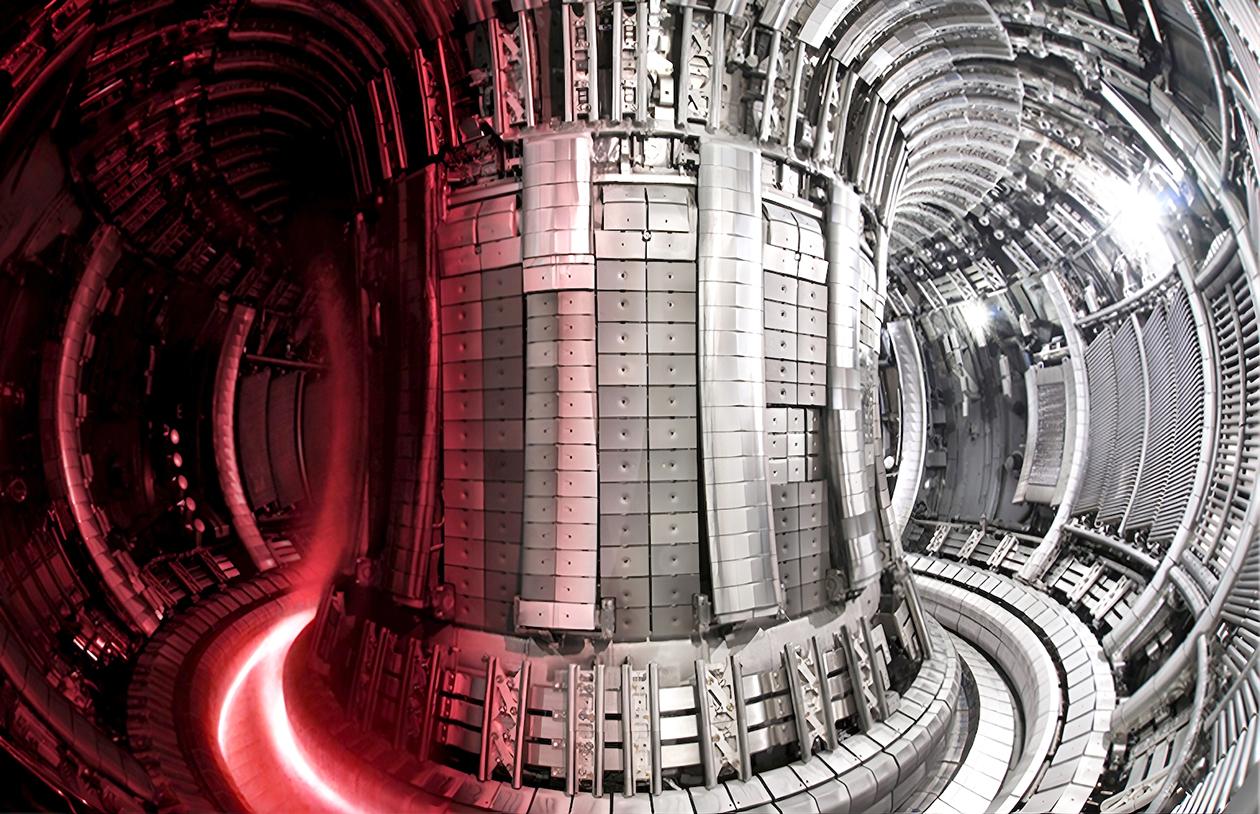 Photo: UKAEA, courtesy of EUROfusion
Inside the Joint European Torus tokamak (JET) at Culham, UK, with a superimposed image of the hot plasma. The total machine diameter of JET, including the magnetic coils and supporting structure, is approximately 12 metres. The ITER tokamak currently under construction in Cadarache, France, will have a machine diameter of about 30m and a height of about 30m. Given its larger size, ITER will allow experiments to be carried out to show how plasma behaves in a fusion power plant reactor.
Sound Bites
• The most successful experiment at JET is considered to be its record-breaking run on October 3, 2023, when it produced the largest amount of fusion energy ever achieved in one plasma pulse, also called a ‘shot’. The energy produced was 69.26 MJ (Megajoules) and was sustained for 5.2 seconds. The fuel used (a blend of deuterium and tritium) amounted to 0.21 milligrammes. The same amount of heat would have required about two million milligrammes of coal (2 kg of coal).
For more information about the EUROfusion project, visit https://euro-fusion.org/eurofusion. For more science news, listen to Radio Mocha on www.fb.com/RadioMochaMalta/.
DID YOU KNOW?
• Plasma is created when gas is heated to a high temperature so that its atoms break down into electrons, positive ions and neutrons.
• The temperature reached in the core of the plasma is about 150 million degrees Celsius while the internal walls of the reactor components need to be kept cool below 500°C.
• The EU’s largest fusion reactor has been JET, the Joint European Torus, in the UK, which is now being decommissioned.
• A larger experimental reactor, ITER, is currently being built near Marseille in France by an international team, including the EU, and once built will be used for a number of experiments that can help lead the way to building a prototype nuclear fusion reactor capable of producing net electricity.
For more trivia, see: www.um.edu.mt/think.
 Martin Muscat
 Pierluigi Mollicone