Desmond Morris, famous zoologist, author and painter with Malta past, dies at 98
Morris lived on the islands for six years while the book that made him famous was banned
World-famous zoologist, best-selling author and surrealist artist, Desmond Morris, who elevated Maltese fishing boats to a “major art form” on the islands when he lived here, has died, aged 98.
Morris had spent six years in Malta, after the 1967 publication of his ground-breaking The Naked Ape, which explored human behaviour from a zoological perspective and is his best known work of many.
An immediate hit, it was, however, banned under strict censorship laws on the island at the time. Considered too controversial for challenging traditional religious views of humanity, it meant citizens could not legally obtain a copy.
But Morris, who died on April 19, continued to live here, finding fertile ground to write his follow-up books, including The Human Zoo, 1969, and Intimate Behaviour, 1972, in Malta.
Morris, who was born in Purton, in the UK, and lived in Oxford, was a renowned ethnologist, an established painter, authoring almost 100 books, and entrusted with the production of several TV programmes, including Granada’s popular children’s weekly Zoo Time, during his versatile career.
An authority on mammals, he was considered an “encyclopaedic observer of human behaviour”, whose knowledge of natural history and nature and his lifelong interest in animal reproduction also inspired his separate and distinguished work as an artist.
In his decades-long academic career dedicated to the study of animals and zoology, Morris’s books moved from bodies to sex, bison, leopards, intimate behaviour, the art of ancient Cyprus, babies… and even Maltese boat design.
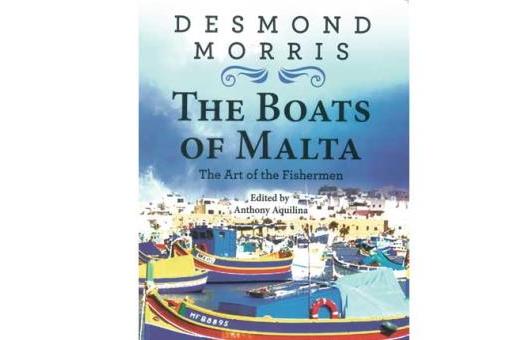 Desmond Morris was fascinated by Maltese fishing boats.
During his stint in Malta in the late 1960s and early 1970s, the renowned author had carried out detailed research on its boats – a study he kept shelved for many years and only saw the light of day a decade ago, according to a 2016 Times of Malta article.
Launched as a special hardback luxury edition, it was edited by Anthony Aquilina from the Translation Department at the University of Malta, who had struck up a friendship with Morris after his translation and publication of Catlore into Maltese (Dinjet il-Qattus).
This had led to the “lavishly illustrated” book, with over 150 colour prints from among an even vaster collection of photographs, the majority taken by Morris himself, the article said.
After making field sketches of each boat he came across around 50 years ago, Morris had produced a study of their complex colour variations. The end result, The Boats of Malta – The Art of the Fishermen, was considered a “thorough piece of work in quantified aesthetics”.
Morris said at the time that the book "sets out to record one of the major art forms of the Maltese Islands – the painted fishing boats”; and the research it included was considered still “fresh” decades later and a stimulus for further studies.
Malta had a special place in his heart not only because it was during his stay among us that he wrote and eventually published two other great books, but also because it was here that his only son Jason was conceived and spent the first years of his life.
‘An ape of great distinction’
The University of Malta honoured Morris with a Doctorate Honoris Causa for his “significant contributions to the good of the Maltese nation and the global community” in 2015.
Along with prominent British archaeologist David Trump, Morris received the degree of Doctor of Literature.
Described at that ceremony as an “ape of great distinction”, Prof. Mark Anthony Falzon, head of the Sociology Department, had said the university was honouring a “polymath who challenges and inspires us to observe and think again, and to do so in style and with impeccable wit”.
Paying tribute following Morris' death, Richard England said he was privileged to be Morris’s architect for alterations and a swimming pool at his Attard house.
“Work visits were followed by long conversations, veritable masterclasses,” he recalled. Accompanied by his Kelb tal-Fenek, “appropriately named Anubis”, discussions revolved around what was to be a future publication, Manwatching: a Field Guide to Human Behaviour and The Human Zoo.
England also recalls his interest in the colour codes of the Maltese luzzu, which led to the book on the subject, and was shown his paintings and those much earlier by his chimpanzee, Congo, which he had encouraged to paint and even exhibit while at the zoo.
Morris was “one of my 1960s great mentors”, together with architects Basil Spence and Quentin Hughes, artist Victor Pasmore, historian Ernle Bradford, novelist Nicholas Monsarrat and others… What a luxury Malta was in those days,” he reminisced nostalgically.
An island for successful authors
In an obituary in the UK newspaper, The Guardian, that period is chronicled too. In 1968, a year after the publication of The Naked Ape: a Zoologist’s Study of the Human Animal, Morris left the Institute of Contemporary Arts for Malta, it said, adding that “very successful authors often moved to milder climates with even milder tax regimes” in those days.
“Morris, relocating with (his wife) Ramona, their son Jason, and a Rolls-Royce, purchased a 30-foot cabin cruiser and a handsome villa on Malta,” it continues.
Celebrating The Naked Ape, which sold an estimated 18 million copies and was placed on the Catholic Church’s notorious index of forbidden books, the newspaper added the same index also contained Balzac, Stendhal, Voltaire and Zola, meaning Morris willingly accepted the ban as flattery.
The island’s strict censorship meant no citizen could legally read the book that had bought him a place in the sun, it noted.
“Malta was by then a retreat for a number of successful writers, among them (Anthony) Burgess, who was so angered by Catholic censorship of his friend that, against the advice of Morris, he caused a public furore. He was compelled to leave, and Morris took up a research post at Wolfson College, Oxford,” The Guardian writes.
"He was certainly the only candidate who could ever have transferred convincingly from curator of mammals at London Zoo to take over the ICA in Pall Mall,” the obituary said about his versatile career.
Morris was both scholar and entertainer. “If I am honest,” he once wrote, “it is a struggle I have never fully resolved, the ‘ham’ and the academic in me still doing battle with one another, with first one, then the other, getting the upper hand.”