Dissecting out cancer
Disparities in surgical oncology training exist across Europe
Cancer surgery remains a key treatment for solid malignancies, such as cancers of the breast, colon, pancreas, ovaries, uterus and many others. This is particularly crucial in low- and middle-income countries where access to other non-surgical newer therapies (for example, immunotherapy) is limited.
With the growing global cancer burden, the demand for high-quality surgery is rising. As precision medicine advances, cancer surgeons need not only technical expertise but also an understanding of multidisciplinary cancer care, in addition to preventive and palliative care.
However, disparities in surgical oncology training exist across Europe. This affects access to complex cases, clinical trials, mentorship and research facilities. These variations are linked to economic disparities and, more importantly, lead to inequalities in patients’ access to treatment, impacting prognosis and overall survival.
The DISSECT project, which stands for ‘Disparities In Surgical Specialisation and Education in Cancer Training’, aims to identify and address these disparities in cancer surgery training in Europe.
DISSECT is a Collaboration in Science and Technology (COST) Action, which is funded by the European Union. The kick-off of this project happened in September 2025, marking the beginning of a four-year collaboration that will bring together experts from different disciplines and countries to advance surgical oncology education, and build lasting European research and training networks.
DISSECT is a Collaboration in Science and Technology (COST) Action, which is funded by the European Union
By fostering knowledge exchange between high- and low-resource settings, the DISSECT project will enhance multidisciplinary training, mentorship and research capacity. It aligns with Europe’s Beating Cancer Plan to ensure equitable access to high standards of care and to reduce cancer-related inequalities. DISSECT seeks to create a sustainable impact on cancer surgery outcomes through improved training and innovation in surgical education.
Cancer surgeons from Mater Dei Hospital, together with academics and researchers from the University of Malta, form part of the management committee and working groups of DISSECT COST Action. They will benefit from gaining expertise in virtual reality technology, fluorescence guided surgery, robotic surgery and precision cancer surgery to optimise surgical training and mentoring. Workshops on innovation and training are essential for enhancing surgical skills, promoting interdisciplinary collaborations and helping to manage complex cases.
The possibility for artificial intelligence (AI) tools to be used for quality improvement and effective management of surgical care pathways will be explored. All of this will ultimately contribute to better patient outcomes both locally and abroad.
Jean Calleja Agius is a full professor and researcher in the Department of Anatomy, Faculty of Medicine and Surgery, and a practising gynaecologist. She is currently a working group lead of the DISSECT COST Action.
Photo of the week
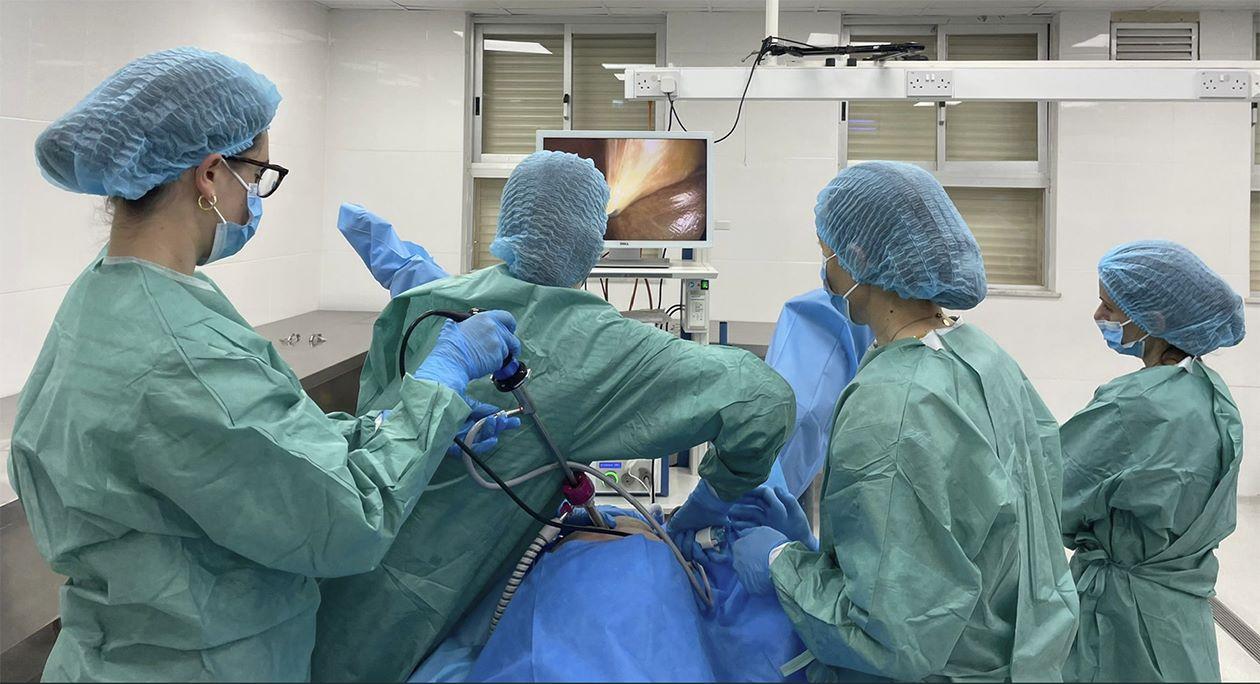
Female surgeons are a growing but still underrepresented minority in surgical fields, making up roughly 20- to 30 per cent of active surgeons overall in the EU and US. Disparities in representation of female surgeons and career progression exist in spite of a feminisation of the medical professions in most countries, including Malta where, on average, more females than men graduate in medicine. A large gap remains between entry into surgical training and becoming senior consultants. Discrimination, sexual harassment and implicit biases (associating men with surgery) are common.
However, evidence points to excellent performance and patient care from female surgeons. Multiple large-scale studies suggest patients operated on by female surgeons have statistically lower rates of 30-day mortality, major complications and hospital readmissions. The photo shows female surgical trainees performing laparoscopic dissection at the Department of Anatomy, Faculty of Medicine and Surgery, University of Malta.
Sound Bites
• Cancer surgery training requires technical skills, mentorship and exposure to diverse operative cases. While some countries have well-resourced, specialised cancer centres, others may face resource limitations but still manage to treat high patient volumes. Despite varying access to innovative tools and treatments, patients receive tailored care based on available resources.
• A cancer patient requires care from a multidisciplinary team, including a cancer surgeon, oncologist, nurses, radiologists, pharmacists, physiotherapists and psychologists. They hold regular meetings to discuss individual cases, ensuring optimal patient management. Support extends beyond the patient to include family members and caregivers, emphasising a holistic approach to cancer care.
For more soundbites, click on: https://www.facebook.com/RadioMochaMalta.
DID YOU KNOW?
• Up to one in two individuals will get cancer at some point in their lifetime, according to a study carried out in the UK.
• Globally, the most common cancers are breast, lung, colorectal and prostate cancers.
• In high- and middle-income countries, around one-third of deaths from cancer are due to tobacco use, high body mass index, alcohol consumption, low fruit and vegetable intake, and lack of physical activity.
• Surgery remains a cornerstone of cancer treatment.
• Advances in prevention, early detection and treatment have significantly improved survival rates for many patients with cancer.
For more trivia, see: www.um.edu.mt/think.