Do gravitational waves challenge Einstein?
Generated during catastrophic events, such as the merger of black holes, neutron stars or a combination of both
Since the first detection in 2015 by the LIGO and Virgo collaboration, over 200 gravitational wave events have been observed. These disturbances in spacetime were predicted by Albert Einstein through his theory of general relativity, where he described gravity as the warping of spacetime caused by massive objects.
Gravitational waves are generated during catastrophic events, such as the merger of black holes, neutron stars or a combination of both. These mergers release enormous amounts of energy, creating ripples in spacetime that propagate outward.
Earth-based gravitational wave detectors, known as interferometers, are designed to capture the wave patterns from such events. By analysing these waves, scientists can determine key properties of the merging objects, such as their mass and spin, as well as estimate the distance of the event based on the wave’s intensity – helping to pinpoint the source of the gravitational waves.
Distortions by gravitational waves are described by different modes: tensors, vectors and scalars
Distortions by gravitational waves are described by different modes: tensors, vectors and scalars. Each of these modes uniquely influences spacetime. Tensor modes stretch and squeeze spacetime in perpendicular directions, like squeezing a ball from the sides while the top and bottom parts bulge out. Vector modes represent sideways shifts in spacetime, analogous to the movement of objects exposed to a gust of wind. Scalar modes are characterised by an even expansion or contraction in all directions, much like inflating and deflating a balloon.
So far, the detected gravitational waves have confirmed the behaviour predicted by general relativity; only tensor modes. So why are physicists considering alternative theories of gravity? While general relativity works remarkably well for explaining gravity at solar system scales, it is incomplete. The theory doesn’t explain gravity at the quantum level, breaks down at singularities, and doesn’t include phenomena such as dark matter and dark energy.
Scientists are exploring other theories of gravity to see if they can explain gravity better, and gravitational waves offer a way to test these ideas. The detection of other modes would signify the need for new physics. The next generation of detectors, including the Einstein Telescope, Cosmic Explorer and LISA, will operate at lower frequency ranges, increasing their sensitivity and ability to detect potential deviations from general relativity.
Researchers with the CosmoLearn project at the University of Malta are exploring gravitational theories beyond general relativity and examining their impact on the behaviour of the universe. By developing viable cosmological models, we can make predictions about observable phenomena, providing valuable insights into the potential modifications to our understanding of gravity.
Maria Caruana completed a PhD in cosmology at the Institute of Space Sciences and Astronomy, University of Malta. She received funding from Tertiary Education Scholarship Scheme (TESS) during her studies.
Photo of the week
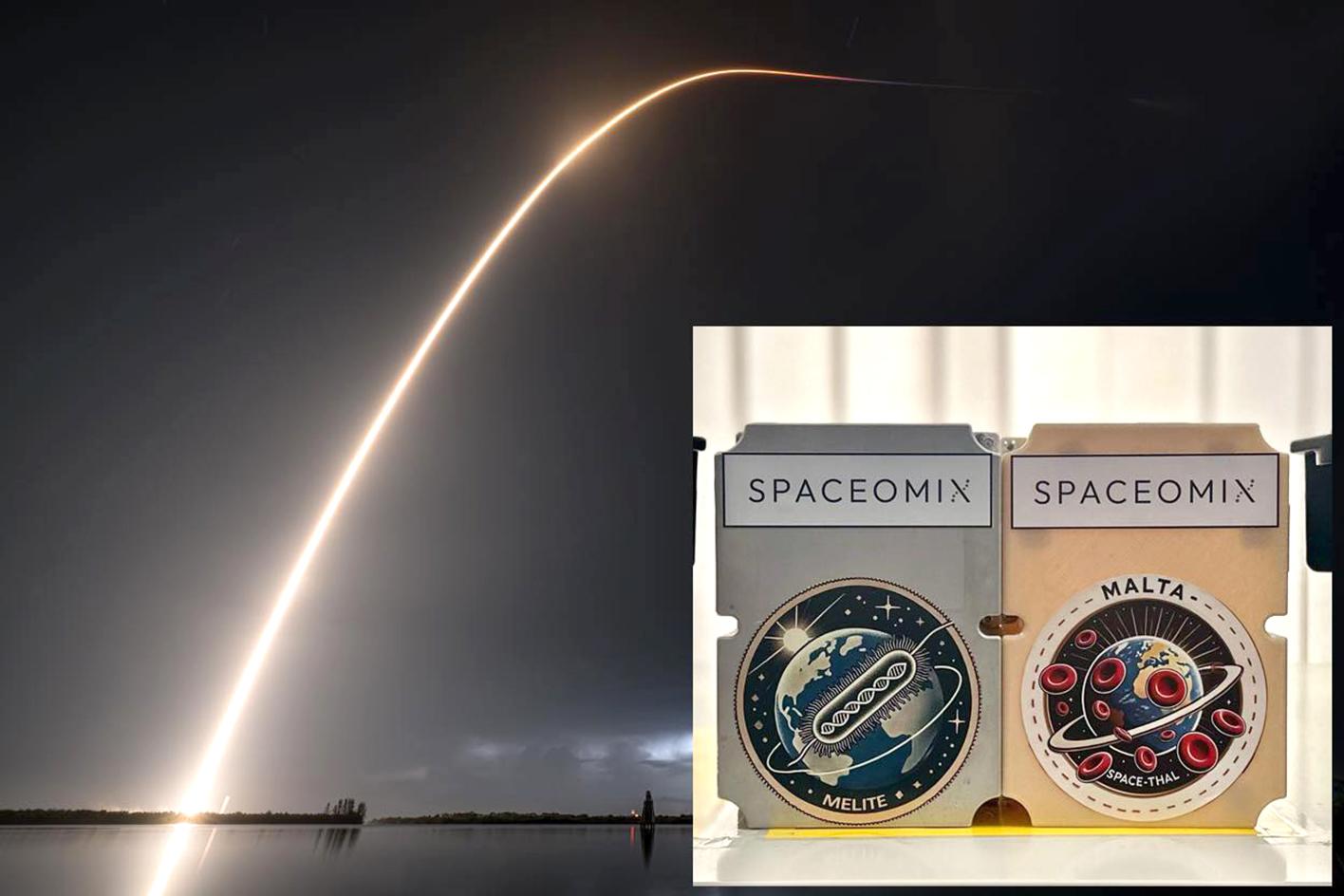 Photo: SPACEOMIX.COM
University of Malta researchers launched two experiments into space this week. This box contains cord blood and corneal eye swabs with the aim to revolutionise our understanding of human health in space and here on Earth. A celebratory seminar will be held on April 24. For more details regarding the event, visit: https://fb.me/e/8auhCmg7j.
Sound Bites
• You can listen to gravitational waves! The first LIGO gravitational wave detection was recorded as a data signal and converted into audio by taking the frequency and amplitude of the wave and adjusting them to ranges that humans can hear. As the two black holes merge, the frequency increases and result sounds like a ‘chirp’.
• LISA (Laser Interferometer Space Antenna) will be the first space-based gravitational wave interferometer. It will operate at low-frequency ranges and is made up of three spacecraft in a triangular formation. It will be able to detect cosmic events such as mergers of supermassive black holes.
For more soundbites, listen to Radio Mocha www.fb.com/RadioMochaMalta/.
DID YOU KNOW?
• The ripple effects caused by gravitational waves alter spacetime by distortions a thousand times smaller than a proton’s diameter.
• Pulsars, rapidly rotating neutron stars, emit regular beams of electromagnetic radiation. By monitoring these emissions, scientists can detect variations in their arrival times, which may indicate the presence of gravitational waves.
• Despite being well known for his theory of relativity, Einstein won the 1921 Nobel Prize in Physics for his work on the photoelectric effect – foundational to the development of quantum theory.
For more trivia, see: www.um.edu.mt/think.