Eco-friendly and sustainable composite materials
They are created by combining sisal and flax fibres in different ratios and orientations
Composite materials are formed by combining two or more distinct phases to produce a material with enhanced properties. One common example is concrete, made from cement and aggregates. When reinforced with steel, its tensile strength improves, creating a fibre-reinforced composite.
Another well-known composite is glass fibre in a polymer matrix, commonly used in the marine sector for building boats and yachts. In high-performance applications such as motorsport and sailing (e.g. Formula cars and hydrofoiling yachts), carbon fibre composites are preferred for their superior strength-to-weight ratio.
In general, composites are lighter than metals, resist corrosion and can be engineered to meet specific loading demands, often exceeding the performance of conventional materials like aluminium or steel.
However, traditional composites present sustainability challenges. Many synthetic fibres and resins, derived from petrochemicals, are difficult to recycle and may pose environmental or health risks during production. As an alternative, bio-composites – materials made from renewable natural fibres and bio-based resins – are being explored.
These offer potential for environmentally friendly applications in sectors such as automotive interiors, sports gear and interior panelling. Hybridising different natural fibres can further enhance both the mechanical and aesthetic properties of these materials.
In general, composites are lighter than metals, resist corrosion and can be engineered to meet specific loading demands
In response to these challenges, the ECO-Composite project developed sustainable composites using natural fibres embedded in a bio-resin. The project focuses on fibres derived from Agave sisalana (sisal) and Linum usitatissimum (flax) plants. Although natural fibres typically have lower mechanical strength than synthetic alternatives, effective fabrication techniques can improve their performance. These new materials aim to bridge the gap between unreinforced plastics and high-strength composites, offering a more sustainable alternative for various industries.
Hybrid composites are created by combining sisal and flax fibres in different ratios and orientations. These can be arranged in woven mats, aligned uniaxially with a particular ratio (intraply laminae), or spun together into blended yarns (intrayarn), which are then woven into unidirectional or biaxial fabrics. A key challenge is combining the coarse, abrasive sisal with finer flax fibres during spinning, braiding or weaving process.
A critical aspect of composite performance lies in the bond between fibre and matrix. Natural fibres present adhesion difficulties due to their cellulose content and hydrophilic nature.
To address this, the project developed a custom bio-resin blend with improved adhesion, faster curing and suitable viscosity for infusion. Mechanical tests (tensile, compressive, shear, impact) and numerical sensitivity analyses were used to determine the optimal resin formulation and fibre layout. These results informed a meso-scale numerical model to guide application-specific composite design that can be used for car parts, boat decks, bicycles, helmets and other consumer products.
ECO-Composite is a joint initiative between the University of Malta and Zhejiang Sci-Tech University, funded by Xjenza Malta and the Ministry for Science and Technology of the People’s Republic of China (MOST), through the Sino-Malta Fund 2022 Call (Science and Technology Cooperation).
Duncan Camilleri is a professor at the Department of Mechanical Engineering, University of Malta, focusing on design, development, fabrication and engineering analysis of composite structures.
Photo of the week
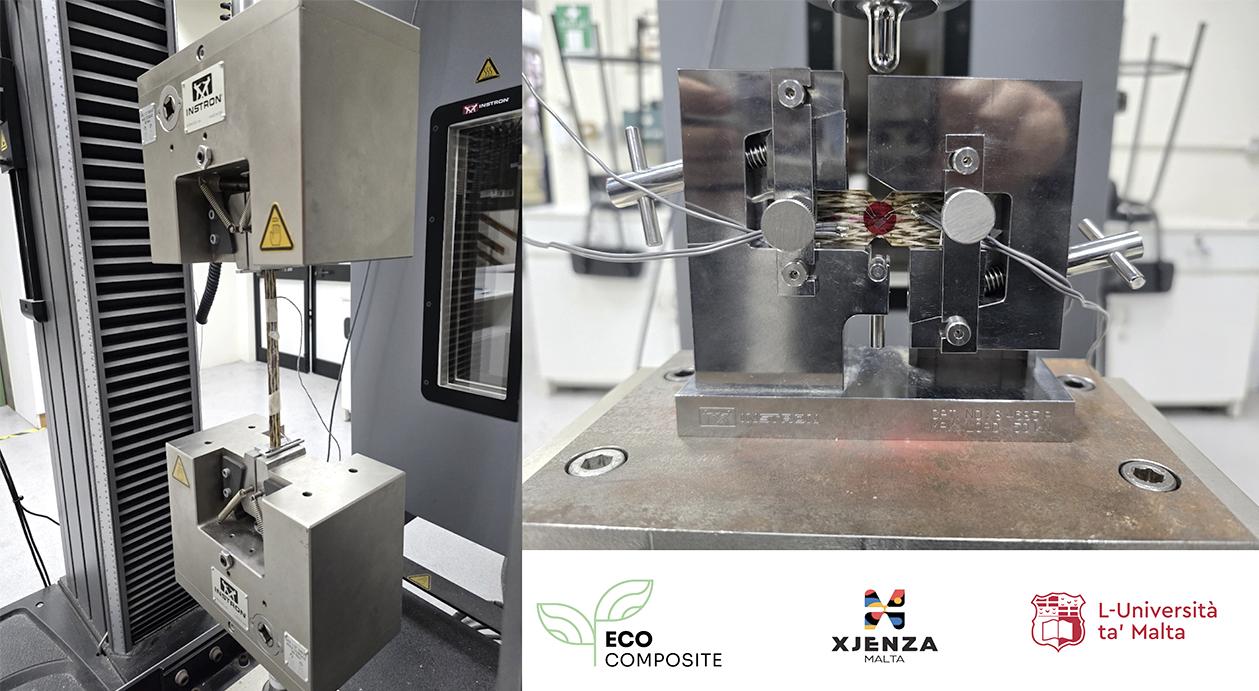 Photo: Daniel Cavalcanti Kawasaki
Tensile and shear testing of sisal/flax hybrid composite specimens carried out in the ECO-Composite Project.
DID YOU KNOW?
• Composites, among humanity’s oldest materials, began with mud bricks reinforced with straw. Today, they are crucial in automotive, maritime and aerospace sectors – cutting car weight by 25% and increasing aircraft composite use from 1% in the 1979 Boeing 747 to 50% in the 2011 Boeing 787 for better fuel efficiency.
• Sisal (Agave sisalana), a tough, drought-resistant plant native to Mexico, grows easily in poor soils with low environmental impact. Its long leaves produce strong, biodegradable fibres traditionally used in ropes, mats and sacks – making it a highly sustainable crop.
• Flax (Linum usitatissimum), one of the oldest cultivated plants, provides durable fibres for linen textiles and nutrient-rich seeds. Its oil is also used in paints and varnishes for its excellent drying properties.
For more trivia, see: www.um.edu.mt/think or listen to Radio Mocha www.fb.com/RadioMochaMalta/.