The E.L.V. enigma deciphered
The identity of the pioneer author of Maltese cuisine and other manuals in the late 1800s and early 1900s revealed
At the turn of the last century, a mysterious author asserted a strong and highly personalised presence in the local publishing scene. The writer insisted on identifying him or herself only by the use of a monogram: E.L.V. So vague was the profile of this author that many believed it concealed a woman.
The pioneer book on Maltese cuisine, Ctieb tal Chcina published in Maltese by E.L.V. in 1894 and re-edited in 1903, 1908 and 1936 was, until recently, stereotyped to a female author. Kitchen? So it must be a woman.
E.L.V. was not a woman. He graduated as a lawyer, and distinguished himself as a politician member of parliament, a soldier and a businessman, about whom almost nothing had been researched so far. This feature attempts to redress an unfair oblivion that overtook one who deserved better.
Between the years 1894 and 1908, a series of practical, informative, didactic books, all signed with the monogram E.L.V., flooded the popular scene. I counted seven, but there could be more. All written in clear, correct and current Maltese, without literary ambitions, at a time when the language had almost no literature to speak of.
All classes spoke Maltese quite effortlessly, but the educated orders wrote Italian. Those who felt compulsions to ape our colonial owners wrote English. Publishing books in Maltese showed independence and an ability to defy convention. E.L.V. did.
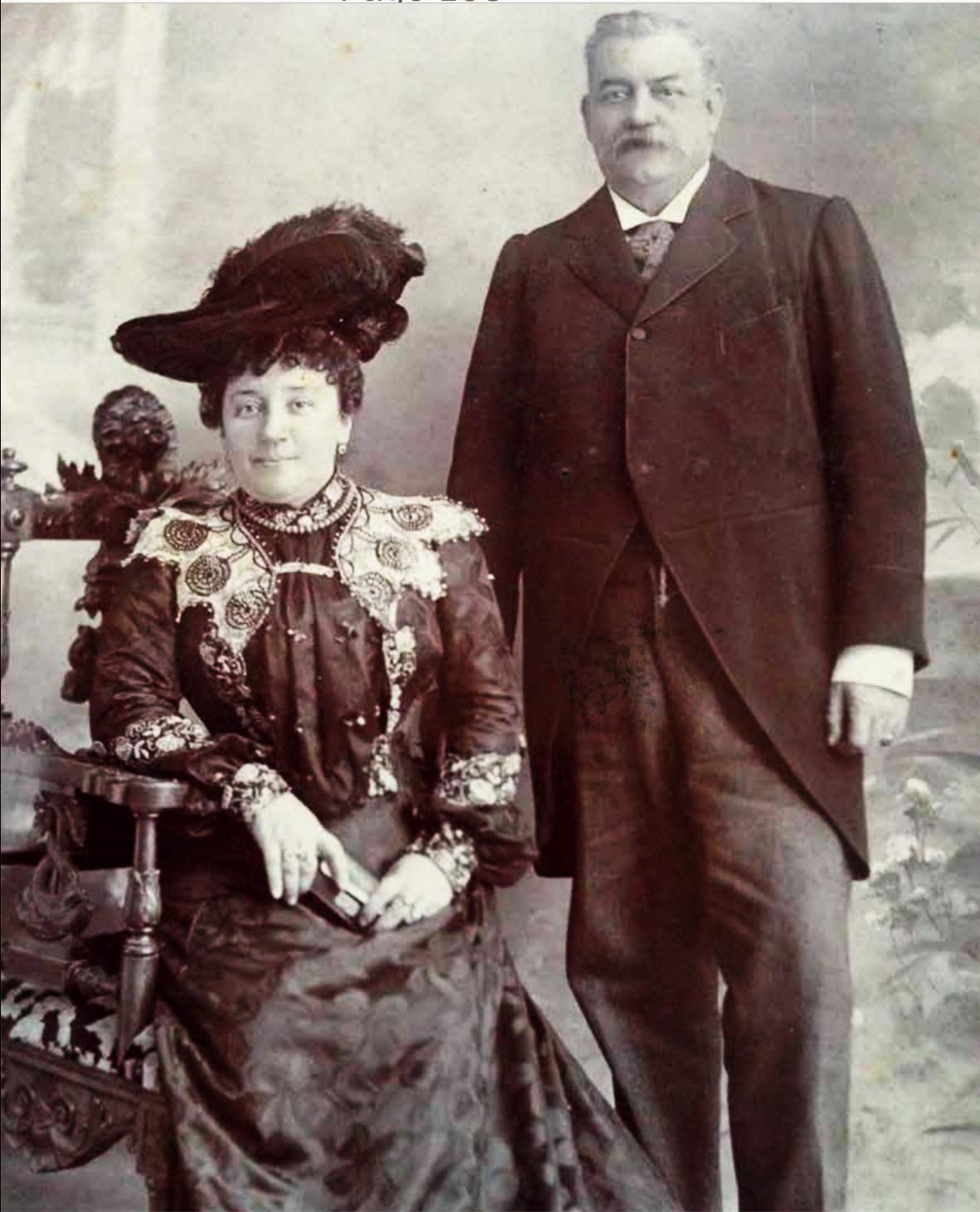 Vella and his wife Giulia had this joint portrait taken on the 25th anniversary of their marriage in 1904.
Truncated political career
Edoardo Luigi Vella was born to bourgeois parents in 1849 or 1850. His father Luigi had married Erminia Tagliaferro, a Preziosi on her mother’s side. No dearth of aristocratic genes and wealth in that family tree.
The young Edoardo graduated as a lawyer on June 5, 1872, with 11 other law students. Evidence, however, shows that Vella did not practise as advocate. Judge Robert Ganado’s papers list him as negoziante. The Preziosi connection may explain Edoardo’s passion for photography, pioneered by his close relative Leandro Preziosi.
 A manual of etiquette in Maltese written by Edoardo Luigi Vella, dated 1905.
Edoardo married Giulia Maria Agius in 1879 and fathered three children, among whom Edgar Vella (1889-1968), who embarked on a distinguished military career, seeing action in Thessalonica (now known as Thessaloniki) in World War I, selected as ADC (aide-de-camp) to Governor Methuen and to the Prince of Wales when he visited Malta. In civilian life, Edgar became managing director of Esso Standard Malta and vice-president of the jinxed National Bank of Malta.
Edoardo’s wife Giulia (1854-1932) also came from affluent, but anglophile, lineage. Her father Tancredi ran a lucrative coal bunkering business ‘Ed. T. Agius & Co’, lived in a mansion in Hampstead, and de facto represented Maltese interests in London. His distinguished descendants include Marcus A. Agius, chairman of Barclays Bank, and the Benedictine Archbishop Dom Ambrose Agius, OSB, who became papal legate to the United States, accredited to President Roosevelt. He died young in 1911 on his way back to Rome to be made cardinal.
Vella embraced politics and journalism on the nationalist patriotic side of the spectrum. He contested the March 1888 election successfully, garnering 1,023 votes. His contributions in the Council of Government have not been studied yet, but his intervention in the historical November 4-8, 1895, sittings remains relevant today for its focus and acuteness. Speaking of the ethical and intellectual qualities required of politicians, Vella observed (free translation from Italian):
“I have no intention of rewriting history. It is true that the history of the past will be that of the future. The faults do not lie in the form of governments … Everything depends on the persons, on the character of the main actors. If voters choose representatives of poor quality, of doubtful integrity, of limited intelligence (that includes myself) what do you expect?
 A Maltese handbook for popular education by Vella dated 1895.
“I am aware that in the last elections the voters chose some of us only because nothing else was available. Someone with an income, who cares for his family, who looks after his private affairs and finds himself more or less comfortable, doesn’t give a damn about politics.
“He knows our grievances are hardly substantial, he is aware that we fight only for the ‘form’ of government. It is not the form of government that we must change but the character of the members of government.”
Did Vella say this 130 years ago?
The family’s traditional lore retains troubled memories of how disenchantment truncated Vella’s political career. His son recalled “a vivid boyhood remembrance of returning home from school one day to find the family home being besieged and the crowd of protesters hurling stones and breaking the house’s windows”.
Vella also left his mark on the armed forces. In 1889, the authorities invited recruits to join the new Royal Malta Regiment of Militia. Vella volunteered to set an example. The aspiring soldiers had to be examined by army physicians. Anti-militia fake information circulated. No one showed willingness to take the plunge.
The authorities set about gathering any information that could harm the patriots, including scandals about their private lives
To break the stalemate, Vella stepped forward to submit to the medical tests, thereby formally becoming the No. 1 recruit of the regiment. He enjoyed rapid advancement and attended Sunday mass in full uniform. Chesney recorded Vella’s breakthrough initiative in his official history of the regiment.
That year, Vella wrote in Maltese about the Milizia Maltia, his first signed publication I know of. The second was a paediatrics and child-rearing manual in Maltese – by a male lawyer – Tghalim ghall Ommijiet fuk it-trobbia ta Uliedom (1906).
Books
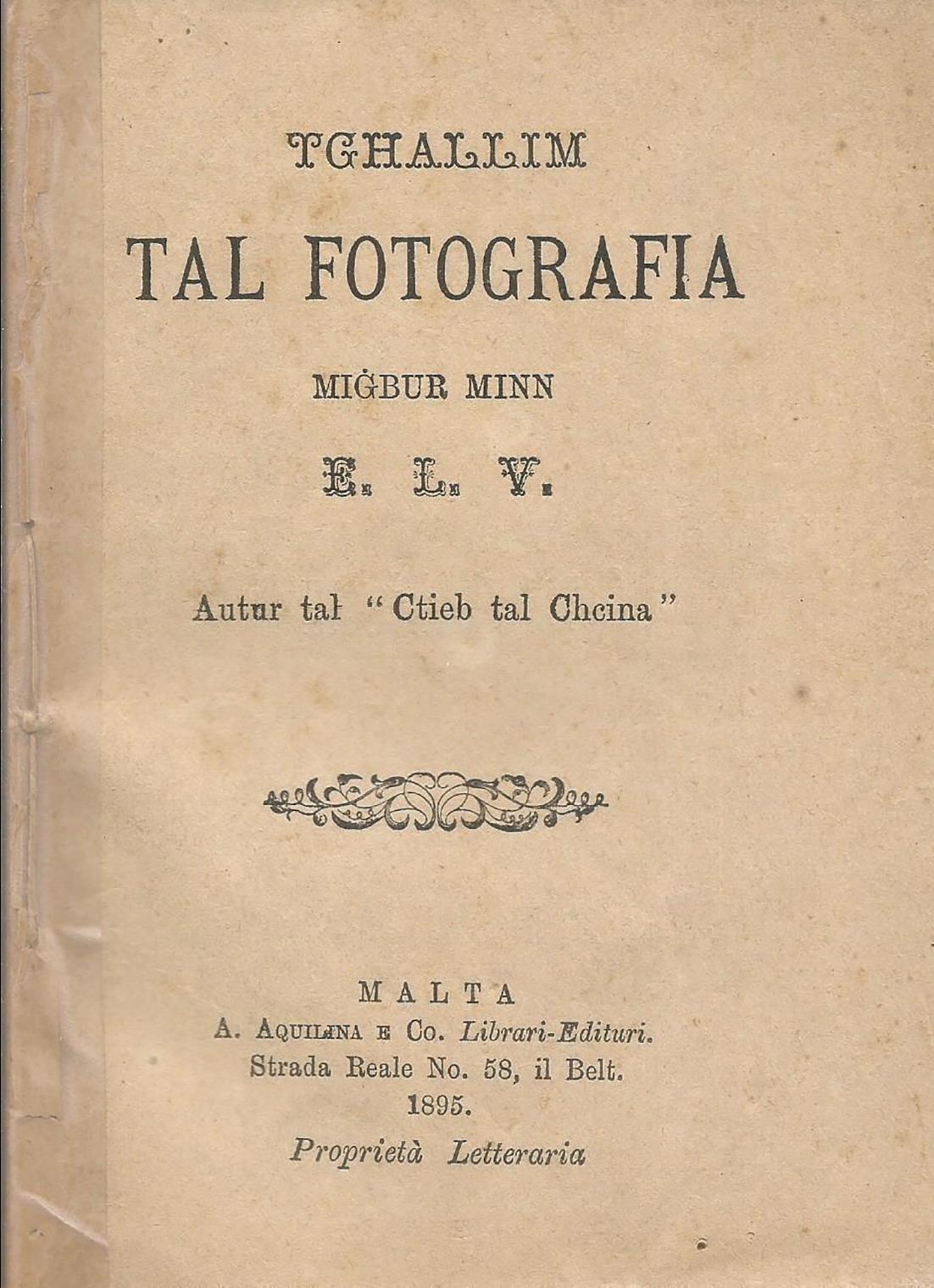 Vella published the first photography instruction manual in Maltese in 1895.
Even though Vella withdrew from active politics, he kept contributing regularly to the nationalist daily Malta, edited by Enrico Mizzi. Like virtually all political journalists of that era, Vella wrote under a nom de plume, Spartacus.
At the turn of the century, imperialism in Malta showed its most repressive face and resorted to aberrant colonial arm twisting and extortion. The government let it be known that anyone opposing imperial interests was under observation. The authorities set about gathering any information that could harm the patriots, including scandals about their private lives.
Targets included Vella, then employed as a cashier with an anglophile London-based company (his father-in-law?). Threatened with losing his job, Vella backtracked and stopped his political contributions to the Malta. My persistent efforts to obtain this official 1901 documentation from the British Archives at Kew met with no success.
Besides E.L.V.’s various editions of Ctieb tal Chcina, I have identified these other books by him: Tghallim tal Fotografia (1895), about which I have written at length, Chif ghandna ingibu ruhna fis-società (1895); Chif ghanda tinzam id-dar (1904); Gabra ta’ sbalji li ma ghandomx isiru u irregolarità li ghandna naharbu fil condotta taghna fis-Società (1905). Matty Cremona has written meaningfully about Vella’s Maltese household books.
Vella’s incumbencies included being consul for Romania and acting consul for Russia, from the early 1880s to at least 1902. He is reputed to have died in 1909.
Acknowledgements
I am indebted to Mark Studer, Chancery barrister in London, for his massive and essential input, to Leonard Callus, Dr Joseph Cassar, Matty Cremona, Vicki-Ann Cremona, Jeremy Debono, Theresa Vella and William Zammit for their assistance.