EU delivers upbeat economic forecast for Malta
Employment growth expected to stabilise
Malta's economy is expected to sustain its growth momentum in 2025, driven by robust domestic consumption and positive net exports, the European Commission said in its spring forecast on Monday.
Following a notable 6% expansion in GDP in 2024, the Maltese economy is expected to grow by 4.1% in 2025 and 4% in 2026, the commission said, largely in line with the government's own projections.
The labour market is projected to stabilise and inflation to slow down.
On the fiscal front, the government deficit is expected to decline further, going below the 3% threshold in 2026, with the debt ratio stabilising below 48% of GDP.
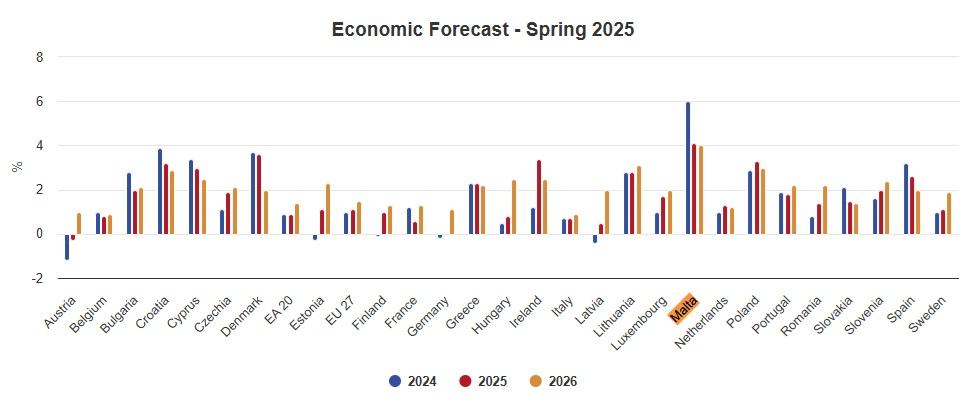 The EU expects Malta to have the best preforming economy in the bloc this year and next year, this chart shows.
Real GDP in 2024 grew by an outstanding 6%, 1 pps higher than expected in autumn, on the back of robust private and public consumption and positive contribution from net exports, namely by the tourism and financial and professional services sectors.
As inflation slowed down, real households’ incomes grew and private consumption exhibited an expansion of 5.7%, while government consumption rose by 7.3%, giving a substantial boost to overall GDP growth, the commission said.
Real GDP growth in Malta is forecast to slow down somewhat but to remain robust, at 4.1% in 2025 and 4% in 2026. Private consumption is expected to grow at 4.1% in 2025 and 3.9% in 2026, continuing to provide the biggest impulse to economic expansion.
Net exports and investment are also expected to continue to provide a positive contribution. In particular, investment is forecast to increase by 2.5% in 2025 and 2.1% in 2026. These rates, however, are visibly below their long-term average.
Employment grew by 5.1% in 2024, supported by strong immigration flows to fill the domestic labour shortages. Nonetheless, employment growth is expected to decelerate towards pre-pandemic growth rates, reaching 3.1% in 2025 and 2.8% in 2026, the commission said. The unemployment rate is set to remain low at 3.1% in 2025 and 2026.
In this tight labour market environment, the nominal wage growth per employee is forecast to exceed inflation and grow by 4.1% in 2025 and 3.5% in 2026.
In 2025, the government's deficit is forecast to decrease further to 3.2% of GDP. This will be mainly driven by a decrease in capital expenditures due to the expiry of costs related to the national airline.
Subsidies are expected to further drop as percentage of GDP while the measures to mitigate the impact of high energy prices are projected to remain unchanged in nominal terms, thereby declining as a share of GDP.
Social expenditures are also expected to decline somewhat as a share of GDP. This is projected to be partially compensated by decreasing revenues from personal income taxes, due to a comprehensive reform of income brackets.
Based on unchanged policies, the deficit is set to decline to 2.8% of GDP in 2026 mainly reflecting a further decrease of subsidies as a share of GDP and the higher growth rate of revenues compared to the growth rate of nominal GDP.
The public debt-to-GDP ratio is expected to broadly stabilise over the forecast horizon below 48% of GDP.