EU states can tap existing funds to improve abortion access, Commission says
Campaigners hail 'more than historic' decision as Maltese MEP says abortion to be regulated 'by Member States'
Updated 6.46pm
The European Commission has said EU countries can “voluntarily and in accordance with their national laws” use an existing social fund to provide women from across the bloc access to abortions, in response to a petition by campaigners.
The commission stopped short of allocating additional funds for access to the procedure, however.
The announcement, hailed as “groundbreaking" by the commission, has been greeted positively by activists but derided as “a ‘no’ masked as a ‘yes’” by one Maltese MEP.
The decision on the ‘My Voice, My Choice’ initiative from the pan-European civil society group of the same name came Thursday, when the commission ruled that member states “can rely on existing EU instruments” to improve access to abortion.
Launched last year, the campaign urged Brussels to help women from EU countries where abortion is not readily available to undergo the procedure elsewhere in the bloc.
Activists demanded legislation “that would create a financial mechanism that helps member states that voluntarily join this policy to provide safe abortion care for all those who don’t have access to it”.
While EU citizens can access emergency care for free in other member states using a Europe-wide health insurance card, abortion may not be covered in most member states, requiring later reimbursement.
The proposal, which attracted over one million signatures of support, was endorsed by the European Parliament (EP) in December, when lawmakers approved a resolution calling for an EU solidarity mechanism to help women access abortion overseas.
The resolution had called on the commission to set up a voluntary opt-in solidarity mechanism providing member states with funds to provide the procedure to “anyone in the EU who still lacks access to safe and legal abortion”.
One Slovenian MEP supporting the resolution had estimated the new mechanism would cost between three and seven million euros per year.
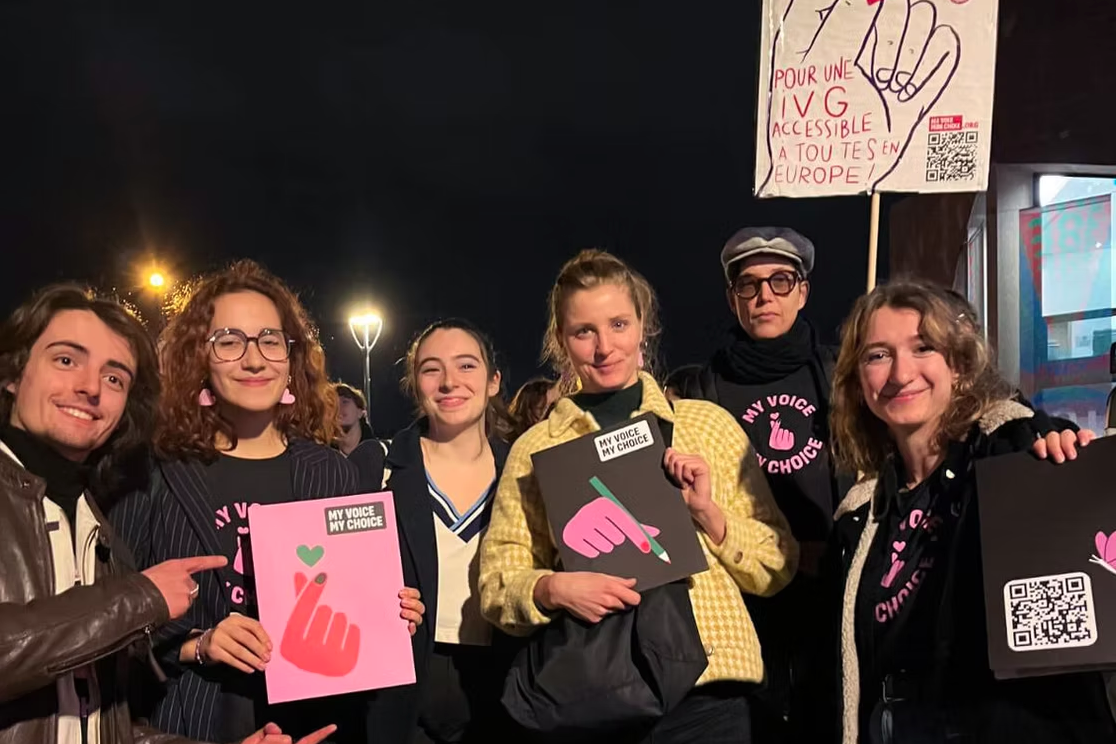 The decision came following a pan-European report. Photo: My Voice, My Choice.
In its response, the Commission said financial support for abortions could be provided through the European Social Fund Plus (ESF+), and that member states could use the fund “voluntarily and in accordance with their national laws, to provide such support”.
“The ESF+ can support the efforts of these Member States, while granting them autonomy to determine how and under what conditions access to safe and legal abortion will be provided”, the commission said in a statement.
“As EU support can already be provided relatively quickly by Member States willing to do so under existing instruments, it is not necessary to propose a new legal instrument.”
Speaking at a press conference announcing the decision, European Commissioner for Humanitarian Aid and Crisis Management Hadja Lahbib said, “from now on, we are granting member states the possibility to use EU funding to improve access to abortion”.
“This means supporting women who need to travel, in their own country, in remote areas and supporting women without financial means. In practice, it means women will have better access to safe abortion care; any vulnerable women, anywhere in Europe".
Noting that an estimated 500,000 women were thought to be at risk annually from unsafe abortions, she congratulated activists on their work advancing the campaign: "They've shown that citizen participation works and democracy delivers".
Campaign coordinator Nika Kovač called the decision a "victory for women in Europe... For the first time, the commission confirms unequivocally that EU funds can be used to guarantee access to safe abortion care".
She said that while campaigners had "conveyed our satisfaction with the positive reply... We expressed our disappointment that no promise of new allocation of financial resources was made at this time".
Activists urged the commission to provide additional funding in the future and provide "clear instructions" to member states on how to tap the funds to provide access to abortion.
Posting on X, Maltese MEP Peter Agius stressed that "abortion is a matter to be regulated by Member States. The EU Commission today confirms that there will be no specific instrument for cross-border abortion".
'Pushback and hate'
Reacting to the decision, Malta campaign organiser Belle de Jong called the decision “more than historic” while noting that campaigners in Malta had faced the “toughest campaigning circumstances, met with incomprehensible pushback and hate”.
“That friction is also why Maltese women gain the most: they will no longer be criminals for accessing healthcare,” said de Jong.
“This decision saves lives. It also leaves Malta with one simple question: as abortion is accessible across Europe through our own tax contributions, how can we continue to criminalise women at home?”
Malta is among the most restrictive countries in the EU when it comes to abortion access; the procedure is illegal except, following a 2023 legal amendment, in cases where a woman’s life is in danger.
The amendment followed the 2022 case of US tourist Andrea Prudente, who was forced to travel to Spain for an abortion after being denied the procedure in Malta, where she suffered a miscarriage while 16 weeks pregnant.
Malta ranks at the bottom of the EU for access to abortion, according to the European Abortion Policies Atlas 2025.
Poland is also notable in Europe for lack of access to the procedure, with ending a pregnancy in the country only permitted in cases of rape, incest or if the mother's life is in danger.
'Deeply concerning' - Life Network
Reacting to the news, Life Network said the European Commission’s decision “raises serious concerns”.
It pointed out the decision opens up the possibility that countries where abortion is permitted could use EU funding to present abortion as healthcare and facilitate access for women from other Member States.
“Such a move would effectively reshape the purpose of EU financial instruments without proper democratic consensus,” Life Network Foundation CEO Miriam Sciberras said.
“This development is deeply concerning.”
Sciberras added the European Social Fund “was not created to subsidise abortion services or cross-border abortion travel.”
“Public policy should prioritise care, support, and solidarity, especially in moments of crisis.”
Sciberras suggested that rather than allocating public funds to facilitate abortion across borders, European institutions and national governments could invest in comprehensive support for pregnant women in difficult circumstances.
She asked whether the Maltese government intended to “make use of taxpayer-funded EU resources to finance abortion travel.