Europe can no longer rely on the US
Europe urgently needs strong leadership to confront a new reality: it can no longer depend on the US for security, markets, border stability, or as a reliable ally, says Michael Frendo
Squashed between the US, Russia and China, the EU can either ‘man up’ or resign itself to be the Cinderella of the new global (dis)order.
It has become amply clear that the Trumpian vision of a Great USA is a USA that asserts its military and economic force in any part of the world where it wants to advance its interests – particularly, but not exclusively, in the Western Hemisphere. That even includes sovereign territories, such as Greenland, of its fellow NATO member states.
Buoyed by the military success of the Caracas adventurist intervention decapitating the country of an albeit decrepit and horrible tyrant, the US now eyes other prizes that the Trumpian vision of national security wants to win for America.
Is the national security ‘claim’ to Greenland a case of ‘upping the ante’ so as to obtain the best negotiated outcome? Military acquisition is always on the cards we are told by Mr President. Clearly that logic does not sit well with the condemnation of the other military option that the other president, called Vladimir Putin, adopted to justify his safeguarding of what he deemed Russia’s interests not to have NATO extend to the whole spread of Ukraine’s borders.
What should happen if the US carries out a “special military operation” to take over Greenland in the name of its vital security interests?
Does the core collective defence Article 5 of the NATO Treaty apply when one NATO member attacks another member? How can that work if the membership solidarity, the foundation stone of NATO, is broken from the inside?
No wonder the Danish prime minister asserted that any assault by the US on its territory in Greenland would mean not only the end of NATO but could also possibly mean the end of the EU.
The EU too, though not a military alliance (once the attempt at a European Defence Community with a common European Army failed in the 1950s), has its own Mutual Defence Article 42(7) TEU:
“If a member state is the victim of armed aggression on its territory, the other member states shall have towards it an obligation of aid and assistance by all the means in their power, in accordance with Article 51 of the United Nations Charter.”
The threat to Europe from Trump’s USA is at its greatest in the issue of Greenland. If NATO collapses, could a new security military alliance emerge from among the able and willing EU member states plus the UK, comprising two permanent members of the UN Security Council and two nuclear-armed states?
Europe would have no choice even if the UK were to opt out of this in the name of its increasingly hollow special relationship with the US.
The EU states need to look seriously at these scenarios and prepare for them.
Does Article 5 of the NATO Treaty apply when one NATO member attacks another?- Michael Frendo
Of course, Trump is right to flag the increasing presence of Russia and China in the Arctic Circle. The opening up of the Arctic route due to climate change (“drill, baby, drill”) changes the commercial and security scenarios (also at the detriment of the Suez Canal and Mediterranean routes – Malta too should be considering the consequences).
Can Denmark handle the security issues around Greenland? Categorically “No” says Mr President. Does that give the US a right to acquire Greenland by hook or by crook? Of course not. That could be a compelling argument for the US to negotiate with Denmark and Greenland that NATO (including the US) collectively safeguards security in that area.
The declaration supporting Denmark issued by six EU member states France, Germany, Italy, Poland, Spain and Denmark plus the UK favours this solution:
“Security in the Arctic must therefore be achieved collectively, in conjunction with NATO allies including the United States, by upholding the principles of the UN Charter, including sovereignty, territorial integrity and the inviolability of borders”.
Where are the rest of the 27 EU member states? Article 42(7) puts a responsibility on all of them.
European strong leadership is urgently required as it faces the new reality: it cannot rely on the US for its security umbrella; it cannot rely on the US as a market for its goods and services; it cannot exclude the US breaching the EU frontiers; it cannot rely on the US as a reliable ally.
It has to forge its own way, secure its own vital and critical resources and infrastructure, for energy, for production of its goods, for its security. That’s a tall order but it has now become an existential issue.
Clearly the checks and balances in the EU system of governance in a Union of Peoples and of States makes such leadership even more difficult when facing the autocratic governance of countries such as Russia, China and, increasingly, the US. But such difficulty just has to be overcome. Emmanuel Macron tries but France should also seek to galvanise the smaller EU member states, not just ignore them. Maybe the EU can learn from the Catholic Church’s emerging synodality concept?
Time is of the essence, for the elected monarch across the pond is religiously executing the Italian expression: “L’appetito vien mangiando.”
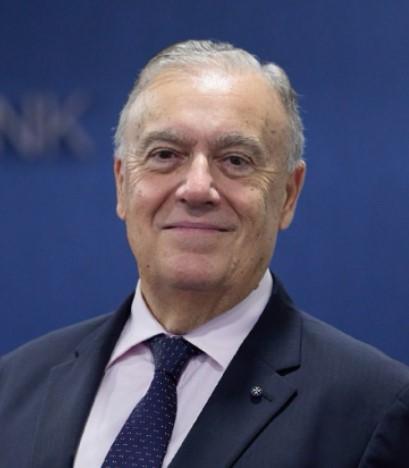
Michael Frendo is a former foreign minister of Malta.