Who won the ICC case, and what did Malta really want?
Your questions about the tribunal's Malta-Steward decision answered
It’s been more than one week since the government announced that international arbitration between Malta and Steward Health Care has been concluded.
The International Chamber of Commerce’s decision has been the subject of much commentary and even more political spin. And while the ICC’s 200-page award document has been published, its legal language makes it difficult for the average person to easily understand.
Attached files
We seek to answer some of the most frequently asked questions about the international tribunal's decision and its impact.
How much money did Malta want from Steward?
As much as €890 million or as little as €87.5 million, depending on a range of factors. But ultimately, the figure to keep in mind is €488 million.
The government went into the case with a laundry list of things they wanted Steward to pay up for. Its lawyers argued that Malta was owed money for all sorts of things Steward had failed to do – from developing the three hospitals under its control to a failure to kickstart medical tourism.
The amounts Malta sought varied at different stages of the ICC case, and were also contingent on what the tribunal concluded.
For instance, if the tribunal found that the concession breached EU state aid rules [a legal angle Malta initially pursued], Malta wanted €87.5 million in compensation. If the tribunal dismissed Malta’s primary defence [more about that later] as well as its state aid arguments, Malta’s lawyers presented an €890 million figure as the sum total of its contractual damage claims.
But the most important figure, and the one the government really pushed to the ICC, was €488 million. That is the amount it ultimately requested in restitution from Steward.
How did Malta calculate its €488 million request?
Both Malta and Steward hired their own respective experts to calculate the benefits which each side received.
‘Benefits’ is a broad term, encompassing anything from literal money transfers to payments made, investments, and the value of healthcare services provided.
Malta’s expert - from a London-based firm - calculated that healthcare services provided by Vitals and later Steward amounted to €607 million in total. Steward’s expert said it was anything between €604 million and €668 million.
The tribunal chose the lower figure of €604 million.
Malta’s expert then presented three scenarios to the ICC.
Scenario 1: No discount applied to the €604 million. Under this scenario, Steward owed Malta €2.5 million.
Scenario 2: A 40% discount on the €604 million, because healthcare services provided were “partially deficient”. Steward owed Malta €245 million.
Scenario 3: An 80% discount, because healthcare services were “highly deficient”. Steward owed Malta €488 million.
Malta pushed scenario 3 to the tribunal, arguing that Steward’s services were extremely poor and that it therefore deserved to get an 80% discount on the value of healthcare services it had to repay Steward. It made that €488 million compensation claim a key part of its case.
Ultimately, it failed to convince arbiters.
 The ICC was not convinced by Malta's request for a discount.
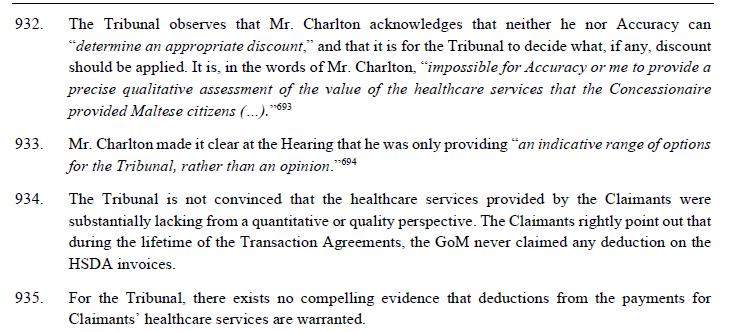
The tribunal said Malta had failed to prove that the services provided by Steward were deficient in any way. It would be “speculative” to apply a specific discount rate, it said.
Malta had never complained about healthcare services provided during the lifetime of the concession, it noted, and Steward’s failure to reach key investment milestones was irrelevant to valuing day-to-day healthcare services.
“There exists no compelling evidence that deductions from the payments for Claimants’ healthcare services are warranted,” the ICC said, noting that even Malta’s own expert had admitted that the discount rates presented in his report were “an indicative range of options for the Tribunal, rather than an opinion.”
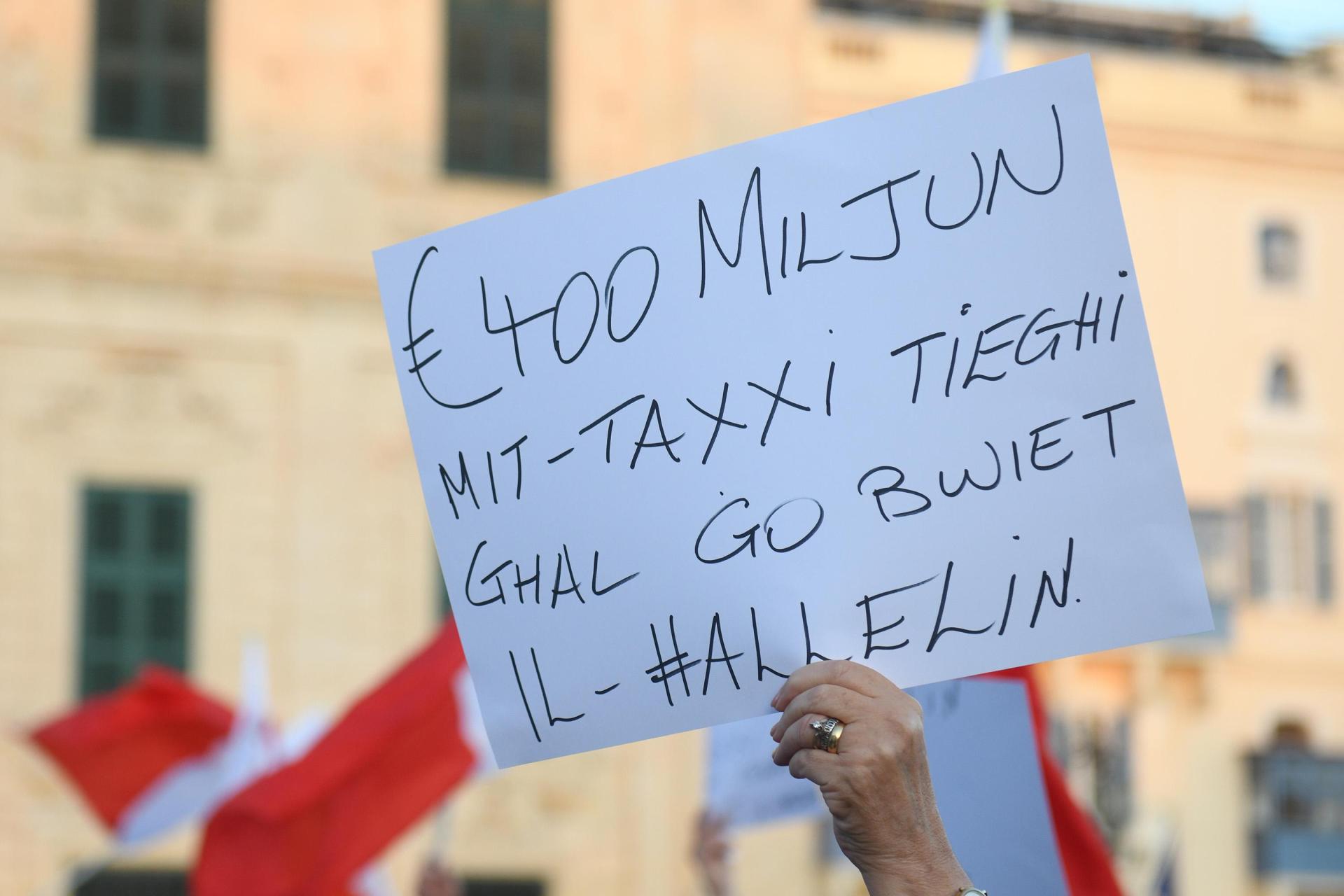 Several protests accompanied the hospitals' saga. Photo: Matthew Mirabelli
How did the ICC calculate Malta’s €889 million in benefits from Steward?
The ICC calculated that in total, Malta received €889 million in benefits from Steward.
This is how it calculated the €889 million:
- €604 million in healthcare services
- €234 million in salaries and wages
- €41.5 million in infrastructural investment
- €8.6 million in services concession fees
- €1.3 million in post-termination services
The tribunal calculated that Steward received €885 million in benefits from Malta. The balance between the €889 million Malta received in benefits and the €885 million Steward did – €4.8 million – was money Malta still owed Steward.
Where did Steward spend €41.5 million on infrastructure?
Apart from the fraud allegations that dogged the concession from the very beginning, the biggest problem with Vitals (and later Steward) was that the big investments they promised never materialised.
The issue was considered so significant that the Health Ministry spent €400,000 on a 355-page report by Grant Thornton to analyse infrastructural investment by Steward.
Grant Thornton analysts settled on €41.5 million. While their report is not public and the ICC ruling does not enter into specifics, we know that the lion's share of Vitals/Steward investment was to build a medical school in Gozo.
Both Robert Abela and Joseph Muscat have previously highlighted that campus, the Barts Medical School, as a key benefit of the Vitals-Steward deal, proclaiming it a facility that Steward “built” and “paid for”.
But the ICC tribunal decision means that, at least in accounting terms, that is no longer true. Malta and Steward must refund each other for everything the other side paid for.
This means that Maltese taxpayers, not Steward, have technically ended up paying for the Barts campus in Gozo.
What did Malta argue in the case?
Malta’s main line of defence in the ICC case was straightforward: it relied on the Court of Appeal’s decision in the case filed by Adrian Delia. That court annulled the hospitals deal, and the government argued that contracts were therefore void from the outset.
The tribunal found that argument persuasive and upheld it. By upholding that defence, Steward no longer had a legal leg to stand on when it came to suing Malta for termination benefits.
Steward filed the initial ICC case because it believed that it was contractually entitled to €148 million in compensation from Malta [including that infamous €100 million payment it was promised by Konrad Mizzi].
The flip side of this legal victory is that Malta’s success was, at least in part, a Pyrrhic one: because the contracts were null and void, Malta was limited to claiming restitution and could not claim any damages from Steward.
And while it hoped to get €488 million in restitution, it ended up in the red, ordered to pay Steward €4.8 million.
 Adrian Delia waged the legal campaign against the hospitals concession. Photo: Adrian Delia
What about Steward’s unpaid €41m VAT bill?
Malta had paid Steward €41.5 million in VAT owed for healthcare services, as part of the terms of the concession deal.
Steward was then expected to pay that tax to the Inland Revenue department. It never did, prompting Malta’s tax commissioner to file legal proceedings to recoup that money.
Steward argued to the ICC that the VAT was recorded as a liability in its books and that it, therefore, should not be included when calculating the total amount it received from Malta.
The ICC disagreed and included the full amount of VAT in the benefits Steward received from Malta. That meant the €41.5 million was included in Malta’s favour when calculating benefits received by either side.
However, the ICC also included an important provision: Malta’s tax commissioner must withdraw his legal claim for the unpaid VAT, to avoid the risk of the company paying the €41.5 million twice over.
How much did all this cost taxpayers?
Malta spent around €11 million in fees for lawyers, experts and other costs in the ICC case. Steward, by contrast, spent €7.4 million on the case.
The €11 million total cost of the ICC action does not include the €4.8 million that the ICC ordered Malta to repay Steward.
Malta’s costs break down as follows:
1. USD $762,500 in ICC costs (50% of total cost)
2. €8.1 million in legal fees
3. €2.2 million in expert witness fees
The lion’s share of Malta’s legal fees went to a UK-based law firm, Clyde & Co, which pocketed more than €6 million. Local law firm Ganado Advocates was paid just over €1.3 million.
Keep in mind that this is just a fraction of the total cost of the Vitals-Steward debacle.
A further €10 million was spent on a years-long magisterial inquiry into the deal. That inquiry indicated millions were moved from Malta to Vitals/Steward and then onward to offshore companies belonging to company shareholders.
And literally tens of thousands of man-hours have been wasted on the concession over the past decade: hours spent by lawyers drafting the concession; National Audit Office analysts who compiled three details reports into the deal; civil servants who negotiated finer details of the concession; prosecutors preparing arguments for ongoing criminal cases; and hours by politicians who debated the deal and held press conferences about it.
Malta even made a similar point itself in its submissions, telling the ICC that "numerous officials had to devote substantial time and effort to this Arbitration, time that should have been dedicated to their core public functions."
All those costs, and time, would have been saved had Malta never entered into the failed deal in the first place.
What did the ICC say about fraud or collusion?
Nothing explicitly, because that was not the tribunal’s job. The tribunal was asked to rule on a dispute between Steward and Malta concerning the termination of the concession, not any crimes committed.
The tribunal could have looked into fraud claims if it rejected Malta’s primary line of defence and looked into an alternative claim advanced by Malta’s lawyers – that Steward fraudulently misrepresented its financial position.
But it ultimately upheld Malta’s original defence and ruled that the concession was null and void. The moment it did that, it no longer had any need or interest in assessing fraud claims.
In one line of its decision, the ICC hints that it found the court of appeal’s reasoning which linked Steward's failures to hit key milestones to collusion as "questionable". But in its concluding remarks, it makes it clear that it has “formed no view” on the collusion claim.
 The tribunal said it had 'formed no view' on the collusion claim.
To refresh your memory: the first civil court judgment concluded that Vitals/Steward had defrauded the Maltese government. The court of appeal said that the government was not a victim; key officials had colluded with the company, it said, allowing it to miss deadlines and milestones without any penalty, granting it extensions and favourable contractual terms against the public interest.
So why did Abela claim that the tribunal found no fraud?
This was misleading by the prime minister. The tribunal made it clear it was tasked with resolving legal issues arising from the concession, not facts [such as crimes].
It is especially misleading to claim the ICC “found no fraud” given the legal defences adopted by the government in the case.
Malta first argued that Steward committed fraud in misrepresenting its financial position when it was taking over the concession.
Malta then switched to argue that Steward and top government officials colluded against the public interest.
Malta’s lawyers also sought to argue that Vitals/Steward misappropriated taxpayer money to spy on then-Health Minister Chris Fearne. The tribunal made it clear that it “was not requested to make determinations in that regard”.
So, who won?
According to the ICC, nobody.
In its concluding notes, the three arbiters who decided the case made it clear that “overall, no clear winner emerges from this arbitration.”
The tribunal did, however, offer a perspective on who lost: Maltese taxpayers.
“Sadly, the concession for these hospitals turned out to be a failure,” it said.
 The ICC decision makes it clear the biggest victims were the 'citizens of Malta'.
“The primary victims of this failure are the citizens of Malta who were anxious about receiving through a private public partnership improved health care services in an improved hospital environment in their beautiful country.”
When determining who was to pay the roughly €1.5 million in ICC costs [plus additional €400,000 in associated case costs], the arbiters noted that while Malta should, in theory, pay less because its primary defence was upheld, the legal strategies it adopted led to additional costs.
In their concluding remarks, the arbiters also flagged an apparent hypocrisy in Malta's line of reasoning, because it complained about Steward resorting to the ICC while at the same time using the tribunal to file compensation claims.
“It is inconsistent for the Respondent [Malta] to criticize the Claimants [Steward] for pursuing contractual claims as “a calculated attempt to circumvent a binding national judgment of the court of final instance in manifest disregard of the principle of res judicata,” when the Respondent itself advanced a massive contractual counterclaim (albeit on an alternative basis) amounting to over €890m with major written submissions and expert reports in support thereof.”