First century of Birżebbuġa parish
The titular statue of St Peter carved in wood by Ferdinando Stuflesser in 1959. The southern seaside village of Birżebbuġa is marking the first century of the foundation of its parish this year. Although one may easily argue that this part of Malta was...
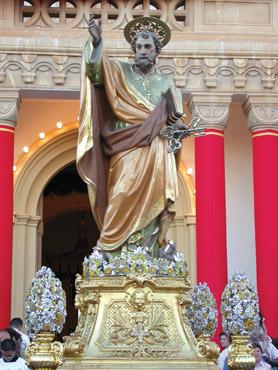 The titular statue of St Peter carved in wood by Ferdinando Stuflesser in 1959.
The southern seaside village of Birżebbuġa is marking the first century of the foundation of its parish this year.
Although one may easily argue that this part of Malta was one of the very first to be inhabited, the process by which it developed into a residential village was relatively slow.
During the Middle Ages, this area was almost uninhabited and its land was used purely for agricultural activities by farmers who flocked from the nearby villages of Żurrieq, Safi, Gudja, Għaxaq and Żejtun.
The lack of fortified structures along its coast made this part of the island unsafe for living, especially with the threat of sea pirates who frequently used to invade the surrounding coast without warning. This was the main reason why farmers used to leave their homes in the early morning and return after spending a day working in their fields.
But the construction of several fortifications, especially those built between the 17th and the 19th centuries, paved the way for a more tranquil life around the entire picturesque harbour of Marsaxlokk, formerly known as Porto Erkole.
As a result, these farmers started to arrange parts of their ranches to accommodate their families, with the main intention of living close to their place of work. This led to the rise of the first hamlets, which in subsequent years developed into two parishes – Marsaxlokk in 1897 and Birżebbuġa 16 years later.
By the second half of the 19th century, the area of Birżebbuġa was made up of three small settlements, Bengħajsa, Ħal Far and the area of the two main bays: St George’s Bay and Pretty Bay. While the hamlets of Bengħajsa and Ħal Far were primarily linked to agriculture, the area of the two main bays was fast developing into a summer residential area for several noble people, mostly from Cottonera.
These summer residents used to enjoy the peaceful environment this village offered at the time. Consequently, during the hot summer months, the population used to reach around 800 inhabitants, but by the end of September, when these noble people went back to their homes in the cities, only a few villagers were left living in the area. In fact, these villagers led a relatively isolated life.
The farmers and their families who lived there all year round remained without a priest to assist them in their daily needs. Canon Penza decided to build a new and bigger church with the aim of asking the Bishop to establish it as an independent parish
One of these summer residents was Canon Spiridione Penza from Cospicua, who owned a summer residence in Pretty Bay. While in Birżebbuġa, he used to serve the people who lived nearby, and to do this he made use of a small chapel dedicated to the Holy Family situated in Żurrieq Road.
However, towards the end of September, all the summer residents, including himself, left the seaside village. The poor farmers and their families who lived there all year round remained without a priest to assist them in their daily needs.
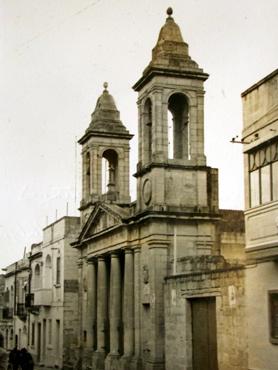 The Doric-style façade of Our Lady of Sorrows church.
Canon Penza gave this a lot of thought and decided to build a new and bigger church with the aim of asking the Bishop to establish it as an independent parish.
This new church was built just a corner away from his summer residence, later to become his permanent residence when he chose to leave his hometown to live among the poor and humble people of Birżebbuġa. Three large barns originally constituted the church, which formed part of an enormous back-garden of a remarkable house built a few years earlier by the noble Paolino Attard Montaldo.
This church, dedicated to Our Lady of Sorrows, was solemnly blessed by Bishop Pietro Pace on August 14, 1907. Some time later, on November 7, Canon Penza presented his formal request to the Bishop so that this church would be raised to the status of a parish.
Another similar appeal was drafted and presented nine days later, this time by Rev. Aloysius Albanese, rector of the Holy Family chapel, in which he continued to emphasise the importance of Canon Penza’s appeal.
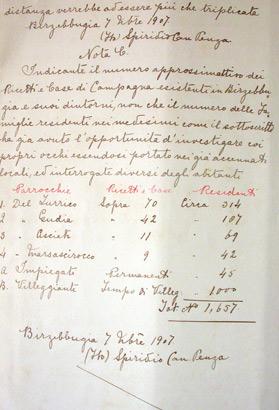 Part of the formal request drafted by Canon Spiridione Penza asking for Birżebbuġa to be raised as a parish.
Years passed and some notable improvements were made to the church, which included its enlargement and the building of two small mansions, one on each side, for administrative purposes, and the construction of its Doric-style façade.
All this work was completed by January 1910 and was the result of several financial contributions offered by some noble summer residents, who over time made this tiny seaside village their own.
The titular statue of Our Lady of Sorrows was donated by Canon Achille Refalo and arrived in the village on August 17, 1910. The titular feast used to be celebrated on every third weekend of September, a little before the summer residents returned to the cities.
These developments led to the most important date, that of September 9, 1913, when, from his palace in Valletta, Bishop Pace issued a decree, by which he separated the limits of Birżebbuġa from the parishes of Żurrieq, Gudja, Għaxaq and Marsaxlokk, and raised the newly-built church of Our Lady of Sorrows to the dignity of an autonomous and independent parish.
To confirm his decision, a week later, Mgr Pace issued a pastoral letter which was read in all churches of the Maltese diocese, where he explained the reasons behind his decision, and also to announce Canon Carmelo Buġelli (a politician who in 1921 contested the general election with the Unione Politica Maltese) as the first appointed chaplain of the new parish church of Birżebbuġa.
As years went by, the population continued to increase, and on August 29, 1926, Bishop Mauro Caruana solemnly laid the foundation stone of the second parish church, dedicated to St Peter in Chains.
The years rolled by, and today a century later, the village, with its population of 10,500, is almost unrecognisable on account of the several residential and industrial developments. In the past century, Birżebbuġa had its fair share of ups and downs, most remarkably during World War II when Kalafrana Bay housed the British naval base. On a more positive note, one cannot but mention the world-renowned event of December 2-3, 1989, when a historic summit was held between George Bush of the US and Mikhail Gorbachev of the USSR. During this summit, which was held a few weeks after the fall of the Berlin Wall, the two leaders buried their differences in the stormy seas of Marsaxlokk Harbour and declared the end of the Cold War.
During this year, several activities are being organised and a book is going to be published by the parish to mark this milestone.
Conrad D’Amato is secretary of the Għaqda Storja u Kultura.