Former Kalaxlokk workers sue the state over ‘decades of injustices’
Workers claim they’re owed money and demand compensation for moral damages
Thirty-eight former employees of the state-owned Kalaxlokk Company Ltd have taken the government to court, demanding their share of a multi-million-euro guaranteed redundancy fund they claim was withheld from them for decades.
The workers are also demanding compensation for moral damages after allegedly spending years being used as cheap labour for private contractors. They claim they were subjected to mandatory transfers and forced to perform menial tasks well below their rank and skill sets. Furthermore, they allege their wages were frozen for nearly two decades.
Speaking to Times of Malta, the workers said they were terminated from Kalaxlokk Company Ltd without compensation despite clearly being protected by the redundancy agreement.
The constitutional case, filed against the prime minister, the state advocate, the finance and economy ministers, and other state entities, marks a major escalation in a saga that traces back to the 1980s.
The workers argue that their fundamental human rights were violated by successive Labour and Nationalist administrations and the General Workers’ Union (GWU), all of which failed to honour a guaranteed redundancy fund established in 1999.
The case was filed in late 2024 but several former government officials are being called to testify this year.
The origins of Kalaxlokk
Kalaxlokk Co. Ltd was set up by the Labour government in 1986 to carry out construction and maintenance works at the Marsaxlokk Port. Originally formed by merging two parastatals, the company was used to build the Freeport.
The company was marred by political controversy and financial instability since its early days. It was the target of PN critics, and workers say they faced weeks where their weekly paycheques could not be cashed because of insufficient funds in the company’s bank accounts.
Despite these hardships, the Labour government granted the workers indefinite contracts just before the 1987 election. By the 1990s, many had advanced into skilled roles, working as welders, foremen, and pipe fitters.
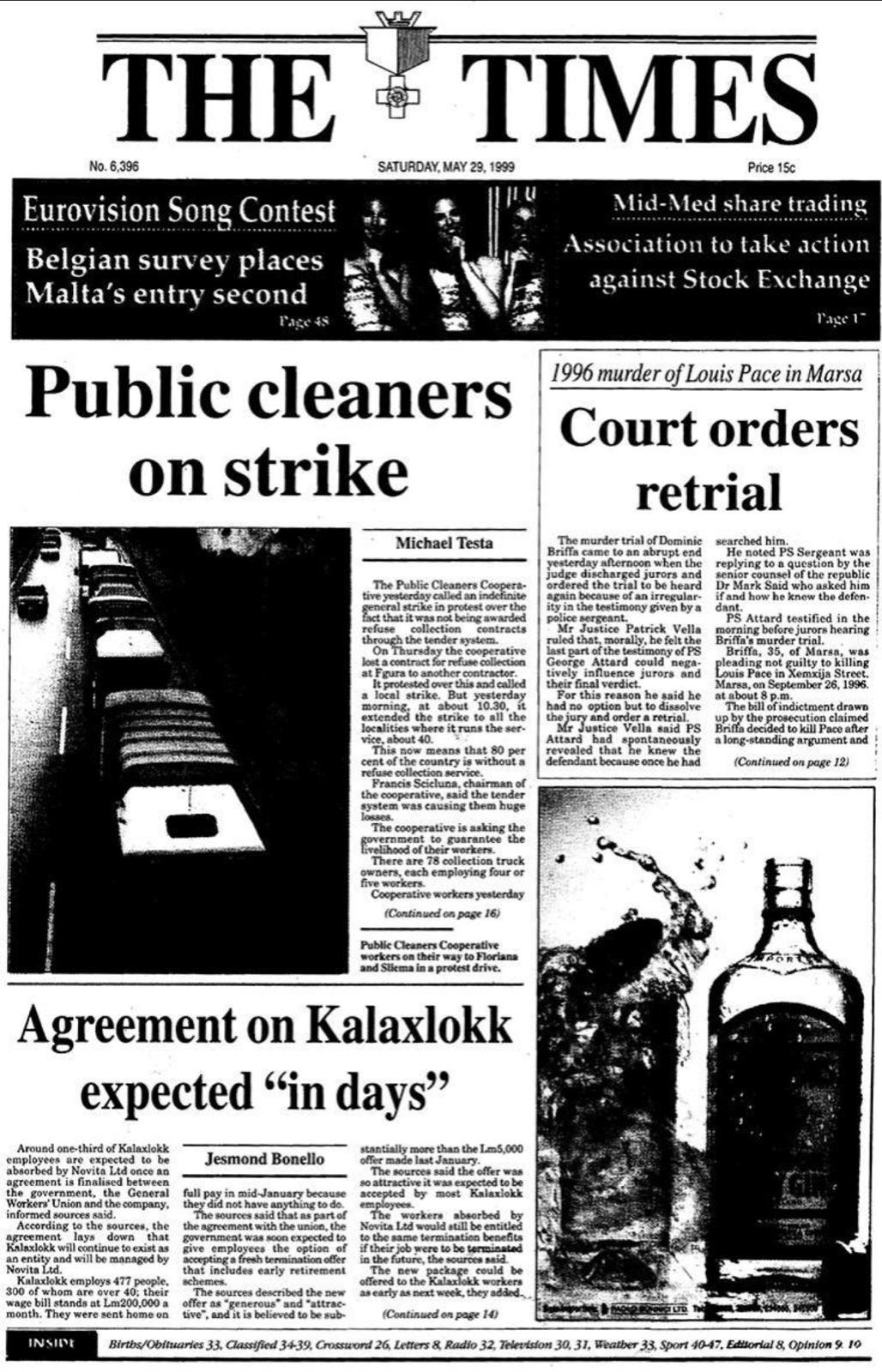 The issue made headlines frequently before the turn of the millennium.
The 1999 agreement: A Lm1.2m promise
But the company kept running into problems. The men say that it felt like the company did not have work for them and they would be given odd jobs that were not within their trades.
By the end of the decade the situation had deteriorated. The former workers say the company initially tried to transfer them to a private entity called Novita Construction, promising them “50 years of work”. Suspicious of private sector job security, the workers refused, sparking industrial actions and periods without pay.
Then in June 1999, the GWU announced it had negotiated a voluntary retirement scheme. Several workers who were the closest to the retirement age took the opportunity, but because the remaining workforce was relatively young, they rejected it to save their government jobs.
A couple of months later the PN government and the GWU signed an agreement creating a Lm1.2 million (€2.8 million) guaranteed redundancy fund for those who had decided to stay.
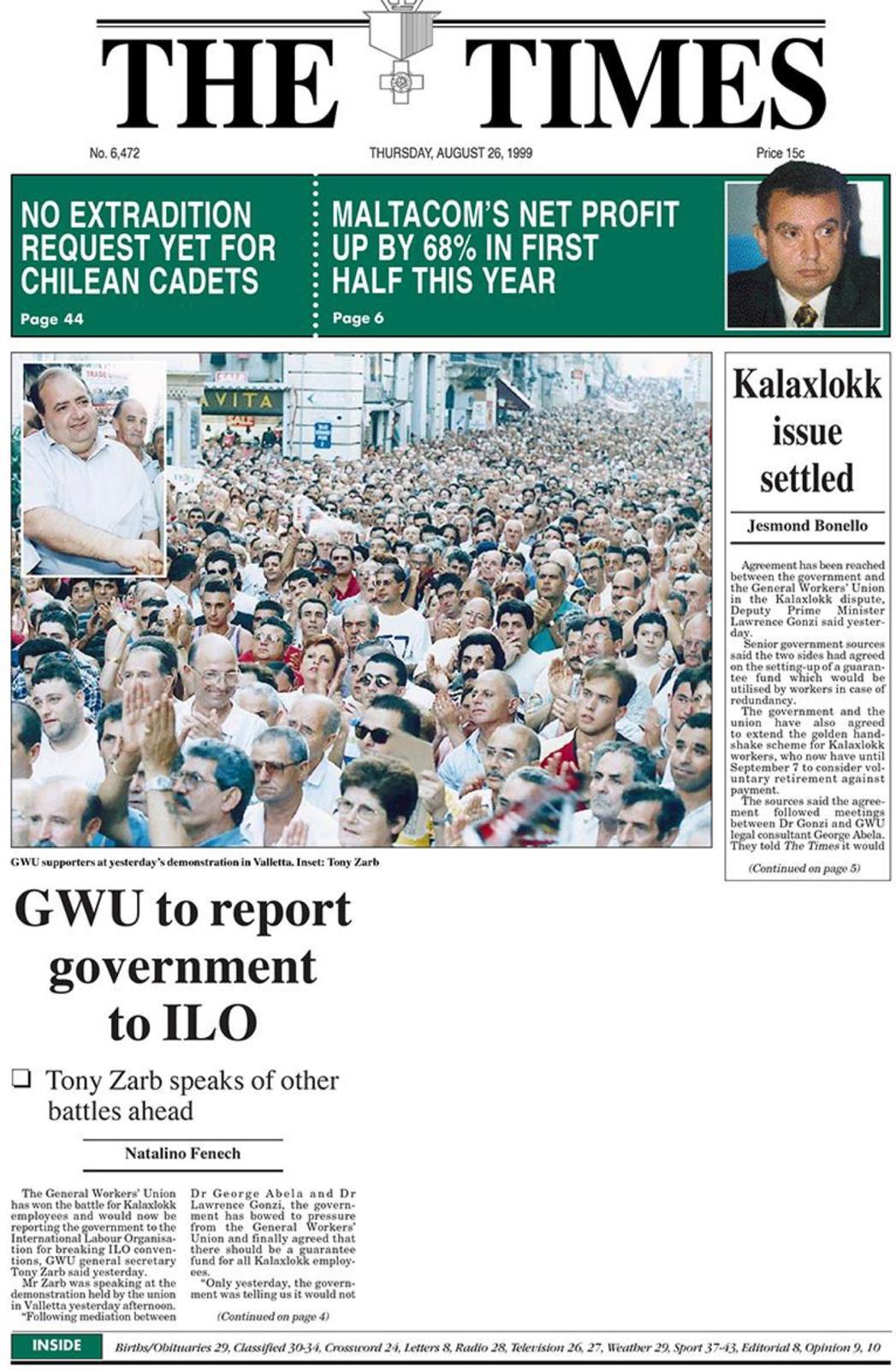 The dispute was deemed 'settled' when the government and the GWU reached the agreement.
Then-GWU General Secretary Tony Zarb hailed it as a “great victory”, telling workers the fund was legally secured for anyone who remained with Kalaxlokk and eventually became redundant.
This agreement lies at the heart of the entire controversy. The workers suing the government say they never got any money from the fund, not even when they were formally made redundant following their involuntary termination from Kalaxlokk in 2013.
This is the main point of contention, however, because in a reply to questions, the government said the workers were never made redundant.
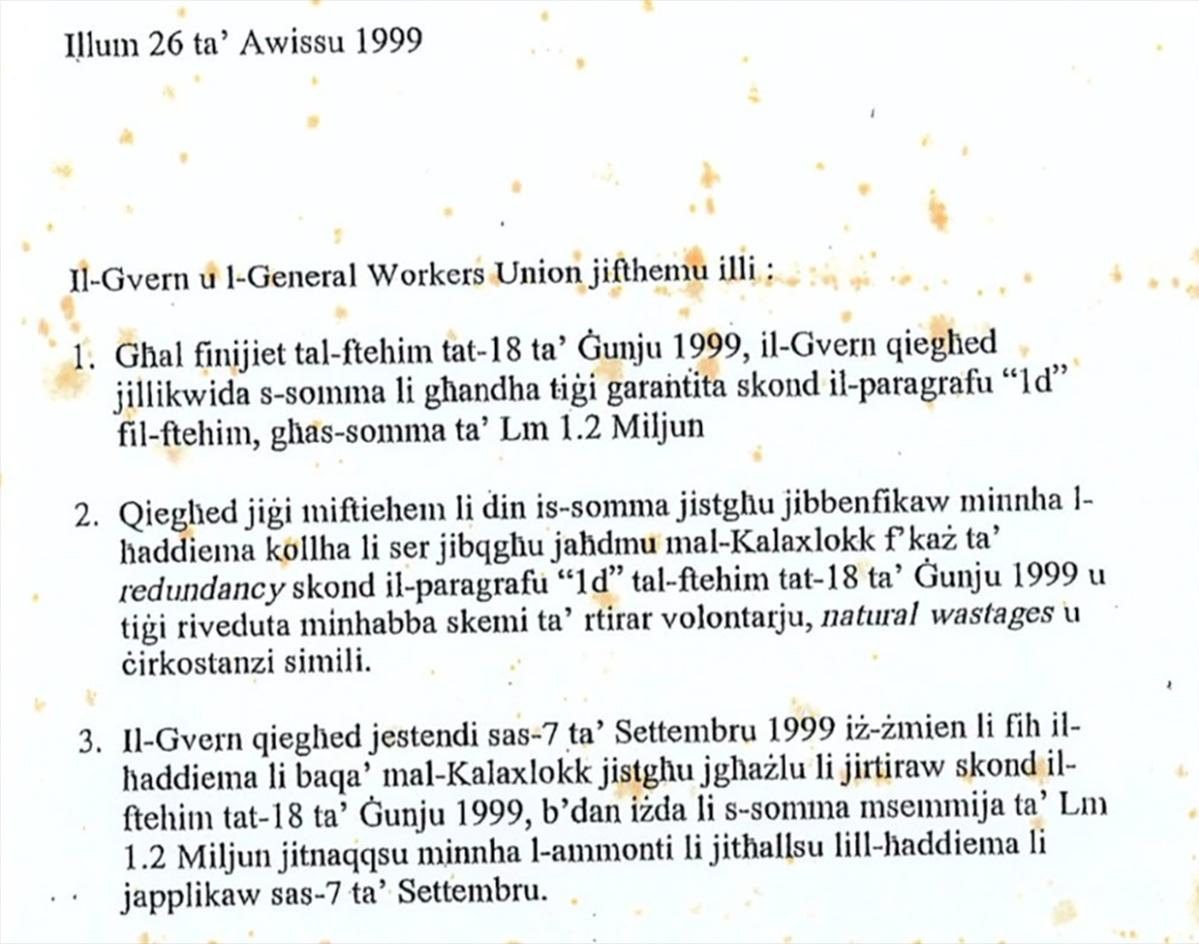 An extract of the agreement through which the government and the GWU set up the guaranteed redundancy fund in 1999.
Transfers and ‘discrimination’
But before 2013, the workers claim they had to endure countless discriminatory transfers and horrible working conditions in what they describe as a decades-long scheme to avoid paying out that fund.
The workers allege that instead of declaring them legally redundant, Kalaxlokk kept them on the books but claimed it had no work for them.
Throughout this time, they claim they were subjected to imposed forced leave lasting anywhere from a few days to an entire year.
They also say they were given frequent, “heartless” transfers from one place to another, sometimes with just a few days’ notice.
Times of Malta saw written transfers, documenting how some workers were transferred through several different workplaces multiple times over a few months. The transfers would sometimes happen over the weekend.
Workers say they were threatened they would be fired if they refused to transfer.
They also complain of having been given demeaning work that was completely unrelated to their trades, and for being denied collective agreements, leaving them with far lower earnings than other government employees doing identical work.
Workers claim they were subjected to years of horrible working conditions
The 2013 ‘redundancy’
The constitutional court application says that in 2003, the government created a new company – the Industrial Projects and Services Ltd (IPSL) to absorb redundant workers from closing state companies.
The Kalaxlokk men say that from then on, they were paid through IPSL but intentionally kept on Kalaxlokk’s books so that, on paper, they were never officially made redundant and the government would not need to fork out payments from the 1999 redundancy fund.
The critical turning point came on December 31, 2013, when the workers were terminated en bloc from Kalaxlokk and moved to Resource Support Services Ltd (RSSL), the successor of IPSL.
They received their transfer letters on January 1, 2014, without any prior consultation or choice. The workers argue this mass termination was a clear case of legal redundancy, which should have triggered the immediate release of the 1999 fund.
Instead, they received nothing, and claim the fund, now worth roughly €2.78 million, remains untouched and trapped inside the Kalaxlokk company, which, according to the Malta Business Registry, has been in dissolution since 2014.
For over a decade since the transfer, the workers say they have pleaded their case to various ministers. They say that while politicians routinely admitted the workers were in the right, no permanent solution was ever offered, save for a one-time payment of €1,000.
‘They were never made redundant’ – government
In a reply to questions, a government spokesperson told Times of Malta that “these employees were never made redundant as they continued to be employed by RSSL in 2014”.
The RSSL’s own website, however, describes the company as having the “core function” to “absorb workers made redundant following the closure or restructuring of public and parastatal entities, including Malta Shipbuilding, Malta Shipyards, Malta Drydocks, Kalaxlokk Co. Ltd”, among others.
The government spokesperson went on to say that the workers benefitted from two collective agreements, one in 2014 and another in 2017, “where they were placed in a scale which was equivalent to their salary”.
“Moreover, they received a one-time payment of €1,000 to compensate for the time they were not covered by a collective agreement,” the spokesperson said.
“A second collective agreement was signed in 2017, and these workers now receive the same allowances and increase in salaries like public officers.”
The men, however, insist that to this day they are still not equally paid for identical work they do alongside other government employees.
‘Union was never approached’ – GWU
In its reply to questions, the GWU confirmed the existence of the agreement through which the fund was set up but said it did not have information about its “creation, maintenance or enforcement”.
It also said none of the workers ever “approached the GWU to request assistance or to initiate representation or proceedings on their behalf. As a result, the union did not have the opportunity to intervene or act for the individuals involved”.
The union also said it was not aware of claims of discriminatory working conditions.
“The GWU is not aware of such practices being formally brought to its attention by the workers involved. The GWU officials who were previously working at the union are no longer in service, and in some cases are deceased, and thus the information at hand is very limited,” the union spokesperson said.
The GWU also confirmed what the government said in its reply, that since the men were transferred to the RSSL, they were covered by a collective agreement.
The union also said its support had not been requested in the workers’ case and it did not know about it until it received questions from the Times of Malta.
‘Workers should get any money owed to them’ – PN
In a reply to questions, the Nationalist Party said it would not comment while the case is ongoing in court, but said “the workers deserve transparency, justice and a fair hearing of their claims”.
“If the workers are legally entitled to the fund under the 1999 agreement, they should receive every euro owed to them. The PN believes that workers should be given what is rightfully theirs,” a party spokesperson said.
“This means that every agreement must be honoured. Beyond any financial agreement, every government must ensure that all workers have decent working conditions so that they are not subjected to unnecessary hardship.”
The workers are asking the constitutional court to declare that they were unlawfully deprived of their money and that they were subjected to unconstitutional forced labour and discriminatory treatment.
They are demanding the immediate liquidation and payout of their share of the fund, plus 8% interest dating back to their 2013 termination, alongside substantial compensation for moral damages.