Fra Mudest made him, but Charles Casha never planned to write for children
Author Charles Casha marks 50 years of collaboration with Midsea Books
It is an admission rich in irony from a writer who would go on to become one of the most recognisable names in Maltese children’s literature. Now 82, Charles Casha looks back on a career that began almost by accident, yet would make him synonymous with the stories that shaped generations of young readers.
Casha has devoted his life to writing, publishing more than 100 works spanning short stories, novels and children’s books. But it was not the novels he once aspired to write that first brought him recognition; it was a character that followed him like a shadow – Fra Mudest.
His foray into children’s literature began with the bilingual publication Children’s Own, where he created Fra Mudest, a lovable, jolly friar who constantly finds himself in unexpected situations. What started as reluctance would eventually evolve into a defining chapter of Maltese literary history.
“At first, I didn’t want to write children’s books, I wanted to work on novels,” says Casha, who is celebrating 50 years of collaboration with Midsea Books.
“I was hesitant about being associated with children’s books,” added the man who would go on to help shape the landscape of Maltese children’s literature.
Casha’s journey into the genre started in 1967. John Demanuele took over Children’s Own when his father fell ill. On his father’s desk, he found a logo with the name ‘Fra Mudest’ written on it. Unsure of its purpose but intrigued by the potential, he passed it on to Casha, believing he could bring the character to life.
“When he asked me, I wasn’t too sure about it, honestly,” Casha recalled. That uncertainty didn’t last. He went on to write over 100 stories and six books featuring Fra Mudest.
Casha believes the character’s popularity lies in his ability to connect across generations.
“For the parents, it would bring a sense of nostalgia. For the children, it opens up a fantasy world. This version of Malta (which was based on Marsa in the 1950s and 1960s) is long gone. They don’t even know what a ‘fra’ is anymore.”
Still, the friar left an indelible mark. “I have over 100 publications but this is what I am most known for. Whatever I do, he will always be there.”
Over 100 stories and six books featuring Fra Mudest
By 1975, Casha had gained a reputation for crafting memorable characters, leading to his first collaboration with Midsea Books / Klabb Kotba Maltin, a partnership that continues to this day.
Unsurprisingly, his first book with the publishing house was another children’s book: Darbtejn Insiru Tfal, which introduced the ever-bickering couple Wiġi and Katrin.
Smiling as he glanced at his wife Mary, who sat beside him, he said: “That book was based on her grandparents. They were a great inspiration for me, they provided me with a lot of material,” he said, as the couple shared a chuckle.
For Casha, the heart of any story is not the plot but the people. His writing always begins with the character. It is this approach, coupled with his gentle nature and deep empathy, that enables him to step into the lives of others and write with authenticity, whether in children’s literature or other genres.
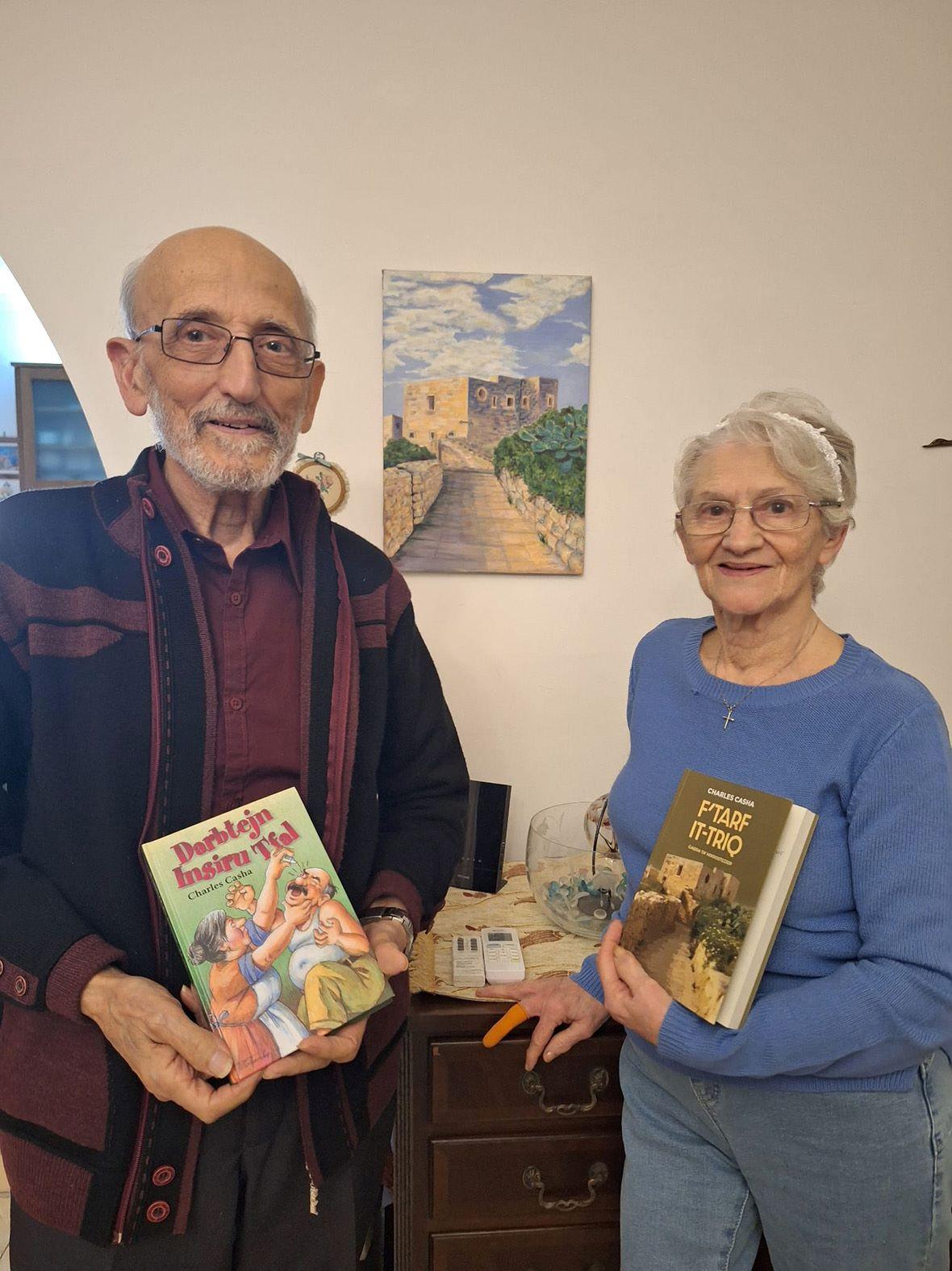 Charles Casha and his wife Mary standing in front of Mary’s painting featured on the cover of F’Tarf it-Triq. Photo: Emma Borg
Across five decades, Casha’s work with Midsea has brought a range of characters to life. His novel Il-Ktieb ta’ Barabba was translated into English, while L-Appartament fir-Raba’ Sular, translated into English and Albanian, was awarded the National Book Prize.
His most recent publication with Midsea is F’Tarf it-Triq, a collection of micro-stories, a format that challenges the writer to convey as much as possible in as few words as possible. The cover, which features a house at the end of the road, was illustrated by his wife, Mary.
“It is depicting the end of the road because that’s what I thought it would be: the end of the road of my writing.” At that, Mary raised her eyebrows and rolled her eyes, silently saying: “As if you would ever stop writing.”
And she is correct.
While Casha admits that F’Tarf it-Triq was meant to be his final book, he simply cannot stop.
“I began writing even before I knew how to write letters. I would scribble what looked like words to me all over my copybooks at school as if I was already a writer,” he said.
Although he is slowing down, he still has more stories to tell. His next children’s book is already in the works, inspired by the tales he shares with his grandson, Nick, who affectionately calls him ‘Nannu Charles’. Fittingly, he is toying with the title, The Stories of Nannu Charles.