Francis Ebejer beyond his words
He stands as one of the great figures of 20th-century Maltese literature
Francis Ebejer is a name every Maltese reader knows. As a novelist and playwright, he stands as one of the great figures of 20th-century Maltese literature, whose plays reshaped Maltese theatre and whose novels gave voice to an island caught between tradition and modernity.
Yet MUŻA’s exhibition, The Other Side: Francis Ebejer the Artist, which took place last month to celebrate the centenary of his birth, reminds us that his creativity was never confined to words.
Drawing and painting were his first loves, an impulse that accompanied him throughout his literary career. This exhibition foregrounds that “other side”, allowing us to encounter the writer as a visual artist, and in doing so, to see his oeuvre in a fuller light.
The surprise is how natural his drawings feel. They are not hesitant sidesteps by a writer dabbling outside his field but fully fledged explorations of line, form and colour.
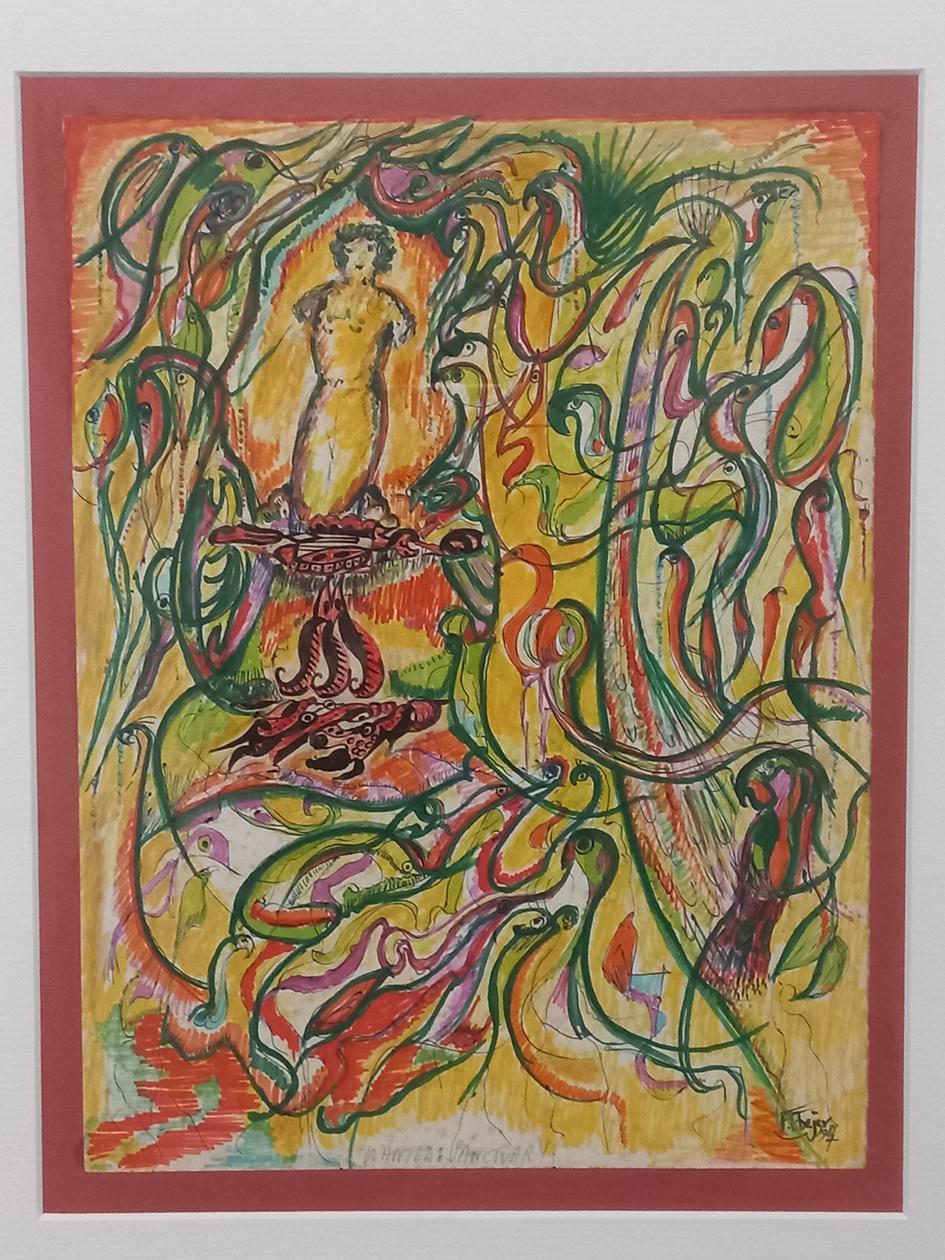 Wanted Sanctuary
The 15 felt-tip-on-paper drawings on display possess a restless energy, a swirling web of tendrils and wire-like connections that recall the surrealist tradition of automatism. Lines dart and curl, forming lyrical rhythms of visual movement.
Colours seep through in kaleidoscopic outpourings, sensuous and vibrant, yet never merely ornamental. They have the improvisatory, dream-driven quality of surrealist automatism: unpremeditated lines emerging instinctively from the unconscious, that take on a life of their own before coalescing into semi-recognisable figures.
In this sense, Ebejer’s drawings thus align with André Masson’s pioneering surrealist automatism.
Seen in this light, Ebejer’s drawings make perfect sense alongside his novels. His novels have always carried an undercurrent of the uncanny, an insistence that beneath rational experience lurk primitive instincts, submerged memories and mythic echoes.
Time itself, in his writing, is never linear but layered: “The Antiquity and the Now; the Now and Antiquity.” The past is never buried but bleeds into the present, even anticipating the future. It is this conflation of temporalities that lends his writing a bizarre, mystical quality.
One might say the same of his drawings. The free explorations into line and colour appear to draw from an inner reservoir of memory and myth. As with his characters caught between pagan instincts and Christian morality, between instinct and restraint, between the land’s ancient rhythms and the demands of modern life, these drawings suggest a subterranean tension between order and instinct, culture and nature, spirit and flesh.
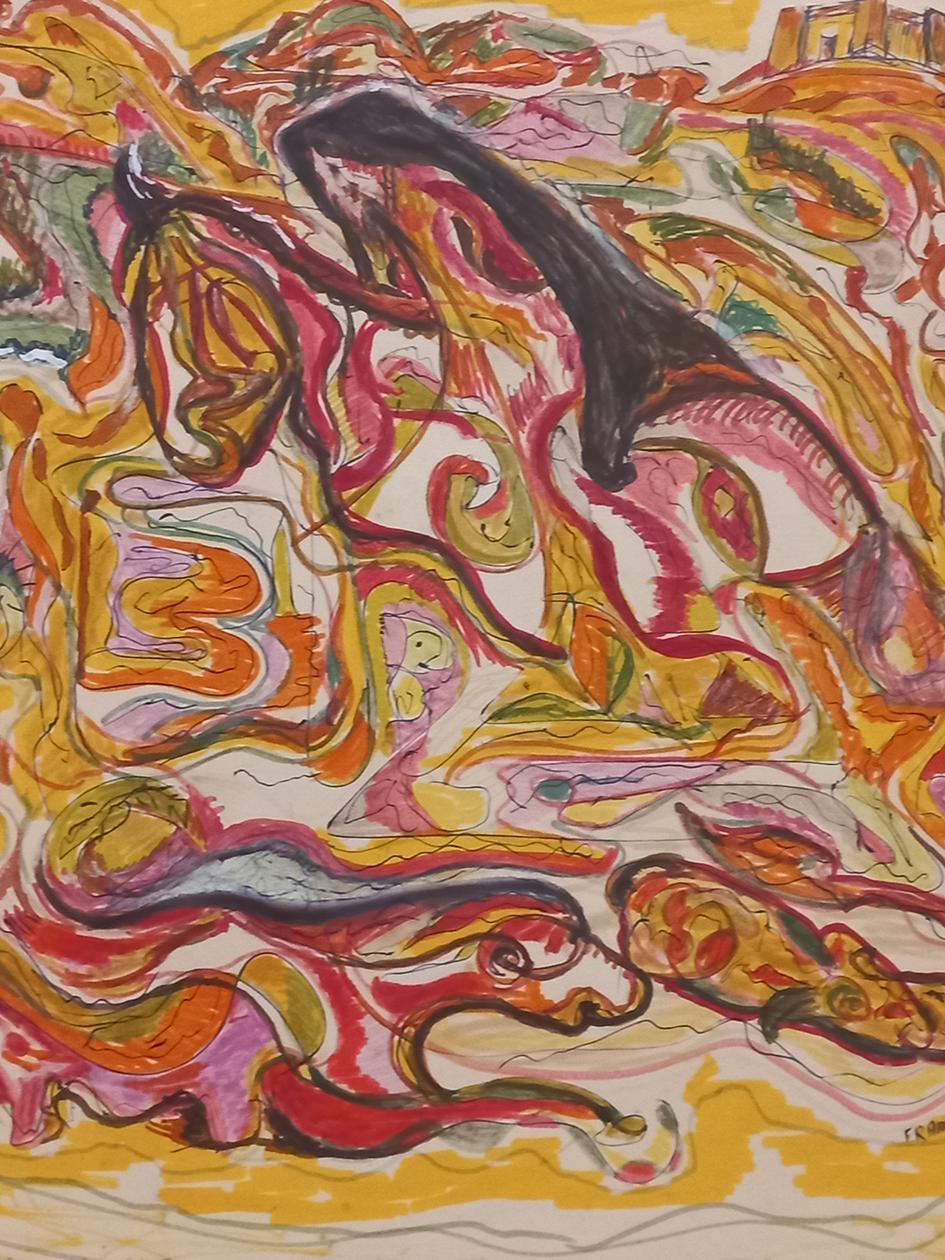 Detail from Day’s End on Southern Cliffs
Forms emerge as if from the landscape itself, recalling the voices Ebejer’s characters hear in Malta’s ancient temples, rocks and sun-drenched land. His vision of God as “a beautiful black… coming out of the primate elements of the universe” resonates with these drawings, where primal, elemental forces pulse through.
The land in Ebejer’s novels is never backdrop but protagonist: Malta’s sun-baked countryside is a living organism, feminine and masculine at once, fertile and harsh, timeless and mutable.
The free explorations into line and colour appear to draw from an inner reservoir of memory and myth
The rocks themselves have “a great mute heart”. In his drawings, too, this vitalist vision of nature finds expression. Tendrils and loops resemble roots, veins and subterranean networks, while chromatic bursts evoke the fertility of the earth.
There is an animism at work here, a conviction that matter is alive and consciousness permeates landscape. In both media, he seems compelled by the same idea: that the land, and by extension life itself, is alive with unseen forces.
Ebejer himself acknowledged the paradoxes and contradictions at the core of his creativity.
“I regard my work… as a quest for that elusive nodus by which one becomes aware… of that meeting point of contradictions,” he once said. His art – whether in words or in images – sought precisely this paradoxical nexus where instinct and reason, past and present, pagan and Christian, male and female, converge. The drawings at MUŻA thus appear less as diversions from his literary path than as parallel expressions of the same obsessions.
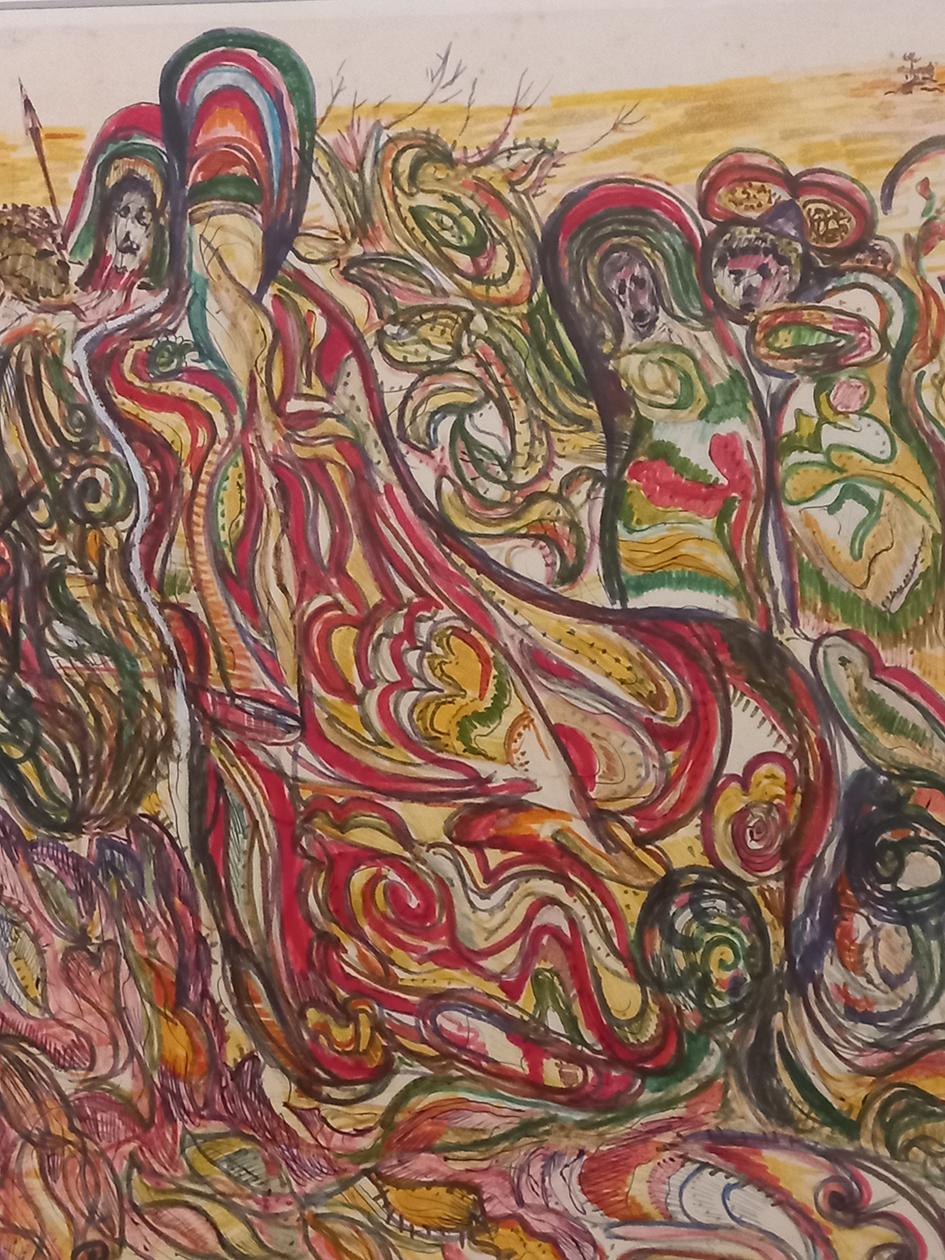 Detail from Africana
From an interview with Ebejer’s son held on the occasion of a previous exhibition at the Wignacourt Museum in Rabat in 2023 – also celebrating the visual side of the artist – we learn that Ebejer always sketched, even on the margins of manuscripts, as though visual mark-making was inseparable from the act of writing.
As his son recounts, in the late 1970s and 1980s, he had built a coherent art collection, leading him to hold his first exhibition at the National Museum of Fine Arts in Valletta in 1991.
By 1992, he was preparing to return more seriously to painting, acquiring paints and heavy paper, with the intention to pursue it with the same seriousness he gave his novels and plays. His untimely death cut short that trajectory, leaving us with traces of an artistic path that might have paralleled his literary one.
The MUŻA exhibition also includes display cabinets featuring Ebejer’s publications, posters from the staging of his plays and personal memorabilia. These elements emphasise the connections between different artistic genres in his practice, highlighting how his literary and visual work were in constant dialogue, and providing a fuller sense of the scope of his creativity.
Ebejer’s drawings are therefore not mere experiments or ancillary exercises. They reveal an artist for whom the act of creation, whether through words or images, was a means of exploring the hidden structures of consciousness, of giving form to the unseen forces that shape human experience, and of anchoring these forces in the specific textures of Maltese life and landscape.
MUŻA’s exhibition thus succeeds in showing us not merely “the other side” of Francis Ebejer but the wholeness of an artist. His “other side” was not separate at all but an extension of the same restless imagination that gave us his literary works.
MUŻA’s decision to dedicate space to this lesser-known aspect of his legacy is both timely and necessary. It reminds us that Ebejer was not only Malta’s great modern writer but also a creator whose imagination was fundamentally visual, forever seeking forms – whether verbal or graphic – that could capture the mystery of life’s contradictions.