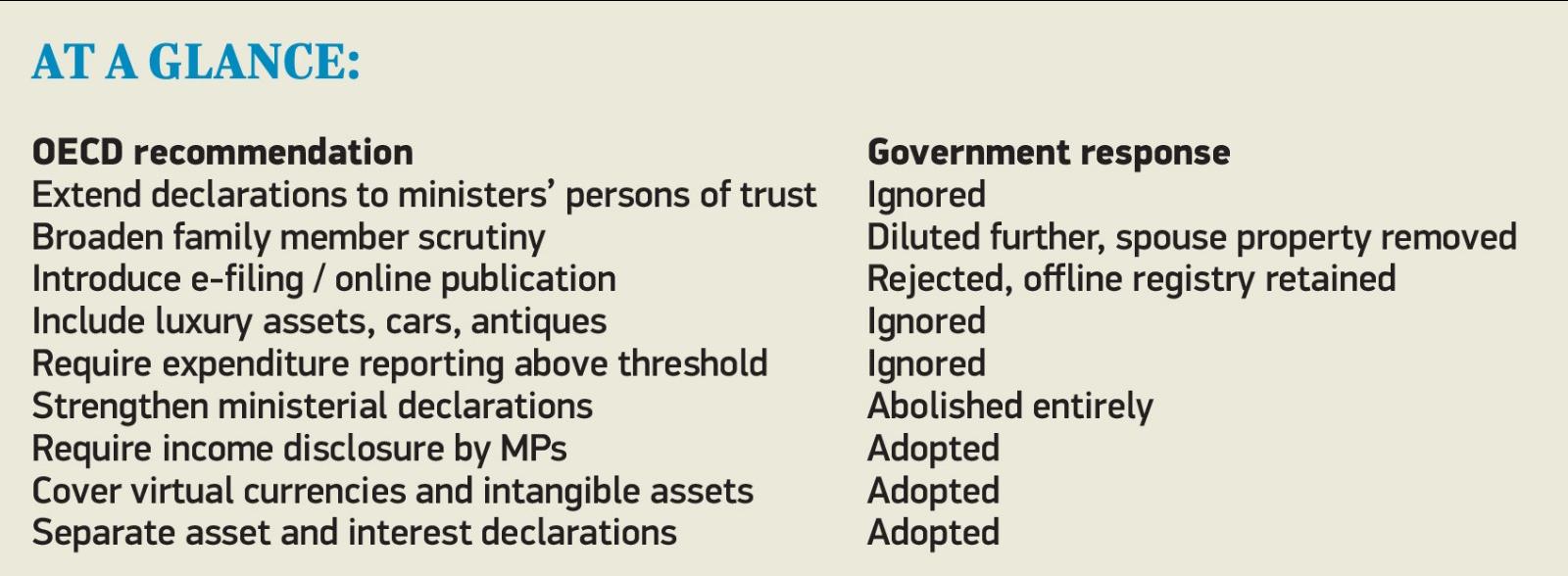
Malta ignored OECD calls - and weakened ministers' asset rules instead
The government’s proposals on asset reporting by MPs fall short of the OECD’s recommendations
Three years ago, the OECD, an international policy body, identified key weaknesses in Malta’s asset reporting regime for top officials and MPs.
It proposed extending asset declarations to ministers’ persons of trust, broadening the scrutiny of family members and introducing an e-filing system to make the declarations easier for the media and public to scrutinise.
Instead, the government has chosen to abolish asset declarations by ministers, remove the obligation by MPs to declare properties acquired by their spouses and refuse to publish the filings online for wider scrutiny.
Family members
The issues:
Under current rules, assets of spouses and family members are only captured within a “limited scope”, the OECD said.
Mechanisms to track the financial assets and interests of not only public officials but also their close relatives and household members can help prevent concealment of assets under the names of family members, spouses or other individuals.
Government’s response:
Asset reporting for family members has been further diluted. Apart from abolishing ministerial declarations, which captured jointly held assets, the government’s proposals only oblige MPs to declare “his own immovable property.”
This appears to be a step back from the current rules for MPs, which explicitly stated that assets acquired by spouses during marriage should be deemed to belong to both in equal shares, unless a formal separation of assets was drawn up prior to marriage.
Reporting luxury assets
The issues:
Current asset reporting templates fall short of allowing a proper analysis of unjustified assets, laundering of criminal proceeds and violations of conflict-of-interest rules, the OECD said.
It proposed obliging MPs to list their income and also include luxury and tangible assets like high-value antiques and cars, which are known to be used to hide profits from money laundering or corruption.
Disclosures should further cover gifts, sponsored travel, virtual assets, foreign bank accounts and blind trusts, among others.
Spending above a certain threshold should also be disclosed.
Government’s response:
Declarations by MPs have been expanded to cover their income, virtual assets, and intangible assets such as patents, trademarks, copyrights and brands.
Proposals to include luxury assets and expenditure reporting were ignored.
Persons of trust
The issues:
The OECD pushed for the government to address the “problematic” lacuna of ministers’ close aides, known as persons of trust, not being subject to asset reporting.
It said some of these persons of trust occupy central decision-making roles, so further transparency mechanisms would strengthen public trust in their functions.
Government’s response:
This proposal was ignored.
Declarations by MPs, which are often handwritten and difficult to decipher, will be retained in an offline registry
Electronic filings
The issues:
Publishing information from asset and interest declarations for public scrutiny act as a deterrent and promote integrity and trust in public administrations, the OECD report said.
Declarations by ministers were tabled in parliament, where they are made public and freely downloadable.
Declarations by MPs are kept by the speaker and made publicly available for review but not put online.
Stakeholders underscored the weaknesses of the system by stating that access not only takes too long, but the information is also scattered and not user-friendly.
The OECD said an e-filing system would make it easier for MPs to submit declarations and allow for automated tools to detect potential asset red flags.
Government’s response:
Asset declarations by ministers have been abolished. Declarations by MPs, which are often handwritten and difficult to decipher, will be retained in an offline registry.
Separating asset, interest declarations
The issues:
Even though asset declarations can serve to identify some potential conflicts of interest, they cannot replace the management of conflicts of interest, which needs to be done differently.
Having separate declarations for interests (such as consultancy roles with a company) and assets recognises the different nature of such diverse goals as wealth monitoring and preventing and managing conflicts of interest.
Government’s response:
A formal register of interests will be introduced.
MPs will be required to disclose professional interests or consultancy roles connected to individuals or companies with an interest in legislation before parliament, as well as membership of voluntary organisations, trips abroad paid for by such entities and any conflicts of interest related to parliamentary work.