Gozo’s Mġarr harbour ‘saturated’ as traffic exceeds highest growth forecasts
Today’s port activity was deemed ‘highly improbable’ 20 years ago
Gozo’s Mġarr harbour has become “saturated” with passenger and vehicle numbers in 2025, shattering the most extreme growth projections set for 2026.
In a report, the Gozo Regional Development Authority said the port, which serves as Gozo’s sole gateway, is currently struggling to balance its conflicting roles as a passenger terminal, vehicle ferry port, and freight logistics hub amid rising economic pressures and tourist influx.
The report reveals that the current intensity of activity at Mġarr was considered “highly improbable” two decades ago.
In 2007, the government had commissioned a strategic plan for the port, which projected different growth scenarios.
In its ‘high-growth’ scenario, it predicted the port would handle seven million passengers and 1.8 million vehicles by the end of 2026. However, official 2025 figures have already blown past those numbers.
This surge in demand has led to “structural congestion” that is spilling out of the harbour and into the surrounding community. Residents in Għajnsielem and commuters along the Mġarr-Victoria corridor now face persistent traffic pressures due to the port’s inability to handle the volume of commuters, tourists and freight.
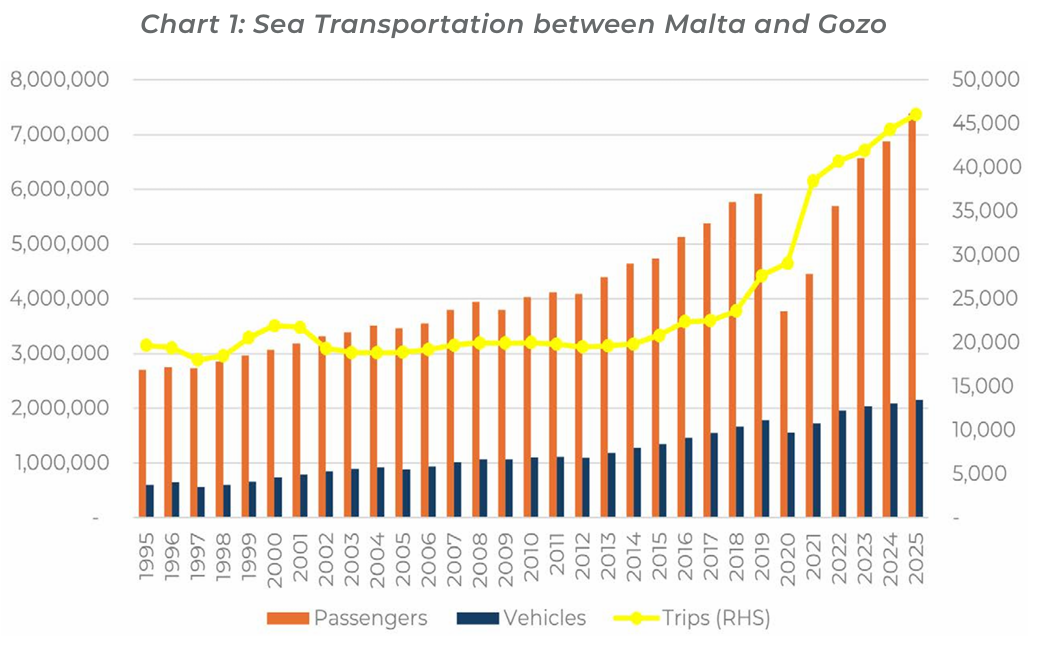 Sea transportation between Malta and Gozo from 1995 to 2025.
The port must handle all sorts of activity going to and coming from Gozo, from small fishing vessels to big yachts, commercial vessels, chartered catamaran cruises and boats that service cruise ship visits, the Comino boat operators, the Valletta fast ferry service and the four Gozo Channel ferries, and it only gets busier as the days get hotter and summer gets closer.
And these do not account for all the vehicles and pedestrians that visit the port for reasons other than travel – to visit bars, dine in restaurants or walk along the marina. Then there are all the public transport buses, the shuttle service buses, the rental cars, tourist coaches and minibuses, all of which circulate around the relatively small, constrained port throughout most of the day.
And it might just get worse.
More ships, more problems?
Despite the existing saturation, the report notes that several new initiatives may worsen the strain on the port.
It specifically mentions the introduction of a new ferry route connecting Sliema, Buġibba and Gozo, the planned increase in the Gozo Channel fleet to five vessels and the projected increase in Gozo’s population and tourism inflows.
“[These] initiatives, while intended to enhance inter-island connectivity, may exert additional pressure on an already saturated port environment,” the report said.
Over the span of a decade between 2014 and 2024, Gozo saw a 71% increase in visitors who spent at least one night on the sister island, a whopping 135% increase in visitors who cross over to Gozo for the day, a 27% increase in population and a 163% increase in GDP.
“As a consequence of these trends, passenger traffic to and from Mġarr increased by 56% over a 10-year period, reaching 7.4 million movements by the end of 2025,” the report said.
“To place this in context, passenger volumes through Mġarr are now broadly comparable to those recorded at Malta International Airport, which handled 8.8 million passengers in 2024.”
These are official figures published by the National Statistics Office (NSO), and they do not even paint the whole picture accurately, because they only account for passengers using the Gozo Channel ferry and the fast ferry, “and therefore exclude those transported by other commercial operators, as well as cruise liner passengers”.
Passenger volumes through Mġarr are now broadly comparable to those recorded at Malta International Airport
The report also notes that Eurostat data for 2024 indicates that “Mġarr ranks among the 30 largest maritime ports in the EU in terms of vessel calls”.
“This is a particularly notable position given Gozo’s small geographic scale and demographic profile.”
The government’s Vision 2050 framework, launched last month, acknowledges these issues. It makes it clear that the current state of Gozo’s connectivity is a bottleneck for the entire nation, noting that major gateways like Mġarr “have come under increasing pressure from economic expansion, tourism growth, rising freight volumes and higher mobility demands”.
The document warns that failing to modernise these entry points will “continue to constrain economic growth, freight capacity and daily mobility for residents and visitors”.
To counter this, the government plans to upgrade the Gozo Channel fleet with cleaner and more efficient vessels, develop a second ferry landing point in Gozo to diversify access routes and construct an airstrip at Xewkija to provide a “critical alternative access route” for emergency and time-sensitive travel.