‘Grotto Girl’, maternal space and the psychic architecture of becoming
Louisa Chircop uses sculpture, communal collaboration, and symbolic inversion to transform MUŻA into a site of psychic excavation and reformation
At the heart of Louisa Chircop’s Grotto Girl project at MUŻA lies a spatial metaphor: the grotto and the well – cavities that invite reflection, vulnerability and emergence.
These voids are not merely geological or architectural features within the museum’s historic courtyard; they function as psychic hollows.
They evoke what French-Bulgarian psychoanalyst Julia Kristeva calls chora, a pre-linguistic, maternal space that precedes identity – a receptacle of becoming.
 Louisa Chircop. Photos: Henry Zammit Cordina
Australian-Maltese multidisciplinary artist Louisa Chircop is set to make history at MUŻA – Malta’s National Community Art Museum – with Grotto Girl, the first-ever art installation to conceptually and physically activate the museum’s 450-year-old central courtyard well.
In this evocative work, Chircop uses sculpture, communal collaboration, and symbolic inversion to transform MUŻA into a site of psychic excavation and reformation.
In essence, the site, the well itself, loses its virginity, not in the literal sense, but as a poetic rupture: it is penetrated for the first time by artistic intent, stirred from its centuries-long silence to become a vessel of creative emergence and symbolic rebirth.
Chircop also creates a dialogue around her hybrid identity by presenting an adjoining exhibition of works alongside the community project. This pairing acts as a catalyst for reflecting on her bicultural experience and what she often describes as “having a foot in two worlds.”
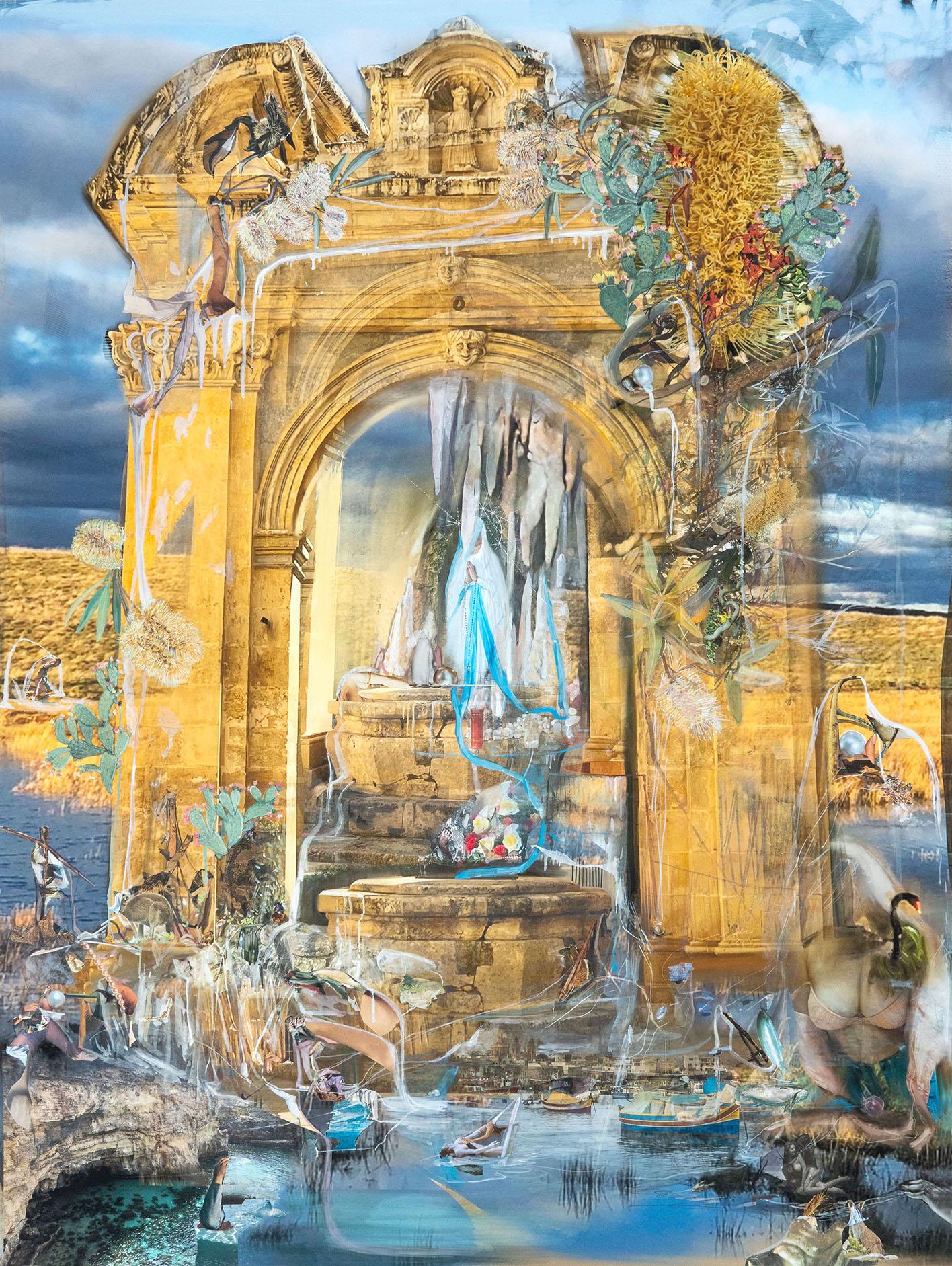 Chircop reimagines a symbolic well of memory and subconsciousness.
This dual belonging, while touching on feelings of otherness, gives rise to a singular and generative identity, layered, fluid, and deeply resonant.
Chircop is a contemporary artist based in Sydney, working between Australia, Malta, and Europe. Her multidisciplinary practice spans painting, sculpture, drawing, mixed media and installation.
Deeply influenced by psychoanalytic, feminist, and postcolonial theory, her work probes the subconscious terrain of memory, identity and transformation.
Chircop is no stranger to surrealism and its radical potential – she recently exhibited in a landmark first show In the Arms of Unconsciousness: Women, Feminism and the Surreal at Hazelhurst Arts Centre Sydney, curated by Carrie Kibbler, alongside 22 of Australia’s most significant female artists, and furthermore being recognised as being influential in the fourth wave of feminism in Australia.
A multi award-winning artist, Chircop is a two-time recipient of the James Gleeson Prize for surrealism at Campbelltown Arts Centre (sponsored by Michael and Marilyn Reardon-Small) and her work is held in one of Australia’s most prestigious collections for drawing, the Kedumba Collection of Contemporary Drawing. With growing recognition in Malta, she is now represented by MarieGallery5 and Art Advisory Sliema.
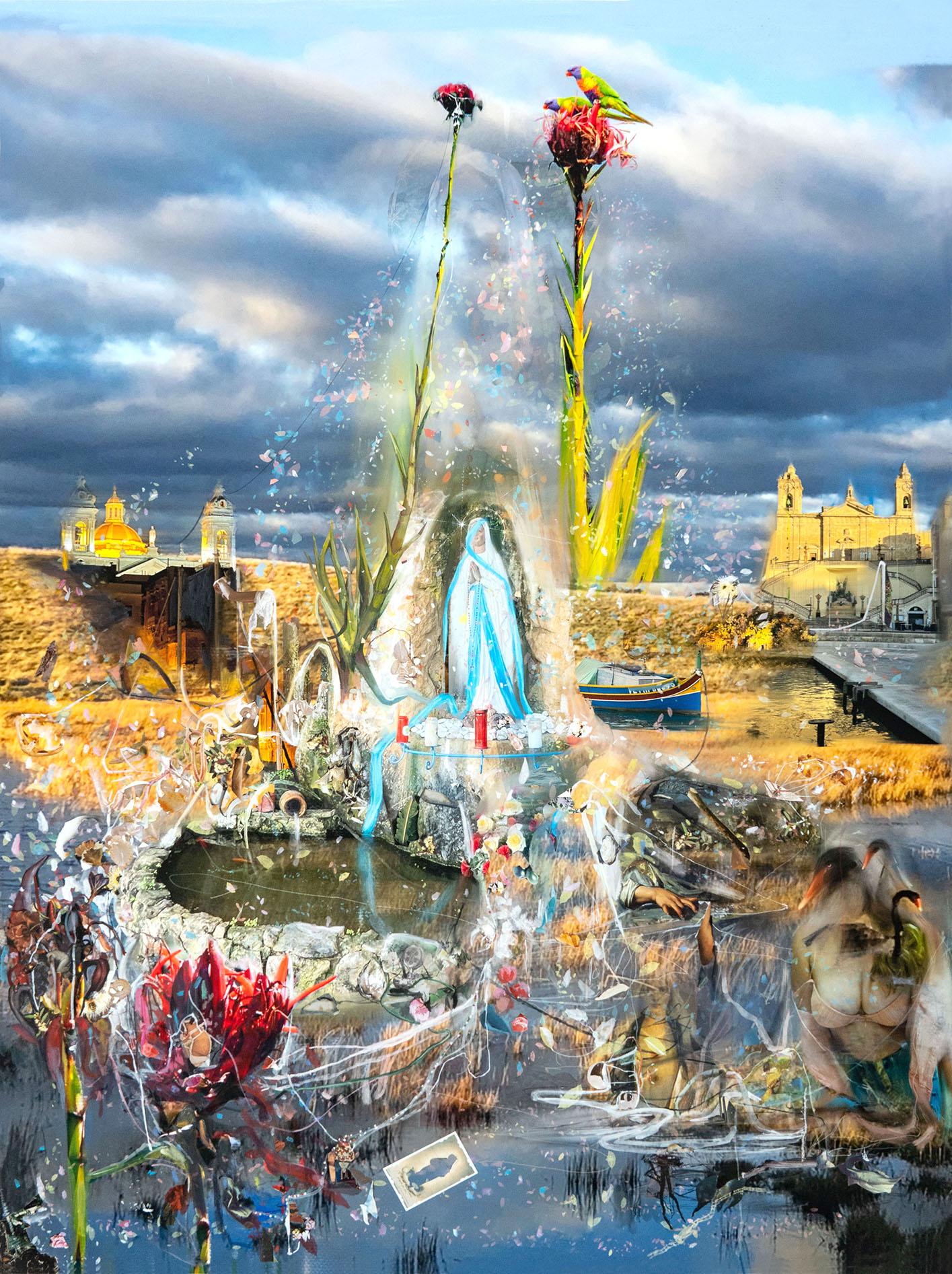 The exhibition is about heritage, connection and shared experiences.
The quasi-faced Grotto Girl statue that anchors Chircop’s installation, within which a small faceless Madonna is nested, reverses the conventional relationship between mother and child. Rather than being cradled in the arms of the maternal figure, the Madonna emerges from within, psychically gestated in the hollow body of the ‘girl’.
This inversion resonates with Kristeva’s rethinking of the maternal not as a fixed identity but as a process: a zone of transformation, abjection, and re-inscription.
In Powers of Horror, Kristeva explores how identity is constructed through a process of expelling what is deemed foreign or abject. Chircop’s Grotto Girl resists this expulsion.
Instead, it draws the abjected: memory, dislocation, displacement, back into view, not as a threat but as origin. The quasi-faced ‘girl’ is both void and vessel, silent, unknowable, and yet full of latent possibility.
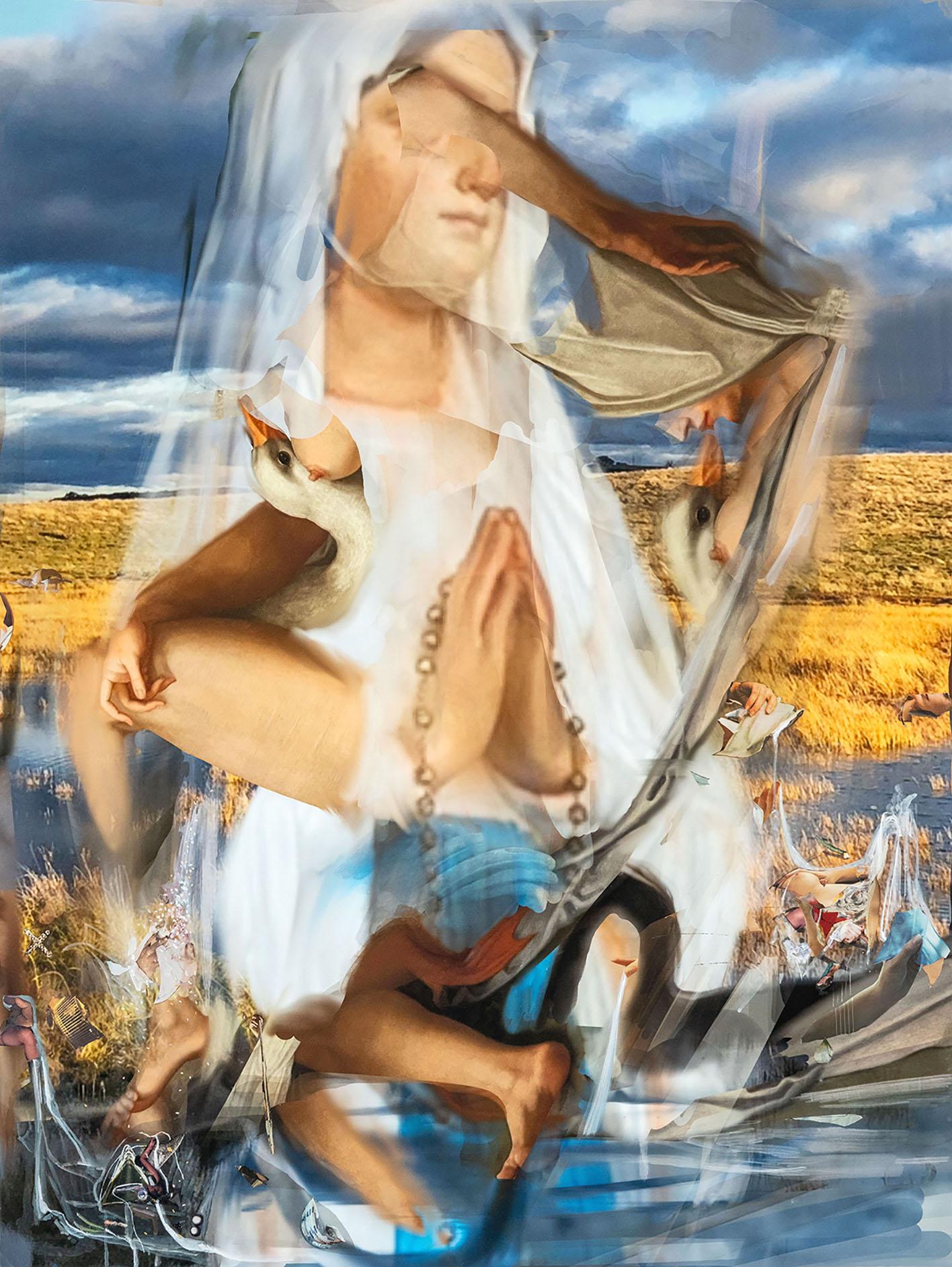 Beneath the paper rain
She is a Kristevan chora made visible: a “non-expressive totality formed before and as a precondition of representation” (Kristeva, 1984).
The installation’s symbolic centre, where the ‘girl’ makes her appearance, standing centre stage on the well amid cascades of satin blue ribbon contrasting with the honeycomb limestone –evokes the image of the Maltese goddess or Venus of Malta and deepens the maternal metaphor.
This striking ceramic figure is the first encounter for visitors entering MUŻA: a powerful synthesis of architecture and archetype breeding presence into something transcendent, an ode to inspiration and creativity referencing the meaning of MUŻA itself.
A literal hollow within MUŻA’s courtyard, it mirrors the womb, the psyche’s interior, and the grotto of myth and memory.
It recalls the Cave of Calypso in Gozo, a Maltese site where, according to Homer, Odysseus was detained by the nymph, a powerful, unknowable female figure, for seven years. In this mythic space, the hero is delayed, not by violence, but by seduction and suspension, a pause between worlds, identities, and journeys.
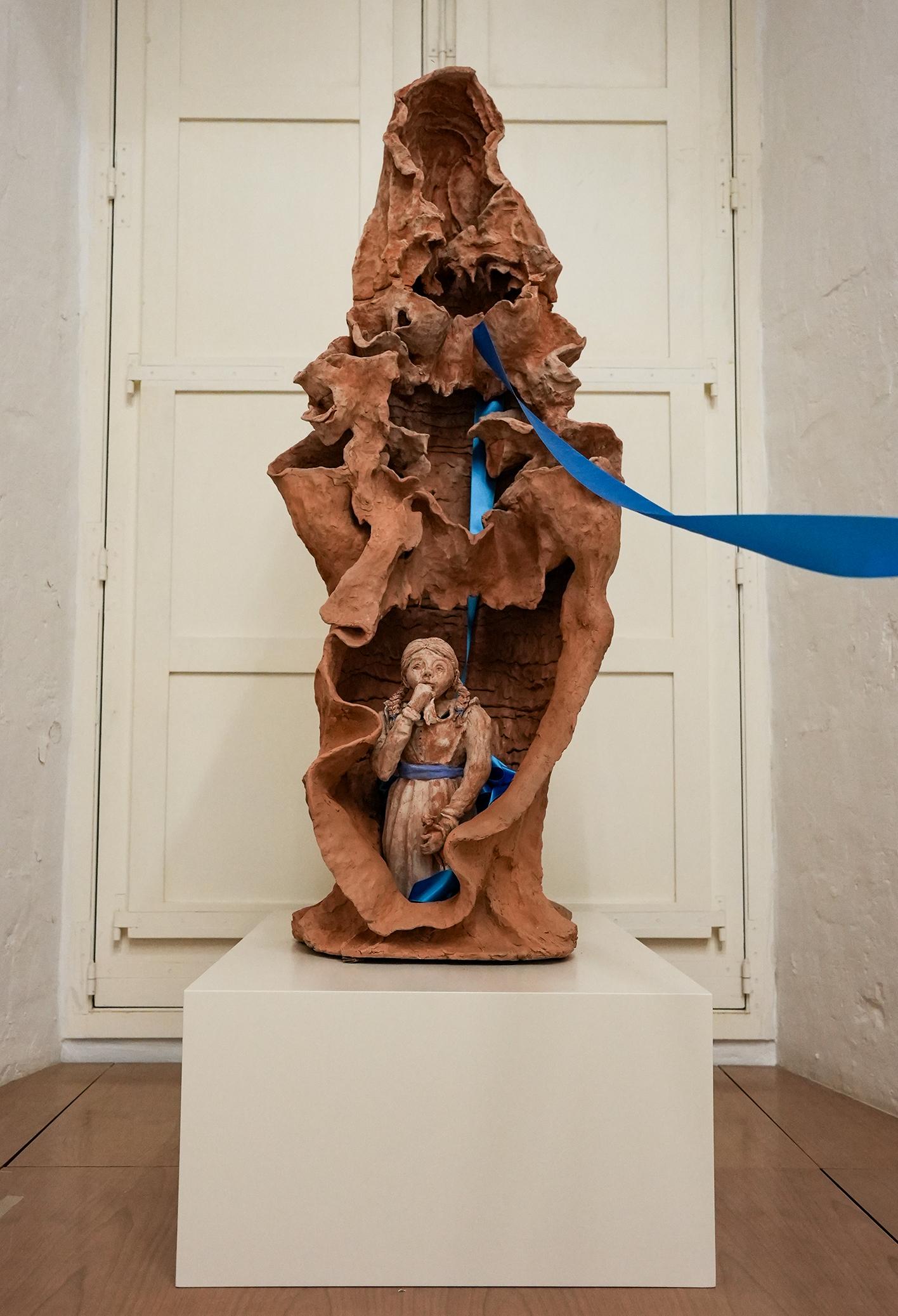 She dreamed the other
So too, Grotto Girl holds its visitors in a psychic interlude, between conscious and unconscious, self, and other, past and present. Here, the ‘girl’ herself is witnessed “becoming,” her vessel-like face, suggesting a tide line of liminality between child and adult, friend and lover, mother, and child.
Chircop suggests that identity is not given, but made; not static, but emergent
Chircop’s project also finds striking parallels with the work of Louise Bourgeois, whose sculptural forms often explored the maternal body, memory, trauma, and identity.
Bourgeois’s Femme Maison (1945-47), which fuses a woman’s body with domestic architecture, and her Cells series, which stage intimate psychological spaces within enclosed rooms, resonate with Chircop’s sculptural environments.
Like Bourgeois, Chircop builds a “container of feeling,” a term Bourgeois used to describe how space could hold psychic states. Conversely, the idea of the ‘girl’ is flipped in reverse in the gallery exhibition room presenting a faceless Madonna figure claiming the arched niche in the historic walls.
Fleshy, she stands as a ghostly hollow vessel containing a distressed small child clasping a tissue and holding her own doll. This can be seen as reflecting Bourgeois’s lifelong preoccupation with the body as both shelter and site of conflict.
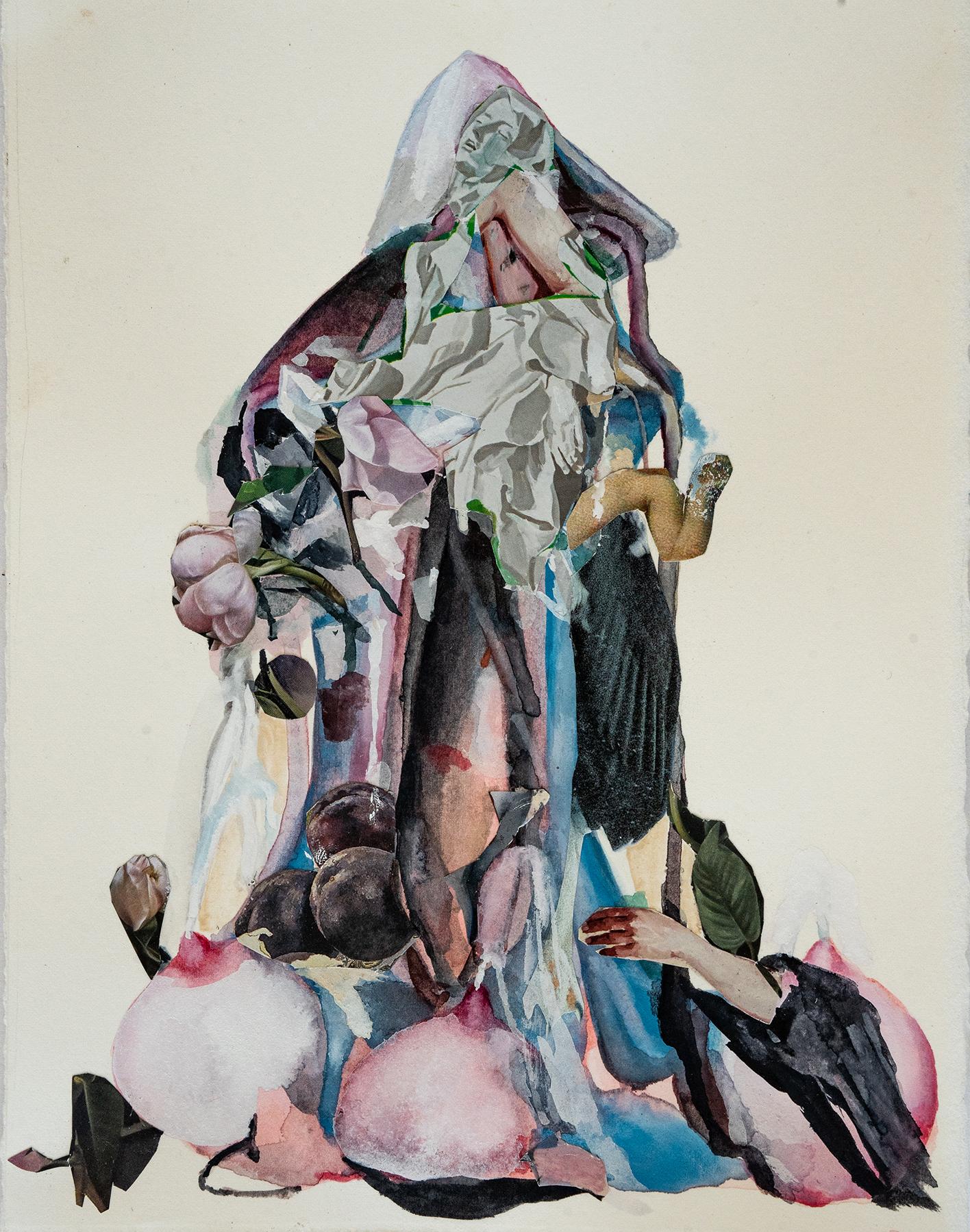 The Maltese community and international participants are invited into a meaningful dialogue.
Chircop also addresses the question of female identity through symbolic representation of maternal space, childhood memory, and the fragmented body; recasting the feminine not as a fixed essence but as a layered psychic terrain shaped by cultural inheritance, personal trauma, and collective myth.
The blue ribbon symbolic of spiritual blue that Chircop intends to connect from the larger doll-like ‘girl’ on the courtyard well to the faceless Madonna in the exhibition room, evokes Bourgeois’s recurrent use of thread and textile.
In her installations, cloth and string acted as literal and symbolic tools for connection, memory, and reparation. Chircop’s ribbon becomes a maternal umbilical cord and a psychic tether, joining generations, selves, and identities across continents and historical traumas.
In this way, Grotto Girl stages what Bourgeois once described as “the return of the repressed,” not as horror, but as healing. It is what this three-dimensional project is all about.
This psychodynamic symbolism is not separate from feminist politics; it is feminist politics.
Both Kristeva and Bourgeois challenged essentialist notions of the feminine. They understood the maternal not as passive or natural, but as a site of contradiction, creativity, and psychic danger. Chircop’s Grotto Girl similarly resists the idealisation of the mother as wholly nurturing or benign.
The Madonna is faceless, absent, unknowable, and therefore open to projection. Her silence speaks volumes. Inside her, the child does not disappear but emerges: formed not despite the maternal hollow but because of it.
Jungian psychology offers further depth to this symbolic encounter. Carl Gustav Jung understood such sacred unions through the concept of the coniunctio, a core alchemical symbol referring to the integration of opposites within the psyche.
In Grotto Girl, this archetypal motif is realised as the unification of ‘girl’ and Madonna, heritage and innovation, unconscious material, and conscious form.
As Jung observes, “In the coniunctio, what was separated is joined, what was apart comes together. This is a sacred marriage of the soul with itself, or with the Self” (Jung, Symbols of Transformation, 1944).
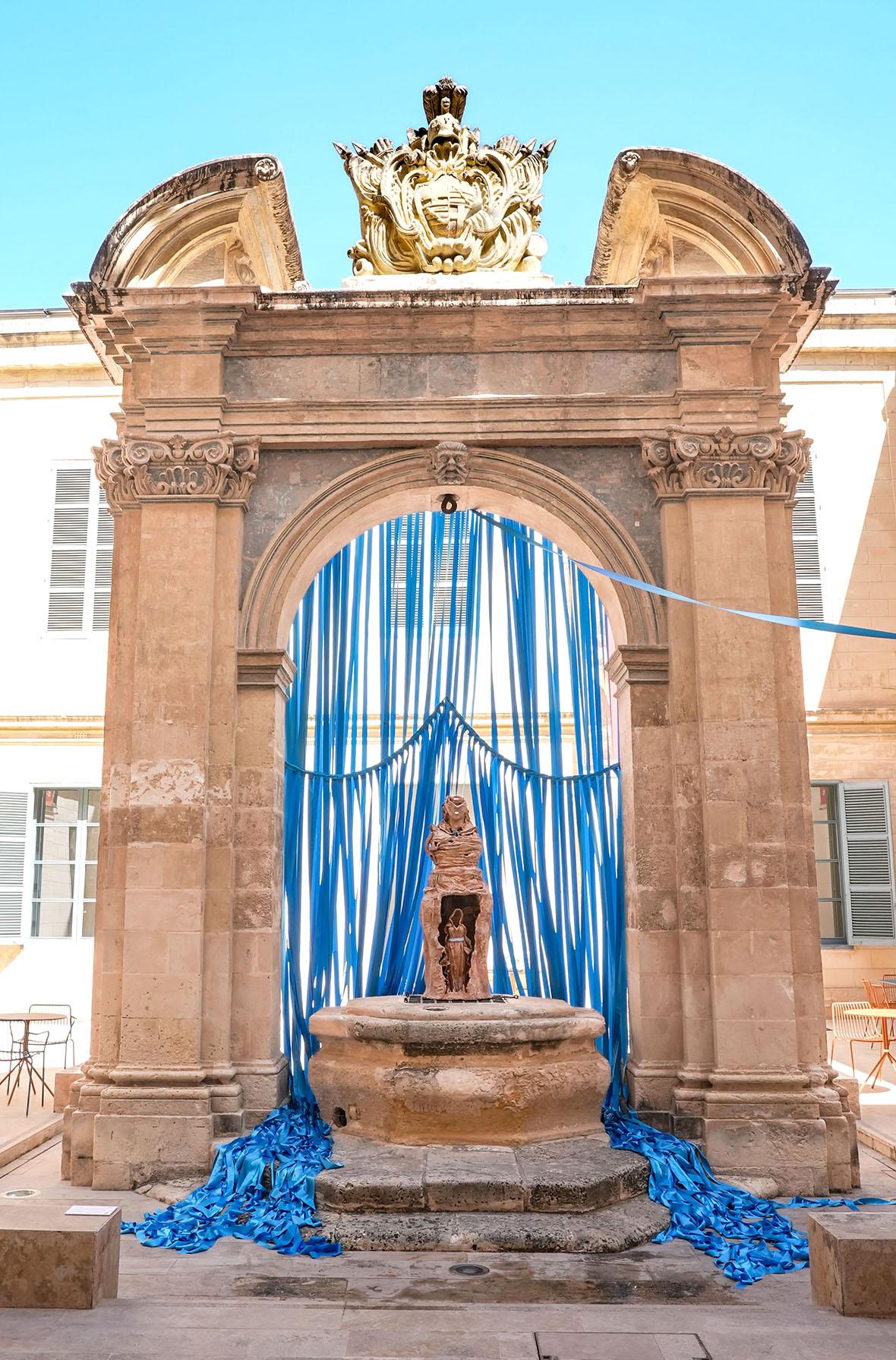 The well in the courtyard of MUŻA in Valletta.
What Chircop ultimately offers is a psychic architecture: a symbolic site where the self might be reformed through collective memory, aesthetic ritual, and symbolic inversion.
Her collaborative workshops, in which Maltese and international participants sculpt forms around five traditional Maltese motifs related to water, represent a communal return to origins.
Water, like the maternal, is symbolic of the unconscious, the amniotic, the fluid and ungraspable aspects of the self. Each clay contribution is a small act of making visible what is often submerged in personal and cultural memory.
Each participant being given the opportunity to reveal in a collaborative exhibition the opportunity to help build a grotto out of the stories of the people of Malta.
In this act of making visible, Chircop addresses what Kristeva identified as the feminine as the unrepresentable. By sculpting the void and exploring through means of opposites, by placing a child within the womb of tradition, rather than merely at its feet, and vice versa, the Madonna inside the core of the ‘girl’.
Chircop suggests that identity is not given, but made; not static, but emergent. And in the sacred coniunctio of opposites, ‘girl’ and Madonna, Australia and Malta, absence and presence is a new synthesis becomes possible.
Grotto Girl is not just a sculpture, not just a community art project, and not just a personal exploration of bicultural identity. It is a living threshold, where the community animates through the artist, a psychic grotto where the feminine speaks, not with one voice, but with many; through shadow, sculpture, silence, and song.
Grotto Girl by Louisa Chircop runs at MUŻA, Valletta, until June 29.
Louis Laganà is an academic, art critic and practising artist.