Malta is happier, says global report, but Gen Z may tell a different story
Malta's performance was driven mainly by GDP per capita
Malta has climbed five places in the latest World Happiness Report, but the upbeat result comes with a warning sign for younger generations.
The country ranked 43rd out of 147 nations, up from 48th last year. Even so, it remains well below its high point between 2017 and 2019, when it reached 22nd place.
The annual report measures happiness based on a three-year average and considering six factors: GDP per capita, life expectancy, social support, freedom to make life choices, generosity, and perceptions of corruption.
For the year under review, Malta recorded an average happiness score of 6.436 out of 10, placing it between Guatemala and Argentina.
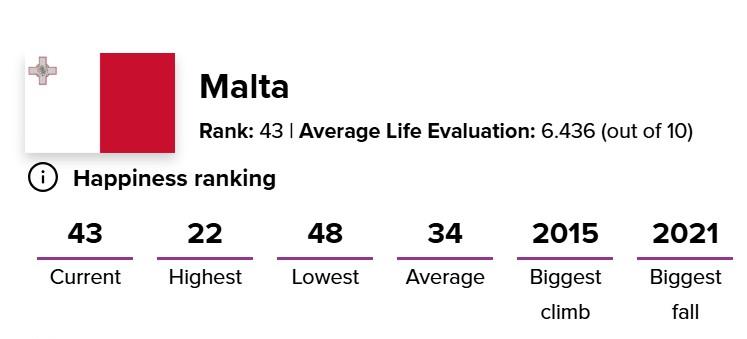 Malta's happiness ranking stats through the years. Source: World Happiness Report
Finland, meanwhile, kept its place as the happiest country in the world for the eighth year in a row.
What's behind the increase in happiness?
Malta’s performance was driven mainly by GDP per capita and strong social support, according to the report. Healthy life expectancy and personal freedom also helped boost the country’s score.
Generosity was one of Malta’s standout areas, with the country ranking third best in the world on that measure. Perceptions of corruption, where Malta ranked 53, however, played a much smaller role in the final result.
Positive emotions rose slightly compared with the year before, while negative emotions fell.
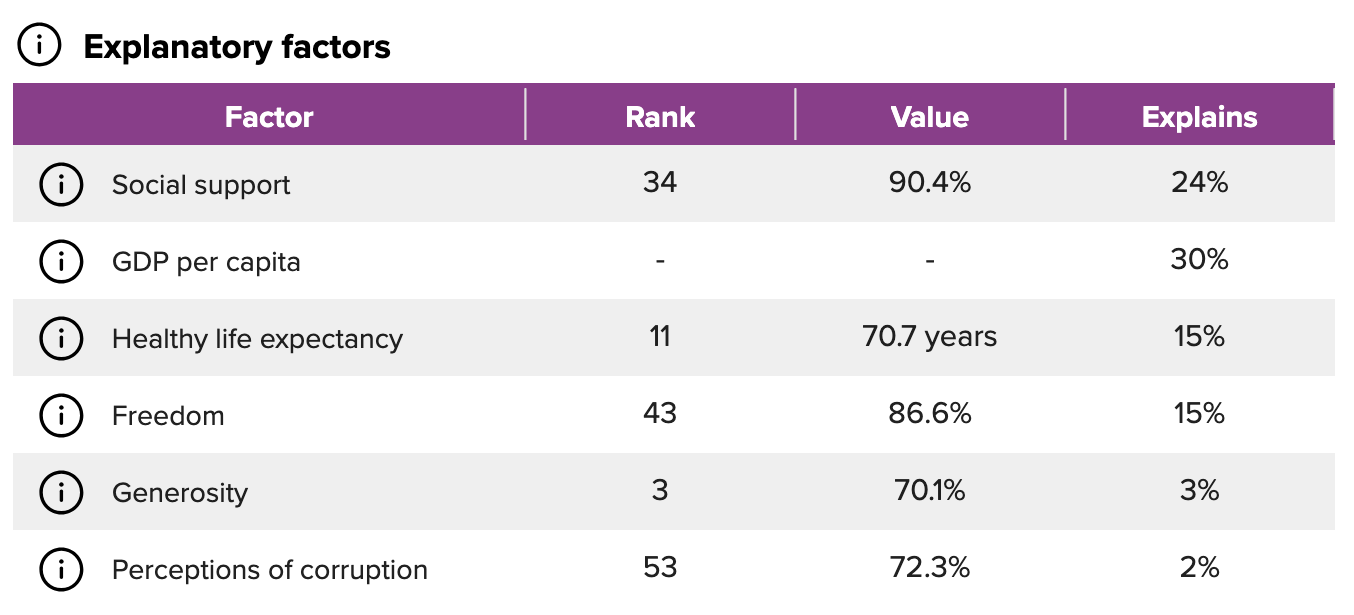 GDP and social support were the biggest contributing factors to Malta's results. Screenshot: World Happiness Report..
The share of people who said they donated money jumped sharply, from about 56% to 70%. More people also reported helping a stranger, while volunteering rates stayed broadly unchanged and inequality fell.
Are the kids alright?
But despite the brighter overall picture, the report points to a more troubling reality for Gen Z, those born between 1997 and 2012.
The study says younger generations across Western Europe, including Malta, have seen major declines in interpersonal trust, social activity, trust in institutions and feelings of safety.
It also highlights the impact of what it calls "problematic social media use", including compulsive behaviour, arguments caused by time spent online and lying to parents about social media use.
That kind of behaviour was linked to increased psychological complaints among adolescents.
 Social media use can be problematic for younger generations. Photo: Shutterstock.
In the Mediterranean region, problematic social media use was found to have a "moderately strong" effect on adolescent wellbeing, though not as significant as the impacts seen in Anglo-Celtic and Nordic countries.
The report notes that almost 95% of 16-to-24-year-olds in Malta use social media.
The impact is not felt equally across generations, however.
According to the study, internet use is most harmful for Gen Z, moderately harmful for Millennials, close to neutral for Gen X and even "slightly beneficial" for Baby Boomers.
The report says this shows the internet’s impact depends heavily on age and social context, and that not all online engagement is automatically harmful.
How do we compare to our fellow EU members?
Malta still trails much of Europe in the rankings. It was placed in the lower third of EU countries, with only nine member states ranking below it. Greece came last in the bloc at 85th place.
Close neighbour Italy ranked ahead of Malta in 38th place, while fellow island state Cyprus was further down in 62nd.
Globally, nearly twice as many countries posted significant gains in happiness as those that suffered significant losses.
But Western industrial nations have generally become less happy than they were between 2005 and 2010, with 15 countries recording significant drops in life evaluation.
And although negative emotions are becoming more common worldwide, positive emotions “continue to be twice as frequent as negative emotions”.
And despite the concerns around social media, younger people in many parts of the world are still reporting more positive emotions overall.