‘Heraldry and coats of arms are embodiments of real people’
New Heritage Malta publication is the first-ever comprehensive record of coats of arms issued under Malta’s heraldic authority
Office of the Chief Herald of Arms of Malta Register of Arms, Vol. 1 (2019-2024)
by Charles A. Gauci, Raymond Cassar
published by Heritage Malta, 2025
A new heraldic publication from Heritage Malta and the Office of the Chief Herald of Arms of Malta provides the first-ever comprehensive record of coats of arms issued under Malta’s heraldic authority since its establishment in 2019.
Compiled by Charles Gauci, Malta’s first-ever chief herald of arms, and Raymond M. Cassar, registrar of the office, The Register of Arms, Volume 1 (2019–2024) includes 133 illustrated personal coats of arms and over 200 heraldic descriptions – known as blazons – that have been registered in Malta.
“Many years ago, at the late Queen’s coronation in 1953, when I was seven years old at school in the UK, we all dressed up in costumes related to the coronation. I was so proud strutting around as a herald that it sparked my interest in heraldry,” Gauci explains.
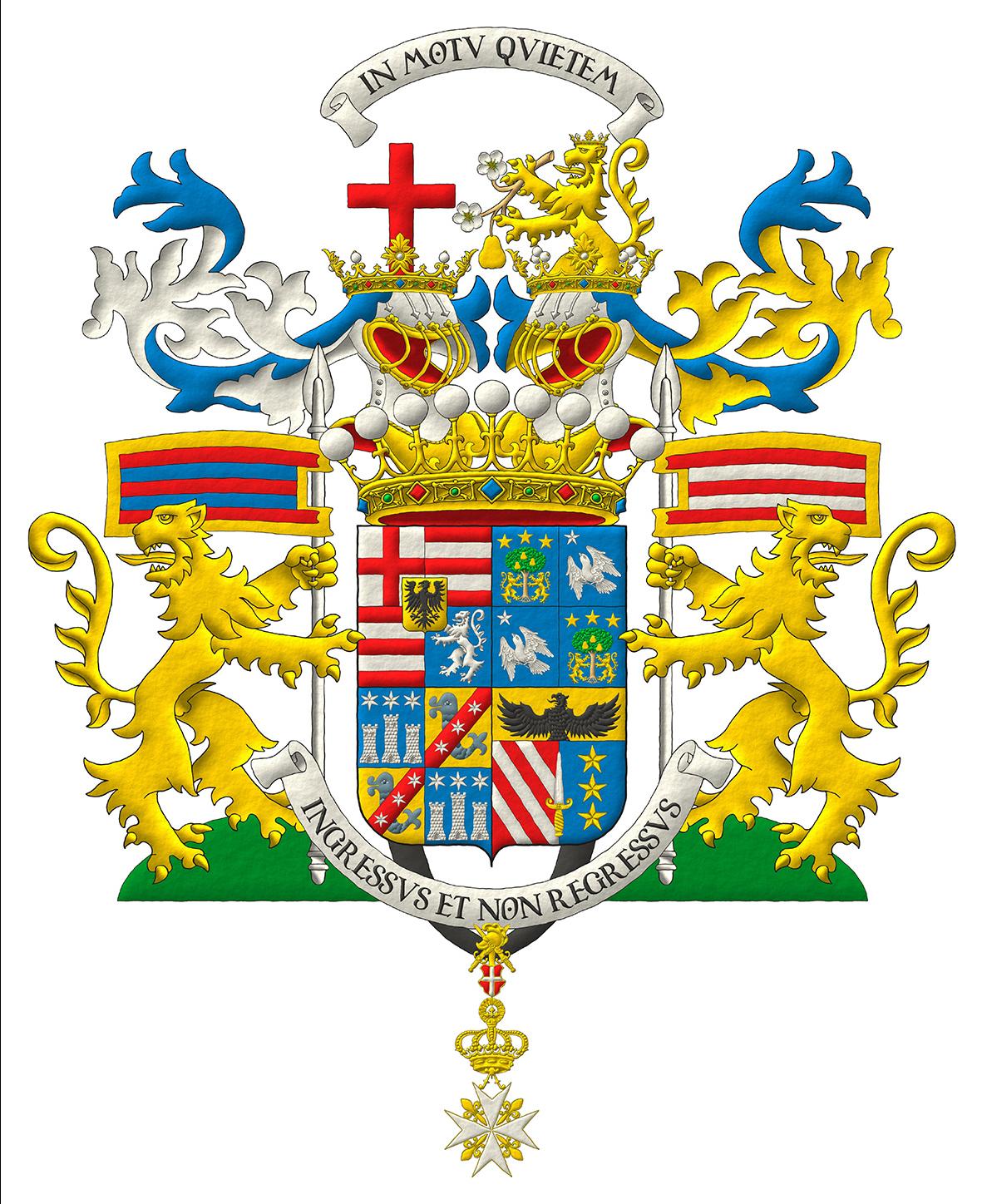 Arms of Count Dr. L.J. Sant Cassia
Heraldry, in its narrowest sense, can be defined as the parading of insignia of identification. However, over time, the term has come to encompass the design, display and study of armorial bearings or coats of arms.
“I find coats of arms fascinating because heraldry is personification. Coats of arms are embodiments of real people: the picture refers to a person or to his or her family, and is created from a combination of their values and interests, their achievements or the country they come from.”
Interestingly, while in most countries, family arms are transmitted through the male line and are passed on through the female line only if there are no male descendants, this has never been the case in Malta where family arms pass through both the male and female line.
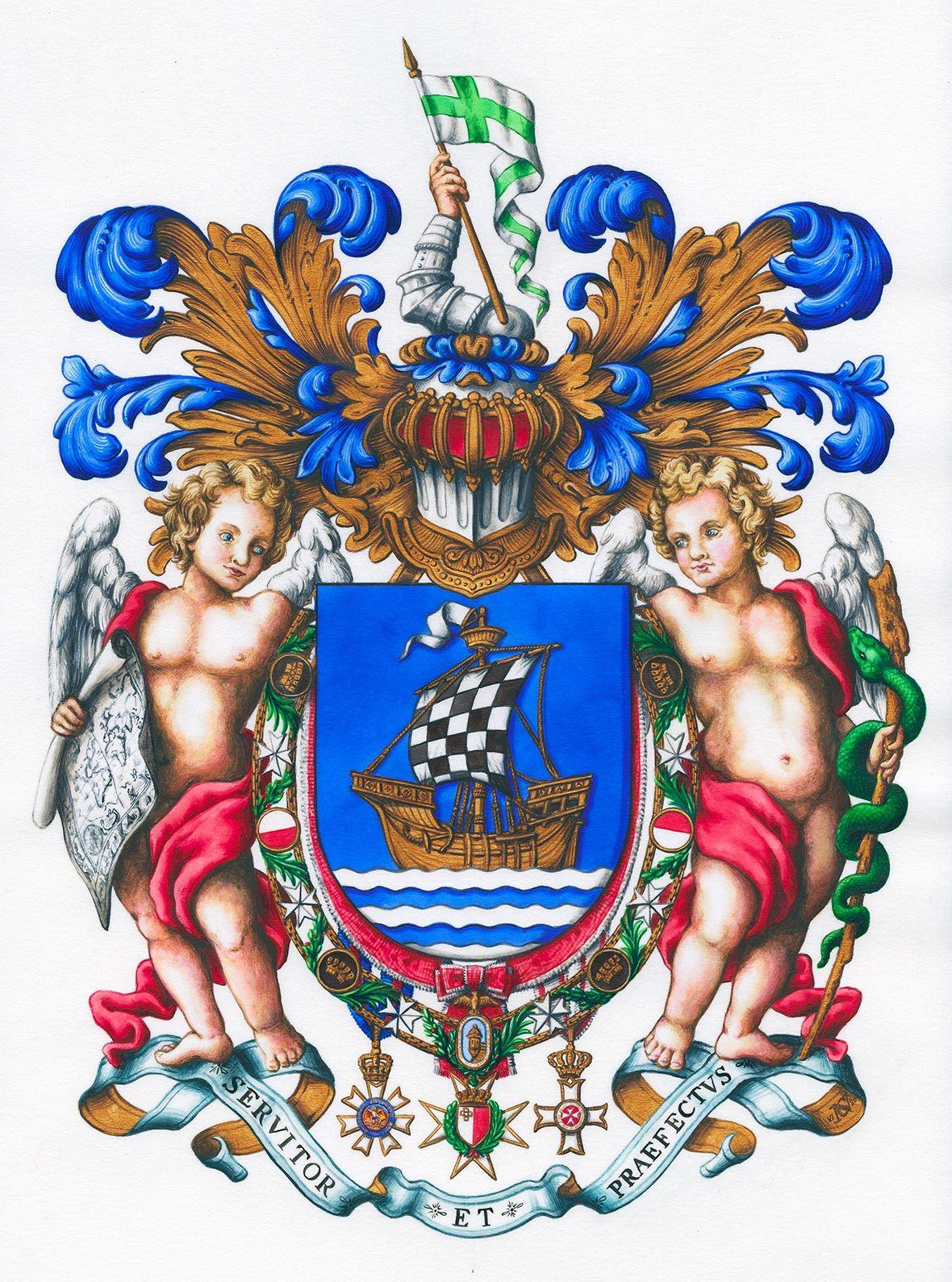 Arms of The President Emeritus of Malta, H.E. Dr George Vella
Some arms are granted to or registered for organisations and are not hereditary. “Although there’s always been a tradition of heraldry in Malta, there was never any central control as the Knights were only interested in their own members; when we were left to our own devices after the era of the Knights, there was still no control on the design of coats of arms,” Gauci continues.
“It became a free-for-all! People simply designed their own arms without reference to long-standing rules of heraldry that had been in place for centuries. For example, ‘the law of tinctures’ says that in the artwork you cannot place a colour on a colour or a metal on a metal. Also, because women never went into battle [back then], they were not entitled to bear their arms on a shield or to use a helm and a crest in their arms. Instead, they would have their arms displayed on an oval or lozenge.”
Now, the Office of the Chief Herald of Arms of Malta ensures that arms are heraldically correct, aligning with historic pan-European rules on presentation that date back to 12th century Europe, mainly France.
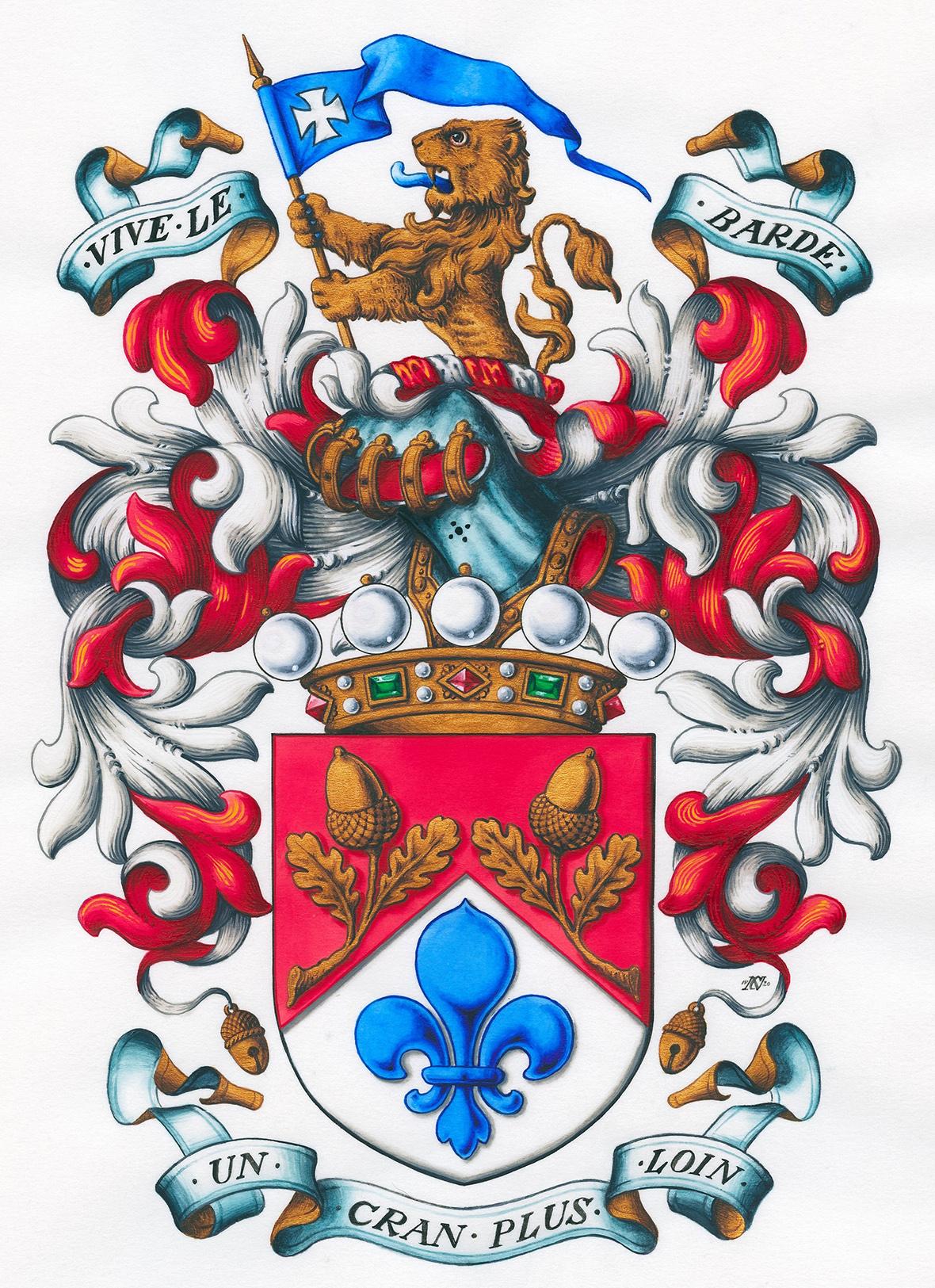 Arms of (Baron) Brady Brim de Forest
Also harking back to this era, Anglo-Norman language is still used in the blazons of English-speaking countries, in which the term for red is gules; for black, sable; and for silver, argent. Other language specific to heraldry describes the direction an animal is facing.
Guardant, for example, described an animal whose body is shown in profile (sideways) but whose head is turned to face the viewer directly. Passant shows an animal walking to dexter (the viewer’s left).
The Register of Arms, Volume 1 (2019–2024) is a meticulous record of both arms that have been used for many years and have now been granted formal recognition and of newly-created arms. These have been granted to petitioners from all walks of life and people from all around the globe who would like to have a link with Malta including those in the UK, Australia, Canada and the US, and more unexpectedly Haiti, Hong Kong and Puerto Rico, and many more countries.
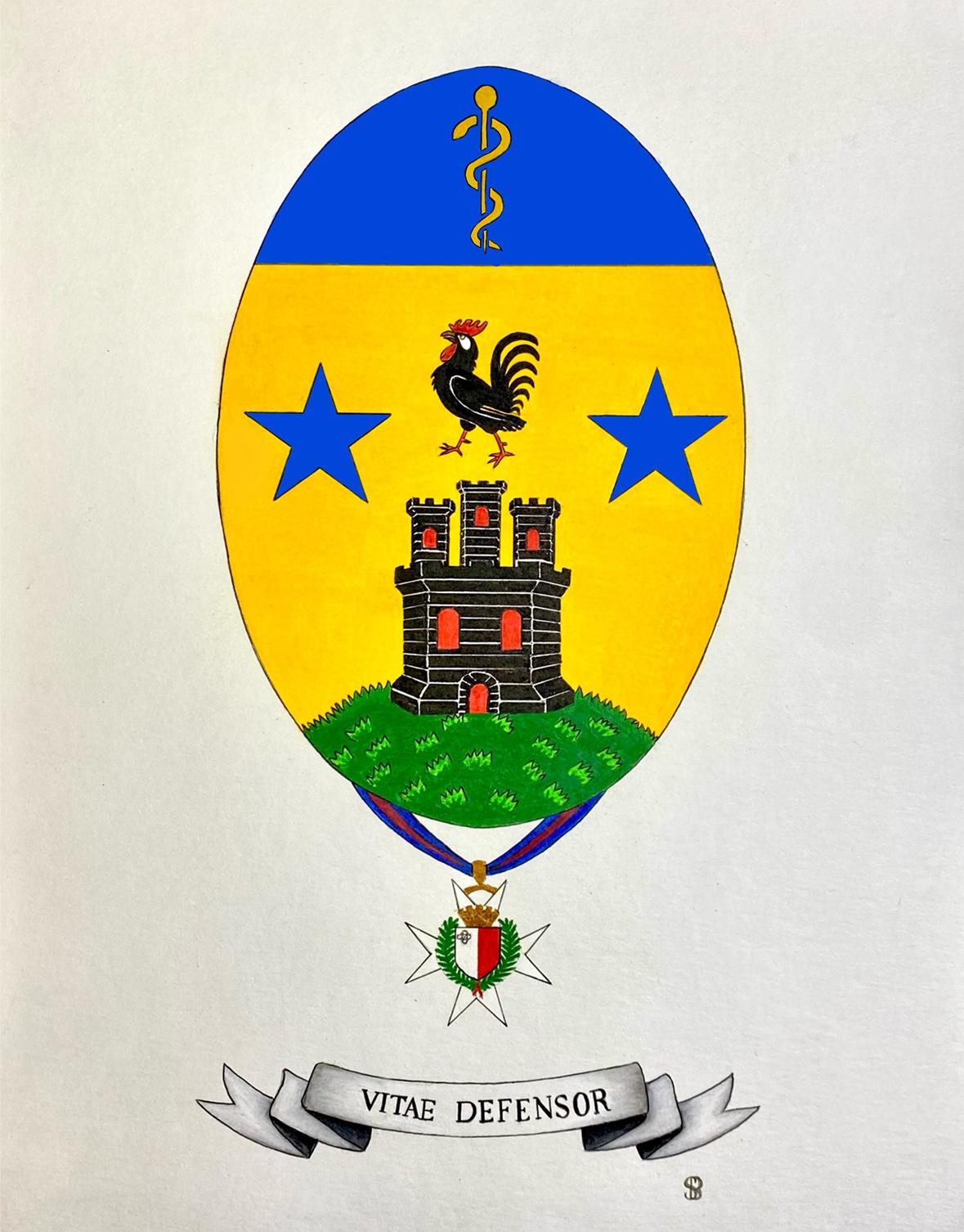 Arms of Prof. Charmaine Gauci
The book includes the arms of prominent national figures including former president George Vella, Archbishop Charles Scicluna, Bishop Joseph Galea-Curmi, the Diocese of Gozo and the basilica of Ta’ Pinu.
Newly granted arms include elements that represent something in the personal life or history of the applicants.
“Their significance is usually always personal. We tend to use ancient symbols, trying to convert contemporary interests and jobs etc. into a classical look. Someone might choose a lion, because it represents courage, or a castle, because their ancestors used to live in a castle. For someone with a strong nautical family history, we might add waves or a sea lion.
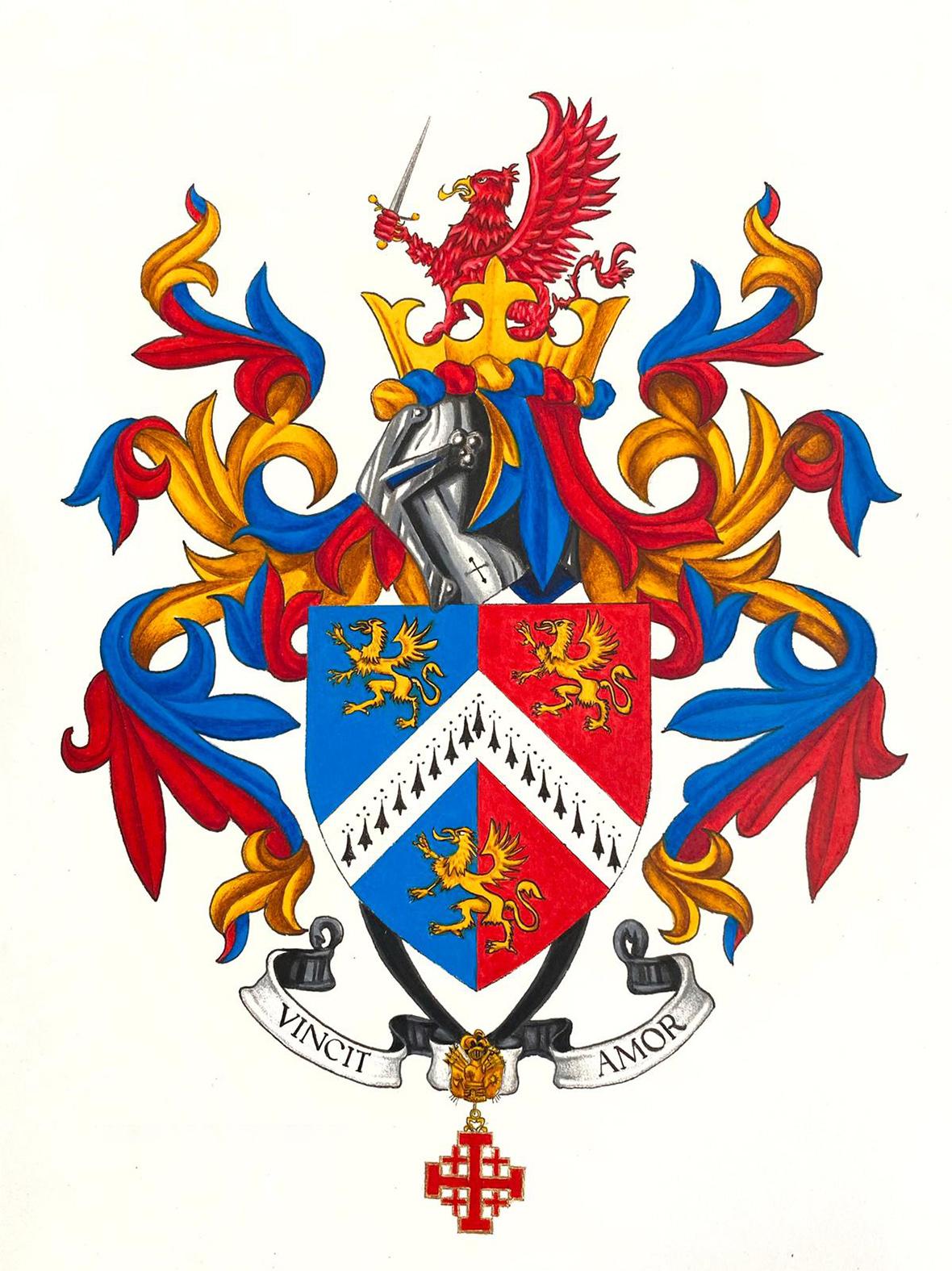 Personal Arms of Chev. Ray M. Cassar
“Arms registered to Japanese professor Dr Shutaro Takeda includes a globe while Dr Dimitri Borisovich Volkov’s includes a piano keyboard. We generally incorporate a person’s own ideas although I might have to hold people back if they get over-extravagant with capes and coronets,” Gauci chuckles.
The blazons for all coats of arms issued here are translated into Maltese and appear in the Government Gazette. While the descriptions of the arms are formalised by these blazons, individual artists still have considerable licence in their choice of illustration style.
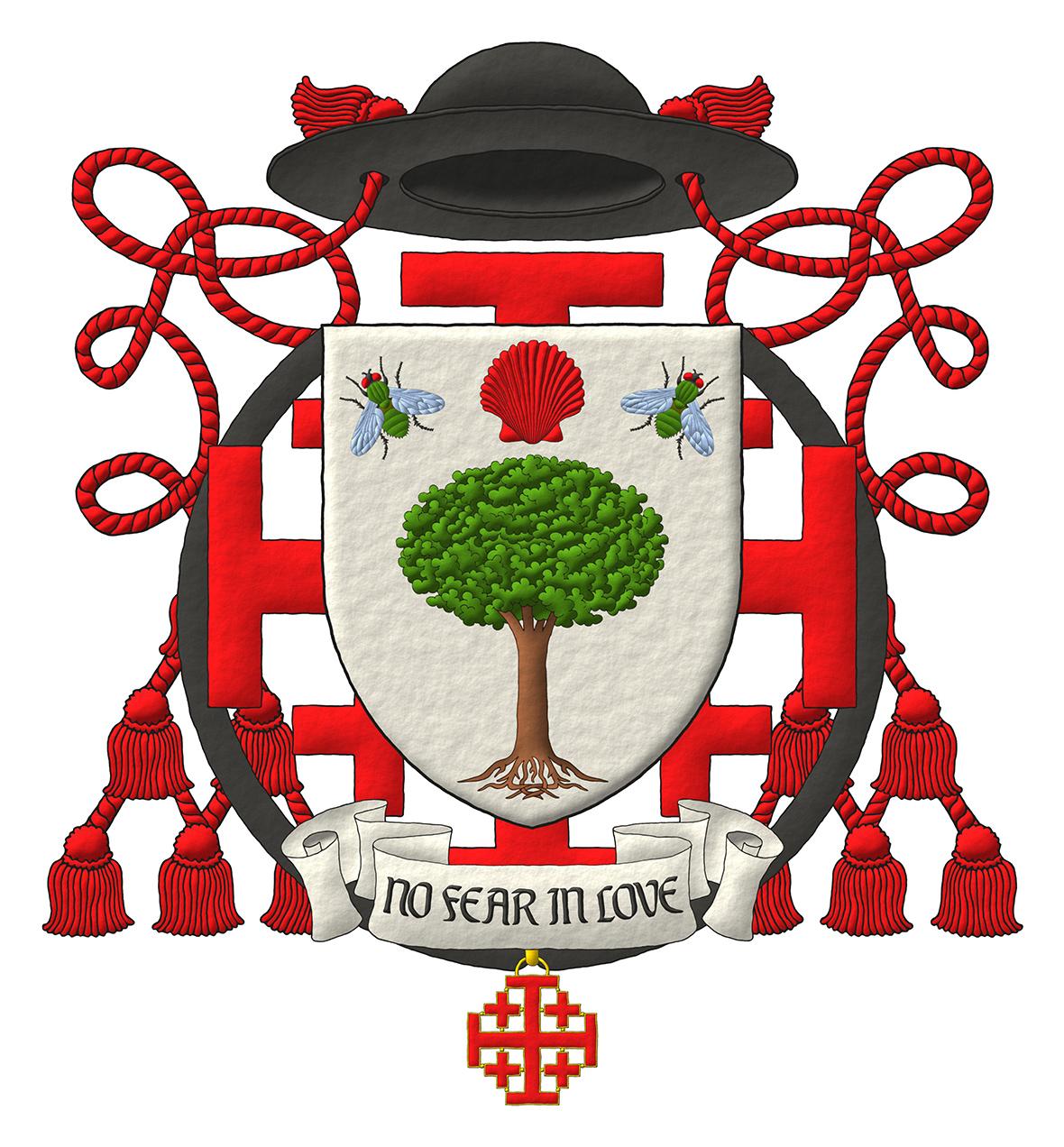 Arms of Rev. Mgr. John Muscat
Many of the arms have mottos – in English, Latin and other languages – and a comprehensive list is included. Unusually, the Arms of Breki Einarsson is written in runes ᚼᚬᛁᚦᚢᚱ᛫ᚼᚢᚴᚱᚬᚴᚴᛁ᛫ᚠᚱᚬᛚᛋᛁ.
For those interested in creating or registering their own arms, The Register of Arms offers a fascinating insight into the process of heraldry which remains a living tradition combining art, symbolism and personal or institutional identity and legacy. In its pages, readers will find lions, owls, eagles, hawks and doves, cherubs and angels, a thistle and a rose, a cockerel and a castle, swords, seashells, and a galley in full sail.
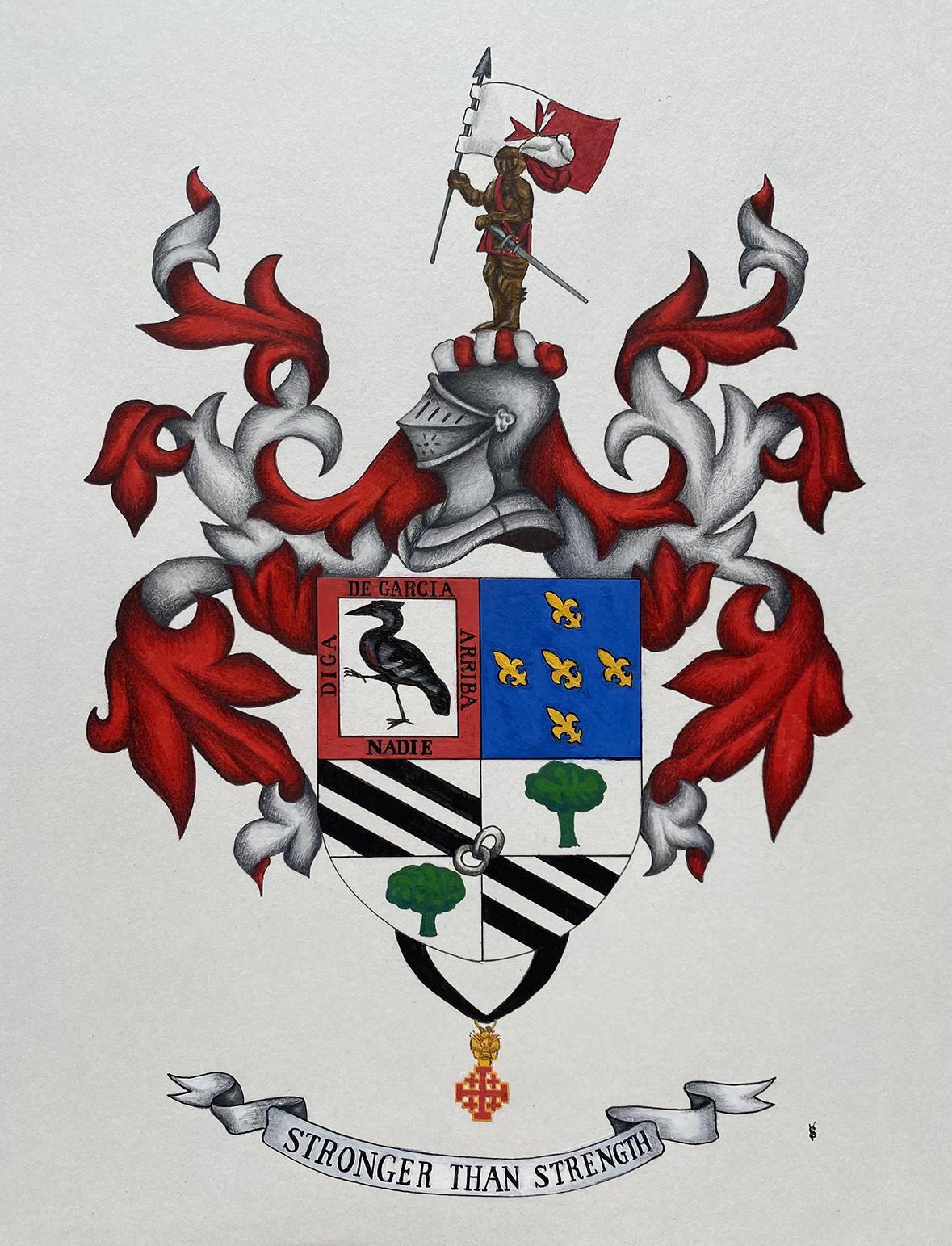 Arms of (Baron) Richard de Morales
More unexpectedly, look out for a Canada lynx with tufted ears, a panther duo with colourful polka dots and even a prairie schooner (a covered wagon used by the 19th-century pioneers in crossing the North American plains).
What would you choose to represent you?
For more information, visit maltaheraldry.mt. Visit heritagemalta.mt to purchase a copy.