How Malta celebrated the end of World War Two 80 years ago
VE Day 80th anniversary: historical alliances and jubilations in Malta
Eighty years ago today, British prime minister Winson Churchill declared peace after the act which brought an end to the war was signed in Reims the previous day. Malta joined Britain and European countries in a night of jubilant celebrations.
After six years of war in Europe, the Allies finally defeated Fascism and Nazism from what the Axis called ‘Festung Europa’ (Fortress Europe). The territorial expansion of three particular countries, Italy, Japan and Germany, and their military pacts, were seen as a threat to the world order of that time.
There are many arguments in favour or against what happened before and during World War II.
I am not going into these historical controversies but we surely know what were the Axis plans for their world order. Surely, if the outbreak of the war didn’t occur in September 1939, war was inevitable and conflict or conflicts were to erupt later on.
Italy, Japan and Germany’s military ambitions led them to sign a number of pacts, which later included other countries.
Military alliances before and during the war
The first alliance between the World War II Axis powers was the Anti-Comintern Pact, which was an anti-communist pact concluded between Nazi Germany and the Empire of Japan on November 25, 1936 and was directed against the Communist International (Comintern).
The second one was signed on May 22, 1939, between Fascist Italy and Nazi Germany, known as the Pact of Steel.
The Tripartite Pact, also known as the Berlin Pact, was an agreement between Germany, Italy and Japan signed in Berlin on September 27, 1940. It was a defensive military alliance that was eventually joined by Hungary (November 20, 1940), Romania (November 23, 1940), Slovakia (November 24, 1940), Bulgaria (March 1, 1941) and Yugoslavia (March 25, 1941). Yugoslavia’s accession provoked a coup d’état in Belgrade two days later.
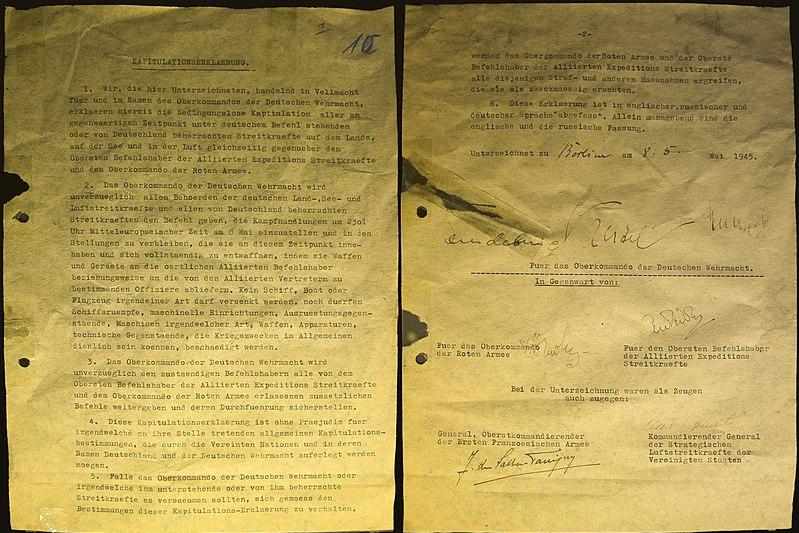 German instrument of surrender, signed on May 8, 1945, at Berlin-Karlshorst.
When World War II broke out on September 1, 1939, the Allied coalition consisted of the UK, France and Poland. As Axis forces began invading northern Europe and the Balkans, the Allies added the Netherlands, Belgium, Norway, Greece and Yugoslavia.
The Soviet Union, which initially had a non-aggression pact with Germany and participated in its invasion of Poland, joined the Allies after the German invasion of the Soviet Union in June 1941.
The US, while providing some material support to European Allies since September 1940, remained formally neutral until the Japanese attack on Pearl Harbour in December 1941, after which it declared war and officially joined the Allies. China had already been at war with Japan since 1937 and formally joined the Allies in December 1941.
The Allies were led by the so-called “Big Three” − the UK, the Soviet Union and the US. A series of conferences between Allied leaders, diplomats and military officials gradually shaped the make-up of the alliance, the direction of the war and, ultimately, the post-war international order.
Relations between the UK and the US were especially close, with their bilateral Atlantic Charter forming the groundwork of their alliance. The Allies became a formalised group upon the Declaration by United Nations on January 1, 1942, which was signed by 26 countries around the world.
And Malta? What was its status? Malta was a British colony at that time but played a very important part in the Mediterranean and North African War, due its strategic position in the Middle Sea.
Although there was a minority of Maltese who, for one reason or another, favoured Fascist Italy, the large majority of the Maltese sided with the British and Allied cause. Therefore, we have to ask: What were the main consequences of the war in Europe before and during VE Day in Europe and Malta?
Maltese celebrations
Malta celebrated the victory over Nazi Germany on Victory in Europe Day along with the rest of the world. In Valletta, civilians, British and other servicemen from Allied countries joined hands and marched down the flagged Kingsway as bands played and church bells rang.
When Victory in Europe Day was proclaimed by then British prime minister Winston Churchill, the Maltese applauded on Palace Square. Then, the big bell of St John’s Co-Cathedral rang, followed by the bells of all the churches of Malta and Gozo.
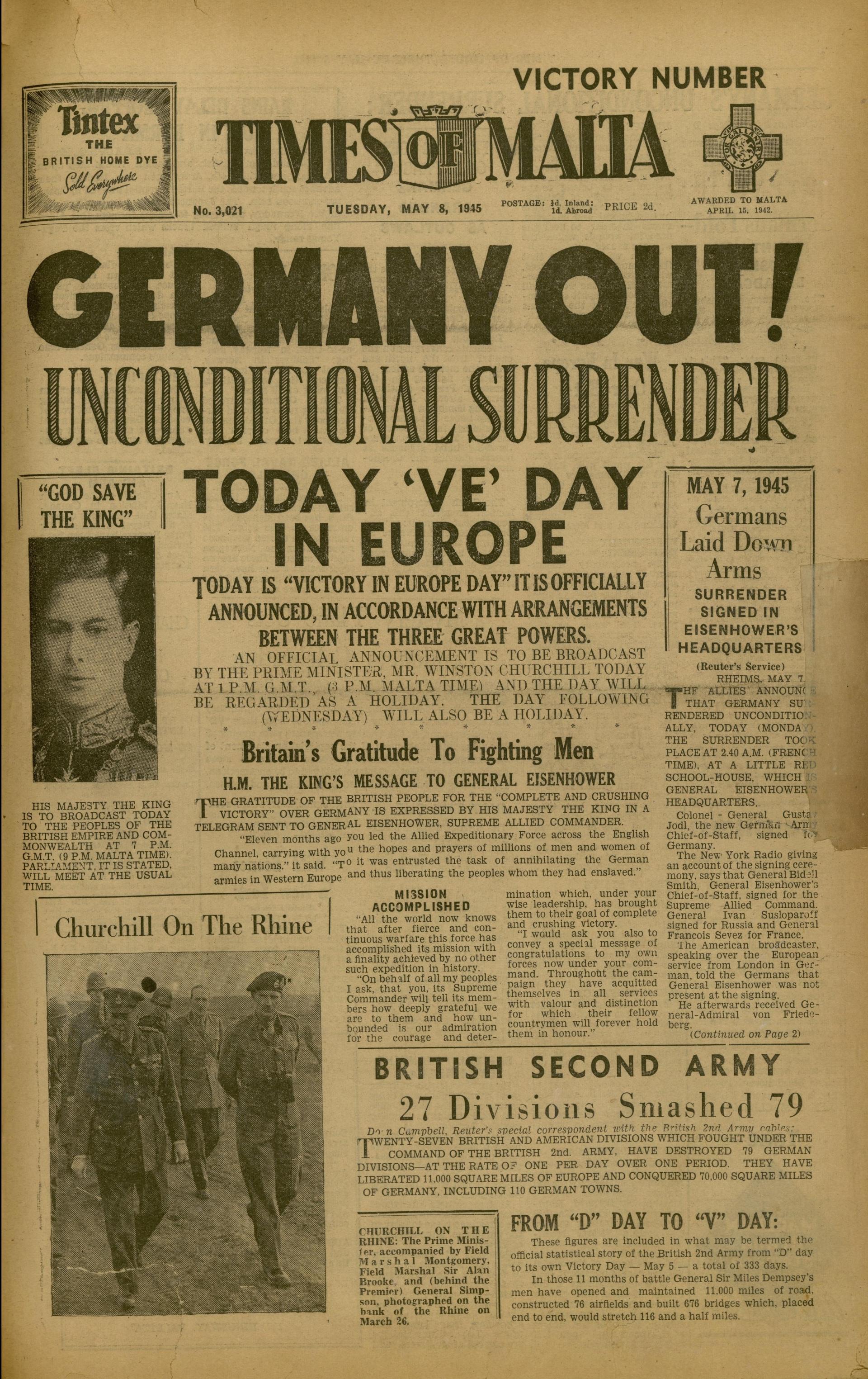
The issue of the Times of Malta with the headline ‘Germany Out: Unconditional Surrender’. Photo: National Library of Malta

Il-Berqa issue of May 8, 1945. Photo: National Archives of Malta
People stood opposite St John’s Co-Cathedral and servicemen joined with the civilians in their cheers. Victory flags in Valletta and throughout both islands were flown only a few minutes after the announcement of Germany’s surrender on the afternoon of Monday, May 7.
The Times of Malta reported that “such was the excitement that Stars and Stripes went up the flagpole upside down. This was quickly rectified. But one Union Jack over the sports editor’s home and castle remained topsy-turvy until blue jackets brought out a tired man at the door at 7.15am on the Victory Day to point it out to him”.
In Kingsway, people were in a festive mood. The Times of Malta issue of the day continued: “The atmosphere though more subdued, having been out of the war for some time, was however not unsimilar to newsflash descriptions of what was happening in Piccadilly and Leicester Square in London. London and Valletta, capitals of the two unbeaten islands of Europe, of the spearheads of the invasions of Hitler’s formerly formidable fortress, experienced the same emotions and reacted to the unofficial news as one.”
Amid the street parties, many people mourned the death of a friend or relative, or worried about those who were still serving overseas
In clubs and bars among Maltese groups, one heard: “What if the Battle of Britain had been lost?” And among English groups, one heard the remark: “What if Malta had fallen? Would the war be over today?” Then came the strains of Land of Hope and Glory and many a blitz-time song that, in these quasi-normal times ,one, perhaps, blushed to repeat.
As mentioned above, Malta rejoiced with Britain and with all the other nations of the Commonwealth and empire, with all members of the United Nations, with all those peoples “whose shackles of serfdom have been sundered on the great glorious victory which has brought to an end the war in Europe. Escalation on the triumph of the finest cause for which men of every clime and creed took arms surged through the island as the church bells rang out their paean of joyousness and thanksgiving immediately”.
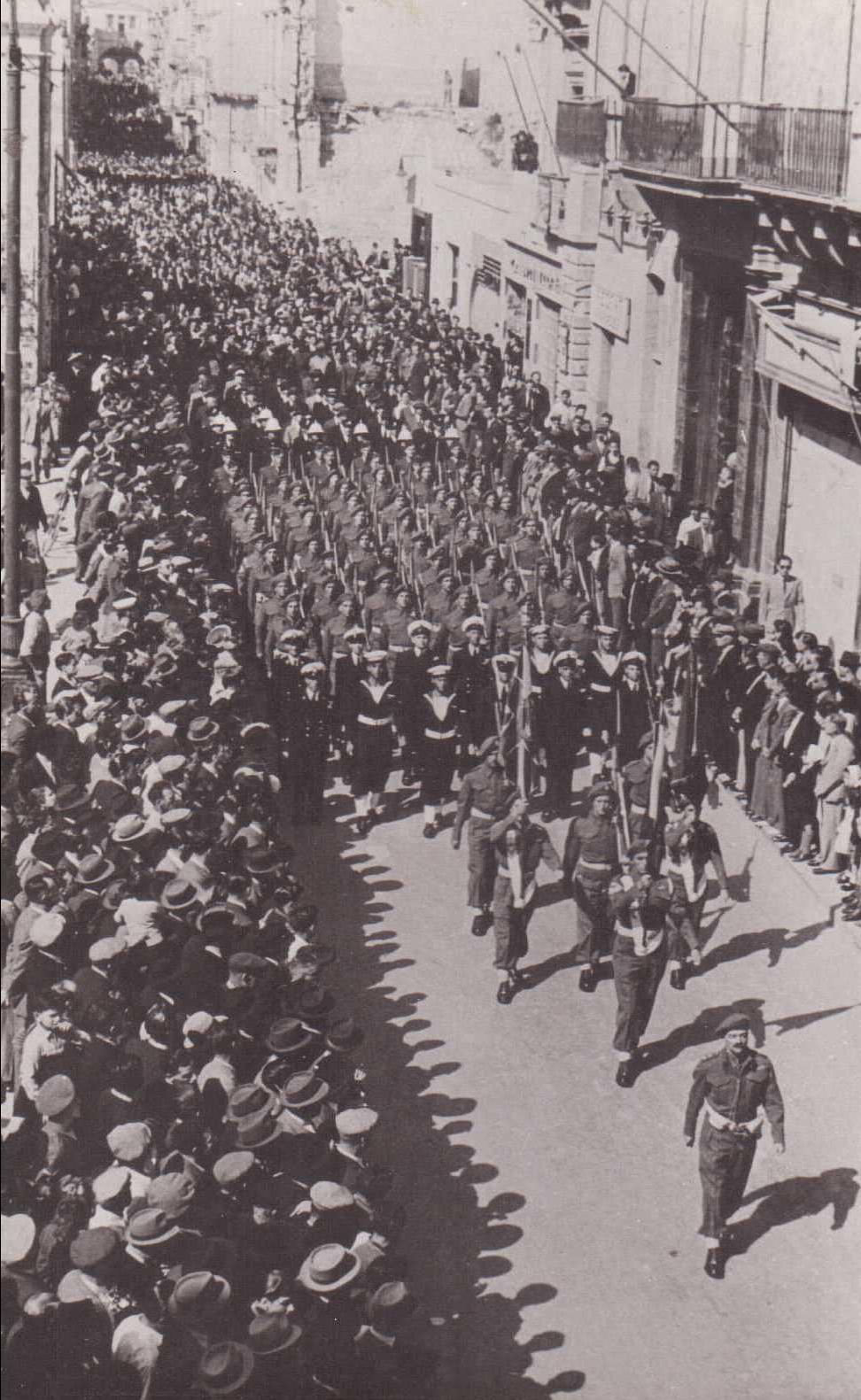 British troops and naval ratings marching in Valletta. Photo: Times of Malta
Various incidents reported
The festive mood of both civilians and servicemen brought about a number of incidents, which were reported to the police. These consisted of thefts, fights and other curious ones. The following are some of the incidents reported to have occurred related to the festivities during VE Day in Valletta:
8.30pm: A fight erupted in the shop of Rogantino Montebello between unknown civilians who broke two large tables, panes of glass, two stools and two small tables.
Apart from the said fight, the owner found missing eight tins of 50 Carlyle cigarettes, 50 packets of Park Drive cigarettes and 50 packets of Gallabhers & Virginia House cigarettes. Montebello could recognise the men on sight.
Another fight erupted between Joseph Tanti, Vincent Borg and Francis Borg − all of them residing in Valletta − in the coffee shop of No. 275, Kingsway, kept by Rogantino Montebello.
During the fight, damages were caused to two panes of glass, two wooden stools and two small tables. During the same time, there seems to have been an attempt to break into the pantry of the Baviera Training School in West Street through a window, which bore signs of having been tampered with. This was discovered by head teacher Gaetano Cauchi.
The police enquired and found that an attempt (although they were sceptical) had taken place as reported by Cauchi. Cauchi requested that the Baviera School be guarded by the police between 6pm until 6am on May 11, when a watchman was to be employed to guard the premises permanently.
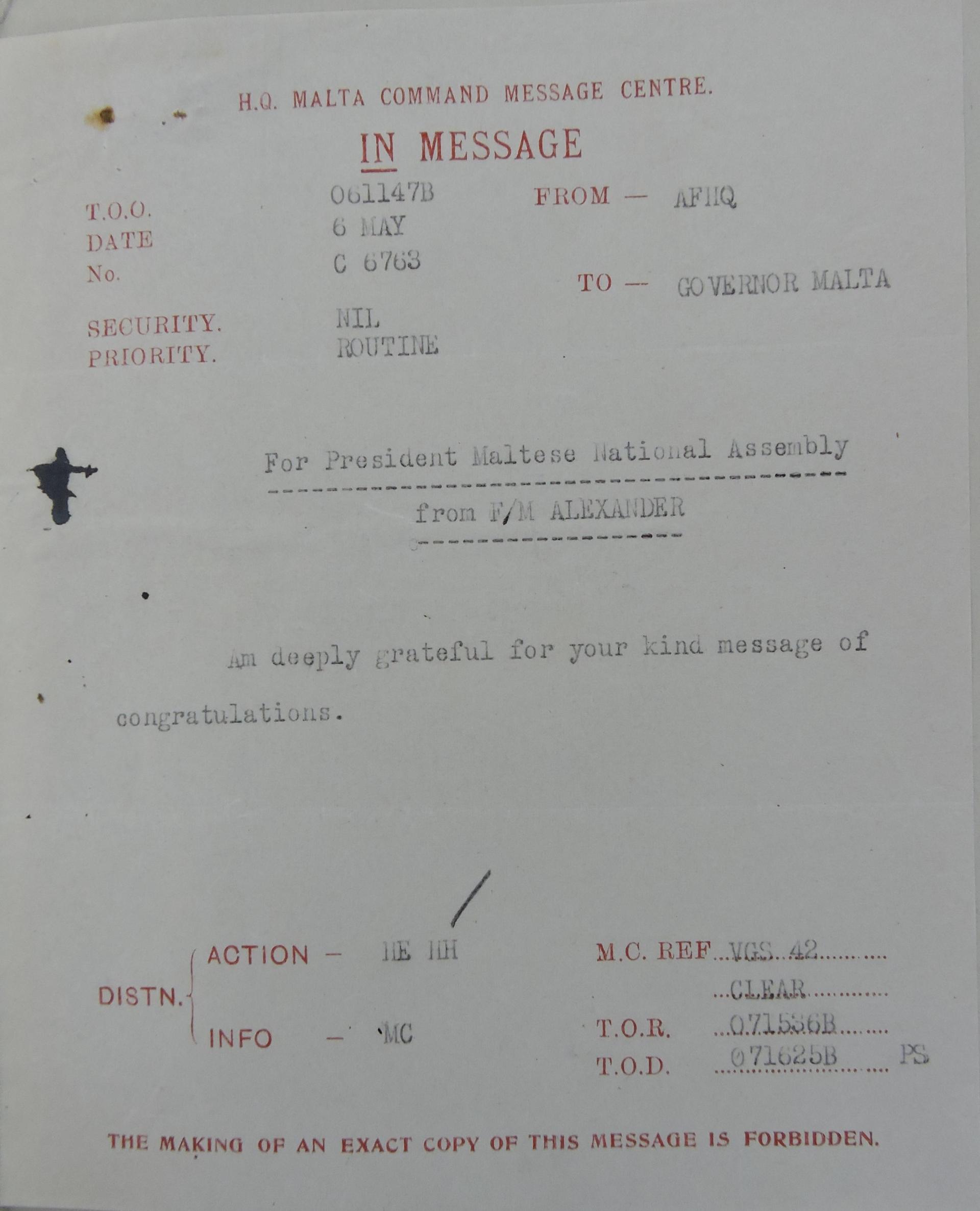 The message sent by Field Marshal Alexander. Photo: National Archives of Malta
9.30pm: A curious incident occurred when several naval ratings from HMS Nelson climbed up the statue of Queen Victoria, in Queen Square, Valletta. They accidently broke three fingers off the left hand of the statue. One of the culprits, stoker Alfred W. Bucknall, was taken into custody by the Naval Standing Patrol. The police collected the statue’s broken fingers. Nothing is known about what happened afterwards but, sure enough, the broken fingers were subsequently affixed to the statue.
10.30pm: A fight erupted between several naval ratings. One of them, A.B. Leslie James, struck A.L. Seaman John Hutchings from HMS Venerable, with a broken bottle. Hutchings ended up with a cut on his forehead. Hutchings was visited by Surgeon Lieutenant Andrade from HMS Sussex, who stated he was suffering from a cut artery but he was not in danger. He was conveyed to Bighi Naval Hospital for further treatment.
11pm: The festivities seems to have continued until this time, when an apparently drunk stoker, Raymond B. Humphries, from HMS Anson, attempted to climb up to the balcony of the Overseas Club. Having failed to do so, and on trying to reach the ground, he got hold of the awning of the Europa Bar but his weight caused the frame of the awning to break.
Last, but not least, the Maltese Legislative Assembly, among other things, sent a signal message to Field Marshal Alexander, the supreme commander of the Allied forces headquarters, responsible for all military operations in the Mediterranean theatre.
On April 29, 1945, he had received the German surrender in Italy. In answering, Alexander sent the following message to Malta: “[I] am deeply grateful for your kind message of congratulation.”
Field Marshal Alexander seems to have been impressed by the message sent by the Maltese Legislative Assembly, and found time to answer it. This was read on May 8, 1945.
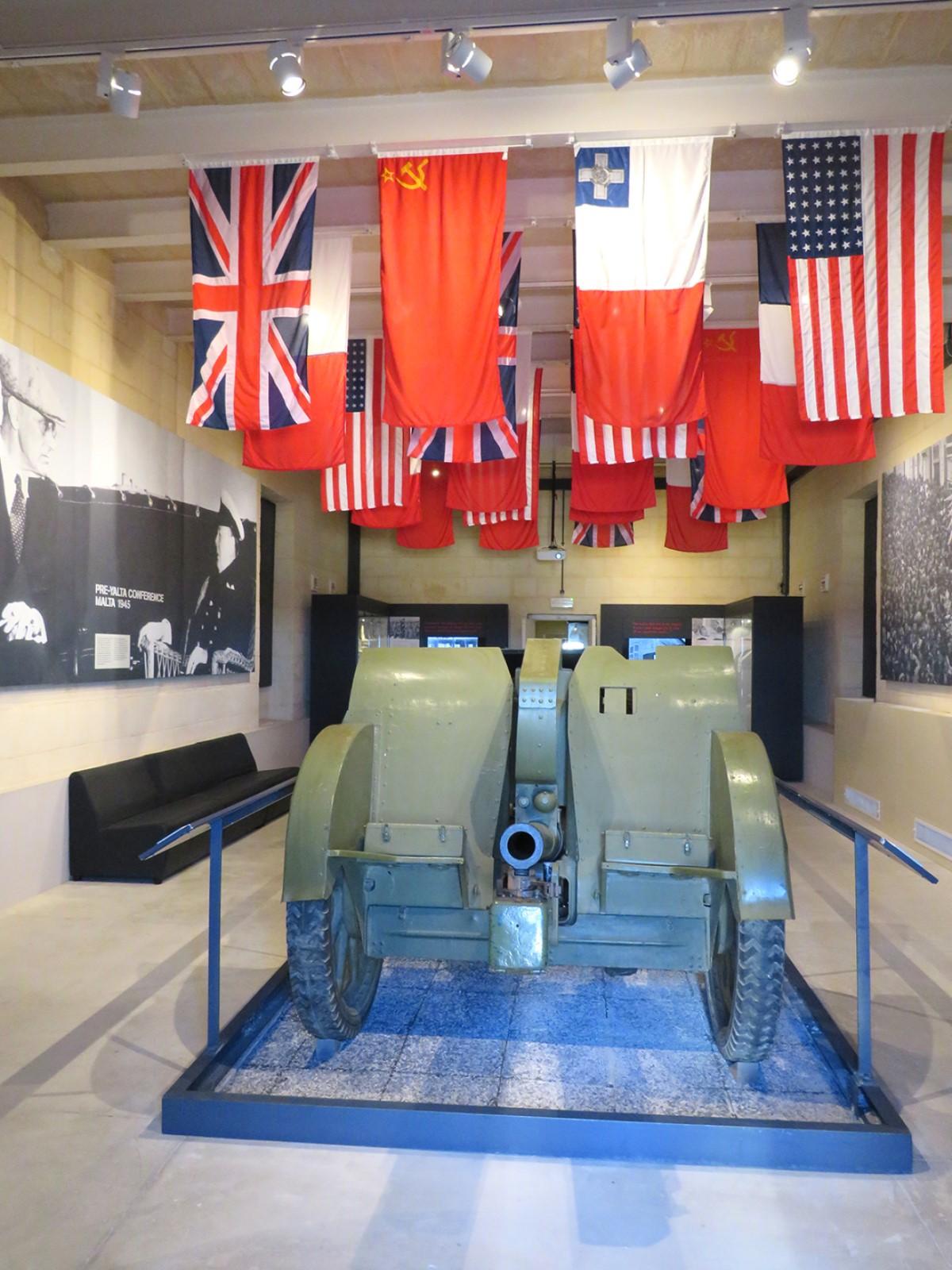 The flags of the victorious Allies and Malta hanging from the roof beams of the National War Museum. Photo: Heritage Malta – National War Museum
Conclusion
There were big festivities in Valletta and elsewhere but we have to keep in mind also those who, for one reason or another, did not celebrate that day.
For those who had lost loved ones in the conflict, it was a time to reflect.
Amid the street parties, many people mourned the death of a friend or relative, or worried about those who were still serving overseas.
For many of the widows of the wartime period, the noise and jubilation of the celebrations may have been too much to bear.
There was also an air of anti-climax. The hardships of the war years had taken their toll on many people and left them with little energy for rejoicing.
Charles Debono is a senior researcher at the National War Museum.