How Microsoft’s AI brought a digital renaissance to the Vatican
Transforming how the world experiences this iconic landmark
Since its unveiling in November 2024, The People’s Basilica − an AI-powered digital twin of St Peter’s Basilica, created in collaboration between the Vatican and Microsoft − has transformed how the world experiences this iconic landmark.
This technological marvel not only merges ancient architecture with modern innovation, but also provides unprecedented access to one of Christianity’s holiest sites through immersive exhibitions and interactive digital experiences.
This initiative raises several questions about the intersection of religion, faith and technology. Is the Church’s use of AI a way to further its religious mission or does it risk overstepping new boundaries? How will AI applications in the preservation of cultural landmarks ensure respect for their sacred nature? Could AI alter or digitally manipulate religious experiences?
What is sure the Church already knows a lot about AI – and it all started when Vatican officials recognised AI’s potential for preservation and engagement.
A legacy of AI and the Vatican’s growing tech engagement
The Vatican’s involvement with AI began as early as 2017 when advancements in transformer architecture led to the rise of generative AI models.
By then, the Vatican had already been collaborating on AI applications in medicine and technology.
In 2018, Franciscan friar Paolo Benanti, Pope Francis’s adviser on AI ethics, delivered a speech on the moral implications of AI, which was attended by a senior Microsoft executive. This dialogue led to Microsoft’s deeper involvement in Vatican AI projects, including its early endorsement of the Rome Call for AI Ethics, a Vatican initiative that later influenced the G7’s AI conduct guidelines.
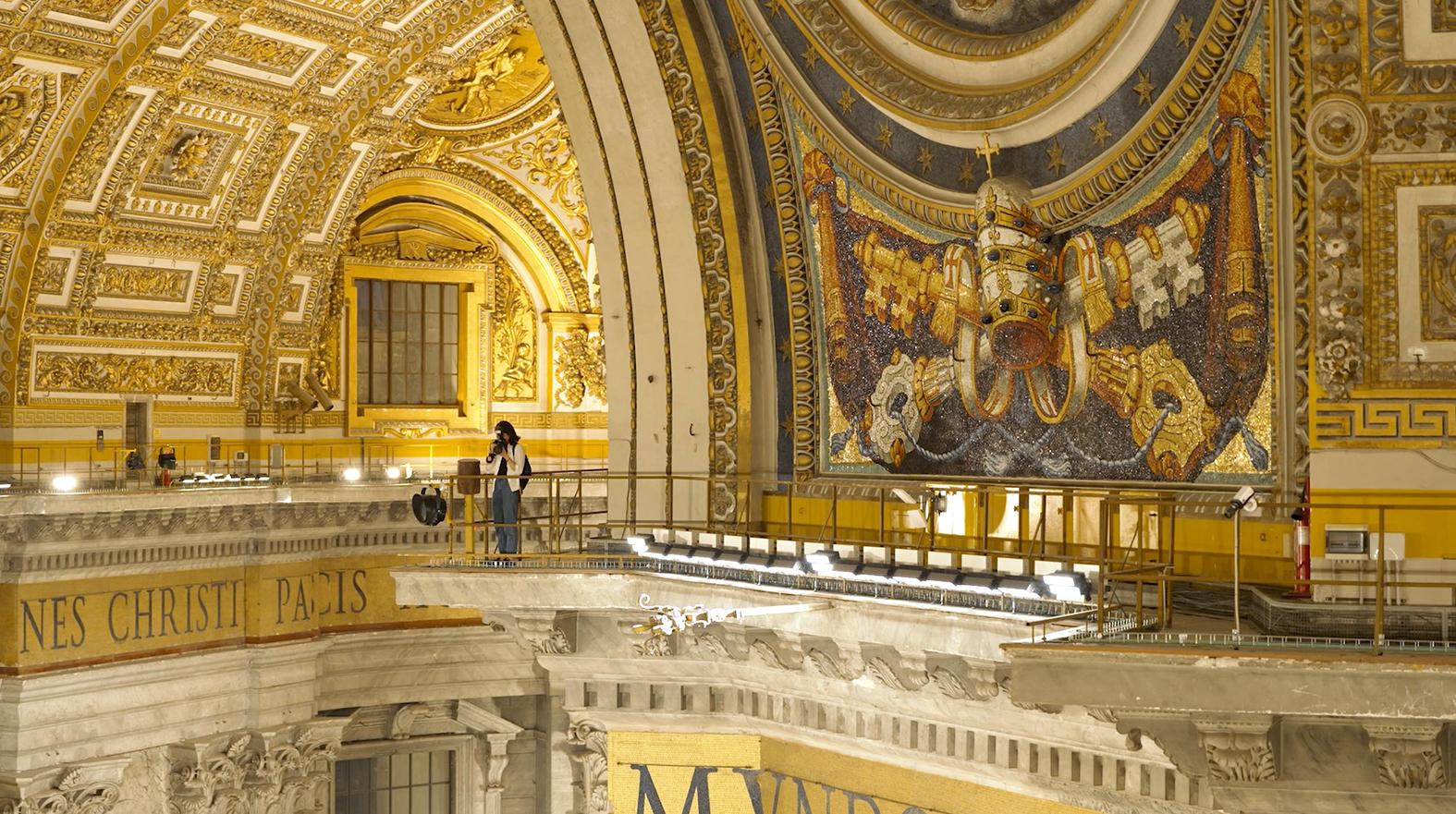 The virtual model allows users to explore the basilica’s sacred spaces, including previously inaccessible areas.
This collaboration culminated in 2024 with the launch of The People’s Basilica, a project developed with Microsoft and Iconem, a leader in digital preservation. At its core is the AI-generated digital twin of St Peter’s Basilica, an ultra-precise 3D model that allows global audiences to explore the basilica in ways that were previously impossible.
A technological marvel: AI meets art and architecture
The creation of the digital twin represents a milestone in preserving and digitally enhancing cultural heritage. Using advanced photogrammetry and AI, this virtual model offers an interactive 3D experience, allowing users to explore the basilica’s sacred spaces, including previously inaccessible areas.
Iconem’s team captured over 400,000 high-resolution images using drones, cameras and laser scanning devices to construct an ultra-precise digital replica. Microsoft’s AI for Good Lab then processed this data, refining the model to millimetre-level accuracy. AI algorithms filled in missing details and created seamless visualisations of the basilica’s structure.
Technology like AI propels us into the future, but it can also play a pivotal role in preserving our past
According to Yves Ubelmann, founder and CEO of Iconem, “it’s like an investigation of 2,000 years of history through one unique monument. We can now see new connections between its past and its future”.
Exploring unseen angles and new discoveries
One of the most striking aspects of the digital twin is its ability to provide previously unattainable perspectives.
AI simulations allow users to explore the basilica’s dome from within, offering a bird’s-eye view of its mosaics.
The crypt, often restricted in physical tours, can now be explored in intricate detail, providing virtual visitors with an intimate experience of the papal tombs and other sacred sites.
Perhaps most significantly, AI analysis uncovered structural vulnerabilities, such as missing mosaic tiles and previously undetected fissures in the basilica’s walls. These findings will aid future restoration efforts, ensuring the long-term preservation of St Peter’s Basilica.
A bridge between tradition and innovation
The Vatican’s collaboration with Microsoft reflects a forward-thinking approach to cultural preservation. By integrating AI into its mission, the Church is making St Peter’s Basilica more accessible to a global audience while maintaining the sanctity of its sacred sites.
Cardinal Mauro Gambetti, archpriest of the basilica, said: “Centuries of degradation, combined with the daily influx of over 50,000 visitors, have impacted the basilica’s structure. AI now allows us to identify and address these vulnerabilities more effectively.”
The Vatican has also ensured The People’s Basilica extends beyond academic and religious communities. The Pétros ení exhibition, named after the inscription believed to mark St Peter’s tomb, offers visitors an immersive blend of digital and physical exploration. On-site AI-powered kiosks provide deeper engagement, while a dedicated website offers interactive 3D tours with narration and soundscapes.
Additionally, in January, a Minecraft Education experience was released, allowing younger generations to explore St Peter’s Basilica in an interactive gaming environment.
The role of AI in cultural preservation
As many historic landmarks face threats from natural disasters, climate change and ageing infrastructure, AI-generated models are becoming essential tools for preservation. These digital twins ensure that cultural heritage is documented for future generations and assist conservationists in restoration efforts.
Brad Smith, vice chair and president of Microsoft, summed up the project’s significance: “Technology like AI propels us into the future, but it can also play a pivotal role in preserving our past. Our cultural heritage provides a link to where we came from and informs us about where we want to go.”
During this year, which marks the Jubilee of Hope, The People’s Basilica project is expected to reach millions of visitors, both in person and online through a groundbreaking initiative that celebrates how AI, when used ethically and thoughtfully, can serve as a powerful bridge between history, faith and the digital age.
https://unlocked.microsoft.com/vatican/