Hundred-year anniversary from the birth of artist George Fenech
An exhibition celebrates this important artist of Maltese modernism
Yesterday marked the birth centenary of artist George Fenech (1926-2011).
Fenech was born in Mellieħa on January 3, 1926. As a child, he liked to draw and paint but did not receive any formal artistic training. During World War II, he was conscripted and was posted at the weapons depository at the Training School in St Andrew’s.
In his free time, Fenech used to draw portraits of his colleagues and make copies of paintings. Though self-taught, his work attracted the attention of Lewis Wirth (1923-2010), a young recruit who was an art lover. At the end of the war, the two friends were discharged from the service, and each went their own way.
Two years later, in October 1948, while returning home from work, Fenech came across Wirth who convinced Fenech to accompany him to the Malta Government School of Art where he introduced him to Vincent Apap (1919-2003), the then head of school.
Apap asked the young newcomer to try his hand at drawing a plaster cast from Canova, and seeing the result encouraged him to register as a student. Fenech complied and a month later Apap led him to the painting class run by Emvin Cremona (1921-1987).
At the time the school was undergoing quite a significant change – Carmelo Attard (1909-1988) had replaced Vincenzo Bonello as history of art lecturer as the latter was interned during World War II and was not reinstated. Edward Caruana Dingli (1876-1950), who had served as director and master of the painting class since 1930, retired and Apap was appointed as head of school.
Cremona joined the staff as master of the painting class. Carmelo Mangion (1905-1997), who had been in charge of the etching class from its inception in the 1930s, was appointed as master of decorative art and shifted his attention from etching to painting.
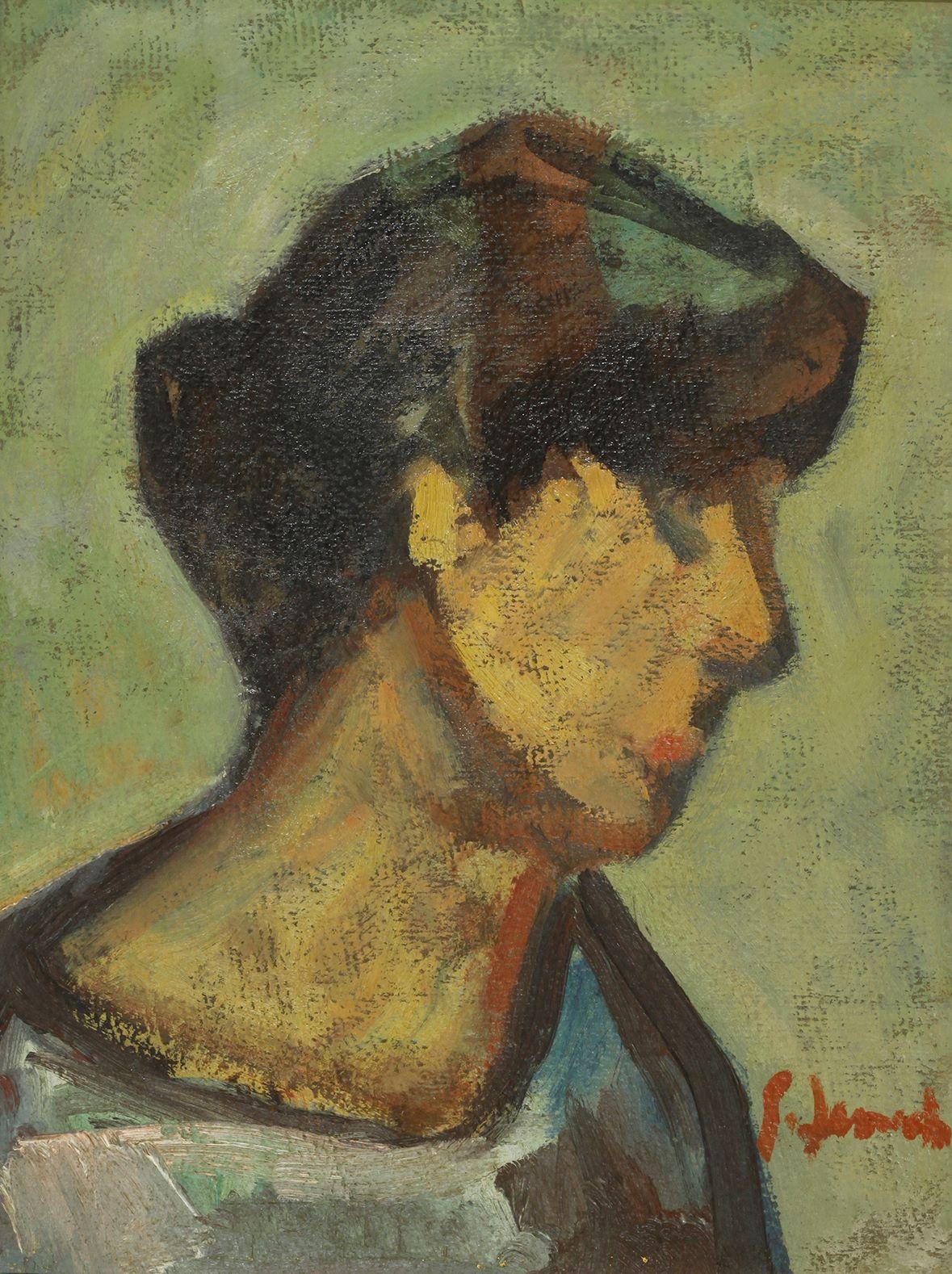 Portrait of a Lady (Rome, 1959).
This change in the teaching staff brought about a penchant towards a sensibility away from the strict academic idiom yet retaining artistic discipline.
Under Cremona, Caruana Dingli’s academic practice of using earth colours for modelling gave way to a wider palette of brighter hues; this was often accentuated by substituting the warm white light-source on the models with coloured spotlights. These adjustments, together with the use of alla prima brushstrokes equivalent to the student’s handwriting, gave due importance to the student’s personality.
In 1956, Fenech won the painting scholarship and proceeded to the Regia Accademia di Belle Arti in Rome.
After a tough entrance examination, he was admitted as a student for painting under the tutorship of Amerigo Bartoli Natinguerra (1890-1971), for intaglio and history of art under the tutorship of Mino Maccari (1898-1989) and Mario Rivosecchi (1894-1981) respectively, and artistic anatomy.
In 1960, on completing the diploma course with excellent results, Fenech’s scholarship was extended by another year to attend the corso di decorazione under Ferruccio Ferrazzi on recommendation of the director of the academy, Michele Guerrisi (1893-1963).
Fenech was an assiduous student, and while in Rome he took the opportunity to attend the corso di affresco at the Scuola Serale, arti ornamenatali under Prof. Ciotti, and the evening Accademia del Nudo in via Margutta.
Fenech proceeded to Rome artistically well-equipped and thus was able to assimilate the predominant artistic currents that has been fomenting in Rome between the wars. As noted by the critic of the Times of Malta in 1957, “for Fenech it was not so much a question of progress and development, but a complete transformation which the artist’s work has undergone at the Accademia”.
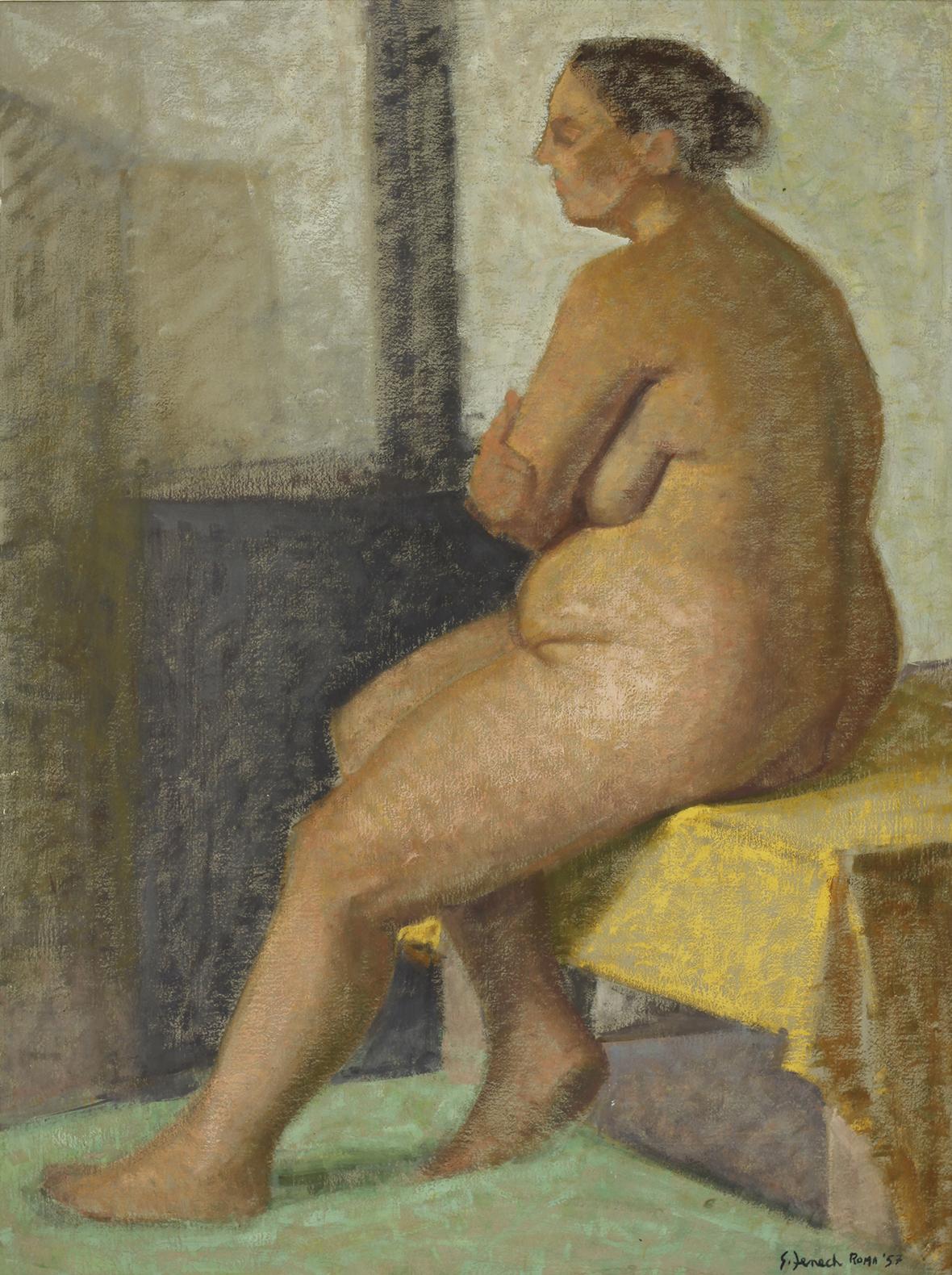 Maria by the Stufa (Rome, 1957)
In Rome, Fenech produced a large corpus of sensitively rendered figure studies in charcoal and crayon, paintings of nudes and en plein-air landscapes of the Roman countryside. These works, such as Portrait of a Lady (1959), which was well spoken of by Amerigo Bartoli and Mario Mafai, or Maria Seated by the Stufa (1957), betray Fenech’s affinity to mid-1920s Italian masters.
In the landscapes of this period such as Via Appia (1957), vertical and horizonal lines and bands of colour create calm compositions. The colour palette is harmoniously toned down to a selection of earth colours. These paintings suggest pensive and reflective moods – introspective poems in colour.
Back in Malta, Fenech was employed as an art teacher, where he conveyed his love for art to his students, shown by the fact that quite a few of them took art for their career. Notwithstanding, his artistic output kept a steady flow creating an extensive oeuvre.
Among the local art lovers, Fenech is best known for his landscapes, perhaps as these comprise his greatest output. His early post-Roman work reflects the solidity similar to those of the Roman period in their geometrical synthesis, composition and predomination of earth colours. This can be noted in The Pine Tree (1958) and Ortenzia (1972). However, the geography of the island brought a gradual change in composition and colour.
Fenech defined light and colour as interchangeable. Consequently, the earth colours that worked so well for the Roman landscape had to be substituted by brighter hues with which to interpret the contrasting hues of Malta’s scourging sun.
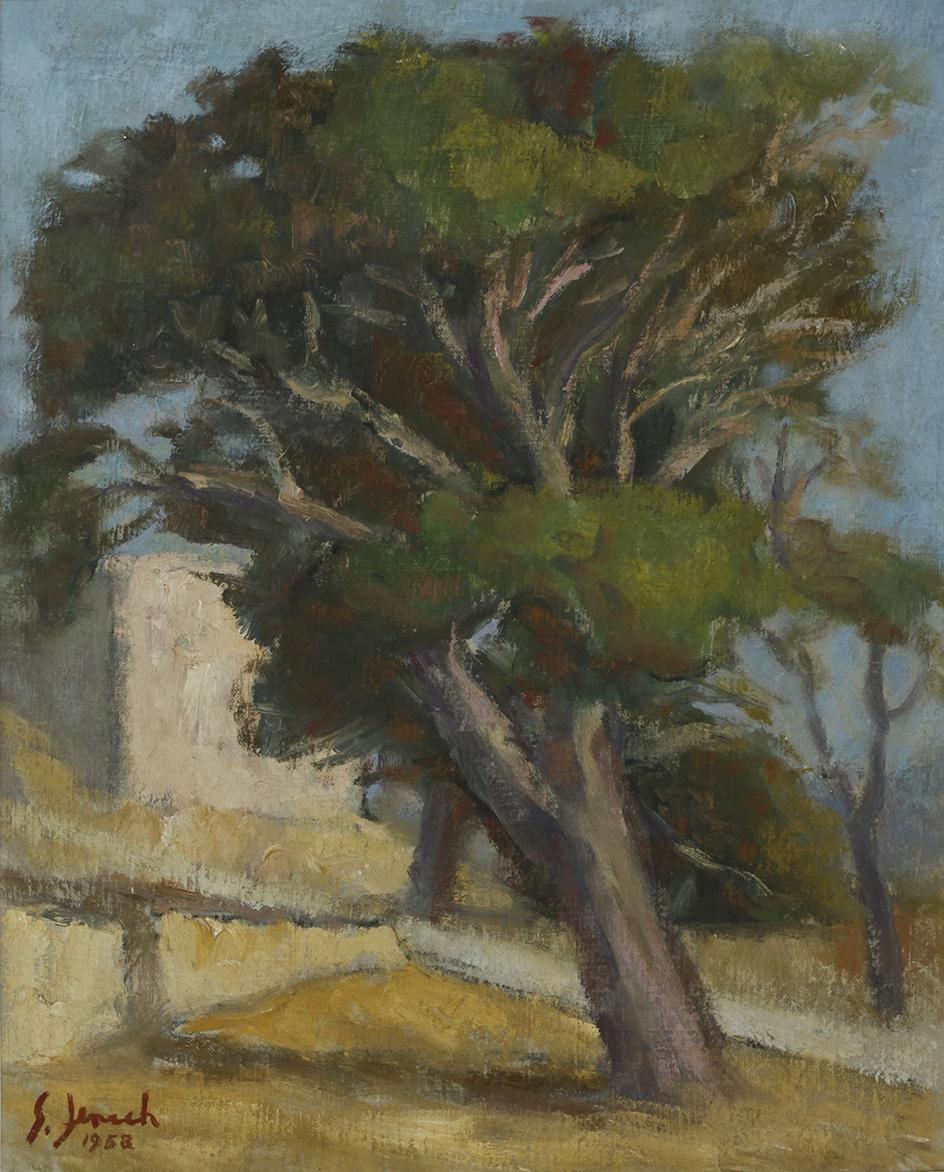 The Pine Tree (1958)
Fenech’s oeuvre includes still-lifes, portraits, religious art and man. His artistic contribution to Maltese 20th-century art is significant. Together with Ġanni Bonnici, he opted to further his studies in Rome, a choice which in 1949 had been barred by the British governor to the previous immediate post-war scholarship holders.
By furthering his studies in Rome, Fenech returned to the roots of Maltese artistic sensibility which traditionally looked up at Italy for inspiration. Yet, his contribution is the fact that, perhaps in his continuous, bold interpretation of Mellieħa landscapes, his Roman background served as a springboard from which he developed a personal idiom, which undoubtedly, is characteristically Maltese.
Quoting Joe Camilleri, “George Fenech’s greatness is that he makes the most complicated things look simple and from humble everyday life and utensils he creates great art”.
In the work of Fenech, the Mellieħa farmers or fishermen in their daily toil are clad in human dignity that elevates them, representing man in his humanity.
In 2010, in recognition of Fenech’s artistic contribution to Malta’s artistic scene, George Abela, then president of Malta, honoured him with the Midalja għall-Qadi tar-Republika.
To celebrate the 100th anniversary, the George Fenech Museum and Gallery is supplementing its permanent collection with 23 paintings from its reserve collection. The museum is housed at 42, Triq il-Kbira, Mellieħa, in a typical early 20th-century town house in which Fenech lived with his wife Doris and his sons Conrad and Gilbert. The museum is run by the family and the entrance is free. The exhibition will remain open till January 18.
The opening hours are Monday, Wednesday, Saturday and Sunday from 10am to 1pm, and on Friday from 4 to 7pm.