'I have more freedom of speech in Malta than I do in the US'
Prof Michael Bugeja says he received threats after writing critically about Trump
A Maltese-American journalism professor has described how he received serious threats after writing critical articles about US President Donald Trump.
In an interview with Times of Malta, Michael Bugeja, Professor Emeritus of Journalism and Communication at Iowa State University, shared his observations about the rising threats journalists and academics are facing in Trump’s America.
“It used to be that journalists would go into public relations because journalism didn’t pay as much. Now, journalists are leaving the profession because they’re targeted by the government,” Bugeja said.
Bugeja, a first-generation Maltese-American, presented his research about the role of generative AI in journalism at a public lecture on Thursday. He was also awarded an honorary degree from the University of Malta.
“Right now, I think I have more freedom of speech in Malta than I do in the United States,” he said.
The academic no longer feels free to speak against the government after he received serious threats from MAGA supporters for writing critical articles about Trump in Poynter Magazine.
At 73, he decided he’s done and said he knows a lot of journalists who share this attitude.
I’m happy I’m leaving academia at this point in my life. I’m not certain that I could teach according to a government philosophy- Retired professor Michael Bugeja
“I’m happy I’m leaving academia at this point in my life. I’m not certain that I could teach according to a government philosophy,” the retired professor said.
Throughout 2025, universities across the United States have confronted massive funding disruptions, with billions of research grant dollars frozen or used as leverage to pressure ideological alignments with the current administration.
Many US-based scholars perceive these measures as an attack on academic freedom.
“I’m somewhat concerned that the more your voice becomes prominent, the more people look at you and scrutinise you to see if anything you’re saying is against their agenda,” he said.
Ever since he received targeted intimidation in response to his writing, Bugeja has become very careful about the content he posts online.
“It’s a type of 1984,” he added, comparing the current historical moment to George Orwell’s dystopian novel about mass-surveillance, censorship and totalitarianism.
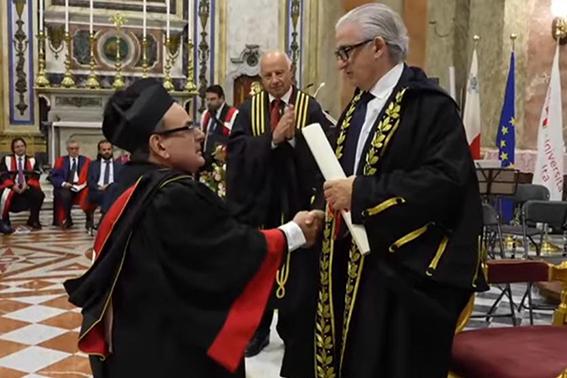 Michael Bugeja receiving his honorary degree during the ceremony.
Worried about lack of data protection in US
The lack of data protection in the United States raises major privacy concerns for Bugeja who worries about personal information falling into malignant hands.
“The Trump administration empowered Elon Musk to such an extent, allowing him to tap into every possible data bank,” he said, referencing Musk’s access to the personal data of millions of Americans prior to leaving his role in the Department of Government Efficiency (DOGE).
Bugeja worries that the combination of artificial intelligence with big data will scale his country’s surveillance capacities to dangerous levels.
“They can actually invade your privacy to such extent that we’ll never know our privacy is being invaded,” he said.
Finding value in the sceptical fact-based approach required of journalists, he urges universities to consider making journalism courses a mandatory education requirement.
“If everybody had that kind of an education as a general requirement, they’d be better accountants. They’d be better engineers. They would be better scientists. They would be better artists.”
According to Bugeja, increased journalistic training and media literacy will strengthen the public’s ability to hold those in power accountable and uphold transparency.